
A practical guide for independent operators ready to delegate serious work to AI agents — and scale without adding headcount.
Running a business alone has always meant juggling decisions that would normally be spread across a team. In 2026, that reality is shifting. Agentic AI workflows are giving solopreneurs access to the kind of operational leverage that once required employees, agencies, or expensive software stacks — and the gap between those using them and those who are not is becoming visible in output, capacity, and competitive reach.
Most solopreneurs have experimented with AI in some form — using a chatbot to draft content, summarise a document, or generate a response to a client query. That is AI as a tool. Agentic AI is something categorically different.
An agentic AI workflow involves a system that can receive a high-level goal, determine the steps needed to achieve it, use tools and data to execute those steps, evaluate the output, and iterate — all with minimal human involvement at each stage. The agent is not answering a single prompt. It is completing a process.
For a solopreneur, this changes the nature of delegation entirely. Instead of outsourcing a task to a freelancer or spending hours doing it yourself, you hand a goal to an agent and review the outcome. The difference in time, cost, and cognitive load is substantial when the workflows are well-designed.
Agentic AI does not replace your judgment. It replaces the hours you spend executing decisions you have already made.
The value of agentic AI is not evenly distributed across every task. It concentrates in workflows that are high-frequency, multi-step, or dependent on research, synthesis, and output generation — exactly the kind of work that consumes disproportionate time for someone operating without a team.
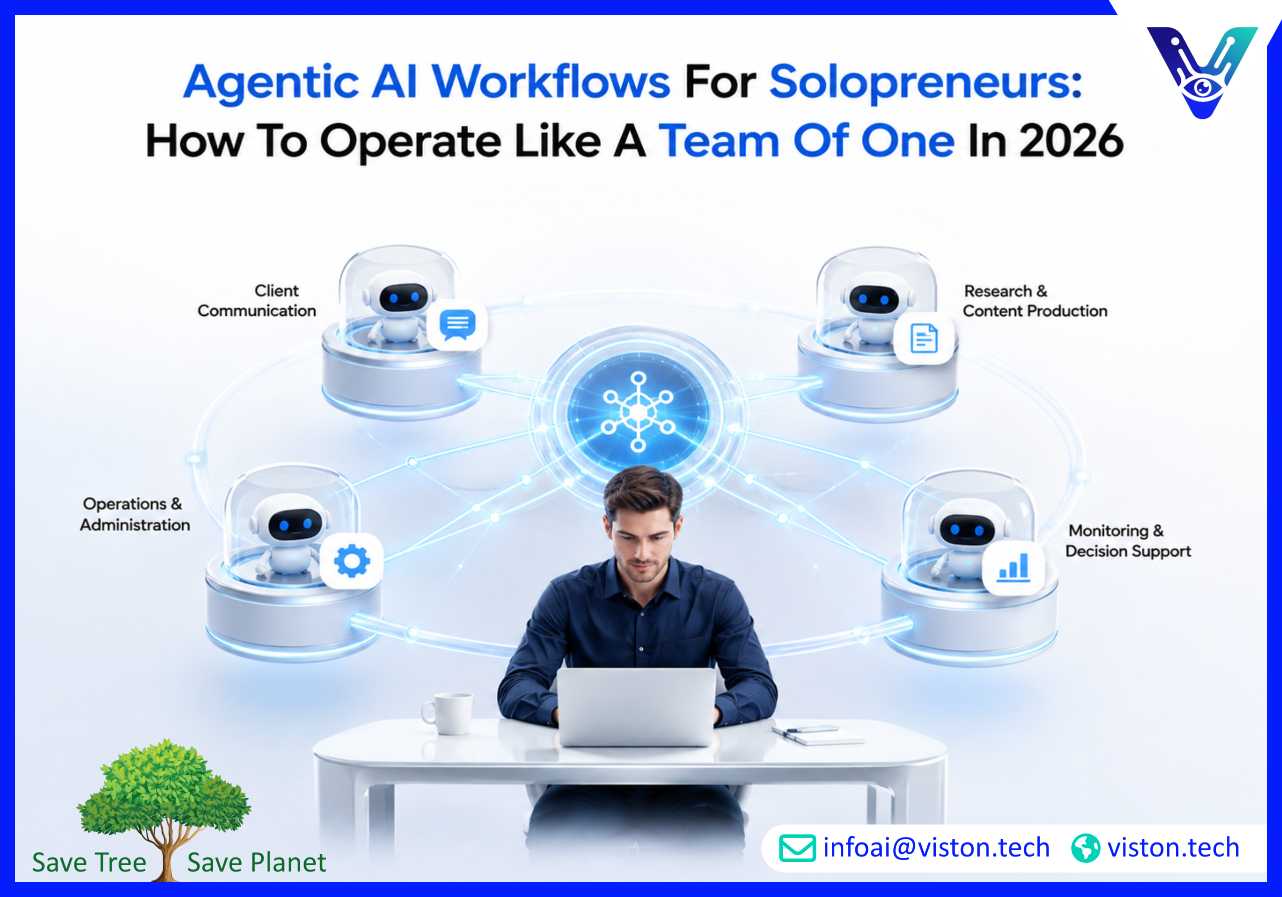
Agents can monitor inbound enquiries, qualify leads based on defined criteria, draft personalised responses, and flag conversations that require direct attention. For a consultant or freelancer managing a steady pipeline, this removes the constant context-switching that erodes deep work time. The agent handles the volume; you handle the decisions that genuinely require your judgment.
Solopreneurs who produce written content — newsletters, thought leadership, proposals, case studies — often find that research and first-draft production consume the majority of their time, not the actual thinking. Agentic workflows can gather source material, structure it, draft outputs aligned to your voice, and prepare materials for your review. This is not about replacing your expertise. It is about removing the hours between having an idea and having a publishable or sendable output.
Scheduling, invoice tracking, CRM updates, file organisation, reporting — the administrative layer of a solo business accumulates silently. Agents connected to your tools via APIs or automation platforms can handle a significant portion of this without your involvement. When these workflows are well-configured, the operational overhead of running a business shrinks considerably.
Agents can watch data sources — industry news, competitor activity, client account changes, campaign performance — and surface the information that requires action. Rather than spending time checking dashboards and feeds manually, a solopreneur receives curated signals and can allocate attention accordingly. This is a genuine competitive advantage for independent operators working in fast-moving markets.
A common concern among solopreneurs exploring agentic AI is whether meaningful implementation requires technical expertise. The honest answer is that it depends on the complexity of what you are building — but the barrier is lower than most assume, and it continues to drop.
For many solopreneur use cases, agentic workflows can be assembled using no-code or low-code platforms that connect LLM capabilities to your existing tools. Platforms in this space allow you to build multi-step agent flows — involving web search, document reading, email drafting, CRM updates, and conditional logic — without writing code. The design challenge is not technical; it is process clarity. You need to understand your workflow well enough to describe it in structured terms.
Where complexity increases — custom integrations with proprietary systems, sophisticated multi-agent architectures, or workflows that need to handle edge cases reliably at scale — development support becomes relevant. But for a significant range of high-value solopreneur workflows, the tools available in 2026 make implementation accessible.
The most important discipline at this stage is starting with a single, well-defined workflow rather than trying to automate everything at once. Pick the process that consumes the most time relative to the value it produces. Define its inputs, outputs, and decision logic clearly. Build the agent, test it in a controlled way, and evaluate it against real outputs before expanding scope.
Agentic workflows introduce a different kind of risk than conventional software. Because agents take autonomous action — sending emails, updating records, making API calls — errors can propagate before you notice them. Understanding how to manage this is part of deploying agentic AI responsibly.
An agent should operate within clearly defined boundaries. It should access only the data it needs, take only the actions it is authorised to take, and escalate decisions that fall outside its defined parameters to you. Scope creep in agentic systems tends to produce noise rather than value, and it increases the surface area for errors.
For workflows involving client-facing outputs — emails, proposals, published content — build in a review step before the agent acts on its output. This is not a concession to imperfection; it is sound practice. As you develop confidence in a specific workflow’s reliability, you can progressively reduce the frequency of review. But starting with human checkpoints protects your reputation while the system matures.
Agentic AI is not a set-and-forget system. Outputs should be reviewed periodically, and agents should be updated as your workflows, tools, or context evolves. The quality of an agentic workflow is not fixed at the point of deployment — it improves through iteration. Treating your agents as systems that require ongoing attention, rather than one-time builds, is the mindset that produces durable results.
Solopreneurs handle client data, proprietary business information, and sensitive communications. Any agentic system that touches this data should operate through secure, authenticated connections, with clear data handling practices. If you are using third-party platforms to build your workflows, review their data privacy commitments. If your clients operate under GDPR, HIPAA, or similar regulatory frameworks, ensure your agentic infrastructure is consistent with those obligations.
Viston AI specialises in enterprise-grade agentic AI workflow design, but their methodology translates directly to the challenges that serious solopreneurs face when moving from experimentation to production-ready automation. Their work covers the full lifecycle of agentic AI integration — from initial workflow design and framework selection through deployment, monitoring, and governance.
Their team builds agents using frameworks including LangGraph, AutoGen Studio, and CrewAI, selecting architecture based on what each specific workflow actually demands. For solopreneurs integrating with existing tools — whether CRMs, project management platforms, email systems, or proprietary databases — Viston’s API-first approach ensures connectivity is established before any build begins, reducing integration risk and time-to-value.
Security and compliance are embedded throughout their delivery process. For independent operators working with client data or in regulated sectors, Viston’s Responsible AI at Scale framework provides the governance foundation that makes agentic deployment auditable and bounded. Whether you are building a single high-impact workflow or designing a broader operational architecture, their approach is built to reduce complexity, establish reliable performance, and support ongoing iteration as your requirements evolve.
Standard AI tools respond to individual prompts — you ask, they answer. An agentic AI workflow involves a system that receives a goal, plans the steps to achieve it, executes those steps using connected tools and data, evaluates the result, and iterates where necessary. It operates across a process, not just a single interaction.
Not necessarily. Many valuable solopreneur workflows can be built using no-code or low-code platforms that connect LLM capabilities to your existing tools. The most important skill is process clarity — understanding your workflow well enough to define its inputs, outputs, and decision logic. For more complex or custom integrations, development support may be worthwhile.
High-frequency, multi-step tasks that involve research, synthesis, communication, or data processing tend to deliver the strongest return. Lead qualification, content production pipelines, client follow-up sequences, administrative automation, and competitive monitoring are common high-value starting points for independent operators.
Operate your agentic systems through secure, authenticated connections and review the data privacy commitments of any platforms involved. Define clear data access boundaries for each agent, limit scope to what is necessary, and ensure your setup is consistent with any regulatory obligations relevant to your clients — including GDPR where applicable.
A well-defined, single-process workflow can often be built and tested within days using available no-code tooling. More complex workflows involving custom integrations or multi-agent orchestration take longer. Viston AI’s methodology is designed to deliver proof-of-concept results within two to four weeks for structured deployments.
Trying to automate too many processes at once, before any single workflow has been validated. The most durable results come from starting with one well-defined, high-value workflow, deploying it carefully, evaluating its outputs over time, and expanding from a foundation of proven performance rather than ambition.
Agentic AI workflows are not a distant enterprise technology. They are accessible, practical, and increasingly necessary for solopreneurs who want to compete on output and quality without trading time they do not have. The opportunity is in identifying the workflows that consume the most disproportionate effort in your business, designing agents that handle those processes reliably, and building the operational discipline to monitor and improve them over time. Whether you are starting with a single client communication workflow or designing a broader agentic architecture, the principles remain the same: clear scope, sound design, and consistent iteration. Viston AI’s approach to agentic AI workflow integration provides the framework and expertise for operators who want to build this infrastructure with production-grade reliability from the outset.
