
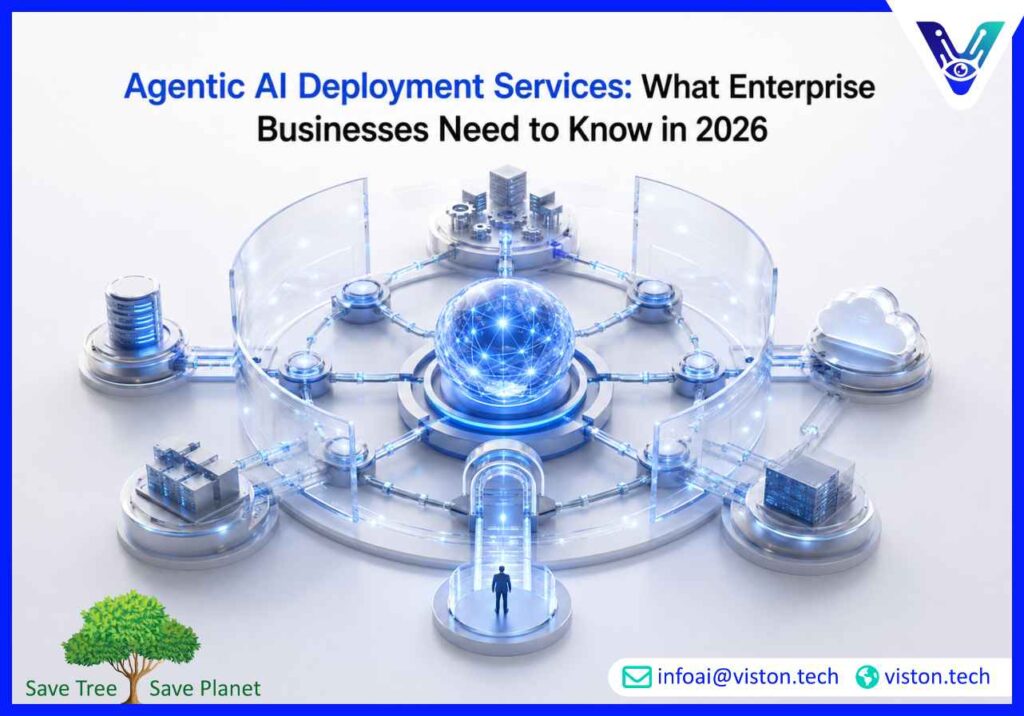
A practical guide for business leaders making deployment decisions
Moving from AI experimentation to production-ready agentic systems is where most organisations stall. The gap between a promising proof of concept and a reliably operating AI agent — one that handles real workflows, integrates with live systems, and performs under enterprise conditions — is wider than it first appears. Understanding what professional agentic AI deployment services actually involve is essential before any serious implementation begins.
Agentic AI is fundamentally different from earlier automation and predictive AI. A deployed agent does not simply score data or respond to a fixed query. It perceives context, plans a course of action, executes tasks using tools and APIs, evaluates outcomes, and iterates — all with varying degrees of autonomy. That operational loop introduces complexity that standard software deployment practices are not designed to handle
Professional deployment services cover far more than placing a model behind an endpoint. The core work includes agent architecture design, selecting the appropriate orchestration framework, configuring memory and state management, connecting the agent to enterprise systems and data sources, defining guardrails and escalation logic, establishing observability infrastructure, and managing the iterative process of testing and refinement before and after go-live.
Each of those elements requires specific expertise. Getting one wrong — a poorly designed memory layer, inadequate access controls, insufficient tracing — creates production problems that are difficult to diagnose and costly to fix after deployment.
Agentic AI deployment is not a configuration exercise. It is an engineering and governance challenge that requires deliberate architecture from the outset.
The choices made before a single line of agent code is written determine how the system will perform, scale, and remain controllable over time. Businesses evaluating deployment services should understand the key technical decisions involved.
Whether the deployment uses LangGraph for stateful multi-step workflows, AutoGen for multi-agent conversational systems, CrewAI for role-based agent collaboration, or a custom orchestration layer depends on the nature of the use case. A single-agent task completion system has different requirements than a coordinated multi-agent pipeline processing hundreds of concurrent workflows. Framework selection has direct consequences for debuggability, scalability, and the cost of future changes.
Enterprise agentic deployments require agents that retain context across sessions and across process steps. Short-term working memory handles immediate task context. Long-term memory — backed by vector stores, structured databases, or knowledge graphs — allows agents to recall prior interactions, track ongoing processes, and apply accumulated context to new situations. Designing memory architecture correctly from the start avoids one of the most common post-deployment failures: agents that behave inconsistently because their state handling was never properly engineered.
An agent’s practical value is limited by the tools it can access. Production deployments require robust integrations with enterprise systems: CRMs, ERPs, internal databases, document management platforms, communication tools, and proprietary APIs. API-first integration architecture — with clear authentication, rate limit handling, error recovery, and versioning — separates production-ready deployments from fragile proofs of concept that break when upstream systems change.
Autonomous agents acting on enterprise systems need clearly defined boundaries. That means specifying which actions the agent can execute independently, which require human confirmation, and which are prohibited entirely. Escalation logic — when the agent hands off to a human, pauses for approval, or flags an anomaly — is a critical design component, not an afterthought. In regulated industries, these controls are also compliance requirements.
Unlike conventional software, AI agent behaviour is probabilistic and context-dependent. A deployment without deep observability — trace-level logging of agent decisions, tool calls, latency, and failure modes — makes it impossible to understand what the agent is actually doing in production or to diagnose performance degradation over time. Tooling such as LangSmith for LangGraph-based systems, or custom tracing infrastructure, should be treated as a core deployment requirement rather than a post-launch addition.
Many organisations have run agentic AI pilots. Far fewer have reached genuine production scale. The difference consistently comes down to the same set of considerations that are easy to defer during experimentation but impossible to ignore in live operations.
Security and data governance are non-negotiable at enterprise scale. Agents operating across internal systems need scoped access permissions that follow the principle of least privilege. Sensitive data must be handled in compliance with applicable regulations — GDPR, HIPAA, CCPA, and sector-specific requirements where relevant. Audit trails for agent actions are increasingly a requirement from legal, compliance, and risk functions within enterprise organisations, not merely a technical nicety.
Scalability planning determines whether a system that performs well in testing continues to perform as load increases. Agentic workloads can be computationally intensive and latency-sensitive. Deployment architecture needs to account for concurrent agent execution, queuing under load, model inference costs, and the infrastructure implications of adding more agents or extending the system’s scope.
Integration depth also matters in ways that pilot projects rarely surface. A proof of concept connecting to a test environment is a different challenge from an agent accessing a production ERP, a live CRM, and a proprietary internal API simultaneously — each with different authentication requirements, data formats, and reliability characteristics. Comprehensive connectivity assessment before build, not after, prevents the most disruptive integration failures.
Not all AI development firms have genuine depth in agentic deployment. The market has expanded rapidly, and the gap between firms with real production experience and those adapting from earlier automation work is significant. Businesses evaluating providers should assess several areas carefully.
Framework experience matters more than general AI capability. Ask specifically which orchestration frameworks the team has used in production, what the typical scale of those deployments was, and how they approach framework selection for different use cases. Vague answers here signal limited production exposure.
Governance and compliance methodology should be a specific deliverable, not a general assurance. Providers working in regulated industries need to demonstrate how compliance requirements are embedded in architecture decisions — not applied retrospectively as a documentation layer.
Observability and post-deployment support are indicators of how a provider thinks about production reality. Firms that treat deployment as the finish line, rather than the beginning of an operational lifecycle, tend to underinvest in the monitoring and iteration infrastructure that enterprise deployments require.
Finally, time-to-value timelines should be specific and milestone-based. Initial proof-of-concept results within two to four weeks is achievable for well-scoped deployments with accessible data and clear process definitions. Full production deployment timelines vary meaningfully based on integration complexity, compliance requirements, and the number of agents involved — any provider quoting a fixed timeline without scoping those variables deserves scrutiny.
Viston AI operates as a specialist in enterprise-grade AI agent development and deployment, managing the full lifecycle from architecture design through to production monitoring and ongoing governance. Their team builds agents using frameworks including LangGraph, AutoGen Studio, and CrewAI, selecting the architecture based on the specific operational demands of each deployment rather than defaulting to a single approach.
For organisations with complex technology environments — legacy ERPs, internal databases, proprietary APIs — Viston’s methodology prioritises comprehensive connectivity assessment and API-first integration architecture before any build begins. This reduces the risk of integration failures that typically surface late in deployment timelines and are expensive to resolve.
Security and compliance are embedded throughout their delivery process. Their Responsible AI at Scale framework incorporates data privacy controls, ethical decision-making guardrails, and regulatory adherence aligned with GDPR, HIPAA, and CCPA — making their approach particularly relevant to organisations in regulated industries where autonomous agent behaviour must remain auditable and bounded. Their SOC 2 Type II certification and ISO 27001 compliance further reflect the governance standards enterprise clients require.
Viston’s deployment methodology is designed to deliver proof-of-concept results within two to four weeks, with full production deployments supported by deep observability infrastructure and continuous performance evaluation. For businesses moving from AI experimentation toward genuine operational deployment, their enterprise-focused capability and governance framework address the technical and compliance requirements that production-grade agentic systems demand.
Agentic AI systems are probabilistic and context-dependent, meaning their behaviour cannot be fully specified in advance. Deployment involves designing orchestration architecture, memory and state management, tool integrations, guardrails, and observability infrastructure — a level of engineering complexity that goes significantly beyond deploying a conventional application or even an earlier generation of AI model.
Financial services, healthcare, professional services, logistics, and enterprise software are among the sectors with the most active production deployments. Common use cases include document analysis and extraction, intelligent customer service triage, autonomous research and reporting, procurement decision support, and complex workflow automation. The determining factor is less about industry and more about whether the specific workflow involves unstructured data, multi-step decision-making, or processes currently dependent on scarce skilled capacity.
Data accessibility and quality directly limit what an agent can do. Before deployment, organisations should assess whether relevant data is accessible via API or structured query, whether data quality is sufficient to support reliable reasoning, and whether access controls and governance frameworks are in place. Agents operating on poor-quality or inconsistently structured data produce unreliable outputs regardless of how well the agent itself is designed.
Agents operating across enterprise systems need scoped access permissions, encrypted data handling, and audit logging for all agent actions. Sector-specific regulations — GDPR for personal data in European contexts, HIPAA for healthcare, CCPA for California consumer data — must be embedded in the agent’s architecture and operating constraints from the outset. Compliance requirements should be defined as design specifications, not applied after the system is built.
Yes. Viston AI’s deployment approach prioritises API-first integration architecture and conducts comprehensive connectivity assessments before build begins. Their team has experience connecting agents to legacy ERPs, internal databases, CRMs, and proprietary internal tools — environments that standard off-the-shelf automation platforms cannot reach.
Well-scoped deployments with accessible data and clear process definitions can produce proof-of-concept results within two to four weeks. Full production deployment timelines depend on integration complexity, the number of systems involved, compliance requirements, and the scope of agent capability. Businesses should treat any fixed-timeline commitment without prior scoping with caution — the variables that determine timeline are specific to each environment.
Agentic AI deployment services are not a shortcut to operational AI — they are the structured process by which experimental capability becomes reliable enterprise infrastructure. The businesses seeing meaningful results in 2026 are those that approached deployment with architectural rigour: selecting frameworks for the right reasons, designing memory and integration layers properly, embedding governance from the start, and investing in observability before problems emerge. For organisations ready to move beyond pilots, the quality of the deployment partner and methodology matters as much as the underlying model. Viston AI’s enterprise-focused approach to AI agent development and deployment addresses the technical depth and governance requirements that production-grade agentic systems demand.
