
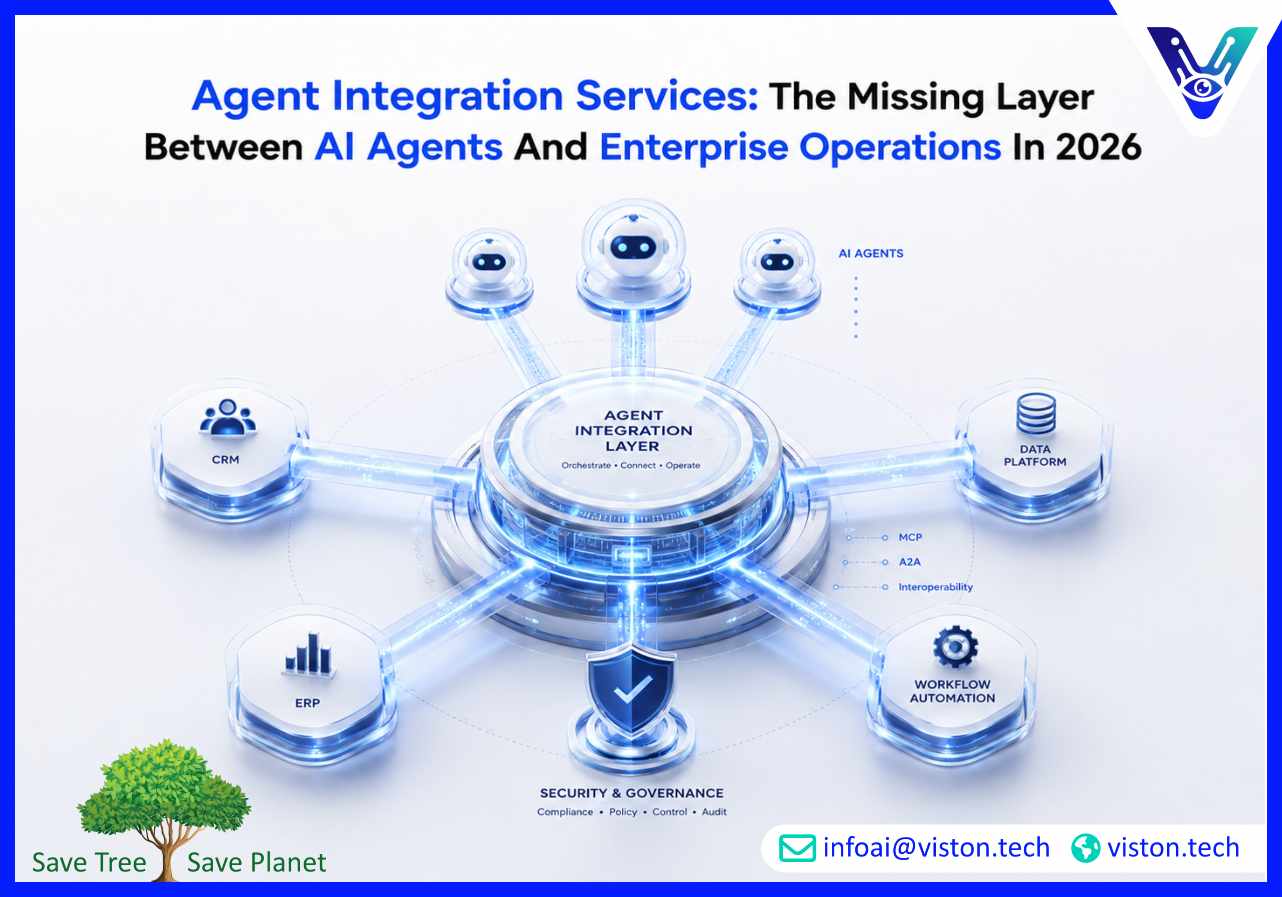
Businesses are rapidly deploying AI agents, but many are discovering a critical bottleneck: these agents cannot effectively connect to the systems, data sources, and workflows they need to execute tasks. Agent integration services have emerged as the essential discipline that transforms isolated AI experiments into cohesive, production-grade automation that delivers measurable business outcomes.
The numbers tell a clear story. According to Mayfield’s 2026 CXO survey of Fortune 500 technology leaders, 42 percent of organizations now have agentic AI in production, with 72 percent either deploying or actively piloting AI agents across real workflows . This marks the fastest shift in enterprise automation observed in the past five years.
However, the same research reveals a persistent challenge: 58 percent of organizations cite data readiness and integration as the primary blocker to scaling agentic AI. This is not a new problem—it has ranked as the top concern for five consecutive years. The difference in 2026 is that the stakes are significantly higher. AI agents cannot simply retrieve information; they must take action within enterprise systems, and that requires purpose-built integration capabilities.
Gartner projects that 40 percent of agentic AI projects will fail by 2027 due to escalating costs, unclear business value, and inadequate risk controls . The organizations that succeed will be those that treat agent integration as a foundational capability rather than an afterthought.
Deploying AI agents that can actually work inside an organization’s technology stack requires solving several interconnected challenges. The research from Workato makes this concrete: agentic AI delivery depends on multi-system enterprise orchestration that connects agents to customer relationship management systems, enterprise resource planning platforms, IT service management tools, human resources systems, and industry-specific applications .
These connections must respect security policies, compliance rules, and data residency requirements—simultaneously for every client in a service provider’s portfolio. Building these integrations custom for each engagement is prohibitively expensive and slow. The alternative is a platform-based approach using standardized connectors, governance frameworks, and open protocols that enable agent interoperability.
The emergence of protocols like Model Context Protocol (MCP) and Agent-to-Agent (A2A) protocols in 2026 represents a significant technical shift. MCP defines a universal interface for agents to access external tools and data sources, eliminating the need for custom adapters for each integration . A2A enables agents from different vendors to discover each other’s capabilities, negotiate tasks, and coordinate actions without hard-coded dependencies. Organizations that adopt these standards can integrate new tools in days rather than months.
The cost implications are substantial. Integration engineering and quality assurance typically account for 40 to 60 percent of total agent build costs . Without standardized integration approaches, these costs escalate exponentially as deployments scale.
Enterprises in regulated industries face an additional layer of complexity. Autonomous AI agents operating within banking, healthcare, insurance, and other compliance-heavy sectors must demonstrate auditability at every step.
The partnership announced in May 2026 between Experian and ServiceNow illustrates how established providers are addressing this need. The integration connects Experian’s decisioning platform directly into ServiceNow workflows, enabling AI agents to access trusted data for employee onboarding, third-party risk management, and model life cycle governance . The explicit focus on regulated environments signals that governance is no longer optional.
Eighty-four percent of enterprises now require security and compliance as non-negotiable for AI deployments, yet 60 percent report having early-stage or no formal AI governance frameworks . This gap between adoption and risk management is widening, and boards are taking notice. AI governance now ranks as an emerging board-level priority that often outranks cybersecurity concerns.
Organizations need integration architectures that provide complete audit trails showing what each agent did, the reasoning behind each action, and the authorization chain. Policy enforcement must work identically across human-executed and AI-executed work. These requirements cannot be retrofitted; they must be designed into the integration layer from the start.
Traditional seat-based and hourly billing models are giving way to outcome-based pricing. More than $5 billion in business process outsourcing deals closed in 2025, with none focused on simply adding more headcount . The shift reflects a fundamental change: buyers want to pay for results, not for access to labor.
However, delivering outcome-based pricing requires infrastructure that can measure what actually happened. Organizations need systems that track outcomes end-to-end across platforms, attribute work between human and AI agents, and generate the reporting clients need to validate invoices. Integration infrastructure that cannot provide this visibility makes outcome-based pricing an unkeepable promise.
Zendesk’s 2026 announcement of AI agents priced only on verified resolutions demonstrates where the market is heading . The company reports that voice AI agents can resolve 80 percent of tickets without human intervention, with customers paying only for outcomes that are independently validated. This model depends entirely on the ability to track resolution end-to-end—a capability that requires robust integration.
Agent integration services bridge the gap between AI agent capabilities and the operational realities of enterprise technology environments. This discipline encompasses several core functions. Integration architects design and implement connections between AI agents and existing systems using standardized protocols and pre-built connectors where available. Governance specialists establish audit trails, policy enforcement mechanisms, and compliance controls that work across both human and automated workflows. Data readiness experts ensure that the information agents access is accurate, current, and properly structured for autonomous decision-making.
The value proposition is straightforward: organizations that invest in proper integration avoid the costly failures that plague agentic AI deployments. They achieve faster time-to-value, lower operational costs, and the ability to scale automation across business functions without rebuilding their technology stack for each new use case.
Research from the International Journal of Engineering and Computer Science demonstrates that implementing agentic systems with proper integration architecture yields a 40 to 50 percent reduction in average handling time and decreases total operating costs by up to 90 percent compared to human-only operations . These results are not theoretical—they are being achieved in production environments today.
Viston AI provides specialized agent integration services designed for organizations moving AI agents from pilot to production. The company focuses on the technical work that determines whether agentic AI delivers business value or becomes another failed experiment: connecting agents to enterprise systems, establishing governance frameworks, and ensuring data readiness for autonomous operations.
Viston AI’s integration approach is built on standard protocols including MCP for tool connectivity and A2A for multi-agent coordination, enabling clients to avoid vendor lock-in and maintain flexibility as their AI deployments scale. For organizations in regulated industries, the company implements governance infrastructure that provides complete audit trails, policy enforcement, and compliance validation across every agent and workflow. This includes the model risk management capabilities that financial services, healthcare, and insurance enterprises require before deploying autonomous systems.
The practical outcomes Viston AI delivers include reduced integration costs through standardized approaches rather than custom development, faster deployment timelines measured in weeks rather than months, governance infrastructure that satisfies compliance requirements, and the ability to implement outcome-based pricing models through accurate end-to-end tracking. For enterprises evaluating agentic AI, Viston AI provides the integration layer that separates production-grade deployments from pilots that never scale.
Agent integration services encompass the technical work of connecting AI agents to enterprise systems, data sources, and workflows. This includes implementing API connections, establishing governance and security controls, ensuring data quality and accessibility, and setting up monitoring and audit capabilities. These services transform isolated AI agents into production-ready automation that can execute real business tasks.
AI agents lack native knowledge of an organization’s specific systems, authentication methods, data structures, and business rules. Every enterprise has unique technology stacks with different APIs, security protocols, and compliance requirements. Agent integration services provide the translation layer that enables agents to work within these diverse environments without requiring custom development for every connection.
Costs vary based on deployment complexity, number of systems requiring integration, governance requirements, and scale. For enterprise deployments with multiple system connections and compliance needs, integration typically accounts for 40 to 60 percent of total project costs, ranging from $80,000 to over $200,000 depending on scope . Organizations using standardized integration approaches and pre-built connectors typically achieve lower costs and faster timelines than those building custom integrations from scratch.
Integration services for regulated industries establish audit trails that record every agent action, implement policy enforcement that works consistently across automated and human workflows, and create governance frameworks that satisfy requirements for model risk management, data privacy, and operational controls. This infrastructure enables organizations to deploy autonomous agents while maintaining compliance with regulations including the EU AI Act, SR 11-7 for financial models, and healthcare data protection requirements.
Traditional system integration focuses on connecting applications for predefined, deterministic workflows. Agent integration must support dynamic, goal-driven behavior where agents decide which actions to take based on context. Agent integration also requires governance for autonomous decision-making, audit capabilities for non-deterministic actions, and support for real-time adaptation. These requirements make agent integration technically distinct from traditional approaches.
Consider agent integration services if your organization is deploying AI agents that need to take action within enterprise systems rather than simply provide information. Specific indicators include agents requiring access to multiple data sources to complete tasks, compliance requirements for audit trails, the need to coordinate across different systems, or scaling challenges with current integration approaches. Organizations experiencing these requirements typically benefit from specialized integration services.
Agent integration services have become the critical enabler for organizations serious about deploying AI agents at scale. The research is clear: data readiness and integration are the primary barriers to production deployments, and organizations that fail to address these challenges face high project failure rates. Agent integration services address these barriers by connecting agents to enterprise systems, establishing governance frameworks, and enabling the outcome-based economics that define successful 2026 deployments. For organizations evaluating agentic AI, the question is no longer whether to adopt the technology but whether they have the integration infrastructure to make it work. Viston AI provides the specialized agent integration services that transform ambitious AI strategies into production systems that deliver measurable business results.
