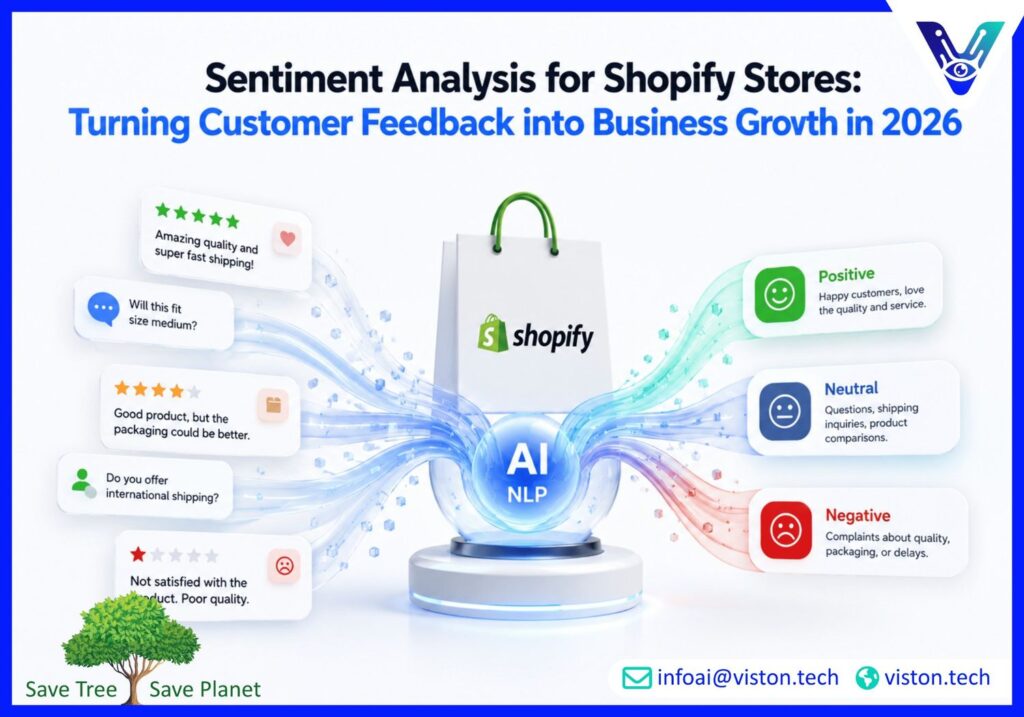
Sentiment Analysis for Shopify Stores: Turning Customer Feedback into Business Growth in 2026
Shopify store owners generate large volumes of customer feedback every day through reviews, support tickets, social media comments, surveys, and product ratings. Understanding what customers truly think can be challenging at scale. Sentiment analysis helps businesses transform unstructured customer feedback into actionable insights, enabling smarter decisions, stronger customer experiences, and sustainable ecommerce growth in 2026.
What Is Sentiment Analysis for Shopify Stores?
Sentiment analysis is a Natural Language Processing (NLP) technique that evaluates customer opinions, emotions, and attitudes expressed in text. For Shopify stores, sentiment analysis automatically classifies feedback as positive, negative, or neutral while identifying recurring themes and customer concerns.Instead of manually reviewing hundreds or thousands of customer comments, ecommerce teams can use sentiment analysis tools to understand customer satisfaction levels, product performance, brand perception, and emerging issues in real time.Common Shopify data sources for sentiment analysis include:
Product reviews
Customer support conversations
Live chat interactions
Email feedback
Survey responses
Social media mentions
Community discussions
Return and refund feedback
As customer expectations continue to rise, businesses increasingly rely on automated sentiment monitoring to gain visibility into customer experiences across multiple touchpoints.
Why Sentiment Analysis Matters for Ecommerce Businesses in 2026
Customer feedback contains valuable information about purchasing behavior, satisfaction drivers, product quality issues, and brand reputation. However, extracting meaningful insights manually becomes difficult as stores scale.Sentiment analysis helps ecommerce businesses identify patterns faster and respond more effectively.
Improve Customer Experience
Negative feedback often reveals friction points within the customer journey. Sentiment analysis highlights recurring complaints related to shipping delays, product quality, website usability, checkout issues, or customer service interactions.By identifying these concerns early, Shopify store owners can prioritize improvements that directly impact customer satisfaction.
Protect Brand Reputation
Online reputation significantly influences purchasing decisions. Monitoring sentiment across reviews and social channels allows businesses to detect reputation risks before they escalate.Real-time sentiment tracking helps brands respond proactively to customer concerns and maintain trust.
Optimize Product Performance
Product reviews often contain valuable information about customer expectations and product performance. Sentiment analysis can uncover specific strengths and weaknesses associated with individual products.This information supports product improvements, inventory planning, merchandising decisions, and future product development.
Support Data-Driven Marketing
Marketing teams can use customer sentiment insights to understand how audiences respond to campaigns, promotions, and messaging strategies.Positive sentiment trends often reveal successful marketing initiatives, while negative reactions may indicate areas requiring adjustment.
Key Business Challenges Sentiment Analysis Helps Solve
Many Shopify businesses face similar challenges as customer feedback volumes increase.
Managing Large Volumes of Customer Feedback
Growing ecommerce stores may receive thousands of customer interactions every month. Reviewing every comment manually is often impractical.Sentiment analysis automates this process while maintaining consistency across feedback evaluation.
Identifying Hidden Customer Concerns
Customers do not always submit formal complaints. Frustrations often appear within reviews, chats, or social media discussions.Sentiment analysis helps uncover underlying issues before they become major operational problems.
Reducing Customer Churn
Persistent negative sentiment can indicate declining customer loyalty. By identifying dissatisfaction signals early, businesses can take corrective action and improve retention.
Understanding Customer Expectations
Customer expectations evolve rapidly in ecommerce. Sentiment analysis provides ongoing visibility into changing preferences, helping businesses stay aligned with market demands.
How Sentiment Analysis Works Within Shopify Environments
Modern sentiment analysis solutions combine machine learning, NLP models, text classification, and data analytics to process customer feedback automatically.A typical implementation may include:
Collecting customer feedback from multiple channels.
Cleaning and organizing unstructured text data.
Applying sentiment classification models.
Identifying positive, negative, and neutral sentiment.
Extracting recurring themes and keywords.
Generating dashboards and business reports.
Providing actionable recommendations.
Advanced solutions may also offer:
Emotion detection
Aspect-based sentiment analysis
Multilingual sentiment processing
Customer intent recognition
Review summarization
Predictive customer satisfaction analysis
Real-time monitoring capabilities
These capabilities help ecommerce teams move beyond simple review tracking toward comprehensive customer intelligence.
Best Practices for Implementing Sentiment Analysis in Shopify Stores
Define Clear Business Objectives
Businesses should identify specific goals before implementing sentiment analysis. Objectives may include improving customer satisfaction, reducing returns, increasing retention, enhancing product quality, or optimizing marketing performance.
Integrate Multiple Feedback Sources
Customer sentiment is distributed across various channels. Combining reviews, support interactions, surveys, and social media data provides a more complete understanding of customer experiences.
Monitor Trends Continuously
Customer sentiment changes over time. Continuous monitoring enables businesses to identify emerging trends and respond quickly to market developments.
Focus on Actionable Insights
Collecting sentiment data alone is not enough. Businesses should establish processes for converting insights into operational improvements, customer experience enhancements, and strategic decisions.
Ensure Data Quality
Accurate sentiment analysis depends on clean, well-structured data. Organizations should implement processes that improve data consistency and reliability across customer feedback sources.
How Viston AI Supports Sentiment Analysis Initiatives
For organizations looking to gain deeper visibility into customer feedback, sentiment analysis requires more than basic text classification. Effective implementation often involves data processing, NLP model development, integration workflows, analytics, reporting, and continuous optimization.Viston AI specializes in sentiment analysis solutions designed to help businesses transform large volumes of customer feedback into actionable business intelligence. By leveraging Natural Language Processing technologies, machine learning models, and scalable analytics frameworks, organizations can better understand customer experiences across digital channels.For Shopify stores and ecommerce-focused businesses, sentiment analysis can support customer experience improvement, product optimization, brand monitoring, and customer retention initiatives. The ability to identify trends, detect emerging concerns, and measure customer satisfaction at scale allows businesses to make informed decisions based on real customer insights rather than assumptions.As ecommerce competition continues to intensify in 2026, businesses increasingly require sentiment analysis solutions that provide reliable insights, support operational decision-making, and integrate effectively with broader customer experience strategies. Organizations seeking to strengthen customer understanding can benefit from specialized expertise in NLP-driven sentiment analysis and feedback intelligence.
Frequently Asked Questions
What is sentiment analysis in Shopify stores?
Sentiment analysis is the process of using AI and Natural Language Processing to evaluate customer opinions, emotions, and attitudes from reviews, support conversations, surveys, and other feedback sources.
Why is sentiment analysis important for ecommerce businesses?
It helps businesses understand customer satisfaction, identify operational issues, improve products, monitor brand reputation, and make data-driven decisions that enhance customer experiences.
Can sentiment analysis analyze Shopify product reviews automatically?
Yes. Modern sentiment analysis systems can automatically process large volumes of product reviews and categorize customer feedback into positive, negative, and neutral sentiment groups.
What data sources can be used for sentiment analysis?
Common sources include product reviews, support tickets, live chat conversations, email feedback, surveys, social media mentions, community discussions, and customer feedback forms.
How accurate are modern sentiment analysis solutions?
Accuracy depends on data quality, model selection, industry context, and implementation approach. Advanced NLP models generally deliver significantly higher accuracy than traditional keyword-based systems.
How can Viston AI help with sentiment analysis projects?
Viston AI provides sentiment analysis expertise that helps organizations extract meaningful insights from customer feedback, improve customer understanding, and support business decision-making through NLP-powered analytics solutions.
Conclusion
Sentiment analysis for Shopify stores has become an essential capability for ecommerce businesses seeking to understand customers at scale. By converting customer feedback into actionable insights, organizations can improve customer experiences, strengthen brand reputation, optimize products, and support long-term growth. As customer expectations continue to evolve in 2026, businesses that leverage sentiment analysis effectively will be better positioned to make informed decisions and maintain a competitive advantage. For organizations exploring advanced sentiment analysis capabilities, specialized expertise from providers such as Viston AI can help ensure successful implementation and meaningful business outcomes.