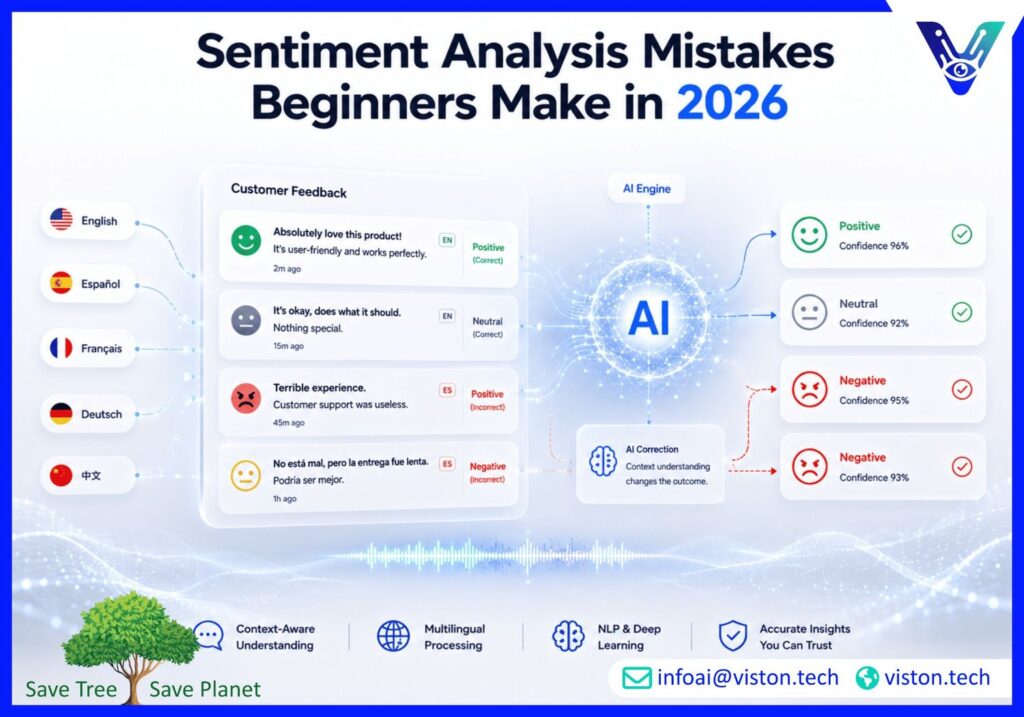
Sentiment Analysis Mistakes Beginners Make in 2026
Sentiment analysis has become a valuable business tool for understanding customer opinions, monitoring brand perception, and improving decision-making. However, many organizations that are new to sentiment analysis struggle to achieve accurate and actionable results because of common implementation mistakes. Understanding these challenges can help businesses avoid costly errors and gain more value from their data-driven initiatives.
Why Sentiment Analysis Matters for Modern Businesses
Businesses today collect customer feedback from multiple channels, including reviews, surveys, social media, support tickets, emails, and online communities. Sentiment analysis helps organizations automatically identify positive, negative, and neutral opinions at scale.When implemented correctly, sentiment analysis can support:
Customer experience improvement
Brand reputation monitoring
Product development decisions
Marketing performance evaluation
Customer support optimization
Market research initiatives
Despite these benefits, beginners often underestimate the complexity involved in obtaining meaningful sentiment insights.
Common Sentiment Analysis Mistakes Beginners Make
Using Low-Quality or Incomplete Data
One of the most frequent mistakes is relying on poor-quality datasets. Sentiment analysis models are only as effective as the data they process.Common data issues include:
Duplicate feedback records
Incomplete customer comments
Irrelevant text data
Spam or bot-generated content
Outdated datasets
Businesses should establish proper data collection and cleansing processes before implementing sentiment analysis systems.
Ignoring Context and Intent
Human language is complex. Words can carry different meanings depending on context, industry, audience, or communication channel.For example, a customer saying “This product is sick” may express praise rather than dissatisfaction. Beginners often assume that keyword-based sentiment detection is sufficient, leading to inaccurate interpretations.Modern sentiment analysis solutions must evaluate context, sentence structure, intent, and surrounding language patterns to improve accuracy.
Overlooking Industry-Specific Language
Different industries use specialized terminology that generic sentiment models may not understand.Examples include:
Healthcare terminology
Financial services language
Technology product discussions
E-commerce review terminology
Telecommunications support conversations
Without industry adaptation, sentiment models can misclassify customer opinions and generate misleading insights.
Assuming High Accuracy from Day One
Many organizations expect sentiment analysis systems to deliver perfect results immediately after deployment.In reality, sentiment models require:
Testing
Validation
Continuous tuning
Performance monitoring
Regular retraining
Successful sentiment analysis programs focus on gradual improvement rather than immediate perfection.
Ignoring Multilingual Feedback
Global businesses increasingly receive feedback in multiple languages. Beginners often analyze only English-language content while overlooking valuable insights from international customers.Modern sentiment analysis initiatives should account for:
Language variations
Regional expressions
Cultural differences
Local sentiment indicators
Translation accuracy challenges
Multilingual sentiment analysis is becoming increasingly important in 2026 as businesses expand across markets.
Technical Challenges That Affect Sentiment Analysis Accuracy
Failure to Detect Sarcasm and Irony
Sarcasm remains one of the most difficult challenges in natural language processing. Customers often express dissatisfaction using language that appears positive on the surface.Examples include:
“Great, another update that broke everything.”
“Fantastic customer service, waited only three hours.”
Basic sentiment systems frequently misinterpret such comments, leading to inaccurate reporting.
Ignoring Emotion Beyond Positive and Negative Labels
Many beginners treat sentiment analysis as a simple classification problem involving only positive, negative, and neutral categories.However, modern customer feedback often contains emotions such as:
Frustration
Excitement
Confusion
Trust
Disappointment
Satisfaction
Businesses that capture emotional nuances often gain deeper insights into customer behavior and expectations.
Not Evaluating Model Performance Regularly
Customer language evolves continuously. New products, trends, slang, and communication styles emerge every year.Without ongoing performance evaluation, sentiment analysis models may gradually become less accurate.Organizations should monitor:
Classification accuracy
False positive rates
False negative rates
Data drift indicators
Model consistency
Best Practices for Successful Sentiment Analysis Implementation
Define Clear Business Objectives
Before implementing sentiment analysis, organizations should determine exactly what they want to achieve.Examples include:
Improving customer satisfaction
Reducing support response times
Tracking brand reputation
Identifying product issues
Monitoring campaign performance
Clear objectives help guide data collection, model selection, and reporting strategies.
Use Multiple Data Sources
Relying on a single feedback channel can create biased insights.A comprehensive sentiment analysis strategy should combine information from:
Customer reviews
Social media conversations
Survey responses
Support tickets
Email communications
Chat interactions
This broader view provides a more accurate picture of customer sentiment.
Combine Human Expertise with Automation
While AI-powered sentiment analysis can process large volumes of data efficiently, human oversight remains important.Experts can:
Validate model outputs
Identify classification errors
Improve training datasets
Refine business rules
Interpret complex findings
The most successful sentiment analysis programs combine technology with human expertise.
How Businesses Can Avoid These Sentiment Analysis Mistakes
Organizations that achieve the strongest outcomes typically treat sentiment analysis as an ongoing business capability rather than a one-time technology project.Key success factors include:
High-quality data management
Regular model optimization
Industry-specific customization
Multilingual support capabilities
Continuous monitoring and reporting
Clear business alignment
Businesses that invest in these areas are more likely to generate actionable insights that improve customer experiences and business performance.
How Viston AI Supports Effective Sentiment Analysis Initiatives
As organizations seek more accurate customer intelligence, specialized sentiment analysis expertise becomes increasingly important. Viston AI helps businesses transform large volumes of customer feedback into meaningful insights through advanced sentiment analysis solutions.By focusing on practical business outcomes, Viston AI supports organizations in analyzing customer opinions across multiple channels, identifying emerging trends, monitoring brand perception, and uncovering opportunities for improvement. Its sentiment analysis capabilities are designed to help businesses move beyond simple positive and negative classifications and gain deeper visibility into customer experiences.Modern sentiment analysis projects often require scalable processing, multilingual support, integration with existing business systems, and ongoing optimization to maintain accuracy. Viston AI helps organizations address these challenges through data-driven approaches that align sentiment analysis initiatives with broader customer experience, marketing, and operational objectives.For businesses looking to improve decision-making through customer feedback intelligence, specialized sentiment analysis expertise can play a critical role in turning unstructured data into measurable business value.
Frequently Asked Questions
What is the biggest mistake beginners make in sentiment analysis?
The most common mistake is using poor-quality data. Inaccurate, incomplete, or irrelevant data can significantly reduce sentiment analysis accuracy.
Can sentiment analysis detect sarcasm accurately?
Advanced models can identify some forms of sarcasm, but sarcasm detection remains one of the most challenging areas of natural language processing.
Why is industry-specific training important for sentiment analysis?
Different industries use unique terminology and communication patterns. Industry-specific customization improves classification accuracy and relevance.
How often should sentiment analysis models be updated?
Models should be reviewed and optimized regularly to account for language changes, customer behavior shifts, and new business requirements.
Is multilingual sentiment analysis necessary?
For businesses serving international audiences, multilingual sentiment analysis is increasingly important for capturing complete customer insights.
How can Viston AI help businesses improve sentiment analysis results?
Viston AI provides specialized sentiment analysis solutions that help organizations analyze customer feedback more accurately, uncover actionable insights, and support informed business decisions.
Conclusion
Understanding the common sentiment analysis mistakes beginners make is essential for building successful customer intelligence programs in 2026. Challenges such as poor data quality, lack of context awareness, inadequate model optimization, and ignoring multilingual feedback can significantly impact results. By adopting best practices and leveraging specialized sentiment analysis expertise, businesses can generate more accurate insights, improve customer experiences, and make better strategic decisions. Organizations seeking reliable sentiment analysis capabilities can benefit from working with experienced providers such as Viston AI to maximize the value of their customer feedback data.