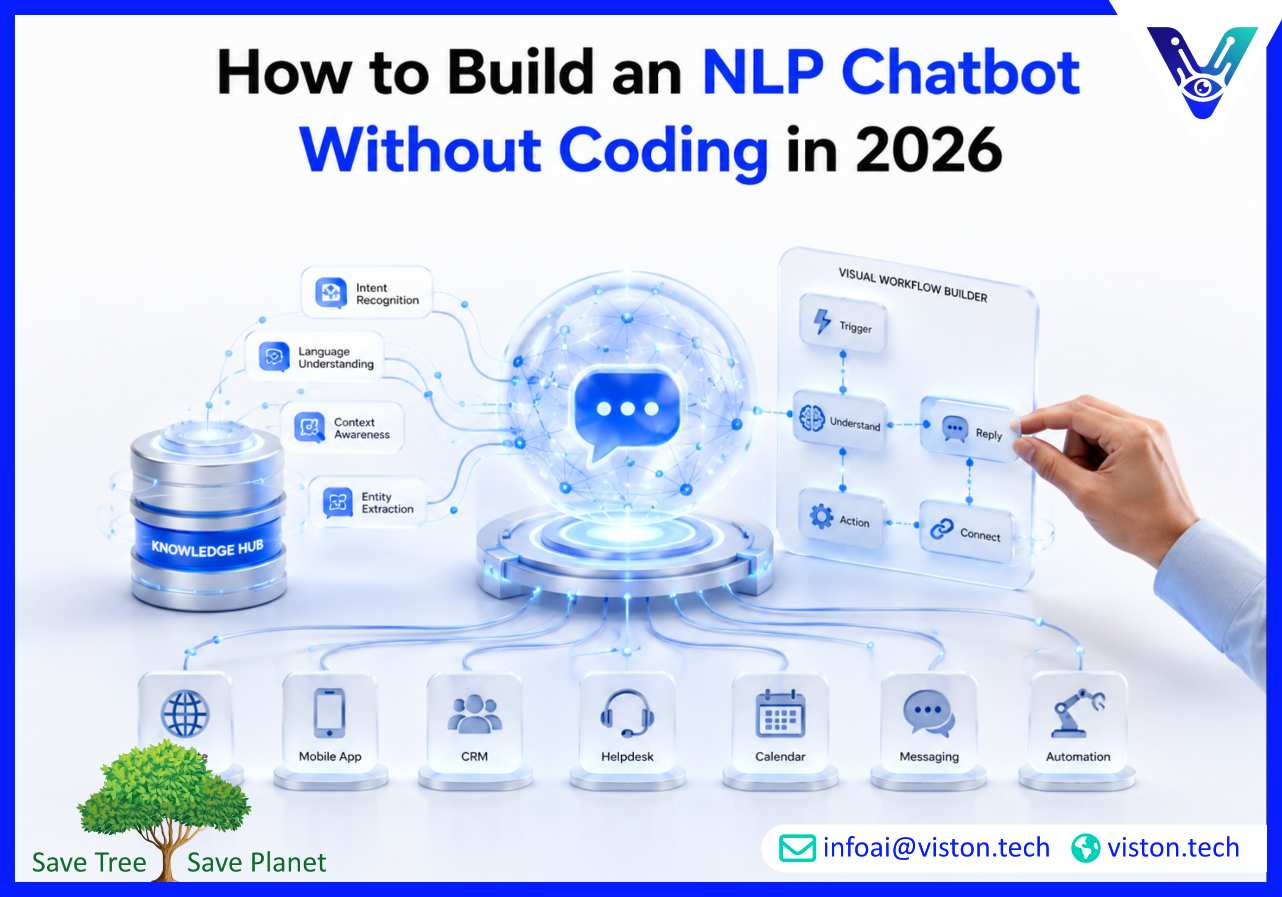
How to Build an NLP Chatbot Without Coding in 2026
Building an NLP chatbot without coding is now a practical option for businesses that want faster customer support, lead qualification, internal automation, or guided self-service without hiring a full engineering team. In 2026, no-code chatbot platforms make conversational automation more accessible, but success still depends on strategy, data quality, workflow design, and reliable Natural Language Processing Solutions.
What It Means to Build an NLP Chatbot Without Coding
An NLP chatbot is a conversational system that uses natural language processing to understand user intent, interpret questions, identify relevant information, and respond in a human-like way. Unlike basic rule-based bots, NLP chatbots can process free-text input, recognize variations in language, and guide users through more flexible conversations.Building one without coding means using a no-code or low-code platform that provides visual builders, pre-built AI models, templates, integrations, analytics, and deployment tools. Instead of writing backend logic or training language models from scratch, business teams can configure conversation flows, upload knowledge sources, define intents, connect tools, and launch the chatbot across websites, messaging apps, or internal systems.This approach is especially useful for companies that need automation but do not want to wait months for custom development. However, “without coding” does not mean “without planning.” A chatbot still needs clear goals, clean knowledge content, escalation rules, security controls, testing, and continuous optimization.
Common no-code NLP chatbot use cases include:
Answering customer support questions
Qualifying website leads
Booking appointments or demos
Guiding users through product selection
Helping employees find internal policies
Automating FAQs and knowledge base search
Collecting customer information before human handoff
Supporting multilingual customer conversations
For business owners, operations teams, marketing leaders, and product managers, the main value is speed. A no-code NLP chatbot can help teams validate automation opportunities before investing in a fully custom solution.
Why No-Code NLP Chatbots Matter for Businesses in 2026
Customer expectations have changed. People expect instant, accurate, and context-aware answers across websites, mobile apps, WhatsApp, social channels, and support portals. At the same time, businesses are under pressure to reduce repetitive manual work, improve response times, and make better use of customer data.No-code NLP chatbots help bridge this gap by giving non-technical teams a practical way to automate common interactions. Sales teams can qualify leads outside business hours. Support teams can deflect repetitive tickets. HR teams can answer employee policy questions. Ecommerce teams can guide shoppers toward relevant products. SaaS companies can improve onboarding and reduce dependency on support agents.In 2026, businesses are also more cautious about chatbot quality. Buyers no longer want generic bots that provide vague responses or frustrate users. They expect conversational AI systems to be reliable, secure, measurable, and integrated with real workflows. This is where Natural Language Processing Solutions become important. The chatbot must not only respond; it must understand intent, retrieve the right information, handle exceptions, and know when to escalate.
Key business benefits of no-code NLP chatbot development
Faster implementation: Teams can launch initial chatbot workflows without long software development cycles.
Lower technical dependency: Business users can manage content, flows, and updates through visual tools.
Improved response speed: Customers receive immediate answers to common questions.
Better lead capture: Chatbots can collect visitor intent, contact details, budget, and requirements.
Scalable support: Repetitive queries can be automated while human teams focus on complex issues.
Measurable insights: Analytics reveal common questions, drop-off points, and automation opportunities.
The biggest advantage is not simply avoiding code. It is giving business teams more control over customer conversations while still using AI-powered language understanding.
How to Build an NLP Chatbot Without Coding: Step-by-Step Process
A successful no-code NLP chatbot project should follow a structured implementation process. The goal is to create a useful business tool, not just a chatbot interface.
1. Define the chatbot’s business objective
Start by deciding what the chatbot must achieve. A chatbot for customer support will need different workflows than a chatbot for lead generation, onboarding, or employee self-service.Useful objectives include reducing repetitive support tickets, increasing qualified leads, improving customer onboarding, answering product questions, helping users book appointments, or routing inquiries to the right department.The objective should be specific and measurable. For example, “answer common pricing and product questions on the website” is clearer than “improve customer engagement.”
2. Choose the right no-code chatbot platform
No-code chatbot platforms vary widely. Some are designed for simple website chat. Others support advanced NLP, integrations, multilingual responses, analytics, knowledge base search, and omnichannel deployment.When evaluating a platform, look for:
Visual conversation flow builder
NLP intent recognition
Knowledge base or document upload support
CRM, helpdesk, email, calendar, or ecommerce integrations
Human handoff features
Analytics and conversation reporting
Security and role-based access controls
Multichannel deployment options
Fallback handling and response testing tools
The right platform depends on the business model, customer channels, data sensitivity, and expected scale.
3. Map the conversation journey
Before building the chatbot, map the user journey. Identify what users are likely to ask, what information they need, what actions they should take, and when a human should step in.For example, a lead generation chatbot may follow this structure:
Welcome the visitor
Ask what they need help with
Identify their business requirement
Collect contact details
Recommend a service or next step
Book a consultation or send the lead to sales
A customer support chatbot may need issue categories, account verification, troubleshooting steps, knowledge base answers, and ticket creation.
4. Prepare the chatbot knowledge base
An NLP chatbot is only as useful as the information it can access. Prepare clean, updated, and structured content before launch.Useful knowledge sources include:
FAQs
Product documentation
Service pages
Pricing explanations
Support articles
Internal policies
Onboarding guides
Troubleshooting documents
Avoid uploading outdated, duplicated, or contradictory content. Poor content quality leads to inaccurate responses, weak user trust, and higher escalation rates.
5. Create intents, responses, and fallback rules
Intent recognition helps the chatbot understand what the user wants. Common intents may include “request pricing,” “book a demo,” “track order,” “speak to support,” “compare plans,” or “cancel subscription.”For each intent, define clear responses and next steps. Also create fallback rules for cases where the chatbot does not understand the question. A strong fallback should acknowledge the issue, offer alternative options, and provide human support when needed.
6. Connect business systems where needed
A no-code chatbot becomes more valuable when it connects with existing business tools. Integrations allow the chatbot to create tickets, update CRM records, schedule meetings, send notifications, or retrieve order details.Common integrations include CRM platforms, helpdesk systems, email marketing tools, calendars, ecommerce platforms, spreadsheets, databases, and internal communication tools.Even without coding, integration setup should be handled carefully. Businesses must check data permissions, authentication, privacy settings, and workflow accuracy before launch.
7. Test the chatbot with real user scenarios
Testing is essential. Use real customer questions, different wording styles, spelling mistakes, incomplete queries, and edge cases. The chatbot should be tested by people from sales, support, operations, and leadership so that practical issues are caught early.Measure whether the chatbot understands intent correctly, provides accurate answers, avoids unnecessary repetition, escalates properly, and captures useful data.
8. Launch, monitor, and optimize
After launch, review chatbot analytics regularly. Look at completion rates, unanswered questions, fallback frequency, user satisfaction, conversion rates, and escalation patterns.Optimization may involve improving knowledge content, adding new intents, rewriting responses, changing conversation paths, or adjusting human handoff rules. In 2026, chatbot success depends on continuous improvement, not one-time setup.
What Businesses Should Watch Out for When Using No-Code NLP Chatbots
No-code chatbot builders make development easier, but they do not remove every risk. Business leaders should evaluate quality, security, scalability, and governance before relying on a chatbot for customer-facing or operational workflows.
Over-automation
Not every conversation should be automated. Complex complaints, sensitive customer issues, legal questions, billing disputes, and high-value sales conversations may require human support. The chatbot should assist, qualify, and route users rather than block access to people.
Poor data quality
If the chatbot pulls from weak or outdated content, it may provide incorrect answers. Businesses should assign ownership for chatbot content maintenance.
Weak escalation paths
Users should always know how to reach a human when needed. A chatbot that traps users in loops damages trust.
Limited integration planning
A chatbot that cannot connect with CRM, support, scheduling, or internal systems may remain useful only for basic FAQs. Integration planning is important for long-term value.
Privacy and compliance gaps
If the chatbot collects names, emails, phone numbers, account details, or sensitive business information, security and privacy requirements must be considered from the beginning.
Lack of performance measurement
Businesses should define success metrics before launch. Useful KPIs include lead conversion rate, response time, ticket deflection, user satisfaction, handoff rate, and completed conversations.The best no-code NLP chatbot projects combine ease of deployment with professional planning. The platform may be no-code, but the strategy should still be expert-led.
How Viston AI Helps Businesses Build NLP Chatbots Without Coding
Businesses that want to build an NLP chatbot without coding often need more than access to a chatbot builder. They need guidance on conversation strategy, language understanding, workflow design, integration planning, and long-term optimization. Viston AI supports organizations through Natural Language Processing Solutions that help turn chatbot ideas into practical business automation systems.For companies exploring no-code or low-code chatbot development, Viston AI can help define use cases, structure conversation flows, organize knowledge content, plan NLP intents, and align chatbot behavior with business goals. This is especially valuable when teams want a chatbot that supports customer service, lead qualification, appointment booking, internal support, or operational automation without depending heavily on internal developers.The value of a specialist partner is in reducing implementation mistakes. A chatbot should understand real user questions, connect with business workflows, protect customer data, and provide measurable outcomes. Viston AI’s focus on Natural Language Processing Solutions makes its support relevant for businesses that want scalable, practical, and business-focused chatbot automation rather than a basic scripted bot.
Frequently Asked Questions
Can I build an NLP chatbot without coding?
Yes. No-code chatbot platforms allow businesses to create NLP chatbots using visual builders, templates, knowledge base uploads, integrations, and AI-powered conversation tools. However, successful implementation still requires planning, testing, and optimization.
What is the difference between a rule-based chatbot and an NLP chatbot?
A rule-based chatbot follows predefined buttons or scripted paths. An NLP chatbot can understand natural language input, identify user intent, and respond more flexibly to different ways of asking the same question.
Do no-code NLP chatbots work for business automation?
Yes, they can support business automation when properly designed. Common uses include lead capture, customer support, appointment scheduling, FAQ automation, employee self-service, and CRM or helpdesk routing.
What should I prepare before creating a no-code NLP chatbot?
You should prepare clear goals, common user questions, approved answers, knowledge base content, escalation rules, required integrations, data privacy requirements, and success metrics.
When should a business use a specialist instead of building alone?
A specialist is useful when the chatbot needs advanced NLP planning, complex workflows, integrations, multilingual support, compliance considerations, or measurable business outcomes. Viston AI can support businesses that need expert guidance around Natural Language Processing Solutions.
Conclusion
Learning how to build an NLP chatbot without coding is a practical starting point for businesses that want faster automation, better customer engagement, and more efficient support workflows. No-code platforms reduce technical barriers, but the real value comes from clear use cases, strong knowledge content, thoughtful conversation design, secure integrations, and continuous improvement. Natural Language Processing Solutions help ensure the chatbot understands user intent and supports meaningful business outcomes. For organizations that want expert support, Viston AI offers a relevant path to building practical NLP chatbot experiences that are scalable, business-focused, and aligned with modern automation needs.