NLP in Email Classification Systems: How It Works and Why It Matters in 2026
A practical guide for business leaders looking to automate email workflows with intelligenceEmail remains the backbone of business communication, yet most organisations still rely on manual triage to sort, prioritise, and route what arrives in their inboxes. NLP in email classification systems changes that fundamentally — replacing rule-based filters and human sorting with intelligent models that understand context, intent, and tone. For any business processing high volumes of inbound email, the operational case for NLP-driven classification has never been stronger.
What NLP in Email Classification Systems Actually Does
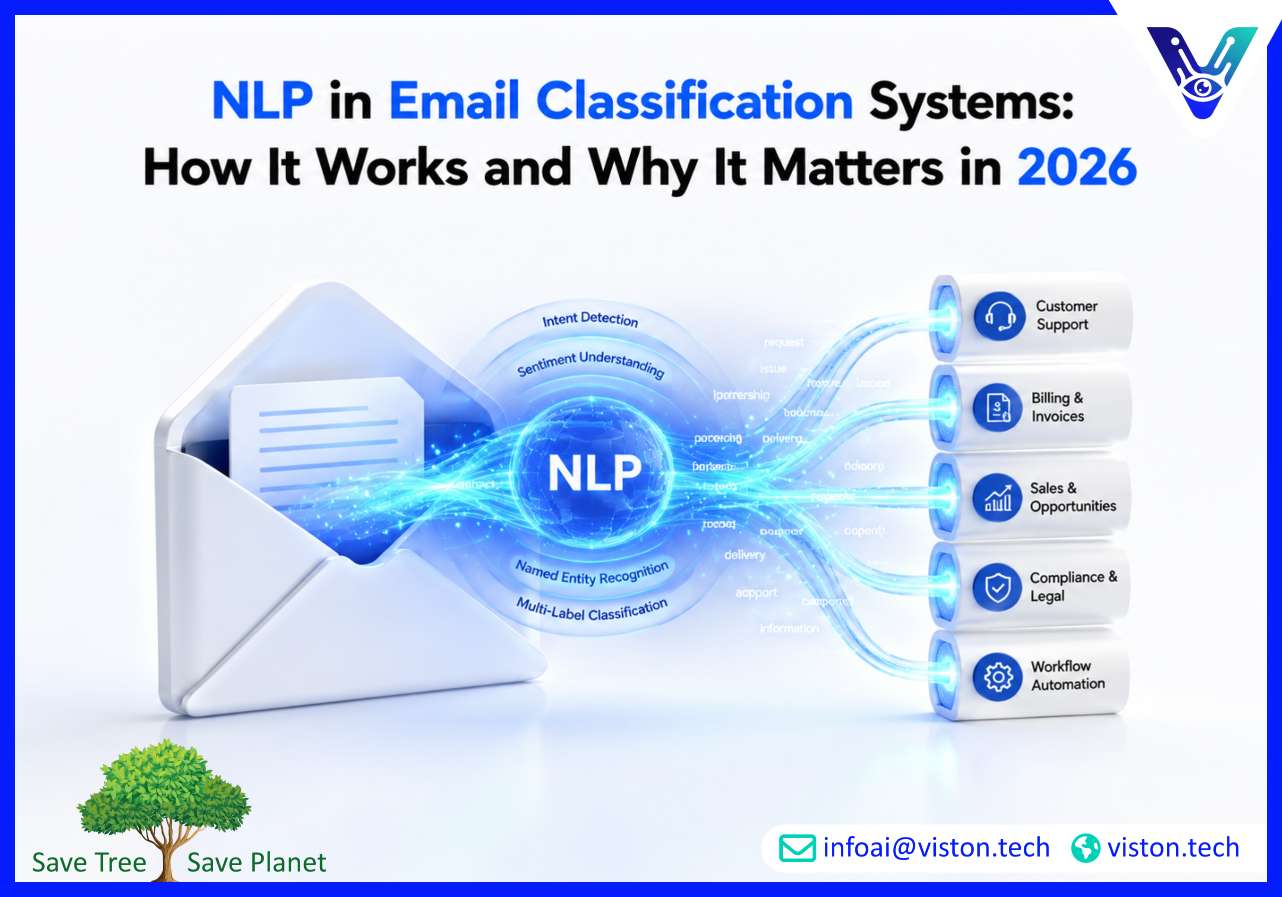
Traditional email filters operate on keywords and rigid rules. If a message contains a specific phrase, it gets routed to a folder or flagged accordingly. The problem is that human language does not follow rigid rules. A customer complaint may never use the word “complaint.” An urgent procurement request might read as routine without broader context. Keyword-based systems miss this constantly.NLP-based email classification works differently. Rather than matching words, the model reads the full message, analyses its structure, interprets the semantic meaning behind the language, and assigns the email to the correct category based on genuine understanding. This might mean classifying inbound messages as billing enquiries, support requests, sales leads, escalations, or regulatory communications — all without a human reading each one first.The core NLP techniques that power these systems include intent detection, sentiment analysis, named entity recognition, and multi-label text classification. Intent detection identifies what the sender is trying to accomplish. Sentiment analysis gauges the emotional tone — distinguishing a satisfied customer follow-up from an at-risk relationship. Named entity recognition pulls structured information such as account numbers, company names, dates, and product references directly from unstructured message bodies. Multi-label classification allows a single email to belong to more than one category simultaneously, which is how real-world messages often behave.
NLP does not just sort email. It understands what the sender actually needs — and that distinction is where the operational value lies.
The Business Problems NLP Email Classification Solves
The operational inefficiencies caused by manual email handling are significant and often underestimated. Teams spend hours each day reading, categorising, and forwarding messages that an NLP model could classify in milliseconds. Response times suffer. High-value messages get buried. Errors in routing create friction that reaches customers. And as email volume grows, the problem compounds without a scalable solution.
Reducing Response Time Across High-Volume Inboxes
For customer-facing operations — support teams, account management, client services — the speed of initial triage directly affects customer experience. NLP classification systems automatically identify message urgency and route emails to the right team or individual the moment they arrive. What previously required a manual review cycle of hours can be reduced to near-instant routing, improving first-response metrics across the board.
Prioritising What Matters Most
Not all email is equal, and one of the most valuable capabilities an NLP system provides is intelligent prioritisation. By combining intent classification with sentiment detection, the system can surface messages that represent at-risk customers, time-sensitive requests, or regulatory communications — ensuring these reach the right person before lower-priority items. The model learns from patterns in language rather than relying on explicit labels, which means it handles the unexpected better than any static ruleset.
Enabling Downstream Automation
Email classification is rarely an end in itself. In most enterprise deployments, accurate classification feeds directly into downstream automation: triggering CRM updates, opening support tickets, initiating approval workflows, or populating reporting dashboards. The accuracy of that classification determines the reliability of everything that follows. NLP models operating at scale maintain classification accuracy that manual processes cannot match consistently, which means downstream systems receive clean, structured inputs rather than requiring further human correction.
Compliance and Risk Monitoring
In regulated industries — financial services, healthcare, legal — email communications carry compliance obligations. NLP classification systems can monitor inbound and outbound email for regulatory risk indicators, flag communications that require escalation or documentation, and maintain audit trails that satisfy governance requirements. This transforms email from a compliance liability into a manageable, monitored channel.
How NLP Email Classification Systems Are Built and Deployed
Understanding how these systems are constructed helps businesses evaluate what is involved in a production deployment and what distinguishes a robust implementation from a superficial one.
Training Data and Model Selection
Every effective NLP email classification system begins with labelled training data — a dataset of emails tagged with the correct categories that the model will learn to predict. The quality and breadth of this data directly determines model performance. For enterprise deployments, training data is typically drawn from historical email archives, cleaned for accuracy, and augmented to cover edge cases and less common message types. Model architectures for email classification in 2026 most commonly employ transformer-based approaches, including fine-tuned large language models, which offer substantially higher accuracy on contextually complex messages than earlier statistical methods such as Naive Bayes or standard LSTM networks.
Multi-Label and Hierarchical Classification
Production email classification rarely involves simple binary decisions. Real-world systems operate across multiple label dimensions simultaneously — an email might be classified by department, urgency, topic, and sentiment in a single pass. Hierarchical classification architectures allow for primary routing followed by secondary sub-classification, which mirrors how human triage teams actually work and enables more granular downstream automation.
Confidence Scoring and Human-in-the-Loop Design
A well-designed NLP classification system includes confidence scoring on every classification decision. When the model’s confidence falls below a defined threshold — because the message is ambiguous, highly domain-specific, or contains unusual phrasing — the system flags it for human review rather than routing it automatically. This human-in-the-loop design maintains operational reliability in edge cases while allowing the automation to handle the high-confidence majority at full speed. It also generates feedback data that improves model accuracy over time.
Integration With Existing Infrastructure
For enterprise organisations, a classification model that cannot connect to existing email infrastructure, CRM systems, ticketing platforms, and reporting tools delivers limited value. Production deployments require robust API integration, support for common email protocols, and alignment with existing access controls and data governance frameworks. The integration architecture should be designed before model selection, not as an afterthought, to ensure the system delivers end-to-end value from day one.
What to Evaluate Before Deploying NLP Email Classification
Organisations approaching this decision for the first time should evaluate several practical factors before committing to a deployment approach.
Volume and Complexity of Email Traffic
NLP classification delivers the most measurable ROI in environments with high inbound email volumes and genuine category complexity. If a business receives thousands of messages weekly across multiple departments and customer segments, the case for automation is immediate. For lower-volume environments, the evaluation should focus on whether classification errors or delays are causing operational problems that NLP could resolve.
Data Readiness
The single biggest factor determining deployment timeline and model performance is the quality and availability of historical email data for training. Businesses should assess whether labelled examples of the target categories exist in their archives, whether data privacy and consent frameworks permit their use for model training, and whether sufficient volume exists to cover less frequent but operationally important categories.
Domain Specificity
General-purpose NLP models perform well on standard language but can struggle with highly domain-specific terminology, industry jargon, or proprietary product naming. Enterprise deployments in sectors such as financial services, healthcare, manufacturing, or professional services typically require fine-tuning on domain-relevant data to achieve the accuracy levels that production operations demand.
Security and Data Privacy
Email data is among the most sensitive an organisation holds. Any NLP classification system must be deployed within a security architecture that restricts model access to authorised use, encrypts data in transit and at rest, and complies with applicable data privacy regulations. For organisations operating under GDPR or other regional frameworks, the processing of personal data within email content requires careful legal basis assessment and appropriate technical controls.
How Viston AI Approaches NLP in Email Classification
Viston AI specialises in enterprise-grade Natural Language Processing solutions, with capabilities that span the full lifecycle of an NLP deployment — from initial data assessment and model architecture selection through to integration, monitoring, and continuous improvement. Their work on email classification systems draws on the same NLP infrastructure that underpins their broader AI capabilities, including sentiment analysis, intent detection, named entity recognition, and multi-label classification.For organisations dealing with high-volume inbound email across customer service, sales operations, compliance, or internal workflows, Viston’s approach centres on building classification systems that are purpose-fitted to the specific language and category structure of each client’s environment. Rather than applying generic models, their team fine-tunes architectures on domain-relevant data to ensure the accuracy levels that enterprise operations require.Security and compliance are embedded throughout Viston’s delivery model. Their platform operates with robust data governance controls and supports compliance requirements across regulated industries, including financial services and healthcare. For organisations evaluating NLP in email classification as part of a broader operational automation strategy, Viston brings both the technical depth to build reliable classification infrastructure and the enterprise experience to integrate it effectively within complex existing systems.
Frequently Asked Questions
What is NLP email classification and how does it differ from standard email filters?
NLP email classification uses natural language processing models to understand the meaning, intent, and context of email content before assigning category labels. Standard keyword filters match text patterns mechanically. NLP models read the message as a human would — interpreting what the sender actually means — which results in significantly higher accuracy on complex, ambiguous, or domain-specific communications.
What categories can an NLP email classification system distinguish between?
The categories are defined by the organisation’s specific operational needs. Common implementations classify by department routing (support, billing, sales, compliance), by urgency level, by sentiment or customer health signal, and by topic or product line. Hierarchical classification allows primary and secondary categories to be assigned simultaneously, enabling more granular downstream automation.
How accurate are NLP email classification systems in production environments?
Accuracy in production depends on training data quality, category complexity, and the degree of domain-specific fine-tuning applied. Well-implemented systems operating on sufficient labelled data typically achieve high accuracy on clearly defined categories. Confidence scoring mechanisms help manage edge cases by routing uncertain classifications to human review rather than automating them incorrectly.
Can NLP email classification integrate with existing CRM and helpdesk platforms?
Yes. Production deployments are designed to connect directly with platforms such as Salesforce, HubSpot, Zendesk, ServiceNow, and similar tools via API integration. Classification outputs trigger downstream actions — ticket creation, CRM field updates, workflow initiations — automatically, without requiring human intermediaries to transfer information between systems.
What are the main data privacy considerations when deploying NLP on email content?
Email data regularly contains personal information, making GDPR compliance, data minimisation, and appropriate access controls essential design requirements. Systems must encrypt data in transit and at rest, restrict model access to authorised use cases, and operate within a documented legal basis for processing. For organisations in regulated industries, compliance requirements should be defined before model deployment begins, not retrofitted after.
How does Viston AI support businesses implementing NLP email classification?
Viston AI provides end-to-end Natural Language Processing solutions, including email classification system design, model development, domain fine-tuning, enterprise integration, and ongoing monitoring. Their team assesses data readiness, defines the classification architecture appropriate to the operational environment, and manages deployment within clients’ security and compliance frameworks.
Making the Right Decision on NLP in Email Classification
NLP in email classification systems represents one of the most practically accessible applications of natural language processing for enterprise operations. The benefits — faster routing, improved prioritisation, downstream automation, and compliance monitoring — are concrete and measurable. What makes the difference between a functional proof-of-concept and a production-grade system is the quality of training data, the degree of domain-specific fine-tuning, and the rigour of the integration architecture. Viston AI’s Natural Language Processing solutions are designed to address exactly these requirements, bringing the technical depth and enterprise experience needed to move from classification concept to reliable, scalable deployment.