How Do NLP Solutions Work in Business? A Practical Guide for Organizations in 2026
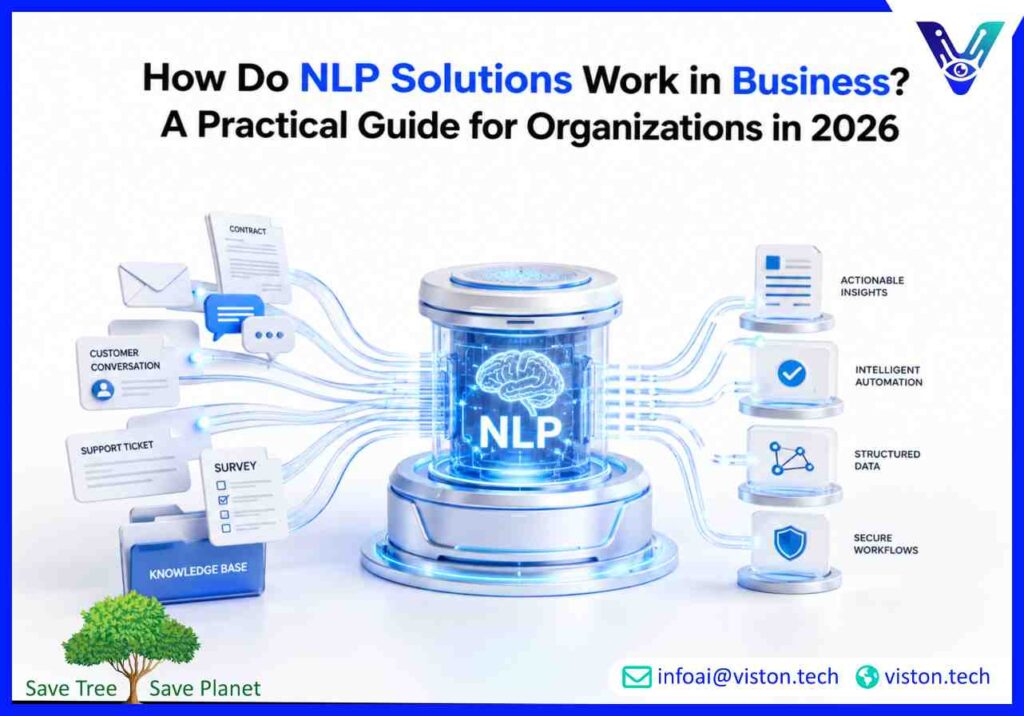
Businesses today generate and process enormous amounts of text-based information through emails, customer conversations, documents, support tickets, surveys, contracts, and digital communications. Understanding and managing this data manually is time-consuming and often inefficient. This is where Natural Language Processing (NLP) solutions help organizations automate language-related tasks, improve decision-making, and create more efficient business operations. As AI adoption continues to accelerate in 2026, NLP has become a foundational technology for businesses seeking smarter automation and better customer experiences.
What Are NLP Solutions and Why Do Businesses Use Them?
Natural Language Processing (NLP) is a branch of artificial intelligence that enables computers to understand, interpret, analyze, and generate human language. NLP solutions combine machine learning, linguistic analysis, large language models, and data processing technologies to transform unstructured text into actionable business insights.Businesses use NLP solutions because a significant portion of organizational information exists in unstructured formats such as:
Customer emails and messages
Support tickets
Product reviews
Survey responses
Contracts and legal documents
Knowledge base content
Social media conversations
Internal communications
Instead of relying on manual review, NLP systems can process large volumes of text rapidly, identify patterns, extract relevant information, and support automated workflows.
How NLP Solutions Work in Business Environments
NLP solutions typically follow a structured process that converts raw language data into useful business outcomes.
Data Collection and Input Processing
The first step involves collecting language-based data from various business sources. These sources may include CRM platforms, customer support systems, websites, databases, document repositories, communication tools, and enterprise applications.The NLP system gathers text data and prepares it for analysis by removing irrelevant content, correcting formatting issues, and organizing information into a usable structure.
Language Understanding and Analysis
Once data is processed, NLP models analyze the language to identify meaning, context, and relationships between words.Key NLP capabilities often include:
Intent recognition
Entity extraction
Sentiment analysis
Topic classification
Language detection
Keyword identification
Semantic understanding
Text summarization
This stage allows businesses to automatically understand customer requests, categorize documents, detect trends, and identify important information.
Decision-Making and Workflow Automation
After understanding the content, NLP solutions can trigger predefined business actions. For example, a customer inquiry can be automatically routed to the appropriate department, a support ticket can be prioritized based on urgency, or a contract can be classified for review.Modern NLP platforms increasingly integrate with business applications to support real-time decision-making and process automation.
Continuous Learning and Optimization
Many NLP systems improve over time by learning from user interactions, business rules, and historical data. Continuous monitoring and optimization help maintain accuracy, improve performance, and adapt to evolving business requirements.
Common Business Applications of NLP Solutions
NLP technology supports a wide range of operational and customer-facing use cases across industries.
Customer Support Automation
One of the most common applications of NLP is customer service automation. NLP-powered chatbots and virtual assistants can understand customer questions, provide responses, retrieve information, and escalate complex cases when necessary.Benefits include:
Faster response times
24/7 support availability
Reduced support workloads
Improved customer satisfaction
Document Processing and Information Extraction
Organizations often manage thousands of documents containing valuable information. NLP solutions can automatically classify documents, extract relevant data, summarize content, and identify critical details.This is particularly valuable for businesses dealing with contracts, invoices, compliance records, applications, and reports.
Customer Feedback Analysis
Understanding customer opinions at scale is difficult through manual analysis alone. NLP systems can evaluate reviews, survey responses, support conversations, and social media comments to identify customer sentiment and recurring issues.This enables organizations to make more informed product, service, and operational decisions.
Knowledge Management and Enterprise Search
NLP improves access to organizational knowledge by allowing employees to search information using natural language rather than exact keywords.Employees can ask questions conversationally and receive relevant answers from internal knowledge repositories, reducing time spent searching for information.
Email and Communication Classification
NLP systems can automatically categorize emails, prioritize messages, identify urgent requests, and route communications to the correct teams.This improves operational efficiency and helps organizations manage increasing communication volumes.
Why NLP Solutions Matter for Businesses in 2026
The business landscape continues to generate larger volumes of unstructured data every year. Organizations that can efficiently understand and act on this information gain significant operational advantages.Several factors are driving NLP adoption in 2026:
Increased demand for automation
Growing use of AI-powered customer engagement
Expansion of enterprise knowledge systems
Rising customer expectations for fast responses
Need for scalable operational efficiency
Advancements in large language models
Improved integration capabilities with business systems
Businesses are no longer implementing NLP solely as a technology experiment. Instead, organizations increasingly view NLP as a strategic capability that supports customer experience, productivity, compliance, and business growth.
Key Considerations When Implementing NLP Solutions
Successful NLP implementation requires more than selecting a technology platform. Organizations should evaluate several important factors before deployment.
Data Quality
The effectiveness of NLP systems depends heavily on the quality and relevance of the underlying data. Poorly structured or inconsistent data can reduce performance and accuracy.
System Integration
NLP solutions should integrate seamlessly with existing business systems such as CRM platforms, ERP systems, helpdesk software, communication tools, and knowledge management applications.
Security and Governance
Businesses handling sensitive information must ensure that NLP solutions support data protection requirements, access controls, auditability, and responsible AI practices.
Scalability
Organizations should choose solutions capable of supporting future growth, additional use cases, increasing data volumes, and evolving business requirements.
Performance Measurement
Clear success metrics should be established before deployment. Common KPIs include automation rates, response times, customer satisfaction, operational efficiency, accuracy, and return on investment.
How Viston AI Supports Natural Language Processing Solutions
As businesses increasingly adopt AI-powered automation, Viston AI helps organizations implement Natural Language Processing Solutions that connect advanced language technologies with practical business outcomes. Rather than treating NLP as a standalone technology initiative, the focus is on aligning language intelligence with operational workflows, customer engagement strategies, and business objectives.Viston AI supports organizations seeking to leverage NLP for customer service automation, conversational AI, intelligent document processing, semantic search, knowledge management, and workflow optimization. By combining NLP capabilities with business system integration, organizations can transform large volumes of language-based information into actionable insights and automated processes.For companies evaluating NLP investments in 2026, successful implementation increasingly depends on factors such as scalability, integration readiness, governance, performance monitoring, and long-term optimization. Viston AI helps businesses navigate these considerations while building NLP solutions designed to support sustainable growth and measurable operational value.
Frequently Asked Questions
How do NLP solutions help businesses?
NLP solutions help businesses automate language-based tasks such as customer support, document processing, email classification, sentiment analysis, and knowledge management, improving efficiency and decision-making.
What industries benefit most from NLP solutions?
Industries including healthcare, finance, legal services, retail, education, technology, manufacturing, and customer service commonly use NLP solutions to automate operations and improve customer experiences.
Can NLP solutions work with existing business systems?
Yes. Modern NLP solutions are often integrated with CRM platforms, ERP systems, customer support tools, databases, communication platforms, and workflow automation software.
Are NLP solutions suitable for small and medium-sized businesses?
Yes. NLP technologies are increasingly accessible to businesses of all sizes and can be scaled according to operational requirements and budgets.
How can Viston AI help businesses implement NLP solutions?
Viston AI provides Natural Language Processing Solutions that support automation, conversational AI, document intelligence, semantic search, and language-driven workflow optimization aligned with business objectives.
Conclusion
Understanding how NLP solutions work in business is essential for organizations seeking to improve efficiency, automate communication, and extract value from unstructured data. By combining language understanding, intelligent automation, and system integration, NLP technologies enable businesses to streamline operations, enhance customer experiences, and support better decision-making. As AI adoption continues to mature in 2026, Natural Language Processing Solutions are becoming a core component of modern business transformation strategies. Organizations looking to implement these capabilities effectively can benefit from experienced specialists such as Viston AI that focus on connecting NLP technology with practical business outcomes.