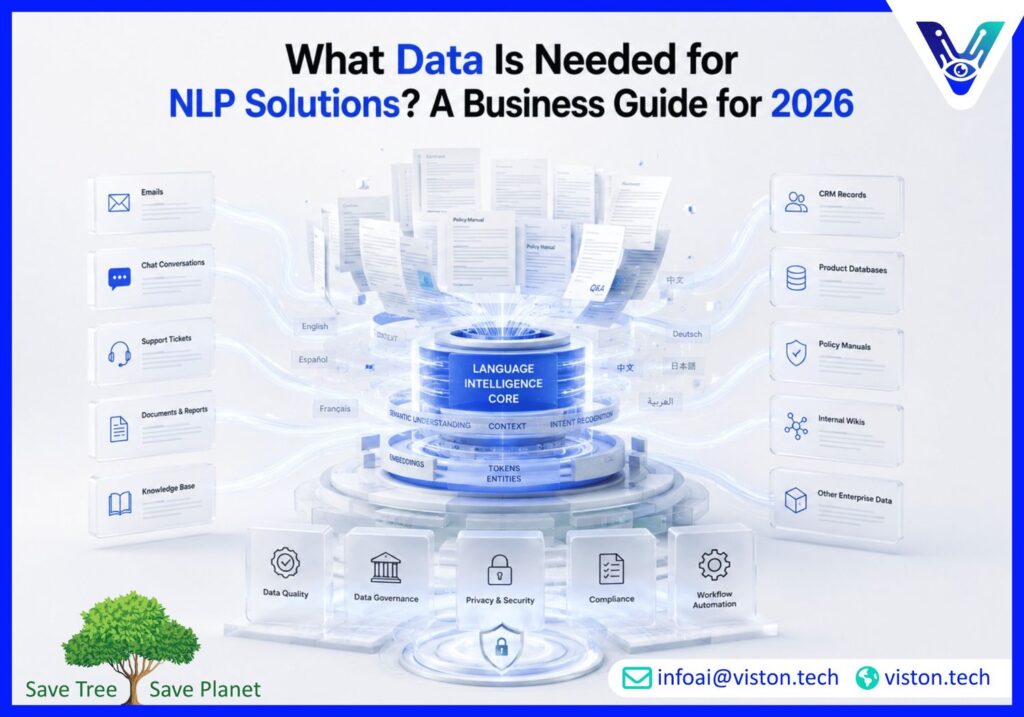
What Data Is Needed for NLP Solutions? A Business Guide for 2026
Natural Language Processing (NLP) solutions are transforming how businesses automate communication, analyze information, and improve customer experiences. However, the effectiveness of any NLP initiative depends heavily on the quality, relevance, and structure of the data used to train, configure, and optimize it. Understanding what data is needed for NLP solutions helps organizations plan successful AI projects, reduce implementation risks, and achieve better business outcomes.
Why Data Matters in NLP Solutions
NLP systems are designed to understand, interpret, classify, and generate human language. Whether an organization is implementing an AI chatbot, document processing platform, sentiment analysis tool, or intelligent search system, data serves as the foundation for how effectively the solution performs.In 2026, businesses increasingly expect NLP solutions to deliver accurate responses, contextual understanding, multilingual capabilities, and seamless integration with operational workflows. These outcomes depend on providing the right data during implementation and ongoing optimization.Without sufficient or relevant data, NLP systems may struggle with:
Understanding user intent
Recognizing industry-specific terminology
Providing accurate responses
Classifying documents correctly
Generating meaningful insights
Supporting automation workflows
Core Types of Data Needed for NLP Solutions
The exact data requirements vary depending on the business objective, but most Natural Language Processing Solutions rely on several key categories of information.
Text-Based Content
Text data forms the foundation of nearly every NLP project. This includes the language that the system must analyze, understand, or generate.Examples include:
Emails
Customer support tickets
Chat transcripts
Website content
Knowledge base articles
Product descriptions
Reports and documentation
Survey responses
Social media content
The more representative the content is of real-world interactions, the more effectively the NLP solution can learn and perform.
Customer Interaction Data
Organizations implementing conversational AI often need historical customer communication data.This may include:
Live chat conversations
Call center transcripts
Email inquiries
Support requests
Customer feedback
FAQ interactions
These datasets help NLP systems understand common questions, user intent patterns, and expected responses.
Structured Business Data
While NLP primarily focuses on language, many business applications require access to structured data sources.Examples include:
Customer records
Product databases
Inventory systems
Order information
CRM data
Service histories
Combining language understanding with business data allows NLP systems to deliver more personalized and actionable responses.
Domain-Specific Knowledge
Industry expertise often needs to be incorporated into NLP solutions.This includes:
Technical documentation
Policy manuals
Compliance requirements
Industry terminology
Standard operating procedures
Training materials
Organizations in healthcare, legal services, finance, manufacturing, and technology sectors particularly benefit from domain-specific language models and knowledge sources.
Data Requirements for Common NLP Use Cases
Different NLP applications require different types and volumes of data.
AI Chatbots and Virtual Assistants
Chatbots typically require:
Frequently asked questions
Customer conversation history
Knowledge base content
Product and service information
Support documentation
Workflow rules
This data helps the chatbot deliver accurate, context-aware responses while supporting customer engagement and automation goals.
Document Processing and Classification
Organizations using NLP for document automation need:
Contracts
Invoices
Forms
Reports
Compliance documents
Classification examples
Historical examples improve the system’s ability to categorize and extract information automatically.
Sentiment Analysis
Businesses analyzing customer sentiment often use:
Reviews
Survey responses
Social media comments
Customer feedback forms
Support conversations
These datasets help identify customer opinions, satisfaction levels, and emerging business trends.
Knowledge Management Systems
For intelligent search and internal knowledge retrieval, organizations often provide:
Policies
Procedures
Technical documentation
Training materials
Employee handbooks
Internal communications
This allows employees to access information using natural language queries instead of traditional keyword searches.
Data Quality Considerations for NLP Success
Having large amounts of data does not automatically guarantee successful NLP implementation. Data quality remains one of the most important factors influencing project outcomes.
Accuracy
Data should be current, correct, and representative of actual business operations. Outdated information can reduce model performance and create poor user experiences.
Consistency
Language usage, terminology, formatting, and classification standards should remain consistent across datasets whenever possible.
Completeness
Incomplete records may limit the NLP system’s ability to understand context and make accurate decisions.
Relevance
Only data related to the intended use case should be prioritized. Excessive irrelevant information can reduce efficiency and increase complexity.
Privacy and Security
Organizations must ensure data handling practices align with privacy regulations, security policies, and responsible AI governance frameworks.In 2026, businesses increasingly focus on:
Data anonymization
Access controls
Encryption
Consent management
Auditability
Responsible AI practices
How Businesses Can Prepare Data for NLP Projects
Preparing data effectively before implementation often reduces costs and improves deployment success.
Conduct a Data Audit
Identify available data sources, formats, ownership, quality levels, and accessibility requirements.
Define Business Objectives
Determine what the NLP solution is expected to achieve before collecting or organizing data.
Clean and Organize Information
Remove duplicate records, correct inconsistencies, and standardize formats where appropriate.
Identify Integration Requirements
Many NLP systems require connections to CRM platforms, support systems, databases, and business applications.
Establish Governance Policies
Create clear policies regarding data ownership, retention, security, and compliance management.
How Viston AI Supports Data-Driven NLP Solutions
Successful Natural Language Processing Solutions require more than advanced AI models. They depend on well-structured data, business context, system integration, and continuous optimization. Viston AI helps organizations implement NLP solutions that connect language intelligence with real business processes and operational objectives.Its capabilities support conversational AI, intelligent document processing, semantic search, workflow automation, sentiment analysis, and language-driven business applications. By assessing available data sources, integration requirements, and business goals, organizations can develop NLP systems that deliver practical value rather than isolated technical functionality.For businesses exploring NLP adoption, understanding data readiness is often one of the most important steps toward achieving scalable, accurate, and sustainable AI outcomes.
Frequently Asked Questions
How much data is needed for NLP solutions?
The amount varies by use case. Some NLP applications can perform effectively with existing business content and documentation, while custom AI models may require significantly larger datasets for training and optimization.
Can NLP solutions work with unstructured data?
Yes. NLP is specifically designed to process unstructured text such as emails, documents, chat conversations, reviews, and customer feedback.
Do businesses need labeled data for NLP projects?
Some applications benefit from labeled data, especially for classification and intent recognition tasks. However, many modern NLP solutions can also leverage pre-trained models and retrieval-based approaches.
What industries benefit most from NLP solutions?
Healthcare, finance, legal services, retail, technology, education, manufacturing, and customer service organizations commonly use NLP to improve efficiency and automate language-driven processes.
Can Viston AI help assess data readiness for NLP implementation?
Yes. Viston AI supports organizations in evaluating data sources, integration requirements, and implementation strategies for Natural Language Processing Solutions that align with business goals.
Conclusion
Understanding what data is needed for NLP solutions is essential for businesses seeking successful AI implementation in 2026. Text content, customer interactions, structured business information, and domain-specific knowledge all play important roles in helping NLP systems deliver accurate and meaningful outcomes. Organizations that focus on data quality, governance, and business alignment are more likely to achieve measurable value from Natural Language Processing Solutions. For businesses exploring language-based automation and intelligence, working with experienced specialists such as Viston AI can help ensure the right data foundation is in place for long-term success.