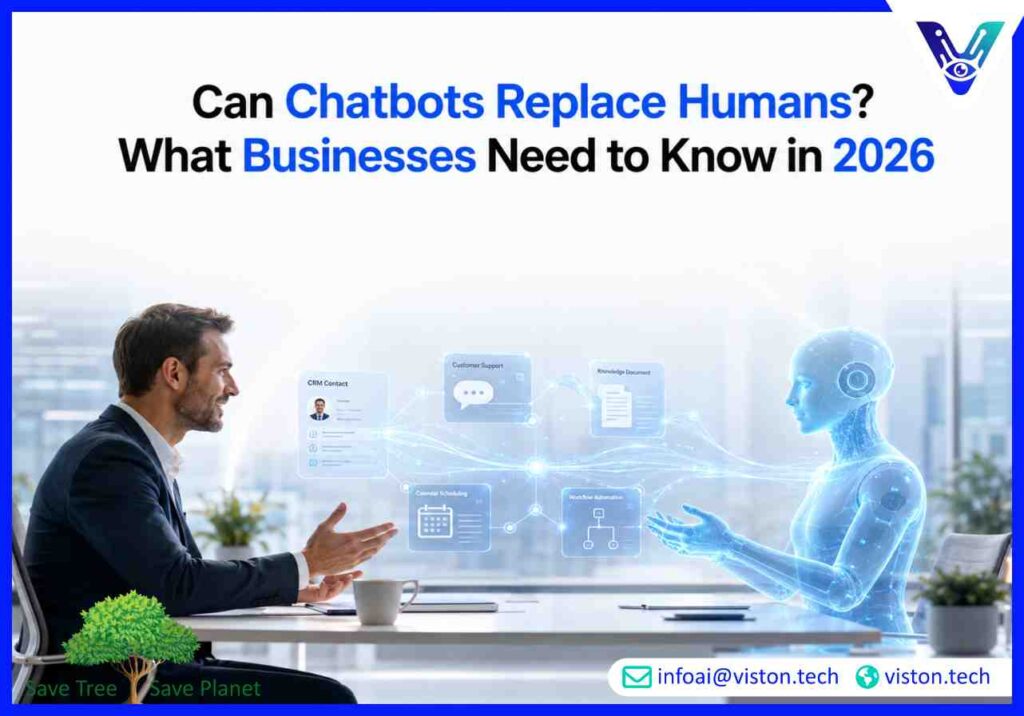
Can Chatbots Replace Humans? What Businesses Need to Know in 2026
As artificial intelligence becomes more capable, many business leaders are asking a practical question: can chatbots replace humans? The answer is more nuanced than a simple yes or no. Modern chatbots can automate many repetitive interactions, improve response times, and reduce operational workloads, but human expertise remains essential in areas that require judgment, empathy, creativity, and complex decision-making. Understanding where chatbots fit within a business strategy is critical for organizations investing in AI chatbot integration in 2026.
Understanding the Role of Chatbots in Modern Businesses
Chatbots have evolved significantly from simple rule-based systems. Today’s AI-powered chatbots can understand natural language, access business data, automate workflows, and support customers across multiple channels.Organizations use chatbots for a variety of purposes, including:
Customer support automation
Lead generation and qualification
Appointment scheduling
Order tracking
Knowledge base assistance
Employee self-service support
Customer onboarding
Sales inquiries
These capabilities allow businesses to handle large volumes of routine interactions without increasing staffing requirements.However, chatbot technology is designed primarily to augment human teams rather than completely replace them.
What Chatbots Can Replace Effectively
There are many business functions where chatbots can deliver substantial automation benefits.
Routine Customer Inquiries
Questions about business hours, order status, account information, product availability, and basic troubleshooting can often be handled entirely by a chatbot.This reduces wait times while allowing support teams to focus on more complex cases.
Lead Qualification Processes
Chatbots can gather prospect information, ask qualification questions, categorize leads, and route opportunities to the appropriate sales teams.This creates a more efficient sales pipeline while ensuring that human representatives spend their time on high-value conversations.
Appointment Booking and Scheduling
Many businesses use chatbots to automate calendar management, meeting scheduling, reminders, and booking confirmations.These tasks typically follow predictable workflows that are well-suited to automation.
Internal Support Functions
Organizations increasingly deploy chatbots for employee assistance, including HR inquiries, IT support requests, policy lookups, and knowledge management.These applications improve productivity while reducing administrative workloads.
Where Humans Remain Essential
Despite major advances in AI, there are important areas where human involvement continues to provide significant value.
Complex Problem Solving
When situations involve ambiguity, multiple variables, or unusual circumstances, human judgment becomes critical.Customers often require personalized solutions that extend beyond predefined workflows or available knowledge bases.
Emotional Intelligence and Empathy
In industries such as healthcare, financial services, legal services, and customer support, people frequently seek understanding and reassurance alongside technical answers.While chatbots can simulate conversational empathy, genuine human connection remains difficult to replicate.
Strategic Decision-Making
Business decisions involving risk assessment, negotiation, relationship management, or long-term planning require context, experience, and judgment that AI systems do not independently possess.
Creative and Consultative Work
Consulting, product innovation, strategic planning, marketing creativity, and complex advisory services continue to rely heavily on human expertise.AI can support these activities, but it rarely replaces the value created by experienced professionals.
Why Businesses Are Moving Toward Human-AI Collaboration
The most successful organizations are not pursuing complete human replacement. Instead, they are creating collaborative models where chatbots and employees work together.This approach delivers several advantages:
Faster customer response times
Reduced operational costs
Improved service availability
Higher employee productivity
Better scalability
Enhanced customer experiences
More efficient resource allocation
In this model, chatbots handle repetitive and structured tasks while humans manage complex, sensitive, or high-value interactions.The result is often better performance than relying solely on either humans or automation.
Business Risks of Replacing Humans Too Aggressively
Organizations that attempt to automate every customer interaction may encounter several challenges.
Customer Frustration
If users cannot easily access human assistance when needed, customer satisfaction can decline rapidly.Many customers appreciate automation for simple requests but expect human support when issues become complicated.
Reduced Trust
Over-automation can make businesses appear inaccessible or disconnected from customer needs.Trust often depends on the ability to reach knowledgeable people when important decisions or problems arise.
Escalation Failures
Without effective handoff mechanisms, chatbots may struggle to resolve situations outside their training scope.This can increase resolution times rather than reduce them.
Compliance and Risk Concerns
In regulated industries, human oversight remains important for ensuring compliance, managing exceptions, and reviewing sensitive interactions.AI systems should operate within clear governance frameworks rather than without supervision.
How AI Chatbot Integration Supports Balanced Automation
Successful chatbot adoption depends not only on chatbot capabilities but also on how well the technology integrates with existing business processes.Effective AI chatbot integration enables:
Access to CRM systems
Customer history retrieval
Helpdesk integration
Knowledge base connectivity
Workflow automation
Real-time data access
Human escalation pathways
Performance monitoring and reporting
By connecting chatbots to operational systems, businesses can create seamless customer experiences while ensuring human teams remain involved when appropriate.This integration-first approach typically delivers stronger long-term outcomes than viewing chatbots as standalone automation tools.
How Viston AI Helps Businesses Build Effective Human-AI Experiences
Organizations implementing conversational AI often achieve the best results when automation and human expertise work together. Viston AI specializes in AI chatbot integration, helping businesses connect intelligent chatbot solutions with customer support platforms, CRM systems, business workflows, and operational data sources.Rather than focusing solely on automation, effective chatbot integration requires careful planning around user journeys, escalation processes, system interoperability, security, reporting, and performance optimization. Businesses need chatbots that can automate routine interactions while ensuring complex requests are routed to the right people at the right time.Viston AI supports organizations in building scalable conversational AI environments that improve efficiency without sacrificing customer experience. Through practical integration strategies, businesses can leverage AI to reduce repetitive workloads, increase responsiveness, and create more productive collaboration between technology and human teams.As AI capabilities continue to advance throughout 2026, companies that balance automation with human expertise are likely to achieve the strongest operational and customer outcomes.
Frequently Asked Questions
Can chatbots completely replace customer service agents?
No. Chatbots can automate many routine inquiries, but human agents remain essential for complex issues, sensitive situations, relationship management, and personalized problem-solving.
What types of jobs are most likely to be affected by chatbots?
Roles involving repetitive communication tasks, basic information delivery, scheduling, and standard support processes are more likely to be partially automated by chatbots.
Do customers prefer chatbots or humans?
Most customers prefer chatbots for quick and simple requests but want access to human assistance when issues become complicated or require personalized attention.
Can AI chatbots improve business efficiency?
Yes. Properly integrated chatbots can reduce response times, automate repetitive tasks, improve availability, and help teams focus on higher-value work.
How can Viston AI help businesses implement chatbot solutions?
Viston AI provides AI chatbot integration services that connect conversational AI with business systems, workflows, and customer engagement processes while supporting scalable automation and human collaboration.
Conclusion
The question of whether chatbots can replace humans is best answered by understanding the strengths of both. Chatbots excel at handling repetitive tasks, delivering instant responses, and supporting operational efficiency. Humans remain essential for empathy, judgment, creativity, relationship management, and complex decision-making. In 2026, the most successful organizations are not replacing people entirely but combining AI chatbot integration with human expertise to create more efficient, scalable, and customer-focused operations. Businesses that adopt this balanced approach can achieve stronger outcomes while maintaining the trust and quality that customers expect.