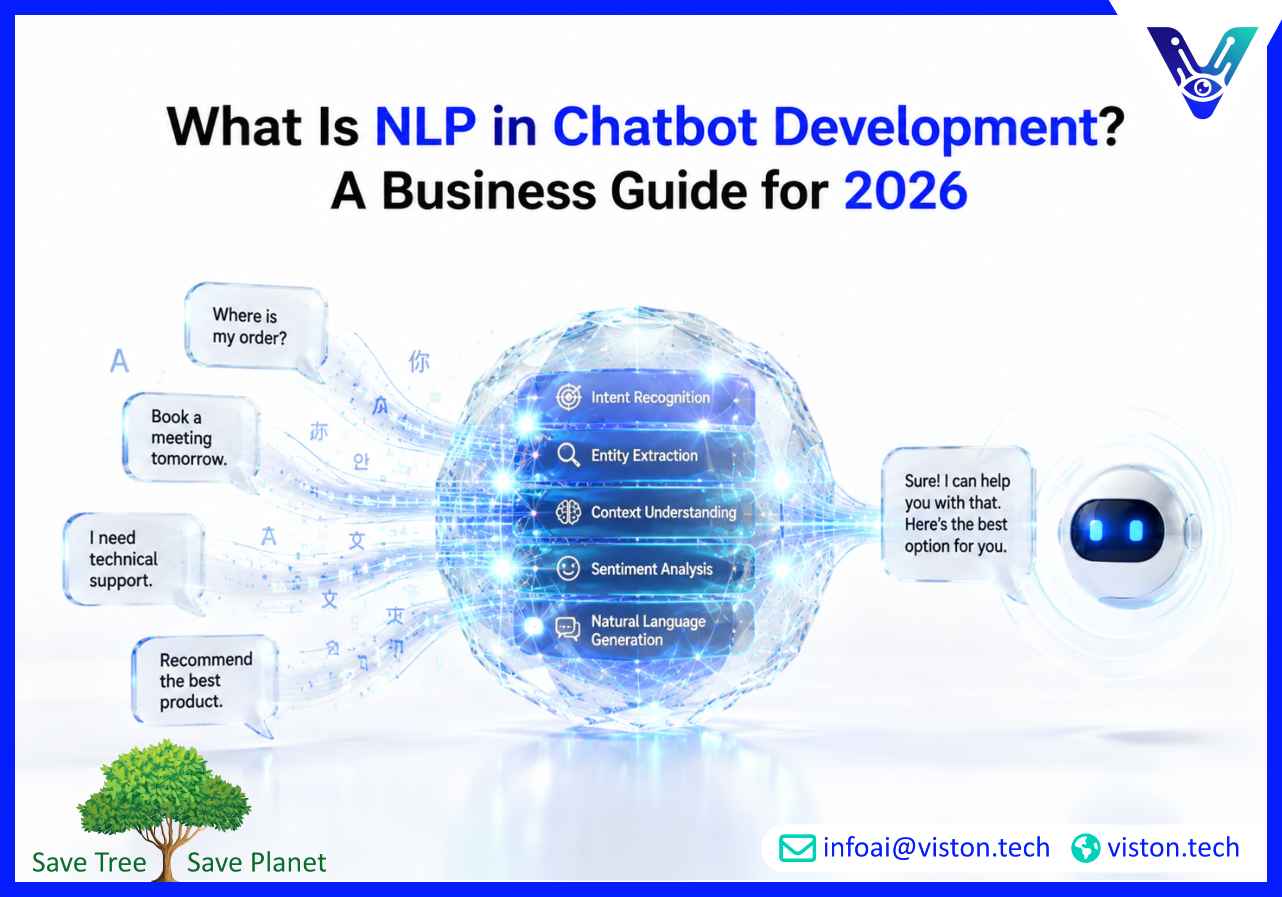
What Is NLP in Chatbot Development? A Business Guide for 2026
As AI-powered chatbots become increasingly sophisticated, businesses expect them to understand customer questions, respond naturally, and handle complex conversations. The technology that makes this possible is Natural Language Processing (NLP). In modern AI chatbot development, NLP enables chatbots to interpret human language, identify intent, and provide relevant responses, creating more effective and engaging customer interactions.
Understanding NLP in Chatbot Development
Natural Language Processing (NLP) is a branch of artificial intelligence that allows computers to understand, interpret, and generate human language. In chatbot development, NLP acts as the bridge between what a user says and how a chatbot understands and responds.Without NLP, chatbots would rely primarily on predefined commands and rigid conversation flows. NLP-powered chatbots can process natural language, recognize context, and respond in a way that feels more conversational and intuitive.For businesses, this means customers can communicate naturally rather than learning specific commands or keywords.
Core Functions of NLP in Chatbots
Understanding user intent
Recognizing keywords and entities
Analyzing sentence structure
Identifying context and meaning
Detecting sentiment and emotion
Generating relevant responses
Supporting multilingual conversations
Improving conversational accuracy over time
Why NLP Matters for Businesses in 2026
Customer expectations have evolved significantly. Users expect immediate, accurate, and personalized responses regardless of the communication channel they use.NLP helps businesses meet these expectations by enabling chatbots to handle conversations more intelligently and efficiently.Organizations using NLP-powered chatbots often benefit from:
Faster customer support
Improved customer satisfaction
Reduced support workload
Higher lead qualification accuracy
Better customer engagement
Consistent user experiences across channels
Greater automation capabilities
As conversational AI adoption continues to grow in 2026, NLP has become a fundamental component of successful chatbot implementations.
Example of NLP in Action
Consider a customer typing:“I ordered a product last week and want to know when it will arrive.”An NLP-powered chatbot can identify:
Intent: Order tracking
Relevant entity: Product order
Customer objective: Delivery status request
The chatbot can then retrieve the appropriate information and provide a meaningful response without requiring the customer to follow a rigid menu structure.
Key NLP Components Used in AI Chatbot Development
Modern chatbot solutions use multiple NLP technologies working together to create effective conversational experiences.
Intent Recognition
Intent recognition helps the chatbot understand what the user wants to accomplish.Examples include:
Booking appointments
Checking order status
Requesting technical support
Getting pricing information
Scheduling consultations
Accurate intent recognition improves response relevance and customer satisfaction.
Entity Extraction
Entities are specific pieces of information within a conversation.Examples include:
Names
Dates
Order numbers
Locations
Product names
Email addresses
Entity extraction allows chatbots to process detailed requests and perform relevant actions.
Sentiment Analysis
Sentiment analysis helps chatbots identify whether a user is frustrated, satisfied, confused, or neutral.This information can influence how the chatbot responds or whether it escalates the conversation to a human agent.
Context Management
Advanced NLP systems can remember previous messages within a conversation.This helps create more natural interactions by allowing users to ask follow-up questions without repeating information.
Natural Language Generation (NLG)
Natural Language Generation enables chatbots to create human-like responses rather than relying solely on predefined scripts.This capability has become increasingly important as businesses seek more personalized customer experiences.
Common Business Applications of NLP-Powered Chatbots
NLP technology supports a wide range of chatbot use cases across industries.
Customer Support Automation
Businesses use NLP chatbots to answer common customer questions, troubleshoot issues, and resolve support requests more efficiently.
Lead Generation and Qualification
Sales-focused chatbots use NLP to understand prospect needs, gather information, and qualify leads before routing them to sales teams.
Ecommerce Assistance
Online retailers use NLP-powered chatbots to provide product recommendations, answer questions, and support purchasing decisions.
Appointment Scheduling
Chatbots can understand scheduling requests, check availability, and book appointments through conversational interactions.
Employee Self-Service
Organizations use NLP chatbots internally to provide HR support, IT assistance, policy information, and knowledge management services.These applications demonstrate how NLP helps transform chatbots from simple automation tools into valuable business assets.
Challenges and Best Practices for NLP Chatbot Development
While NLP offers significant advantages, successful implementation requires careful planning and ongoing optimization.
Common Challenges
Understanding ambiguous language
Managing industry-specific terminology
Handling complex customer requests
Supporting multiple languages
Maintaining conversational context
Ensuring response accuracy
Best Practices
Train chatbots using high-quality datasets
Continuously analyze conversation performance
Implement clear escalation paths
Use real customer interaction data for optimization
Integrate chatbots with relevant business systems
Regularly update NLP models and training data
Businesses that treat NLP optimization as an ongoing process typically achieve stronger long-term performance.
How Viston AI Supports NLP-Powered AI Chatbot Development
For businesses seeking advanced conversational automation, Viston AI develops AI chatbot solutions that leverage NLP technologies to create more intelligent and effective customer interactions. Modern chatbot development requires more than basic conversation flows. It involves intent recognition, contextual understanding, system integrations, workflow automation, and continuous optimization.Viston AI focuses on building chatbot solutions that help businesses automate customer engagement, improve support efficiency, qualify leads, and streamline operational processes. By combining NLP capabilities with practical business objectives, organizations can deploy chatbot experiences that deliver measurable value while integrating seamlessly with existing digital ecosystems.As conversational AI continues to evolve in 2026, businesses increasingly benefit from NLP-driven chatbot solutions that prioritize accuracy, scalability, personalization, and user experience.
Frequently Asked Questions
What does NLP stand for in chatbot development?
NLP stands for Natural Language Processing, a branch of artificial intelligence that enables chatbots to understand, interpret, and respond to human language.
Why is NLP important for chatbots?
NLP allows chatbots to understand user intent, process natural conversations, provide relevant responses, and create more engaging customer experiences.
Can a chatbot work without NLP?
Yes, but functionality is limited. Rule-based chatbots can operate without advanced NLP, but they generally provide less flexible and less natural interactions.
How does NLP improve customer support?
NLP helps chatbots understand customer requests more accurately, automate responses, reduce wait times, and provide faster issue resolution.
Does Viston AI develop NLP-powered chatbots?
Yes. Viston AI develops AI chatbot solutions that incorporate NLP technologies to support customer engagement, automation, lead generation, and business process optimization.
Conclusion
NLP in chatbot development is the technology that enables chatbots to understand and respond to human language effectively. As businesses continue adopting conversational AI in 2026, NLP plays a critical role in improving customer experiences, automating support processes, and enhancing operational efficiency. Organizations investing in AI chatbot development should prioritize NLP capabilities to ensure their chatbot solutions can handle real-world conversations accurately and at scale. For businesses seeking intelligent conversational automation, specialists such as Viston AI can help design and implement NLP-powered chatbot solutions aligned with business goals and customer expectations.