AI Chatbot Prompts for Customer Support: A Practical Guide for Businesses in 2026
Customer expectations continue to rise, and businesses are under increasing pressure to deliver fast, accurate, and consistent support across every digital channel. AI-powered chatbots have become a critical component of modern customer service strategies, but their effectiveness depends heavily on the quality of the prompts that guide their behavior. Well-designed AI chatbot prompts help organizations improve customer experiences, automate routine interactions, and maintain service quality at scale.
What Are AI Chatbot Prompts for Customer Support?
AI chatbot prompts are the instructions, rules, context, and guidance provided to a chatbot to determine how it responds to customer inquiries. These prompts shape the chatbot’s tone, behavior, decision-making process, escalation procedures, and ability to deliver relevant answers.In customer support environments, prompts act as the operational framework that helps conversational AI provide reliable assistance while aligning with business objectives.Effective customer support prompts help chatbots:
Answer customer questions accurately
Resolve common issues efficiently
Maintain brand-consistent communication
Reduce support workloads
Collect relevant information
Escalate complex cases appropriately
Improve customer satisfaction
As AI models become more advanced in 2026, prompt design remains one of the most important factors influencing chatbot performance.
Why AI Chatbot Prompts Matter in 2026
Many businesses invest in AI chatbot integration expecting immediate results, only to discover that poor prompt design limits chatbot effectiveness.Without proper prompts, chatbots may:
Provide inconsistent answers
Misunderstand customer intent
Generate irrelevant responses
Fail to follow company policies
Escalate too often or too late
Create frustrating customer experiences
Well-structured prompts help businesses create predictable and reliable customer support experiences while maximizing automation opportunities.
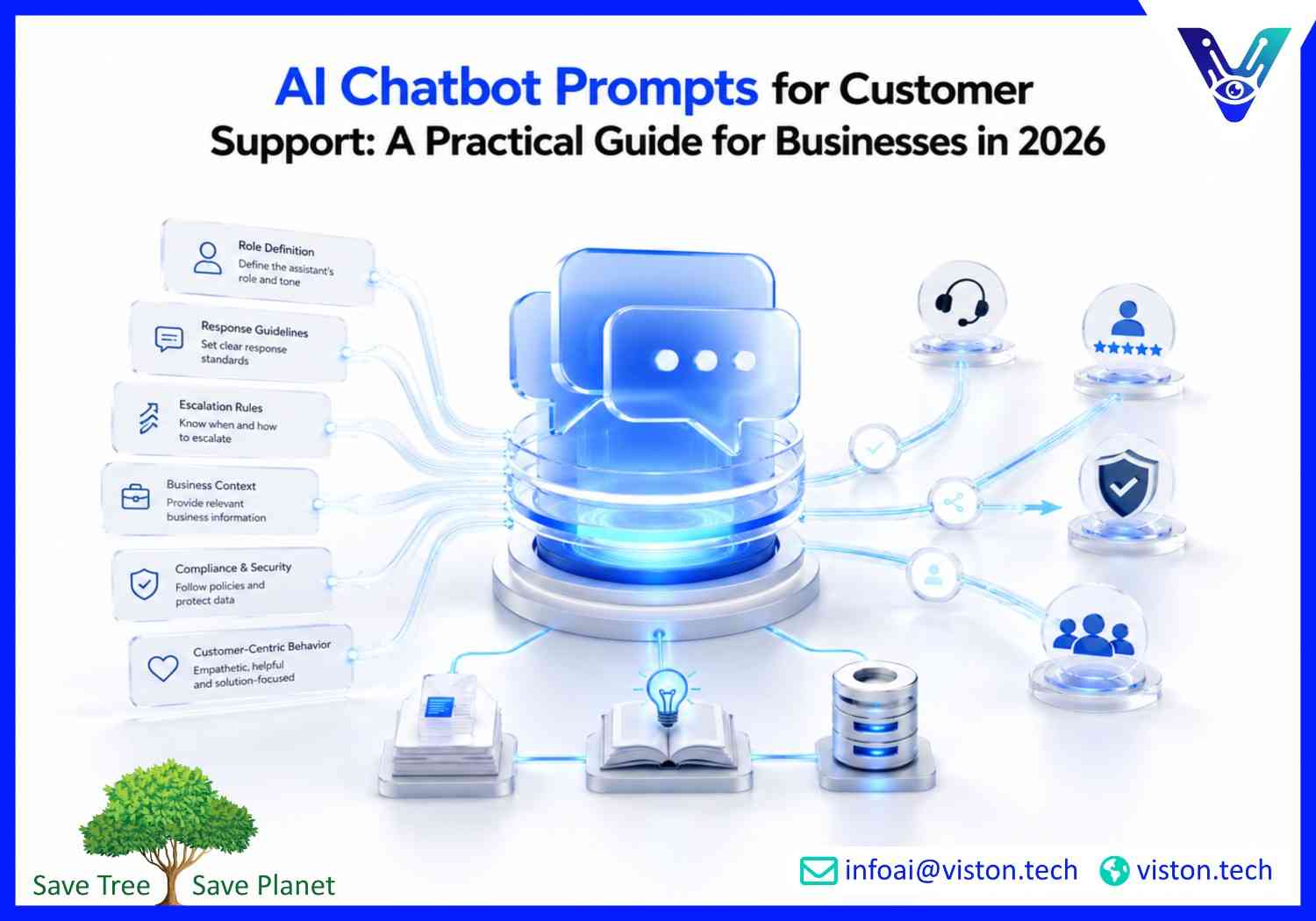
Characteristics of Effective Customer Support Prompts
Clear objectives
Specific response guidelines
Defined escalation procedures
Customer-focused language
Accurate business context
Role-based instructions
Compliance and security considerations
The goal is not simply to generate responses but to create interactions that solve customer problems efficiently and professionally.
Essential AI Chatbot Prompts for Customer Support Teams
Different support scenarios require different prompt structures. The following examples illustrate practical prompt frameworks businesses can use when implementing AI chatbot integration projects.
1. General Customer Support Prompt
Prompt Example:“You are a professional customer support assistant. Your goal is to help customers resolve their issues quickly and accurately. Always communicate clearly, remain polite, ask follow-up questions when necessary, and provide step-by-step guidance. If you cannot confidently resolve the issue, escalate it to a human support representative.”This foundational prompt establishes behavior expectations and escalation rules.
2. Order Status Support Prompt
Prompt Example:“Help customers track their orders by requesting order numbers and verifying available information. Provide clear updates regarding order status, shipping progress, estimated delivery dates, and next steps. If tracking information is unavailable, explain the situation and offer escalation options.”This prompt is commonly used in ecommerce and logistics environments.
3. Technical Support Prompt
Prompt Example:“Act as a technical support specialist. Gather relevant troubleshooting information before suggesting solutions. Ask questions one step at a time, avoid technical jargon when possible, and guide users through diagnostic procedures. Escalate issues involving system outages, account security, or unresolved technical problems.”This approach improves troubleshooting efficiency while reducing customer confusion.
4. Billing and Payment Support Prompt
Prompt Example:“Assist customers with billing inquiries, payment issues, subscription questions, and invoice requests. Explain information clearly and accurately. Never provide financial advice. If sensitive account verification is required, direct the customer through approved authentication procedures.”Financial interactions require additional accuracy and compliance considerations.
5. Complaint Resolution Prompt
Prompt Example:“Respond to customer complaints with empathy and professionalism. Acknowledge concerns, gather relevant details, summarize the issue, and provide available resolution options. Remain calm and constructive regardless of customer sentiment. Escalate unresolved complaints to a support manager.”Empathy-focused prompts help improve customer experiences during difficult interactions.
Best Practices for Creating High-Performing Support Prompts
Effective prompt design requires more than writing a few instructions. Businesses should approach prompt development strategically.
Provide Clear Role Definition
The chatbot should understand its role within the customer support process. Defining responsibilities helps improve response consistency and accuracy.
Establish Escalation Rules
Not every issue should be handled by AI. Prompts should clearly define when conversations need to be transferred to human agents.
Include Business Context
Chatbots perform better when they understand company services, support policies, product information, and operational procedures.
Focus on Customer Outcomes
Prompts should prioritize problem resolution rather than simply generating responses.
Maintain Brand Voice
Customer support interactions should reflect the organization’s communication standards, professionalism, and customer experience goals.
Continuously Optimize Prompt Performance
Businesses should regularly review chatbot conversations and refine prompts based on:
Customer feedback
Resolution rates
Escalation patterns
Support team insights
Customer satisfaction metrics
Prompt optimization is an ongoing process that improves chatbot effectiveness over time.
Common Mistakes Businesses Make with AI Chatbot Prompts
Many customer support chatbot projects underperform because of avoidable prompt design issues.
Overly Generic Instructions
Broad instructions often produce inconsistent responses that fail to meet customer expectations.
Missing Escalation Guidance
Without clear escalation rules, chatbots may continue conversations they are unable to resolve effectively.
Lack of Business Context
Chatbots need access to accurate business information to provide relevant support.
Ignoring Customer Experience Design
Technical accuracy alone is not enough. Prompts should also support positive and efficient customer interactions.
Failing to Update Prompts
As products, services, policies, and customer expectations evolve, chatbot prompts should evolve as well.
How Viston AI Helps Businesses Build Effective Customer Support Chatbots
Successful AI chatbot integration involves much more than connecting an AI model to a website or messaging platform. The quality of prompt design, workflow configuration, system integration, and business alignment significantly impacts customer support outcomes.Viston AI specializes in AI chatbot integration solutions that help businesses connect conversational AI with customer service operations, CRM systems, knowledge bases, support platforms, and digital communication channels. Effective customer support chatbots require carefully structured prompts, conversation design, escalation workflows, reporting capabilities, and ongoing optimization.By combining AI chatbot integration expertise with practical business requirements, Viston AI helps organizations develop customer support solutions that improve responsiveness, automate routine inquiries, and deliver consistent customer experiences. As customer service automation continues to expand in 2026, businesses increasingly benefit from chatbot systems that are strategically designed around real customer needs rather than generic automation templates.
Frequently Asked Questions
What are AI chatbot prompts for customer support?
AI chatbot prompts are instructions that guide how a chatbot interacts with customers, resolves issues, gathers information, and escalates complex cases when necessary.
Why are prompts important in customer support automation?
Prompts influence chatbot behavior, response quality, consistency, accuracy, and customer experience outcomes, making them essential for effective support automation.
How often should chatbot prompts be updated?
Prompts should be reviewed regularly and updated whenever products, services, policies, customer expectations, or support workflows change.
Can AI chatbot prompts reduce support costs?
Well-designed prompts can improve automation rates, reduce repetitive support workloads, and allow human agents to focus on more complex customer issues.
Can Viston AI help businesses create customer support chatbot prompts?
Yes. Viston AI supports AI chatbot integration projects that include prompt design, workflow development, system integration, customer support automation, and chatbot optimization strategies.
Conclusion
AI chatbot prompts for customer support play a crucial role in determining the success of customer service automation initiatives. Strong prompts help chatbots deliver accurate responses, maintain consistent communication, support efficient issue resolution, and create better customer experiences. As businesses continue expanding AI chatbot integration efforts in 2026, prompt design remains a critical component of chatbot performance, scalability, and long-term value. Organizations that invest in structured prompt development and continuous optimization will be better positioned to deliver reliable customer support while improving operational efficiency. For businesses seeking expert implementation support, Viston AI provides practical AI chatbot integration solutions aligned with modern customer service requirements.