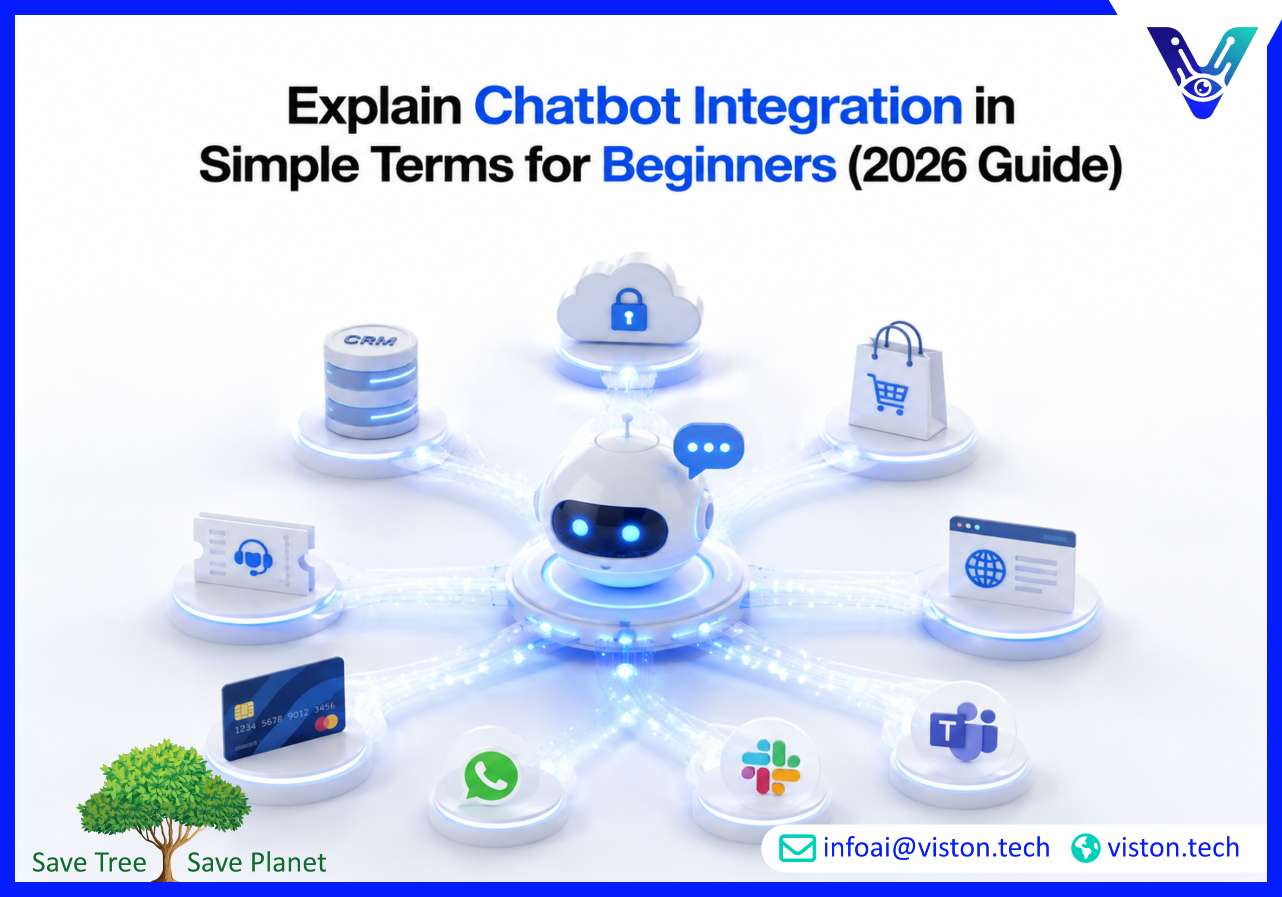
Explain Chatbot Integration in Simple Terms for Beginners (2026 Guide)
Businesses increasingly rely on chatbots to improve customer support, lead generation, sales assistance, and user engagement. However, a chatbot becomes significantly more valuable when it can connect with the systems a business already uses. This is where chatbot integration comes in. Understanding chatbot integration is essential for organizations looking to automate conversations while delivering a better customer experience in 2026.
What Is Chatbot Integration?
In simple terms, chatbot integration means connecting a chatbot with other software, platforms, or business systems so they can exchange information automatically.Think of a chatbot as a helpful employee. On its own, it can answer basic questions. But when connected to tools like customer databases, CRM platforms, websites, payment systems, or messaging apps, it becomes much more intelligent and useful.For example, instead of simply saying “Your order is being processed,” an integrated chatbot can check real-time order data and provide an exact delivery status.Chatbot integration allows businesses to:
Access customer information instantly
Automate repetitive tasks
Provide personalized responses
Reduce manual work
Improve customer experiences
Increase operational efficiency
Why Chatbot Integration Matters in 2026
Modern customers expect fast, accurate, and personalized support across multiple channels. A standalone chatbot often lacks access to the information needed to deliver these experiences.Chatbot integration bridges that gap by allowing the chatbot to interact with business systems and retrieve relevant information when needed.In 2026, organizations are focusing on:
Omnichannel customer support
AI-powered automation
Real-time customer interactions
Self-service experiences
Workflow automation
Data-driven decision making
Integrated chatbots support all of these goals by acting as a central communication layer between customers and business systems.
A Simple Real-World Example
Imagine you order a product online and ask a chatbot, “Where is my order?”Without integration:
The chatbot can only provide generic responses.
You may need to contact customer support.
With integration:
The chatbot connects to the order management system.
It retrieves your order information.
It provides the current shipping status instantly.
This is chatbot integration in action.
What Systems Can a Chatbot Connect To?
One of the biggest advantages of AI chatbot integration is its flexibility. Modern chatbots can connect with a wide range of business tools.
Customer Relationship Management (CRM) Systems
CRM integration allows chatbots to access customer records, purchase history, support tickets, and communication logs.Benefits include:
Personalized customer interactions
Lead qualification
Sales automation
Improved customer service
Websites and E-Commerce Platforms
Chatbots commonly integrate with websites and online stores to assist visitors.They can:
Answer product questions
Recommend products
Track orders
Collect leads
Support checkout processes
Messaging Platforms
Businesses often connect chatbots with communication channels such as:
WhatsApp
Slack
Microsoft Teams
Facebook Messenger
Telegram
This enables customers and employees to interact through their preferred channels.
ERP and Business Management Systems
Enterprise Resource Planning (ERP) systems manage inventory, finance, procurement, and operations.Integrated chatbots can retrieve operational information and automate internal business processes.
Help Desk and Customer Support Platforms
Chatbots can integrate with support systems to:
Create tickets
Update ticket statuses
Route inquiries
Provide self-service support
How Chatbot Integration Works
Although the technology behind chatbot integration can be sophisticated, the process itself is relatively straightforward.
Step 1: User Sends a Message
A customer asks a question through a website, app, or messaging platform.
Step 2: Chatbot Understands the Request
The chatbot uses AI and natural language processing (NLP) to determine the user’s intent.
Step 3: Connected Systems Are Accessed
If information is needed, the chatbot communicates with connected business applications through APIs or integration platforms.
Step 4: Data Is Retrieved
The requested information is collected from the relevant system.
Step 5: Response Is Delivered
The chatbot presents the answer to the user in real time.The entire process usually takes only a few seconds.
Benefits of Chatbot Integration for Businesses
Organizations invest in chatbot integration because it creates measurable business value beyond basic automation.
Improved Customer Experience
Customers receive faster and more accurate responses without waiting for human assistance.
Greater Efficiency
Routine tasks can be automated, reducing workload for support and operations teams.
Better Data Utilization
Integrated chatbots can access information across multiple systems, making interactions more personalized and useful.
Scalability
As customer inquiries increase, integrated chatbots can handle larger volumes without requiring proportional staffing increases.
24/7 Availability
Businesses can provide support and assistance around the clock, even outside working hours.
Increased Lead Generation
Chatbots can capture leads, qualify prospects, schedule appointments, and support sales processes automatically.
How Viston AI Supports AI Chatbot Integration
As businesses adopt more digital tools and customer engagement channels, successful chatbot implementation increasingly depends on effective integration. Viston AI specializes in AI chatbot integration solutions that help organizations connect conversational AI with the systems that drive daily operations.Rather than treating chatbots as isolated tools, effective integration focuses on creating seamless communication between websites, CRM platforms, customer support systems, messaging applications, databases, and business workflows. This allows organizations to deliver more personalized, responsive, and efficient customer experiences.Viston AI’s approach to AI chatbot integration emphasizes practical business outcomes, including workflow automation, improved customer engagement, operational efficiency, and scalable digital support. By connecting chatbots with existing business infrastructure, organizations can unlock real-time data access, automate repetitive processes, and provide consistent interactions across multiple channels.For companies exploring chatbot adoption in 2026, integration is often the factor that determines whether a chatbot becomes a simple FAQ tool or a valuable business asset capable of supporting growth, customer satisfaction, and process optimization.
Frequently Asked Questions
What is chatbot integration?
Chatbot integration is the process of connecting a chatbot with other software systems, platforms, or applications so it can exchange data and perform useful business tasks automatically.
Do I need technical knowledge to use an integrated chatbot?
Most modern chatbot platforms provide user-friendly interfaces. However, complex integrations may require technical expertise or professional implementation support.
Can a chatbot connect with a CRM system?
Yes. CRM integration is one of the most common chatbot use cases. It allows chatbots to access customer information, qualify leads, and personalize interactions.
Is chatbot integration only for large businesses?
No. Small and medium-sized businesses also benefit from chatbot integration through improved customer service, automation, and lead management.
How long does chatbot integration take?
Simple integrations may be completed within days, while more advanced projects involving multiple systems and custom workflows can take several weeks.
How can Viston AI help with chatbot integration?
Viston AI helps businesses connect AI chatbots with websites, CRM systems, support platforms, messaging channels, and business applications to create efficient and scalable conversational experiences.
Conclusion
Understanding chatbot integration is an important first step for businesses exploring conversational AI. In simple terms, chatbot integration allows chatbots to communicate with other systems, making them far more useful than standalone chat tools. By connecting customer data, business applications, support platforms, and communication channels, organizations can automate processes, improve customer experiences, and increase operational efficiency. As AI adoption continues to grow in 2026, AI chatbot integration is becoming a key capability for businesses seeking smarter, more connected digital interactions. Organizations looking to implement these capabilities can benefit from working with experienced specialists such as Viston AI to ensure successful and scalable integration.