Best Multilingual Support Setup for Ecommerce Brands in 2026
The best multilingual support setup for ecommerce brands combines localized self-service, AI-assisted conversations, ecommerce integrations, and skilled human escalation. It should help shoppers receive accurate product, delivery, payment, and return information in their preferred language without creating disconnected workflows or requiring support teams to translate every message manually.
What the Best Multilingual Support Setup for Ecommerce Brands Looks Like
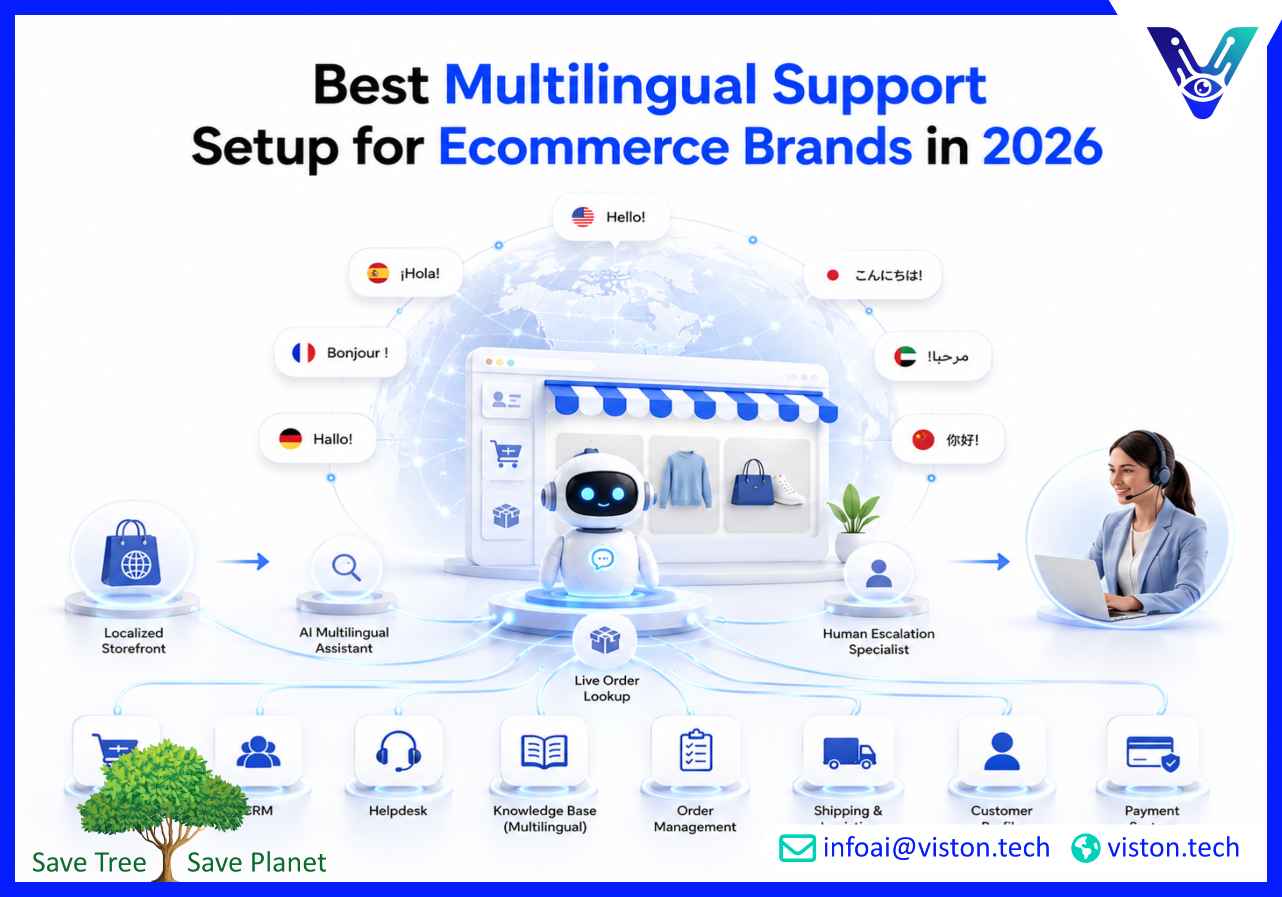
Effective multilingual ecommerce support is not simply a translation tool added to live chat. Ecommerce questions depend on operational context. A customer asking where an order is needs an answer based on the correct order, carrier, destination, and current shipment status—not a translated generic response.The strongest setup has four connected layers:
A localized storefront and help centre
Language-aware AI support for routine conversations
Integrations with ecommerce, CRM, and helpdesk systems
Human escalation for complex or sensitive cases
These layers should share approved terminology, policies, customer context, and performance data.
Localized customer-facing content
Begin with the information customers use before and after purchase. Product descriptions, size guides, shipping rules, return conditions, payment guidance, order notifications, FAQs, and help-centre articles should be available in priority languages.Ecommerce localization extends beyond translating sentences. Depending on the market, it may also include local currencies, payment methods, product availability, measurements, delivery expectations, imagery, domains, and regional policies. Shopify’s international commerce guidance similarly treats localization as adapting the overall shopping experience for each market.Create an approved terminology glossary for product names, materials, sizes, promotional language, and policy terms. This prevents the storefront, chatbot, emails, and human agents from describing the same item differently.High-impact content such as warranty limits, return eligibility, safety instructions, subscription conditions, and delivery exclusions should receive qualified human review before publication.
Language-aware AI support
An AI assistant can detect or confirm a shopper’s preferred language, retrieve approved information, answer repetitive questions, and guide customers through standard workflows.Suitable ecommerce use cases include:
Order tracking and delivery updates
Stock and product-variant enquiries
Sizing and product-care guidance
Account access and loyalty questions
Subscription changes
Standard return eligibility
Shipping and store-policy questions
The assistant should use controlled knowledge and current system data. When information is missing or uncertain, it should ask a clarifying question or transfer the conversation rather than inventing an answer.
Contextual human escalation
Payment disputes, damaged goods, repeated delivery failures, chargebacks, fraud concerns, legal requests, high-value orders, and emotionally sensitive complaints usually require human judgment.A useful handover should include the customer’s language, original message, translated summary, order details, actions already attempted, and reason for escalation. This allows the agent to continue the conversation without making the customer repeat everything.
Core Systems and Workflows Ecommerce Brands Need
A multilingual chatbot has limited value if it cannot access order details, stock data, customer history, or current return rules. The conversation layer must connect with the systems that determine the correct answer.
Ecommerce platform integration
The support system should securely retrieve relevant information from the ecommerce platform, including fulfilment status, tracking events, product availability, variants, customer accounts, and subscription details.For example, an order-tracking workflow could verify the customer, retrieve the latest carrier event, explain it in the selected language, and escalate the case when a shipment exceeds a defined delay threshold. This is more useful than directing every customer to a tracking page.Access should follow the principle of least privilege. The support tool should receive only the data required to complete the customer’s request.
Helpdesk and CRM integration
Multilingual conversations should create or update helpdesk tickets while preserving both the original-language message and the translated agent view. CRM integration can provide customer tier, preferred language, purchase history, previous cases, and open issues.This context is important because similar questions may require different handling. A wholesale buyer, marketplace seller, subscription customer, and first-time retail shopper may each follow a different service workflow.
Centralized multilingual knowledge
The knowledge base should act as the controlled source for approved answers. Each article needs a content owner, source language, translated versions, review date, and publishing status.Multilingual help centres also require translated categories, navigation, and supporting interface text. Translating an individual article is not enough when customers cannot find it through the surrounding help-centre structure.When a policy changes, the source content and affected language versions should be updated together. Archived information must be removed from chatbot retrieval, and agents should have a simple way to report missing or conflicting content.
Omnichannel language continuity
Ecommerce customers may move between website chat, email, WhatsApp, social messaging, mobile apps, and marketplace channels. The support setup should preserve language preference and conversation history wherever the channel technology allows it.A customer who begins a conversation in Spanish on WhatsApp should not receive an English-only follow-up email or reach an agent who cannot see the translated history. Modern service platforms increasingly support multilingual communication across digital channels, but brands still need consistent routing, knowledge, and escalation rules behind those channels.
How to Balance AI Translation, Human Expertise, and Quality
The most reliable ecommerce model is hybrid. AI provides speed, availability, and efficient first-line handling. Human expertise protects accuracy where nuance, commercial value, or risk makes an incorrect response costly.
Automate structured and verifiable enquiries
AI performs best when it can retrieve a clear answer or complete a controlled workflow. Order status, standard delivery guidance, basic product information, care instructions, account support, and approved policy summaries are practical examples.Define confidence thresholds and fallback rules. A low-confidence answer should trigger clarification, knowledge search, or escalation rather than a fluent but unsupported response.
Use human review where language affects trust
Native or highly proficient reviewers are valuable for product terminology, brand tone, policy language, campaign messaging, complaints, and culturally sensitive communication.A translation can be grammatically correct and still sound unnatural, overly formal, or misleading in a specific market. Human reviewers can also identify differences in regional vocabulary, politeness expectations, measurements, and product descriptions.Brands do not necessarily need a full native-speaking support team for every language. A practical operating model can combine localized self-service, AI-assisted first responses, translated agent workspaces, external language specialists, and internal reviewers for priority markets.
Protect customer information
Multilingual support systems may process names, addresses, contact details, order histories, account records, and conversation transcripts. Data minimization, encryption, access controls, retention rules, and audit logging should apply across every language and channel.Brands serving customers in the European Union must also evaluate how personal data is processed under GDPR. Translation, chatbot, and AI providers should be assessed as part of the wider data-processing chain.Procurement teams should confirm where customer data is processed, how long it is retained, whether it is used for model training, and how access or deletion requests are handled.
Test real customer language
Testing should include spelling mistakes, abbreviations, regional vocabulary, mixed-language messages, product nicknames, informal phrasing, and voice-to-text errors. Professionally translated test questions rarely represent the full complexity of real conversations.Brands should also test operational edge cases, such as duplicate payments, delayed international shipments, missing parcels, unavailable products, damaged goods, and return requests made close to a deadline.
How to Roll Out and Measure the Right Ecommerce Setup
Most ecommerce brands should use a phased deployment rather than launching every language, market, and channel at once. A narrower rollout makes it easier to validate knowledge, integrations, routing, and service quality.
Choose languages using real demand
Review customer locations, browser languages, store analytics, sales by market, abandoned checkouts, support tickets, refund requests, search terms, and expansion plans.Start with the languages representing the strongest combination of commercial opportunity and existing support demand. For many brands, two or three well-supported languages are more valuable than broad but unreliable coverage.
Begin with high-volume, lower-risk workflows
Order tracking, delivery information, account access, product guidance, standard returns, and FAQs are sensible starting points because they have clear answers and repeatable processes.Complex disputes, policy exceptions, regulated products, legal questions, and unusual refund cases should remain human-led until stronger controls and validated workflows are available.
Measure each language separately
Overall reporting can hide poor performance in smaller language groups. Track results separately using:
First-response time
Resolution rate
Fallback rate
Escalation rate
Repeat-contact rate
Customer satisfaction
Translation corrections
Workflow completion
Ecommerce teams can also measure successful order-status checks, return-flow completion, delivery-related contacts, and conversion from product-support conversations.Review failed interactions weekly during launch. After stabilization, maintain monthly performance reviews and scheduled content audits. Product launches, seasonal delivery changes, promotions, and policy updates should trigger immediate checks across affected languages.
How Viston AI Supports Multilingual Ecommerce Service Operations
Viston AI is relevant to ecommerce brands because its service portfolio includes Multilingual AI Chatbot Support, AI Chatbot Integration, Enterprise AI Chatbots, language translation, NLP and text analysis, workflow automation, and integration with business systems. Its published capabilities also include ecommerce intelligence and retail-focused AI solutions.For ecommerce operations, these capabilities can support product enquiries, order tracking, delivery updates, return guidance, account assistance, and routing to human teams. The practical value comes from connecting multilingual conversations with approved knowledge, commerce data, customer records, and helpdesk workflows.A deployment can begin with selected languages and repetitive use cases before expanding by market, channel, or customer journey. This phased approach allows teams to test terminology, response quality, integration reliability, and escalation performance before increasing coverage.Viston AI’s integration-led capabilities are particularly relevant where a brand needs its multilingual assistant to retrieve live information, update records, trigger workflows, preserve conversation context, and produce measurable service data. This provides a structured alternative to relying on standalone translation tools or disconnected chat widgets.
Frequently Asked Questions
What is the best multilingual support setup for a growing ecommerce brand?
The best setup combines localized content, language-aware AI support, ecommerce and helpdesk integrations, and contextual human escalation. Brands should start with priority languages and routine workflows before expanding.
Should automatic translation handle every ecommerce conversation?
No. Automatic translation is useful for structured and repetitive interactions, but sensitive complaints, payment disputes, policy exceptions, and high-value cases should receive human review or escalation.
Which ecommerce questions should be automated first?
Start with order tracking, shipping information, product availability, sizing guidance, account access, standard return eligibility, loyalty questions, and common store FAQs.
How many languages should an ecommerce brand support?
The number should reflect customer demand, revenue opportunity, and operational readiness. Supporting two or three languages reliably is usually better than offering many languages with incomplete knowledge or weak escalation.
How should multilingual ecommerce support quality be measured?
Track response time, resolution, fallback, escalation, repeat contact, customer satisfaction, translation corrections, and workflow completion separately for each language.
Can Viston AI connect multilingual support with ecommerce systems?
Viston AI provides multilingual chatbot, business-system integration, NLP, routing, and automation capabilities that align with ecommerce workflows involving commerce platforms, knowledge bases, CRM systems, and helpdesks.
Conclusion
The best multilingual support setup for ecommerce brands combines accurate localized content, AI-assisted self-service, current operational data, and timely human escalation. It should help customers complete practical tasks in their preferred language while preserving policy consistency, data protection, and service quality. Brands should begin with high-demand languages and lower-risk workflows, measure performance separately for each language, and improve the system continuously. Viston AI offers relevant Multilingual Support, chatbot integration, NLP, and workflow capabilities for ecommerce businesses seeking a scalable and operationally connected support model.