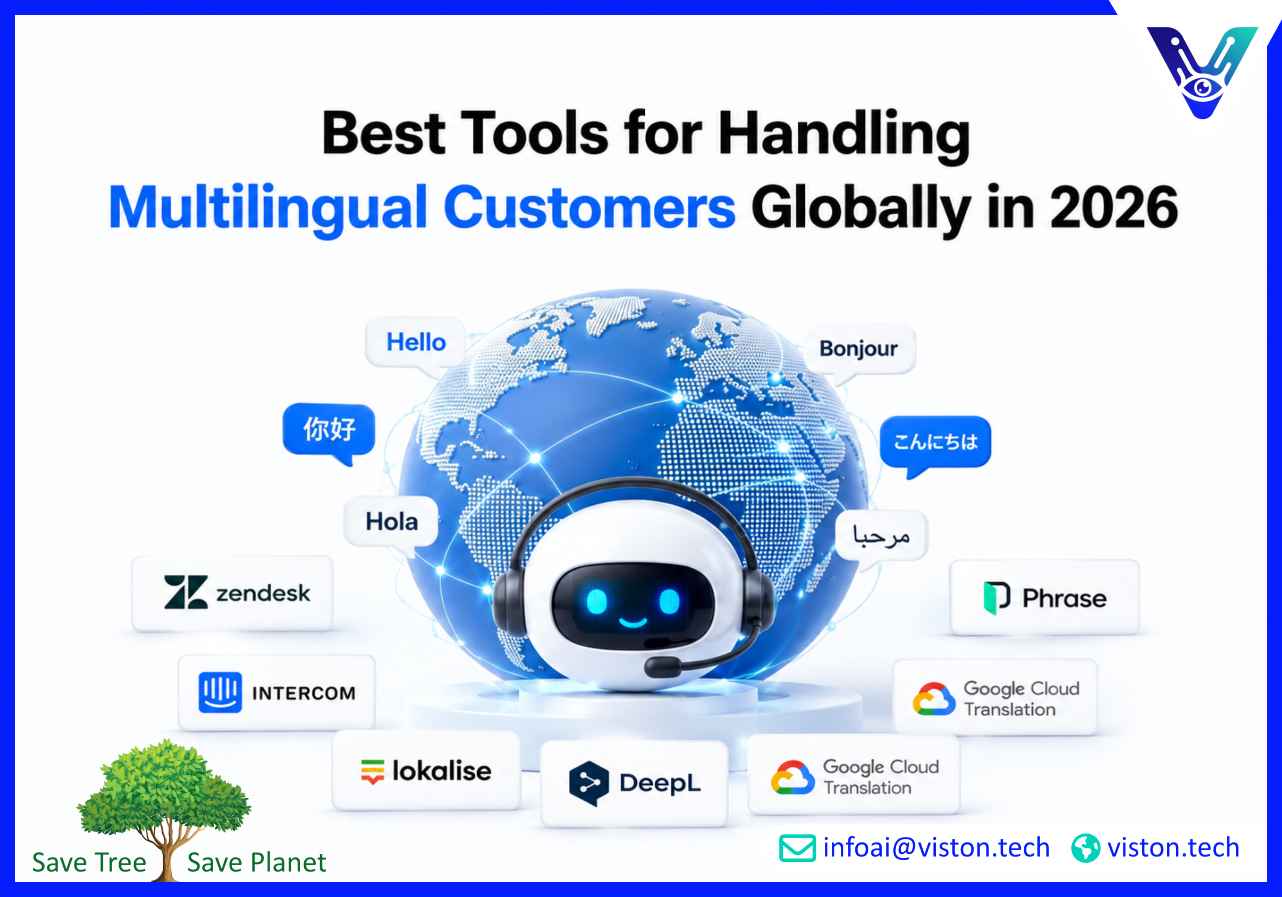
Best Tools for Handling Multilingual Customers Globally in 2026
Choosing the right tools for handling multilingual customers globally requires more than adding a translation widget. Businesses need a connected support stack that can understand customer intent, localize approved content, automate routine enquiries, route complex cases, protect customer data, and measure service quality across languages and channels.
What a Global Multilingual Customer Support Tool Stack Should Include
No single platform solves every multilingual support requirement. A translation engine may convert text accurately but cannot manage tickets, retrieve account information, enforce refund policies, or escalate complaints. A help desk may organize conversations but still require a localization platform, multilingual knowledge base, AI chatbot, or translation API.The most effective setup combines several capabilities around one service workflow.
Omnichannel customer service management
A global support operation needs a central platform for email, live chat, messaging, social media, voice, and help-desk tickets. Customer history should remain available when a conversation moves between channels or agents.Platforms such as Zendesk and Intercom are commonly considered when businesses need centralized support operations with multilingual content, automation, reporting, AI assistance, and human handover. Zendesk supports AI-led service across channels including web, mobile, social, email, and voice, while Intercom provides multilingual help-centre, workflow, messaging, and AI-agent capabilities across several digital channels.
Machine translation and language APIs
Translation tools convert customer messages, agent replies, documents, chatbot responses, and knowledge content between languages. For operational support, businesses should prioritize tools that offer APIs, terminology controls, glossaries, document handling, security settings, and integration options.General consumer translation tools may be suitable for occasional low-risk conversations. High-volume customer service usually requires a business-grade translation service that can be integrated into a help desk, chatbot, mobile application, website, or contact-centre workflow.
Localization and translation management
Multilingual support is more reliable when approved content is localized before customers need it. A translation management system can organize language versions, terminology, review workflows, translation memory, quality checks, and content updates.This matters for frequently used materials such as help articles, returns policies, onboarding instructions, product documentation, error messages, subscription guidance, booking information, and escalation notices. Without centralized localization, different teams may translate the same policy differently.
Multilingual AI chatbots and automation
An AI chatbot can identify a customer’s language, retrieve approved information, answer routine enquiries, collect account details, and trigger workflows. The chatbot should be connected to business systems rather than operating as an isolated translation interface.Useful integrations may include CRM platforms, ecommerce systems, booking software, order management, billing tools, knowledge bases, identity systems, and ticketing platforms. These connections allow the chatbot to provide contextual answers instead of generic translated responses.
Voice translation and contact-centre tools
Businesses supporting customers by telephone also need multilingual speech recognition, real-time translation, agent assistance, translated summaries, and language-aware routing. Voice interactions require careful testing because accents, background noise, interruptions, numbers, names, addresses, and technical terminology can affect accuracy.
Analytics and quality assurance
Global support quality must be measured separately for each language. A dashboard should show response time, resolution rate, fallback rate, escalation rate, translation corrections, customer satisfaction, repeat contact, chatbot completion, and workflow failures by language and channel.
Recommended Tools for Handling Multilingual Customers Globally
The best choice depends on whether the business needs a complete customer service platform, a translation layer, a localization workflow, or a custom multilingual automation system. The following tools serve different parts of the multilingual support stack rather than representing a single universal ranking.
Zendesk for structured omnichannel customer service
Zendesk is suitable for organizations that need ticket management, agent workspaces, automation, knowledge content, messaging, AI agents, analytics, and multiple support channels in one environment.It can be a practical choice for established support teams that want to route enquiries by language, maintain customer histories, manage service levels, and combine automated resolution with human support. Organizations should evaluate the exact language coverage and translation features available within their chosen plan and channel.Zendesk has also continued expanding multilingual AI capabilities, including voice automation developments announced in 2026.
Intercom and Fin for conversational digital support
Intercom is relevant to SaaS companies, digital services, subscription businesses, online platforms, and product-led organizations that want messaging, help-centre content, workflows, AI assistance, and support automation within a conversational interface.Fin can use multilingual support content and workflows to answer customer questions, while conversations can be handled across channels including web and mobile messaging, email, WhatsApp, SMS, Facebook, and Instagram. Intercom also supports multilingual help-centre structures and language-specific workflow controls.It is particularly useful when support is closely connected to onboarding, product usage, account management, and customer success. Teams should test how well the platform handles their terminology, lower-volume languages, technical content, and escalation scenarios.
Lokalise for customer-service localization
Lokalise is designed for businesses that need to manage translated content and support conversations across languages. Its customer-service capabilities include multilingual knowledge-base content and two-way translation for chats and tickets, with published integrations for platforms such as Intercom and Zendesk.This makes it relevant when a company already has a help desk but needs a stronger localization layer. It can help support, product, content, and localization teams coordinate terminology and updates instead of maintaining disconnected translations in documents and spreadsheets.Lokalise may be especially valuable when customer support content changes frequently or when the same terminology must remain consistent across an application, website, help centre, and agent responses.
Phrase for enterprise localization management
Phrase is suitable for enterprises managing large volumes of multilingual content across products, documentation, marketing, applications, and customer support. Its platform focuses on translation management, workflow automation, content governance, quality evaluation, and connections with different language technologies.It is less about answering an individual support message and more about controlling the multilingual content lifecycle. Enterprises with multiple brands, markets, vendors, content systems, or approval teams may benefit from this level of localization governance.
DeepL for business translation, documents, and voice
DeepL can support text translation, document translation, API-based workflows, and real-time voice use cases. It is relevant when agents need translation assistance, businesses process multilingual files, or developers need to embed translation into internal tools and customer-facing systems.Businesses should test it using real customer messages rather than polished sample text. Product names, abbreviations, regional expressions, industry terminology, and informal writing may produce different results from standard business documents.
Google Cloud Translation for custom applications and high-volume workflows
Google Cloud Translation is appropriate for development teams building translation into websites, applications, document systems, customer-service tools, or contact-centre workflows. Its advanced capabilities include glossaries, custom translation options, batch processing, document translation, and integrations for real-time chat and voice scenarios.This option gives technical teams significant flexibility, but it also creates implementation responsibilities. The business must design interfaces, monitoring, access controls, fallback logic, terminology management, cost controls, and human-review processes.
How to Choose the Right Multilingual Customer Support Tools
A long language list should not be the main buying criterion. A platform may claim broad language coverage while performing inconsistently for the languages, dialects, terminology, and customer situations that matter to a particular business.
Test real customer language
Build an evaluation set from genuine enquiries, including spelling errors, short messages, mixed-language sentences, regional expressions, technical terms, product names, and emotionally charged complaints. Remove or anonymize personal data before using conversation records for testing.Measure whether the tool preserves meaning, not whether the output merely sounds fluent. A grammatically polished answer can still communicate the wrong policy, price, deadline, eligibility rule, or troubleshooting step.
Check channel and system integrations
The tool should fit the channels customers already use. A company serving customers through WhatsApp, email, live chat, voice, and an ecommerce marketplace needs different integrations from a B2B software provider using an in-app messenger and ticket portal.Review whether the platform connects with CRM, help-desk, knowledge, order, subscription, payment, booking, and identity systems. Also determine whether integrations are native, API-based, partner-built, or dependent on middleware.
Evaluate terminology and knowledge controls
Strong multilingual tools should support glossaries, protected terms, approved translations, content versioning, and clear source ownership. Product names, plan names, legal phrases, medical terms, technical components, and contractual language should not change unpredictably between conversations.The support team also needs a reliable source of truth. When two documents conflict, the system should know which one is authoritative or escalate the question instead of generating a confident answer.
Assess security, privacy, and regional requirements
Customer messages may contain names, addresses, account details, payment information, health information, contractual records, or confidential business data. Buyers should examine data retention, encryption, subprocessors, access control, audit logs, hosting regions, deletion workflows, and whether customer data is used to improve shared models.Requirements should be reviewed against the privacy, consumer protection, accessibility, employment, financial, healthcare, and AI governance rules that apply in each operating market.
Inspect human handover quality
Automation should transfer a conversation when confidence is low, the customer is dissatisfied, the issue is sensitive, or an action requires approval. The receiving agent should receive the original message, translated version, conversation summary, detected intent, account context, attempted resolution, and relevant records.A weak handover forces customers to repeat information. A strong handover uses automation to prepare the agent rather than block access to a person.
Calculate the total operating cost
Pricing may be based on agent seats, conversations, AI resolutions, translated characters, API calls, documents, languages, projects, storage, or voice minutes. Buyers should model expected volume across all channels and include implementation, integration, localization, human review, training, quality assurance, and ongoing optimization.
How to Build a Practical Global Multilingual Support Stack
The right architecture should reflect the organization’s current support maturity rather than an idealized enterprise setup.
For small and growing businesses
Begin with one central help desk, a business-grade translation tool, and localized content for the highest-volume enquiries. Prioritize two or three languages supported by real customer demand.Automate safe use cases such as order tracking, opening hours, basic product questions, account access, booking confirmations, and standard subscription guidance. Keep complaints, disputes, refunds, legal enquiries, and unusual technical issues under human supervision.
For scaling digital businesses
Add a multilingual AI chatbot, a translation management platform, language-aware routing, CRM integration, and structured analytics. Create approved glossaries and review performance by language rather than relying on aggregate results.At this stage, the business should define content owners, escalation rules, confidence thresholds, review schedules, and procedures for launching a new language. Product, support, legal, operations, and localization teams need a shared governance process.
For global enterprises
Enterprises usually require orchestration across multiple help desks, business units, brands, regions, and data systems. The architecture may include custom AI agents, translation APIs, localization platforms, voice systems, regional knowledge sources, role-based access, model monitoring, audit controls, and human quality review.Implementation should proceed by use case. Start with high-volume, well-documented, lower-risk enquiries and validate accuracy, resolution, handover, security, and customer satisfaction before expanding into sensitive or transactional workflows.
A practical implementation sequence
Analyze enquiry volume, revenue potential, and unresolved cases by language.
Select priority languages and channels based on verified demand.
Clean the source knowledge and define authoritative content.
Create glossaries, escalation rules, and protected terminology.
Integrate the help desk, chatbot, CRM, and operational systems.
Test with native speakers and real-world customer phrasing.
Launch gradually and monitor quality separately for every language.
The goal is not to automate the highest possible percentage of conversations. It is to resolve appropriate conversations accurately while giving customers a dependable route to human support.
How Viston AI Supports Global Multilingual Customer Service
Viston AI provides Multilingual AI Chatbot Support for organizations that need more than an off-the-shelf translation tool. Its published capabilities include multilingual intent recognition, real-time translation and localization, omnichannel chatbot deployment, intelligent routing, performance analytics, and connections with knowledge bases and business systems.This service-led approach is relevant when a business needs a multilingual support environment designed around its own workflows, policies, customer data, terminology, and escalation requirements. A chatbot can be connected with CRM, ecommerce, ticketing, transaction, booking, or internal knowledge systems so that responses reflect the customer’s actual context.Viston AI’s broader capabilities include enterprise AI chatbots, voice-enabled assistants, language translation services, NLP, AI chatbot integration, automation workflows, model monitoring, and AI strategy. These capabilities support organizations that need to combine language handling with workflow completion, governance, system integration, and continuous optimization.For businesses operating across countries, channels, or customer segments, the practical value lies in creating one coordinated multilingual service model. Rather than deploying separate translation tools without shared control, Viston AI can help structure language detection, approved knowledge retrieval, automated resolution, human handover, analytics, and ongoing improvement around measurable customer-service outcomes.
Frequently Asked Questions
What is the best tool for handling multilingual customers?
There is no universal best tool. Zendesk or Intercom may suit centralized customer service, Lokalise or Phrase can manage localization, DeepL or Google Cloud Translation can provide language processing, and a custom multilingual chatbot can automate connected workflows.
Can translation software replace multilingual customer service agents?
Translation software can reduce dependence on language-specific staffing for routine interactions, but it should not replace human judgment in complex complaints, regulated matters, negotiations, safety issues, legal requests, or emotionally sensitive cases.
Should businesses use one multilingual platform or several integrated tools?
Most businesses need an integrated stack. A help desk manages conversations, a translation engine processes language, a localization platform controls approved content, and an AI chatbot automates suitable enquiries. The exact combination depends on scale and complexity.
How should multilingual support tools be tested?
Test them with anonymized real customer conversations across every priority language. Include misspellings, regional language, technical terminology, mixed-language messages, complaints, and ambiguous requests. Measure accuracy, resolution, escalation, response time, and customer satisfaction.
What security features should a multilingual support platform have?
Review encryption, access permissions, audit logs, data retention, deletion processes, hosting locations, subprocessors, model-training policies, and integrations. Security requirements should match the sensitivity of the customer data being translated or processed.
Can Viston AI integrate multilingual support with existing business systems?
Viston AI’s published multilingual and chatbot integration capabilities include connections with knowledge bases and business applications. This can help organizations link multilingual conversations with customer data, support workflows, routing rules, and performance reporting.
Conclusion
The best tools for handling multilingual customers globally are those that work together around real customer journeys. Businesses need more than translation: they need centralized conversations, localized knowledge, accurate automation, contextual system access, secure data handling, reliable human escalation, and language-specific reporting. A focused Multilingual Support stack can begin with priority languages and routine enquiries before expanding into more channels and complex workflows. Viston AI offers relevant multilingual chatbot, integration, routing, NLP, and analytics capabilities for organizations seeking a customized and scalable global customer-service model.