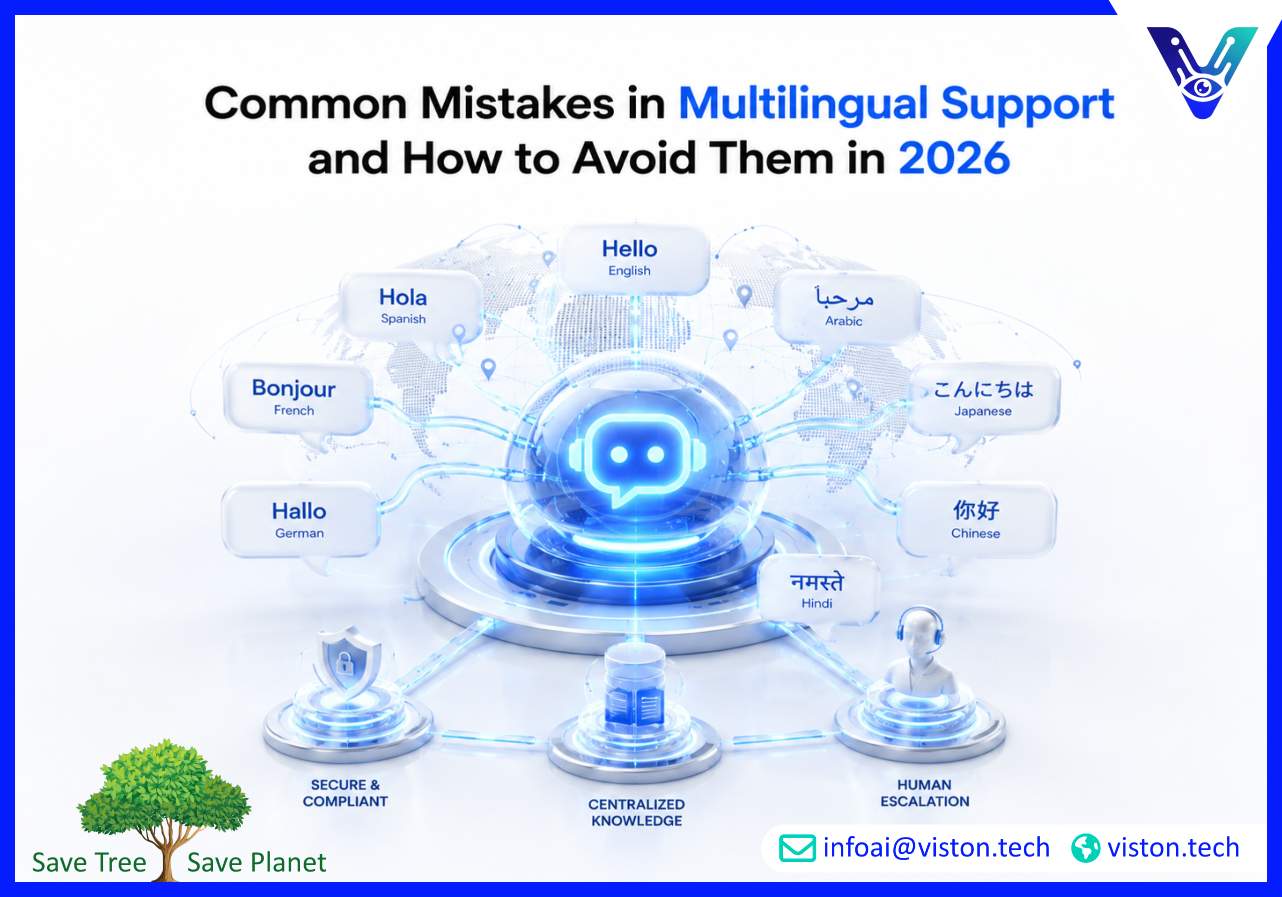
Common Mistakes in Multilingual Support and How to Avoid Them in 2026
Common mistakes in multilingual support usually begin when businesses treat language as a translation task rather than a complete customer service operation. Reliable multilingual support requires localized knowledge, accurate routing, appropriate automation, human escalation, data protection, and consistent quality across every supported language.
Common Multilingual Support Mistakes That Damage Customer Trust
Offering support in several languages can improve accessibility and help a business enter new markets. However, poorly planned language coverage can create more frustration than providing a smaller, clearly defined service. Customers expect the same accuracy, clarity, and ownership regardless of the language they use.
Relying on word-for-word translation
One of the most common multilingual support mistakes is assuming that accurate translation automatically creates a good customer experience. A sentence may be grammatically correct while still sounding unnatural, overly formal, insensitive, or confusing in the customer’s market.Effective localization considers regional vocabulary, tone, formality, currencies, dates, measurements, product terminology, and cultural expectations. It also preserves the practical meaning of policies and instructions. Refund terms, technical guidance, payment information, and safety-related messages require particular care because small wording differences can change how customers interpret their options.
Supporting too many languages too quickly
Businesses sometimes launch an extensive language list before they have sufficient knowledge content, workflows, or quality assurance for each language. This creates uneven service. Popular languages may receive accurate answers and fast escalation, while lower-volume languages depend on weak automated translation or unavailable agents.A better approach is to prioritize languages using customer demand, revenue opportunity, support volume, market strategy, and operational risk. Businesses should define exactly what is available in each language, including channels, operating hours, self-service content, human assistance, and escalation coverage. Current multilingual service guidance similarly emphasizes selecting a realistic level of support and communicating availability clearly.
Assuming all speakers of a language communicate identically
Language coverage should not ignore regional variation. Spanish used in Spain may differ from Spanish used in Mexico or Argentina. French terminology and customer expectations may vary between France, Canada, Belgium, and parts of Africa.Regional differences can affect spelling, vocabulary, preferred channels, politeness, examples, legal terminology, and purchasing conventions. Businesses do not need a separate operation for every country, but they should identify important regional differences and maintain an approved terminology guide for each priority market.
Using the same tone in every language
A casual English support style may appear friendly in one market but unprofessional in another. Direct instructions may be appreciated by some customers and perceived as abrupt by others.Support leaders should define language-specific guidance for greetings, formality, empathy, apologies, technical explanations, and closing messages. The objective is not to create a completely different brand in every market. It is to preserve the brand’s personality while communicating in a way that feels natural and respectful locally.
Operational and Workflow Mistakes in Multilingual Support
Many multilingual service failures are operational rather than linguistic. Even a strong translation tool cannot compensate for outdated knowledge, disconnected systems, poor routing, or unclear responsibility.
Translating conversations but not the knowledge base
Agents and AI assistants need an approved source of truth. If help centre articles, policies, troubleshooting guides, product documentation, and internal procedures remain incomplete or outdated, translated answers will repeat the same underlying errors in multiple languages.Businesses should first improve the source content in their primary language. Each article should have an owner, review date, intended audience, and version history. Approved content can then be localized into priority languages using consistent terminology.When a policy changes, translations should be updated through a controlled process. Leaving old localized pages online can lead customers to receive conflicting information about pricing, eligibility, returns, subscriptions, or service conditions.
Creating separate language silos
Another mistake is operating each language team as an isolated unit. Separate teams may develop different answers, escalation rules, service standards, and interpretations of the same policy.Multilingual support needs centralized governance with local input. Core policies, quality standards, knowledge ownership, escalation criteria, and reporting definitions should remain consistent. Regional teams should then adapt communication and workflows where local requirements genuinely differ.
Poor language detection and routing
Customers may change languages during a conversation, use mixed-language messages, write with spelling errors, or communicate in a regional dialect. Routing based only on browser settings, country codes, or a single opening sentence can send the conversation to the wrong queue.A reliable workflow should combine automatic language detection with customer preference and account history. Customers should also be able to select or change their preferred language manually.Routing must consider more than language. Urgency, sentiment, customer value, subject matter, product, region, and agent expertise may all affect where the case belongs. A fluent agent without the required technical or policy knowledge may not be the right person to resolve it.
Weak human handover
Automation becomes frustrating when customers cannot reach a person or must repeat the entire issue after escalation. A good handover should transfer the original message, translated summary, detected intent, customer details, relevant account information, attempted actions, and reason for escalation.Human assistance should be available for complaints, payment disputes, cancellations, legal requests, vulnerable customers, sensitive personal matters, unusual technical issues, and situations where the system lacks confidence.
Hiding language limitations
Businesses should not imply that every language receives identical service when that is not true. Customers need to know whether support is automated or human, which channels are available, expected response times, and when specialist assistance can be provided.Clear expectations protect trust. Limited but dependable language support is usually better than broad coverage that becomes unreliable when an issue moves beyond a basic question.
AI, Data, Security, and Compliance Mistakes
AI can make multilingual support more scalable, but it also increases the need for governance. Fluent output can appear trustworthy even when the underlying answer is incomplete, outdated, or contextually wrong.
Automating high-risk conversations without safeguards
Routine enquiries such as order tracking, opening hours, appointment confirmations, password guidance, and standard product information are often suitable for automation. Complex complaints, financial decisions, medical questions, contract interpretation, fraud concerns, and legal requests require stronger controls.Businesses should define what an AI assistant may answer, what actions it may perform, and when human approval is required. Confidence thresholds and escalation rules should be tested separately for each supported language because performance may not be equal across languages.
Testing only with polished translations
A multilingual system may perform well on carefully written test scripts but fail with real customer language. Customers use slang, abbreviations, spelling mistakes, incomplete sentences, mixed languages, voice transcription errors, and product-specific terminology.Testing should include native-language conversations from real support environments, with personal information removed where required. Teams should evaluate intent recognition, factual accuracy, tone, workflow completion, fallback behaviour, and escalation quality.
Ignoring data privacy across channels and regions
Multilingual conversations may contain names, addresses, payment details, account information, health data, employment information, or contractual material. Moving this information through translation services, AI platforms, CRM systems, and external integrations can create unnecessary exposure.Businesses should document where conversation data is processed, which vendors can access it, how long it is retained, and whether data crosses national borders. Access controls, encryption, data minimization, audit logs, deletion processes, and regional data residency should be considered according to the use case.
Failing to disclose AI use
Customers should understand when they are communicating with an automated system. Concealing automation can damage trust and may create compliance issues in regulated markets.For organizations serving the European Union, this becomes especially relevant in 2026. The European Commission states that AI Act transparency obligations require people to be informed when they are interacting with systems such as chatbots, with the transparency rules applying from August 2026.
Measuring only global averages
A high overall resolution rate can hide weak performance in individual languages. Businesses should avoid combining every conversation into one dashboard without language-level reporting.Useful multilingual support metrics include:
First-response time by language and channel
First-contact and self-service resolution rates
Fallback and misunderstanding rates
Escalation rate and handover quality
Customer satisfaction by language
Repeat-contact and abandonment rates
Translation corrections and terminology errors
Workflow and integration success rates
Performance should also be reviewed by intent. A chatbot may answer delivery questions accurately in German while performing poorly on billing questions in the same language.
How to Avoid Common Mistakes in Multilingual Support
A successful multilingual support model is built gradually. Businesses should begin with real customer demand, controlled knowledge, suitable automation, and measurable service standards.
Define language priorities and service scope
Review customer locations, sales enquiries, website language data, ticket history, product usage, and expansion plans. Select a manageable number of priority languages and define which services will be available in each one.Document supported channels, operating hours, response-time targets, automated use cases, human escalation availability, and ownership. This prevents sales and marketing teams from promising language coverage that support operations cannot reliably deliver.
Create a multilingual knowledge governance process
Build clear source content before translating it. Maintain terminology glossaries for product names, technical terms, policy wording, prohibited phrases, and regional variations.Each translated article should be connected to its source version so updates can be identified quickly. High-risk content should receive review from qualified language specialists and relevant business owners.
Use AI and people for the right tasks
AI can handle high-volume, repetitive, and well-documented enquiries. Human teams should manage ambiguity, negotiation, sensitive complaints, complex judgment, and exceptions.The strongest model is usually hybrid. Automation provides speed and broad availability, while specialists provide accountability, cultural understanding, and judgment where mistakes would have greater consequences.
Integrate multilingual support with business systems
Support becomes more useful when it has access to the customer’s order, booking, subscription, product, ticket history, or account status. CRM, helpdesk, ecommerce, scheduling, knowledge, and transaction integrations reduce repetitive questions and allow conversations to produce practical outcomes.Integration also improves reporting. Businesses can connect language-specific conversations with resolved tickets, refunds, appointments, qualified leads, renewals, and other measurable outcomes.
Review conversation samples for every supported language. Quality checks should assess accuracy, completeness, tone, policy compliance, localization, data handling, and escalation decisions.Teams should prioritize failed conversations, negative feedback, repeated fallbacks, unresolved cases, and examples where customers switch to another language to obtain help. These signals often reveal missing content or weak workflows more clearly than average performance scores.
How Viston AI Helps Businesses Avoid Multilingual Support Mistakes
Viston AI provides Multilingual AI Chatbot Support for organizations that need to manage customer conversations across languages, channels, and operational systems. Its published service capabilities include context-aware intent recognition, real-time translation and localization, omnichannel orchestration, intelligent routing, language-level analytics, and integration with CRM platforms, knowledge bases, transaction systems, and business applications.These capabilities address several common multilingual support mistakes. Language-aware intent recognition can reduce incorrect routing, while centralized knowledge integration helps keep answers aligned with approved business information. Intelligent escalation supports smoother transfers when automation is not suitable, and language-specific analytics helps teams identify quality gaps that global averages may hide.Viston AI’s approach is also relevant to businesses that need phased deployment rather than immediate coverage across every market. Priority languages, channels, and use cases can be introduced first, then expanded after testing and performance review.The practical value lies in connecting language technology with the wider support operation. A multilingual chatbot should not simply translate messages. It should retrieve accurate knowledge, recognize context, interact with authorized systems, respect escalation rules, and provide measurable insight into customer outcomes. This structured approach can help businesses scale multilingual support while maintaining greater control over consistency, security, and service quality.
Frequently Asked Questions
What is the most common mistake in multilingual support?
The most common mistake is treating multilingual support as direct translation. Effective service also requires localization, accurate knowledge, language-aware routing, human escalation, system integration, and quality measurement for each supported language.
Is automatic translation reliable enough for customer support?
Automatic translation is useful for routine and low-risk enquiries, but it should not operate without safeguards. Sensitive, technical, legal, medical, financial, or emotionally complex conversations may require human review or escalation.
How many languages should a business support?
The right number depends on customer demand, market opportunity, ticket volume, available knowledge, staffing, automation quality, and risk. Businesses should begin with the languages that create the strongest commercial or service need and expand gradually.
How can multilingual support quality be measured?
Track response time, resolution rate, fallback rate, escalation quality, repeat contact, customer satisfaction, translation corrections, and workflow success separately for each language, channel, and enquiry type.
Should every multilingual chatbot conversation offer human escalation?
Customers should have a clear route to human help when the chatbot cannot resolve the issue, lacks confidence, or encounters a sensitive situation. The escalation method may vary by language, channel, urgency, and operating hours.
Can Viston AI integrate multilingual support with existing business systems?
Viston AI describes integration capabilities for CRM platforms, knowledge bases, transaction systems, analytics tools, helpdesk applications, and other business software. These connections can provide customer context and support workflow completion across languages.
Conclusion
Common mistakes in multilingual support arise when businesses expand language coverage without building the knowledge, workflows, governance, and quality controls needed to sustain it. Translation alone cannot ensure accurate resolutions or consistent customer experiences. Businesses should prioritize relevant languages, localize approved content, combine AI with appropriate human oversight, protect customer data, integrate support systems, and measure performance by language. Viston AI offers multilingual support capabilities aligned with these requirements, helping organizations develop a more structured, scalable, and business-focused service model.