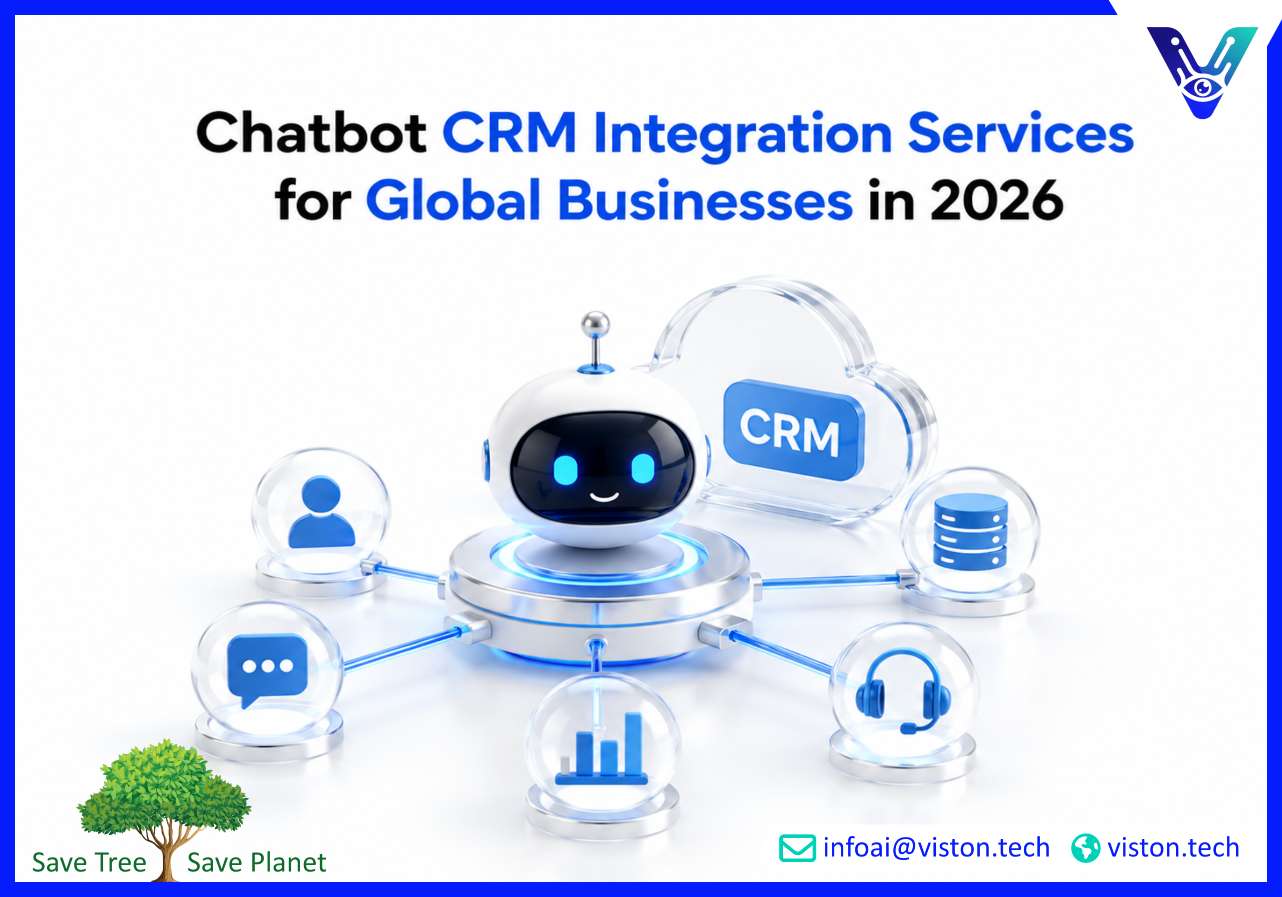
Chatbot CRM Integration Services for Global Businesses in 2026
Chatbot CRM integration services connect customer conversations with sales, marketing, and support data. Instead of operating as a standalone website tool, an integrated chatbot can recognize customers, capture qualified leads, update records, trigger workflows, and give business teams useful context for every interaction.
What Chatbot CRM Integration Services Include
Chatbot CRM integration is the process of connecting an AI-powered conversational interface with a customer relationship management platform. The connection allows information to move securely between the chatbot and the CRM according to defined permissions, validation rules, and business workflows.A basic chatbot may answer questions or collect contact details. A CRM-integrated chatbot can use the conversation to create or update records, associate contacts with companies, identify existing customers, record buying intent, assign leads, schedule follow-up activities, and transfer complex enquiries to the appropriate employee.Modern CRM platforms organize information into objects such as contacts, companies, deals, activities, pipelines, and custom records. Their APIs allow approved applications to create, retrieve, search, associate, and update this information. That structure enables a chatbot to turn natural-language conversations into usable CRM data.
Common integration capabilities
The exact scope depends on the CRM, chatbot platform, business process, and customer journey. Typical chatbot CRM integration services include:
Creating contacts, leads, accounts, opportunities, or support cases
Checking whether a visitor already exists in the CRM
Updating phone numbers, email addresses, preferences, and enquiry details
Capturing product interest, budget, location, company size, and buying timeline
Assigning leads according to territory, product, account ownership, or availability
Logging conversation summaries and important customer messages
Retrieving approved account, order, subscription, or service information
Creating tasks, notifications, appointments, and follow-up workflows
Transferring conversations to sales or support teams with full context
Synchronizing chatbot activity with analytics and reporting systems
CRM platforms that can support chatbot connections
Businesses may require integration with platforms such as Salesforce, HubSpot, Microsoft Dynamics 365, Zoho CRM, Pipedrive, Freshsales, or a custom-built customer database. The implementation may use a native connector, direct API integration, middleware, webhooks, workflow automation software, or a custom integration layer.Native connectors may be suitable for standard use cases with limited customization. Direct API development is usually more appropriate when the business has custom CRM objects, complex field mappings, multiple sales pipelines, legacy applications, or strict workflow requirements.The right architecture should be selected according to the operational need rather than convenience alone. A simple lead-capture bot may require only one-way record creation, while an enterprise assistant may need bidirectional synchronization across CRM, helpdesk, ecommerce, identity, scheduling, and knowledge systems.
How Chatbot CRM Integration Services Improve Business Operations
The main value of chatbot CRM integration services is continuity. Customer conversations become part of the wider business process instead of remaining trapped inside a chat transcript that employees must review and re-enter manually.
Faster lead capture and qualification
A CRM-connected chatbot can engage a prospect immediately, identify the reason for the enquiry, ask relevant qualification questions, and create a structured lead record. It can collect information such as role, company, requirement, preferred solution, timeframe, and contact preference.Qualification logic can then determine whether the lead should be assigned to sales, directed to self-service content, added to a nurture workflow, or routed to a specialist. This reduces delays between initial interest and business follow-up.The chatbot should not ask every visitor the same long list of questions. Effective integration uses conversational context and CRM data to avoid unnecessary repetition. For example, a returning contact may be asked about a new requirement rather than being forced to provide information already stored in the system.
More contextual customer support
Support chatbots become more useful when they can recognize the customer and access approved information connected to the account. Depending on permissions, the chatbot may retrieve subscription details, previous cases, service status, product ownership, renewal dates, or assigned account representatives.This context allows the chatbot to provide more relevant guidance. It can also create a case, select an appropriate category, establish urgency, and transfer the conversation with a useful summary. Human agents receive the customer’s details, detected intent, previous steps, and conversation history instead of asking the customer to start again.
Improved CRM data quality
Manual data entry frequently produces incomplete records, inconsistent formats, duplicate contacts, missing activity logs, and delayed updates. A well-designed chatbot can validate required fields, standardize data formats, identify potential matches, and write information to the correct CRM record.Automation does not remove the need for governance. Validation rules must define what the chatbot can update, which fields are mandatory, how duplicate records are handled, and when human approval is required. High-impact changes should not be completed only because a user requested them in a chat.
Consistent sales and service workflows
CRM integration can trigger repeatable actions after a conversation. A qualified lead might create a deal, notify an account executive, schedule a task, and send an approved confirmation. A support enquiry might open a case, assign a priority, attach a transcript, and notify the correct service queue.This consistency is valuable for global businesses operating across departments, time zones, languages, and customer channels. The chatbot can apply the same routing logic and data standards on a website, mobile application, messaging platform, or customer portal while respecting channel-specific requirements.
How a Chatbot CRM Integration Project Is Implemented
Successful integration requires more than connecting two APIs. The chatbot must understand the business process, convert conversational information into structured fields, perform approved actions, and respond safely when data is unavailable or a system fails.
1. Define the business use cases
The project should begin with clear outcomes. Examples include increasing qualified demo requests, reducing manual lead entry, improving customer handovers, automating case creation, scheduling consultations, or giving customers access to account information.Each use case should define the intended user, required CRM data, allowed chatbot actions, escalation criteria, and success measures. Starting with a focused set of high-value workflows is usually more manageable than trying to automate every customer journey at once.
2. Map CRM records and conversation data
The implementation team must identify where each piece of chatbot data belongs. A customer’s email may map to a contact property, the company name to an account record, product interest to a custom field, and the conversation summary to an activity or case note.Field mapping should account for required values, dropdown options, character limits, naming conventions, custom objects, pipeline stages, and ownership rules. The design must also determine how the integration will find an existing record before creating a new one.
3. Design secure access and permissions
The chatbot should receive only the access needed for its approved use cases. Authentication, credential storage, role-based permissions, encryption, audit logging, and environment separation should be addressed before production deployment.Read and write permissions should be considered separately. A chatbot may need permission to read a deal stage but not change it. It may be allowed to update contact preferences while requiring human approval for account ownership, refunds, contract terms, or sensitive status changes.
4. Build conversational and workflow logic
The conversation flow must collect sufficient information without creating unnecessary friction. It should recognize user intent, extract relevant entities, validate important details, and explain what will happen next.Workflow logic determines when to search the CRM, create a record, update an existing record, trigger an automation, or escalate to a person. The integration also needs fallback behaviour for missing data, expired credentials, rate limits, unavailable services, validation failures, and conflicting records.
5. Test realistic scenarios
Testing should cover more than successful record creation. Teams should test duplicate contacts, incomplete details, incorrect formats, multiple matching records, unavailable APIs, permission errors, workflow failures, multilingual input, repeated messages, and requests the chatbot is not authorized to complete.Sales, support, operations, security, and CRM administrators should participate in acceptance testing. Their feedback helps identify process issues that may not be visible during technical testing.
6. Monitor and optimize after launch
Production performance should be measured through CRM and chatbot data. Useful metrics include lead creation accuracy, duplicate rate, workflow completion, API failure rate, qualified lead conversion, handover quality, case-routing accuracy, response time, and customer satisfaction.Conversation reviews can reveal missing intents, confusing questions, incorrect field mapping, weak qualification logic, and unnecessary escalations. Integration quality should be treated as an ongoing operational responsibility rather than a one-time development task.
How to Evaluate a Chatbot CRM Integration Services Provider
A suitable provider must understand conversational AI, CRM architecture, API development, workflow design, data governance, and business operations. Strong chatbot development alone is not enough if the provider cannot design reliable record matching, permissions, error handling, and synchronization.
Relevant CRM and integration expertise
Ask whether the provider has experience with your CRM, custom objects, sales pipelines, service processes, authentication model, and surrounding technology stack. The team should be able to explain whether a native connector, automation platform, direct API, or custom middleware approach is most appropriate.
Business-process understanding
The provider should map how an enquiry moves from the chatbot into sales, marketing, customer success, or support. Technical connectivity has limited value when records are assigned incorrectly or the integration does not match the company’s working process.
Security and governance controls
Evaluation should include access control, credential management, data minimization, logging, retention, approval rules, and incident handling. Global businesses should also assess how the architecture supports applicable privacy, data-location, contractual, and industry requirements.
Reliability and failure management
CRM APIs can return errors, reject invalid fields, enforce usage limits, or become temporarily unavailable. A production-ready integration should include retries where appropriate, clear error messages, monitoring, alerting, and safe fallback procedures.The chatbot must never tell a customer that an action was completed when the CRM update actually failed. Transaction confirmation and status handling are essential when the conversation triggers operational work.
Measurable commercial outcomes
The implementation should be linked to specific outcomes such as faster lead response, more complete records, improved conversion visibility, reduced manual administration, shorter support handling time, or better customer handovers.Costs depend on the number of CRM platforms, chatbot channels, workflows, custom fields, data sources, security requirements, languages, and integrations involved. Buyers should request a scope that separates initial discovery, development, testing, deployment, monitoring, and ongoing optimization.
How Viston AI Supports Chatbot CRM Integration
Viston AI provides AI Chatbot Integration services focused on connecting conversational interfaces with CRM, ERP, and core business platforms. Its published capabilities include real-time data synchronization, automated workflows, multi-channel orchestration, and integration with platforms such as Salesforce, HubSpot, and Microsoft Dynamics.This service alignment is relevant to organizations that need a chatbot to do more than provide general answers. Viston AI can support use cases involving lead creation, contact updates, conversation logging, sales routing, customer-service escalation, workflow initiation, and approved retrieval of CRM information.The company’s integration approach also covers natural-language processing, business-rule validation, security controls, API connectivity, and connections with broader enterprise systems. These capabilities can help businesses design chatbots that convert conversations into structured, usable actions while maintaining clear boundaries around data access.For global sales, support, ecommerce, and service operations, Viston AI’s integration-focused offering can support phased deployment across selected workflows and channels. The practical value lies in connecting customer intent with accurate CRM records, reliable automation, contextual employee handovers, and measurable operational reporting rather than deploying an isolated chat interface.
Frequently Asked Questions
What are chatbot CRM integration services?
Chatbot CRM integration services connect an AI chatbot with a customer relationship management platform. The integration allows the chatbot to retrieve approved information, create or update records, log interactions, assign leads, open cases, and trigger sales or support workflows.
Can a chatbot integrate with an existing CRM?
Yes. Chatbots can integrate with existing CRM platforms through native connectors, APIs, webhooks, middleware, or workflow automation tools. The best method depends on the CRM, required actions, custom fields, security rules, and surrounding systems.
What CRM data can an AI chatbot use?
A chatbot may use approved contact details, account information, lead status, deal stage, service history, preferences, assigned owners, and previous interactions. Access should be limited to the information required for the specific use case.
Can CRM integration create duplicate customer records?
Duplicates can occur when matching rules are weak or data is inconsistent. A reliable integration should search for existing records using suitable identifiers, validate information, apply deduplication logic, and route uncertain matches for review.
How long does chatbot CRM integration take?
Timelines vary according to workflow complexity, CRM customization, security requirements, number of channels, data quality, and testing needs. A focused lead-capture integration may be completed faster than a multi-system enterprise deployment involving several departments and approval processes.
Can Viston AI integrate chatbots with CRM workflows?
Viston AI’s AI Chatbot Integration offering includes CRM synchronization, API connectivity, workflow automation, lead handling, customer-data updates, and integration with broader business systems. The exact solution should be scoped around the organization’s CRM, workflows, permissions, and desired outcomes.
Conclusion
Chatbot CRM integration services help businesses turn customer conversations into structured sales, service, and operational actions. A well-designed integration can improve lead response, record quality, workflow consistency, personalization, and employee handovers while reducing manual administration. Success depends on accurate field mapping, secure access, reliable API architecture, realistic testing, and continuous monitoring. Businesses evaluating AI Chatbot Integration should select a provider that understands both conversational technology and CRM operations. Viston AI offers relevant capabilities for organizations seeking connected chatbot experiences that support measurable global business processes.