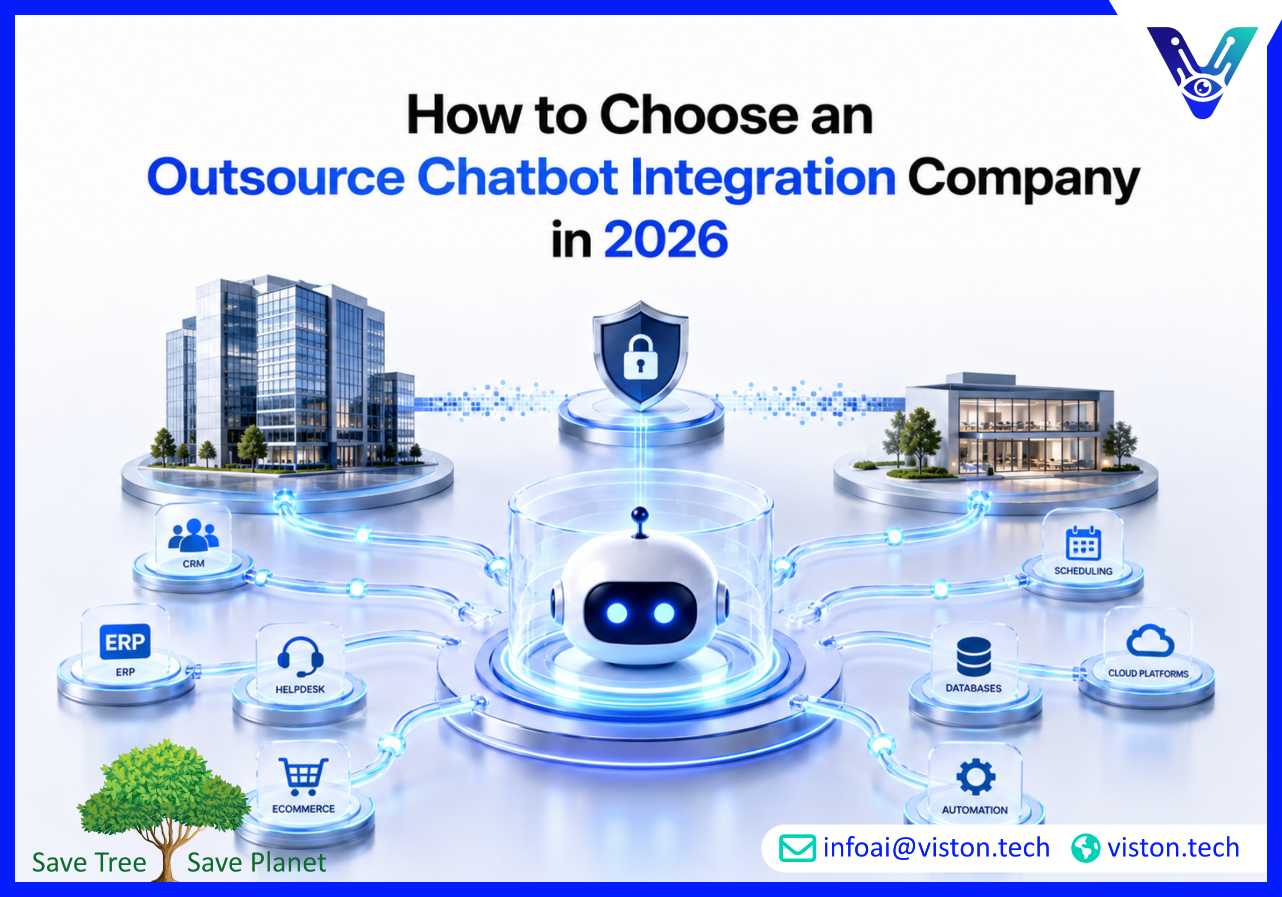
How to Choose an Outsource Chatbot Integration Company in 2026
Choosing an outsource chatbot integration company can help a business deploy conversational AI without building every technical capability internally. The right provider connects the chatbot with existing systems, protects business data, supports reliable workflows, and creates measurable value across customer service, sales, ecommerce, operations, and employee support.
What an Outsource Chatbot Integration Company Actually Does
An outsource chatbot integration company connects a conversational AI solution with the platforms, data sources, communication channels, and workflows a business already uses. Its role extends beyond adding a chat window to a website.A useful chatbot may need to retrieve customer records, check an order, create a support ticket, qualify a lead, schedule an appointment, search a knowledge base, update an account, or escalate a conversation to an employee. Each action depends on reliable connections between the chatbot and other systems.Common integration environments include:
Customer relationship management platforms
Enterprise resource planning systems
Helpdesk and ticketing software
Ecommerce and order management platforms
Marketing automation tools
Appointment and calendar systems
Payment and subscription platforms
Internal databases and document repositories
Knowledge bases and content management systems
Websites, mobile applications, WhatsApp, social messaging, and live chat channels
The integration provider must understand both the conversation layer and the operational systems behind it. A chatbot may produce a fluent answer while still failing as a business tool if it retrieves outdated information, creates duplicate records, sends data to the wrong workflow, or transfers customers without context.
Chatbot development and chatbot integration are different
Chatbot development focuses on how the assistant understands users, manages conversations, generates responses, and presents information. Chatbot integration focuses on how that assistant communicates with business systems and performs approved actions.Most production projects require both capabilities. The provider may need to design prompts and conversation flows while also managing APIs, authentication, data mapping, webhook events, middleware, error handling, access controls, and monitoring.This distinction matters when outsourcing. A company that can build an attractive chatbot interface may not have the engineering depth to integrate complex enterprise systems. Buyers should confirm that a prospective provider can manage the full path from user request to backend action and verified response.
When Should a Business Outsource Chatbot Integration?
Outsourcing is most valuable when chatbot requirements exceed the available time, experience, or capacity of an internal team. It can also help a company move faster while allowing internal technology, customer experience, and operations teams to remain focused on their core responsibilities.
Internal teams lack specialized integration skills
Chatbot integration requires a combination of conversational AI, software engineering, API integration, data architecture, security, testing, and workflow design. These skills may be distributed across several internal teams, making coordination difficult.An experienced external provider can bring these disciplines into one implementation process. This is particularly useful when the chatbot must connect with several platforms or work across customer-facing and internal workflows.
The business needs to modernize an existing chatbot
Many organizations already have scripted bots that answer simple questions but cannot access account data or complete tasks. Replacing the interface alone will not solve the underlying limitation.An integration company can assess the current chatbot, identify reusable components, map missing connections, and determine whether the business should upgrade, rebuild, or gradually migrate the solution. This avoids unnecessary disruption and helps preserve useful knowledge, workflows, and channel configurations.
The chatbot must support multiple departments
A chatbot initially created for customer support may later be expected to qualify sales enquiries, assist employees, process service requests, or provide account information. Each department may use different systems, permissions, terminology, and escalation processes.Outsourcing can provide the architecture and governance needed to support these requirements without creating separate, disconnected bots. The provider can establish shared integration components while preserving department-specific access and workflow rules.
Reliability and security requirements are increasing
In 2026, businesses are paying closer attention to prompt injection, sensitive information disclosure, excessive system permissions, insecure third-party components, and unreliable AI-generated outputs. These risks become more serious when a chatbot can read from or write to operational systems.A capable partner should design the integration around least-privilege access, secure authentication, input validation, output controls, logging, human approval where needed, and controlled failure behaviour. Governance should continue after launch because models, APIs, business rules, and security risks change over time.
The business needs a defined implementation outcome
Outsourcing works best when the goal is specific. Examples include reducing repetitive support tickets, improving lead routing, enabling order self-service, automating appointment booking, or giving employees faster access to approved internal knowledge.A clear outcome helps the provider select the right architecture and prevents the project from becoming an unfocused attempt to make the chatbot answer every possible question.
How to Evaluate an Outsource Chatbot Integration Company
Businesses should evaluate providers according to implementation quality, not the number of AI features listed in a proposal. The strongest partner is usually the one that understands the required workflow, identifies operational risks early, and explains how the solution will be tested and maintained.
Confirm experience with the relevant business systems
Ask which CRM, ERP, helpdesk, ecommerce, analytics, or proprietary platforms the provider has experience integrating. More importantly, ask how it handles systems with limited APIs, inconsistent data, legacy authentication, strict rate limits, or complex approval requirements.The provider should be comfortable evaluating API documentation, creating custom connectors, using middleware where appropriate, and designing fallback procedures when a connected service is unavailable.
Review the proposed integration architecture
A reliable proposal should explain how information moves between the user, chatbot, AI model, knowledge source, integration layer, and target system. It should identify where authentication occurs, which data is stored, what actions the chatbot can perform, and how failures are detected.Buyers should also ask how tightly the chatbot will be coupled to a specific model or platform. A modular architecture can make it easier to replace components, add channels, change models, or integrate new systems later.
Assess security and access controls
The chatbot should not receive broad access simply because it may need data from several systems. Permissions should be based on the user, channel, use case, and action being performed.Important controls include role-based access, secure secret management, encryption, personally identifiable information handling, audit logs, retention policies, API validation, rate limiting, and approval steps for sensitive actions. The provider should also explain how it tests for prompt injection, unauthorized requests, data leakage, and unsafe tool use.
Examine knowledge and response quality
Integration quality is not limited to API connections. The chatbot must retrieve information from approved sources and interpret system responses correctly. Ask how the provider handles retrieval-augmented generation, document permissions, conflicting content, outdated policies, confidence thresholds, and source updates.A well-designed chatbot should acknowledge uncertainty, request clarification, or escalate the conversation instead of inventing an answer.
Require realistic testing
Testing should include more than successful demonstrations. The provider should test incomplete user requests, spelling variations, unexpected inputs, unavailable systems, expired credentials, duplicate submissions, API timeouts, permission failures, and requests that require human approval.User acceptance testing should involve the employees who understand the real workflow. Their feedback can expose operational issues that technical testing alone may miss.
Understand post-launch support
Chatbot integration is not a one-time installation. Business systems change, API versions are retired, knowledge content becomes outdated, and customer behaviour evolves.Ask who will monitor errors, update connectors, review failed conversations, improve prompts, maintain documentation, and respond to incidents. Service expectations should define ownership, response procedures, escalation paths, reporting, and change management.
How to Scope and Manage an Outsourced Chatbot Integration Project
A disciplined scope reduces delivery risk and makes vendor proposals easier to compare. Businesses should document the chatbot’s intended users, channels, systems, workflows, permissions, and measurable outcomes before development begins.
Start with a focused discovery phase
The provider should work with business, technology, security, data, and customer-facing teams to understand the current process. Discovery should identify frequent requests, manual handoffs, data dependencies, system limitations, compliance needs, and exceptions that require human judgment.This phase should result in a prioritized use-case map rather than a broad list of possible chatbot features.
Define the source of truth for each answer
Every important data point should have an authoritative source. Public product information may come from a knowledge base, while customer-specific pricing may come from a CRM or contract platform. Order status may come from an ecommerce system, while refund eligibility may depend on an approved policy.Defining these sources prevents the chatbot from selecting information based only on convenience or document similarity.
Separate read and write actions
Retrieving information generally creates less operational risk than changing records or triggering transactions. A phased project can begin with read-only use cases before adding actions such as updating CRM fields, cancelling orders, issuing service requests, or changing appointments.Write actions should include validation, confirmation, duplicate prevention, audit trails, and clear error messages. High-impact actions may require human approval.
Agree on acceptance criteria
Acceptance criteria should describe what successful integration means. Technical criteria may cover response time, workflow completion, authentication, error handling, and data accuracy. Business criteria may cover resolution rate, qualified lead capture, ticket deflection, booking completion, or reduced manual processing.The chatbot should also be evaluated by intent, channel, language, and user group. A high overall success rate can hide serious weaknesses in a specific workflow.
Plan ownership after handover
The contract should clarify who owns source code, integration configurations, prompts, documentation, test assets, analytics data, and deployment environments. It should also define how the internal team will manage ordinary updates and when specialist support will be required.Training and knowledge transfer reduce long-term dependency on the outsource provider. They also help internal teams understand how changes to policies, data structures, or connected systems may affect chatbot behaviour.
How Viston AI Supports Outsourced AI Chatbot Integration
Viston AI provides AI Chatbot Integration services for businesses that need conversational systems connected with operational platforms rather than isolated chat interfaces. Its published capabilities include API-first integration with CRM, ERP, helpdesk, service, database, and workflow environments, alongside AI chatbot development and business process automation.This service alignment is relevant to organizations outsourcing projects that involve real-time data retrieval, record updates, lead routing, support automation, knowledge access, and multichannel customer interactions. Viston AI also provides related capabilities in enterprise AI chatbots, natural language processing, multilingual support, voice-enabled assistants, custom AI solutions, and automation workflows.For integration projects, this broader capability matters because the chatbot’s conversational behaviour must remain aligned with data access, system permissions, business rules, and escalation procedures. The company’s integration-oriented approach can support discovery, architecture planning, data preparation, connector development, testing, deployment, and ongoing optimization.Viston AI may therefore be relevant to businesses seeking a practical outsource chatbot integration company that can address both the conversational and backend requirements of a deployment. Its strongest fit is likely to be projects where the chatbot must interact securely with existing systems, support measurable workflows, and remain scalable as channels, use cases, and business requirements expand.
Frequently Asked Questions
What does it mean to outsource chatbot integration?
It means hiring an external specialist to connect a chatbot with systems such as CRM, ERP, helpdesk, ecommerce, scheduling, databases, knowledge platforms, and communication channels. The provider may also manage architecture, security, testing, deployment, monitoring, and optimization.
How is an integration company different from a chatbot software vendor?
A software vendor primarily provides a chatbot platform or product. An integration company configures or develops the solution around the buyer’s systems, data, permissions, workflows, and operational requirements. Some providers offer both platform and integration capabilities.
What information should I prepare before contacting a provider?
Prepare a list of target users, priority use cases, communication channels, connected systems, available APIs, knowledge sources, security requirements, expected conversation volumes, escalation processes, and measurable business outcomes.
How long does outsourced chatbot integration take?
The timeline depends on the number of systems, API quality, workflow complexity, data readiness, security review, channel requirements, and testing scope. A focused integration with one established platform is usually simpler than a multichannel deployment involving legacy systems and sensitive write actions.
What are the main risks of outsourcing chatbot integration?
Key risks include weak data protection, unclear ownership, poor documentation, vendor dependency, unreliable connectors, insufficient testing, excessive chatbot permissions, and limited post-launch support. Clear architecture, contracts, acceptance criteria, and governance help reduce these risks.
Can Viston AI integrate a chatbot with existing business systems?
Viston AI’s AI Chatbot Integration offering is designed around connecting conversational AI with CRM, ERP, databases, service platforms, and workflow tools through API-first integration. Suitability should be confirmed through a discovery and technical assessment of the required systems.
Conclusion
Selecting an outsource chatbot integration company should be treated as an operational technology decision, not simply a chatbot purchase. The right provider must understand conversational AI, APIs, data architecture, security, business workflows, testing, and long-term support. A focused scope, authoritative data sources, controlled permissions, measurable acceptance criteria, and clear ownership will improve the likelihood of a reliable deployment. For businesses seeking connected and scalable AI Chatbot Integration, Viston AI offers relevant capabilities across chatbot development, enterprise system connectivity, automation, multilingual support, and ongoing optimization.