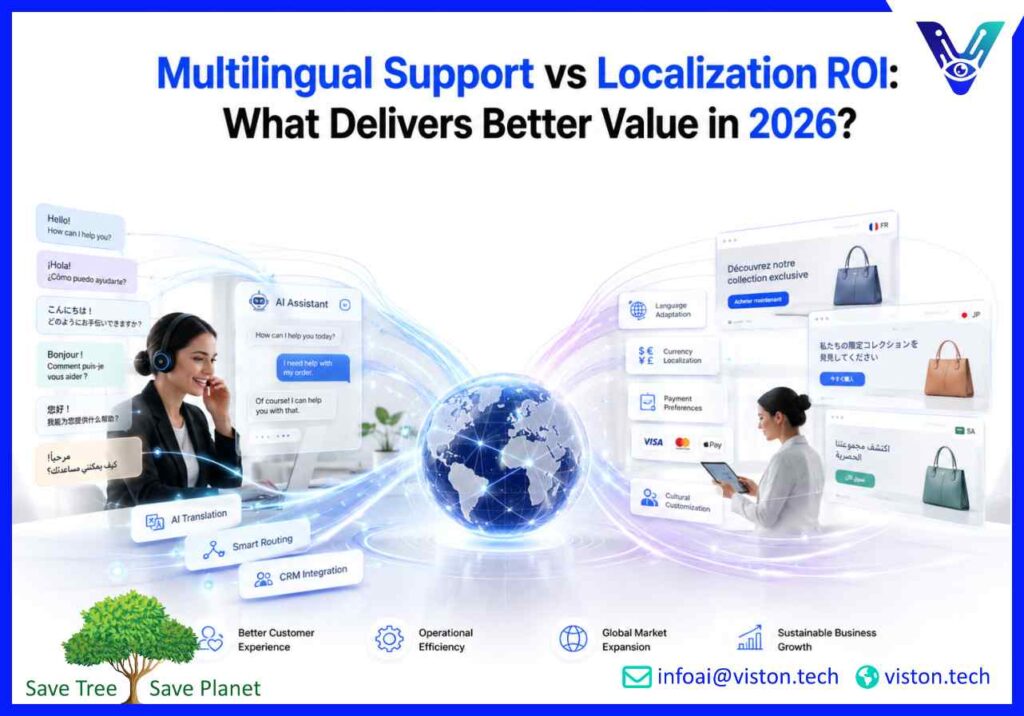
Multilingual Support vs Localization ROI: What Delivers Better Value in 2026?
Comparing multilingual support vs localization ROI is not simply a choice between two language services. Multilingual support improves how customers receive help, while localization adapts the wider product and buying experience to a specific market. Understanding their different costs, outcomes, and measurement models helps businesses invest in the right capability at the right stage.
Multilingual Support vs Localization: What Is the Business Difference?
Multilingual support and localization are closely connected, but they solve different business problems.Multilingual support enables customers to ask questions, report issues, complete service requests, and receive guidance in their preferred language. It may cover live chat, AI chatbots, email, voice, messaging platforms, help centres, onboarding assistance, technical support, and human-agent escalation.Localization adapts a product, service, website, application, or commercial experience for a particular market. It goes beyond translating words. Effective localization may adjust currencies, date formats, payment methods, units of measurement, imagery, terminology, legal information, product examples, navigation, search behaviour, and cultural references.
Multilingual support focuses on customer interaction
The main purpose of multilingual support is to remove language barriers during the customer relationship. It helps users obtain answers, solve problems, understand processes, and complete actions without depending on English or another default business language.Its value is especially visible after a prospect becomes a customer. A company may successfully attract buyers through localized advertising, but those buyers can still become frustrated when billing questions, account problems, returns, technical issues, or cancellation requests are handled in an unfamiliar language.
Localization focuses on market relevance
Localization improves how naturally a product or commercial experience fits a particular market. It supports discovery, comprehension, trust, usability, and conversion before and during the purchase journey.For example, translating a pricing page is not always enough. Buyers may also expect familiar currencies, tax information, local payment methods, regionally appropriate plan descriptions, and terms that reflect how people in that market actually search for the service.
They are complementary rather than interchangeable
A localized product without multilingual support may acquire customers but struggle to retain them. Multilingual support without product localization may resolve questions efficiently, yet support teams may continue receiving avoidable inquiries caused by unclear pricing, unsuitable onboarding, unfamiliar terminology, or regionally confusing workflows.The strongest global customer experience connects both capabilities. Localization reduces unnecessary friction across the product and buying journey. Multilingual support resolves the questions and exceptions that remain.
How Multilingual Support vs Localization ROI Is Created
The return on each investment comes from a different part of the customer journey. Multilingual support ROI is usually tied to service efficiency, customer satisfaction, retention, and support capacity. Localization ROI is more commonly connected to market entry, acquisition, conversion, activation, and regional revenue.
How multilingual support generates ROI
Multilingual support can create financial value by reducing the effort required to serve customers across several languages. AI-powered language detection, multilingual knowledge retrieval, automated responses, intelligent routing, and translated agent assistance can help a business expand language coverage without building a completely separate support operation for every market.Potential returns include:
Lower cost per resolved conversation
Faster first-response and resolution times
Higher self-service and first-contact resolution rates
Fewer repeat contacts caused by misunderstanding
Reduced dependence on language-specific staffing
Better customer satisfaction across language groups
Lower churn associated with poor service experiences
Extended support availability across time zones
The ROI becomes stronger when multilingual support is connected to business systems. A chatbot that only translates messages may provide convenience, but a support assistant integrated with CRM, order management, billing, ticketing, and knowledge systems can help customers complete real tasks.
How localization generates ROI
Localization creates value by making a business easier to discover, understand, trust, and buy from in a target market. It can improve the commercial performance of websites, landing pages, applications, onboarding flows, product interfaces, documentation, and marketing campaigns.Potential returns include:
Higher regional website conversion rates
Improved trial activation and product adoption
Better visibility for local-language search queries
Lower checkout or registration abandonment
Faster entry into new geographic markets
Higher revenue from targeted language segments
Fewer refunds caused by misunderstood product information
Stronger customer trust and brand relevance
Localization often requires a larger initial commitment because it may involve product design, engineering, content management, legal review, regional research, and continuous translation workflows. However, it can influence a broader section of the revenue journey than support alone.
Which one normally produces faster returns?
Multilingual support can produce faster operational results when a business already receives meaningful ticket volume from customers who speak different languages. Automating frequent questions or improving multilingual routing can quickly reduce workload and response delays.Localization may take longer to show a measurable return because it is often linked to market development. The business may need time to generate local traffic, establish distribution, refine pricing, and build regional demand.Neither pattern is guaranteed. The return depends on existing customer volume, market readiness, product complexity, language demand, implementation quality, and the company’s ability to measure outcomes accurately.
How to Measure Multilingual Support and Localization ROI
A useful ROI comparison requires more than reviewing translation costs. Businesses should measure the total investment, establish a baseline, and connect language improvements to operational or commercial outcomes.A practical ROI calculation compares the financial value created with the total cost of implementation and ongoing operation. Costs should include technology, integration, content preparation, human review, quality assurance, maintenance, analytics, and internal staff time.
KPIs for multilingual support ROI
Support leaders should compare performance by language rather than relying only on an overall average. A chatbot may perform well in a high-resource language while producing more fallbacks, escalations, or inaccurate answers in another.Relevant multilingual support KPIs include:
Cost per contact and cost per resolved case
First-response time by language
Average resolution time
First-contact resolution rate
Self-service resolution or ticket-deflection rate
Fallback and escalation rate
Customer satisfaction by language
Repeat-contact rate
Language-specific churn and retention
Knowledge accuracy and translation quality
Businesses should also examine human handover quality. When automation cannot resolve an issue, the receiving agent should have the customer’s language, intent, conversation history, account context, and attempted resolution. A poorly managed handover can remove much of the efficiency gained through automation.
KPIs for localization ROI
Localization performance should be measured by market, language, channel, and funnel stage. Comparing localized pages with an English-language global average can be misleading because traffic quality, competition, pricing, and brand recognition may differ between markets.Relevant localization KPIs include:
Organic traffic from local-language searches
Regional landing-page conversion rate
Registration, trial, or checkout completion
Customer acquisition cost by market
Activation and onboarding completion
Revenue per localized market
Renewal, retention, and expansion revenue
Refund or cancellation rates
Time required to launch localized updates
Translation and localization cost per content unit
Use controlled pilots instead of broad assumptions
A business does not need to localize every product screen or automate every support interaction immediately. A more reliable approach is to select one or two high-potential languages, establish baseline metrics, and run a controlled pilot.For multilingual support, the pilot might cover the highest-volume support intents in one additional language. For localization, it might include a regional landing page, pricing experience, checkout flow, and onboarding sequence.The results should be compared over a meaningful period, with attention to ticket seasonality, campaign activity, traffic source, customer segment, and product changes. This creates a more credible business case for expansion.
How to Decide Where to Invest First in 2026
The right sequence depends on where language friction is currently damaging the customer journey. Businesses should invest first in the capability connected to the clearest demand, cost, or revenue opportunity.
Prioritize multilingual support when service demand already exists
Multilingual support should usually come first when customers from several language groups are already purchasing, submitting tickets, abandoning conversations, or relying on agents to translate manually.It is also a strong priority when:
Support volume is growing faster than the team
Customers repeatedly request assistance in specific languages
Response and resolution times vary significantly by language
The business provides a digital product that can already be used globally
Support costs are limiting international growth
Twenty-four-hour coverage is commercially important
Prioritize localization when acquisition is the main barrier
Localization should often come first when the business has identified a promising market but prospects struggle to understand, evaluate, or purchase the product.Warning signs include low regional conversion rates, high checkout abandonment, weak local-language search visibility, poor onboarding completion, and frequent presales questions about pricing, features, contracts, or payment options.
Use a combined model for strategic markets
For a high-priority market, the best approach is often a coordinated minimum viable localization and support launch. The company can localize the most important buying and onboarding experiences while providing multilingual assistance for common questions and high-value workflows.In 2026, AI can reduce the cost of this combined approach, but automation still requires governance. Teams should evaluate accuracy by language, maintain approved terminology, protect customer data, test regional workflows, and use human review for sensitive, regulated, or high-impact conversations.The objective should not be to offer the maximum possible number of languages. It should be to provide reliable experiences in the languages that materially affect growth, service quality, and customer retention.
How Viston AI Supports Measurable Multilingual Customer Experiences
Viston AI’s Multilingual Support service is relevant to businesses evaluating multilingual support vs localization ROI because it focuses on the operational layer where customers ask questions, complete service requests, and interact with business systems.Its multilingual AI chatbot capabilities combine natural language processing, language-aware conversational experiences, intelligent routing, knowledge management, and omnichannel deployment. These systems can support interactions across websites, mobile applications, messaging channels, SMS, and voice-based environments while maintaining centralized control over approved information and conversation flows.Viston AI also supports integration with CRM platforms, knowledge bases, transaction systems, analytics tools, and other business applications. This is important for ROI measurement because support value depends on completed outcomes, not translated messages alone. Businesses need to know whether customers resolved an issue, received an accurate answer, updated an account, completed a transaction, or reached the correct human specialist.Its approach includes language-specific performance monitoring, escalation design, security controls, testing, and continuous optimization. For organizations operating across markets, these capabilities can help identify which languages deserve broader automation, where human review remains necessary, and whether multilingual support is improving service efficiency and customer experience. The result is a practical foundation for connecting language accessibility with measurable operational and commercial outcomes.
Frequently Asked Questions
What is the main difference between multilingual support and localization?
Multilingual support helps customers communicate with a business and receive assistance in different languages. Localization adapts the product, content, pricing, interface, and commercial experience to the expectations of a particular market.
Does multilingual support have a better ROI than localization?
Not automatically. Multilingual support may deliver faster operational savings when language-related ticket volume already exists. Localization may create greater long-term revenue value when a business is entering or growing within a strategically important market.
Can a business offer multilingual support without fully localizing its product?
Yes. Businesses can provide multilingual chat, email, chatbot, or help-centre support before completing full product localization. However, unresolved product-level language friction may continue to generate support requests and reduce adoption.
Which languages should a company prioritize first?
Prioritize languages using customer volume, ticket demand, regional revenue, growth potential, support cost, conversion data, and operational risk. Language selection should be based on measurable demand rather than total speaker population alone.
How long does it take to measure language-service ROI?
Operational improvements such as faster responses or lower ticket costs may appear relatively quickly. Localization-related revenue and retention changes usually require a longer measurement period because market demand, acquisition campaigns, and customer lifecycles influence the results.
How can Viston AI support multilingual ROI measurement?
Viston AI can connect multilingual conversational systems with knowledge, CRM, workflow, and analytics platforms. This helps businesses monitor language-specific resolution, escalation, satisfaction, automation, and operational performance rather than measuring translation activity alone.
Conclusion
Multilingual support vs localization ROI should be evaluated according to where language friction affects the business. Localization improves market relevance, acquisition, conversion, and product adoption. Multilingual Support improves service access, resolution quality, efficiency, and retention. Businesses with existing international customers may gain faster value from multilingual support, while companies entering a new market may need localization first. In many cases, a focused combination delivers the strongest outcome. Viston AI provides multilingual conversational and integration capabilities that can help organizations turn language coverage into a measurable, scalable customer-service operation.