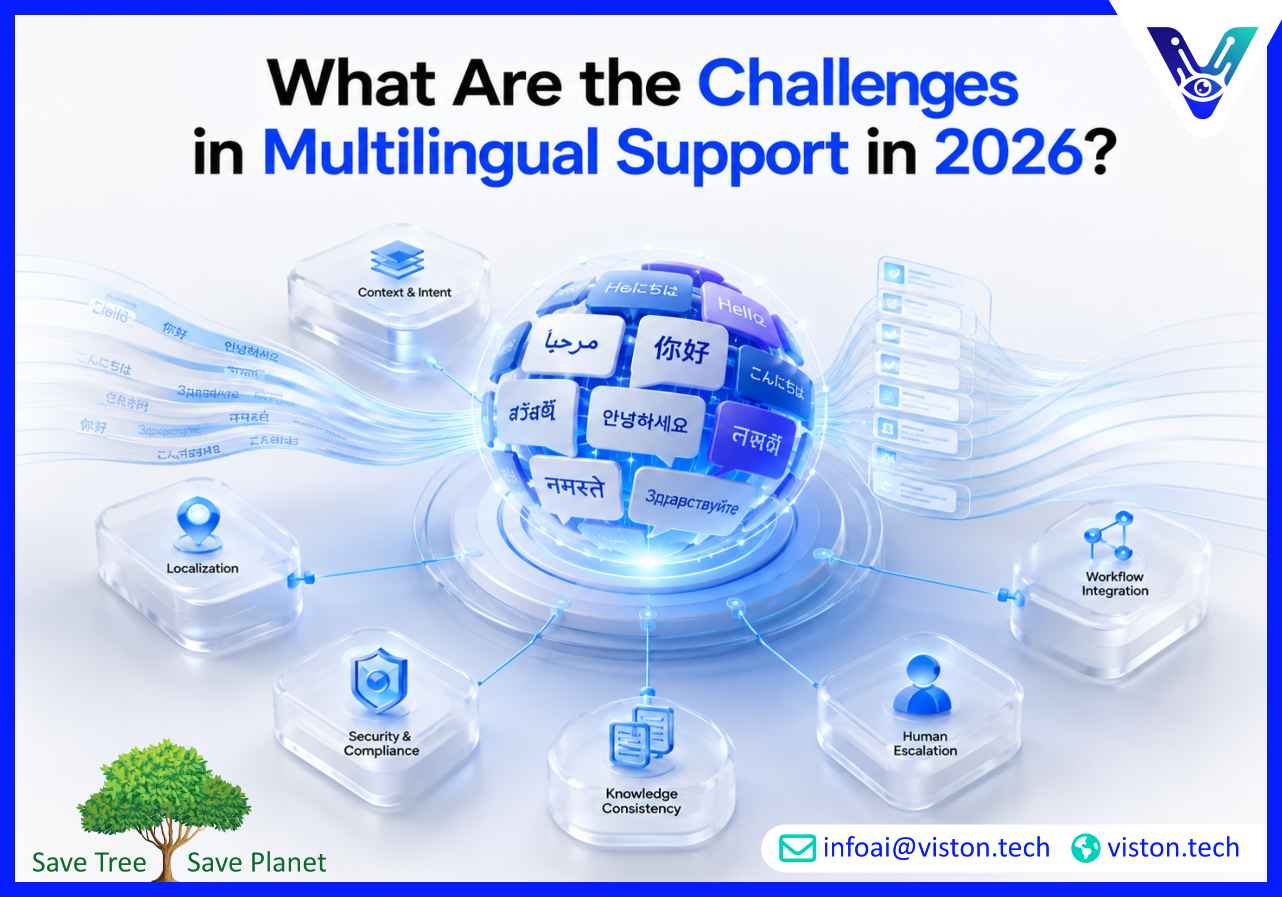
What Are the Challenges in Multilingual Support in 2026?
Multilingual support challenges extend far beyond translating customer messages. Businesses must preserve meaning, accuracy, tone, security, and service consistency across languages while managing costs, integrations, human escalation, and changing customer expectations. Addressing these issues requires a structured operating model rather than relying on standalone translation tools.
Why Multilingual Support Is More Complex Than Translation
Multilingual support is the ability to deliver dependable customer service in more than one language across channels such as web chat, email, mobile applications, messaging platforms, voice assistants, help centres, and support portals. The objective is not simply to convert words from one language into another. Customers must receive answers that are accurate, contextually appropriate, operationally useful, and consistent with company policies.This becomes difficult because languages do not map perfectly to one another. A sentence that is grammatically correct may still sound unnatural, overly formal, culturally insensitive, or unclear to a native speaker. Product terminology, technical vocabulary, humour, idioms, abbreviations, and regional expressions can introduce additional ambiguity.Customer conversations also contain more than language. They contain intent, urgency, sentiment, account context, previous interactions, commercial rules, and expectations about how the issue should be resolved. A multilingual support system must understand all these factors before producing or translating a response.
Translation and multilingual support solve different problems
Translation converts content between languages. Multilingual customer support combines translation with service operations. It must manage knowledge retrieval, customer identification, workflow completion, access permissions, ticket creation, escalation, reporting, and quality control.For example, translating a question about a delayed order may be straightforward. Resolving it may require the support system to identify the customer, retrieve the correct order, interpret the relevant delivery policy, check live shipment information, and explain the next steps in the customer’s preferred language.When multilingual support is treated only as a translation task, businesses frequently experience inconsistent answers, slow resolution, repeated questions, poor escalation, and inaccurate policy explanations.
Language quality varies by use case
A multilingual system may perform well with common product questions but struggle with technical troubleshooting, contractual terms, complaints, refund negotiations, or industry-specific language. Performance may also vary significantly between widely represented languages and lower-resource languages for which fewer reliable training examples are available.Businesses should therefore evaluate quality by language and use case rather than assuming that one successful deployment will perform equally well everywhere.
Core Multilingual Support Challenges Businesses Face
The most significant multilingual support challenges involve linguistic accuracy, contextual understanding, knowledge consistency, and cultural adaptation. These issues directly influence resolution rates, customer trust, operational workload, and the ability to expand into new markets.
Maintaining meaning and accuracy
Literal translation can change the intended meaning of a response. This is particularly risky when dealing with pricing, warranties, subscription terms, returns, safety instructions, financial information, medical terminology, or technical procedures.The system must distinguish between words that have several meanings and choose the correct interpretation based on the conversation. It must also avoid adding details that do not appear in the approved source content. A fluent response is not valuable when the information is wrong.
Understanding dialects and regional variations
Languages often contain regional spelling, vocabulary, tone, and formality differences. Spanish used in Spain may differ from Spanish used in Mexico or Argentina. French customer expectations may vary between France, Canada, Belgium, and parts of Africa. English itself changes across regions and industries.Supporting a language without considering regional variation can make responses feel generic or confusing. Businesses need localization rules that account for terminology, dates, currencies, units, address formats, regulatory language, and regional processes.
Handling code-switching and mixed-language conversations
Customers frequently combine languages within one message or conversation. They may write most of a sentence in one language while using English product names, technical terms, or abbreviations. They may also change languages after the conversation begins.These code-switched conversations remain difficult for many automated systems. Incorrect language detection can cause the chatbot to respond in the wrong language, misunderstand the user’s intent, or send the conversation into an unsuitable workflow.A reliable multilingual support system should detect language at message level, preserve product terminology, understand mixed scripts where possible, and allow customers to select or change their preferred language.
Preserving brand voice and appropriate tone
A brand may want to sound professional, friendly, reassuring, concise, or technically precise. That voice must remain recognizable across languages without forcing identical sentence structures.Tone also changes according to the situation. A casual response may work for a product question but appear insensitive during a complaint. Formality expectations differ between cultures, and direct translations of polite expressions may sound unnatural.Businesses need approved tone guidelines, localized examples, terminology glossaries, and quality review processes for each priority language.
Keeping multilingual knowledge consistent
Support content changes continuously. Products, prices, policies, workflows, interfaces, service areas, and compliance requirements may be updated in the primary language while translated versions remain unchanged.This creates a serious knowledge management problem. Customers asking the same question in different languages may receive conflicting answers. Agents may also rely on outdated articles because it is unclear which version is authoritative.Every multilingual knowledge base should have designated content owners, source-of-truth documents, review dates, version control, and a process for updating all affected languages when business information changes.
Operational, Technology, and Compliance Challenges
Even strong language quality does not guarantee effective multilingual service. Businesses must also connect conversations with customer records, support workflows, security controls, and human teams. These operational requirements become increasingly complex as language and channel coverage expands.
Scaling support without losing quality
Adding languages increases the number of conversations, knowledge variations, tests, routing rules, and performance reports that teams must manage. Hiring native-speaking agents for every language and time zone can be expensive, but relying entirely on automation may create quality and trust risks.A practical model normally combines localized self-service, AI-assisted automation, translation support for agents, and human specialists for sensitive or complex situations. Businesses should expand language coverage according to verified demand rather than launching many languages with limited quality assurance.
Integrating multilingual support with business systems
Customers expect the support channel to recognize their account, order, booking, subscription, claim, or previous ticket regardless of language. This requires integration with CRM platforms, helpdesk systems, ecommerce software, knowledge bases, scheduling tools, payment systems, and internal workflows.Integration errors can cause duplicate records, incorrect ticket routing, missing conversation history, failed transactions, or incomplete handovers. Multilingual data can create additional problems when fields, labels, names, addresses, and free-text notes are handled inconsistently.The support architecture should preserve the original customer message, translated content, detected language, customer context, workflow outcome, and escalation history. This gives agents and quality teams a reliable audit trail.
Designing effective human escalation
Automated systems should not attempt to resolve every conversation. Complaints, cancellations, legal requests, security concerns, payment disputes, urgent cases, and emotionally sensitive issues may require human judgement.The challenge is identifying the correct moment to escalate and finding an appropriate agent. When a fluent agent is unavailable, the receiving employee should still receive a clear translated summary, original message, detected intent, customer information, previous actions, and recommended next step.Poor escalation forces customers to repeat themselves and weakens confidence in the entire support experience.
Protecting privacy and meeting compliance expectations
Multilingual conversations may contain personal, financial, medical, employment, contractual, or identity information. Businesses must understand where this information is processed, which tools can access it, how long it is retained, and whether it crosses regional borders.Data minimization, role-based access, encryption, audit logging, retention controls, and vendor assessment should apply across every language. Businesses must also ensure that legal notices, consent requests, privacy explanations, and mandatory disclosures are translated accurately.Organizations serving users in the European Union should also prepare for AI transparency obligations that become applicable on 2 August 2026. Where an AI chatbot is used, customers should be appropriately informed that they are interacting with an automated system.
How to Overcome Multilingual Support Challenges
Businesses can reduce multilingual support risks by controlling scope, improving source content, combining automation with human oversight, and measuring performance separately for every priority language.
Prioritize languages using customer evidence
Review customer locations, browser settings, sales enquiries, support tickets, website searches, abandoned conversations, and revenue opportunities. Select languages that represent real service demand or strategic market value.A phased rollout is usually safer than launching broad coverage immediately. Begin with high-volume languages and well-documented enquiries, then expand after the operating model has been tested.
Create an approved multilingual knowledge foundation
Before automating support, improve the source material. Remove duplicated articles, resolve conflicting policies, simplify unclear instructions, and identify authoritative business documents.Create glossaries for product names, technical terms, prohibited translations, legal wording, and preferred brand expressions. Localized knowledge should be reviewed by people who understand both the language and the business context.
Automate low-risk, repeatable workflows first
Suitable starting points often include order tracking, opening hours, appointment confirmations, password guidance, account access, standard product information, subscription instructions, and basic troubleshooting.High-risk or highly variable enquiries should remain under stronger human supervision. Automation boundaries should be based on potential business and customer impact, not only conversation volume.
Test with real customer language
Polished translated test questions do not reflect how customers actually communicate. Testing should include spelling errors, informal wording, regional vocabulary, abbreviations, mixed languages, incomplete sentences, and multi-turn conversations.Businesses should also test whether the system retrieves the correct knowledge, preserves critical terminology, asks useful clarifying questions, and escalates when confidence is low.
Measure performance by language
Overall performance averages can conceal weak results in individual languages. Track intent recognition, fallback rate, resolution rate, escalation rate, response time, customer satisfaction, translation corrections, workflow success, and repeat contact separately for each language.Review failed conversations regularly. They reveal missing knowledge, unsupported dialects, poor translations, integration problems, and new customer intents. Continuous improvement should involve support leaders, language reviewers, subject matter experts, technology teams, and compliance stakeholders.
How Viston AI Helps Businesses Address Multilingual Support Challenges
Viston AI provides Multilingual AI Chatbot Support for organizations that need to manage customer conversations across languages, channels, and operational systems. Its service capabilities include language-aware intent recognition, real-time translation and localization, omnichannel deployment, intelligent routing, performance analytics, and integration with business applications.These capabilities address several common multilingual support challenges. Language and intent detection can help route conversations correctly, while localized knowledge and configurable responses support greater consistency across markets. Integration with CRM platforms, knowledge bases, transaction systems, and support tools allows conversations to use relevant customer and workflow context rather than functioning as isolated translations.Viston AI also supports escalation workflows and language-specific performance monitoring. These functions are important for businesses that need to identify underperforming languages, review unresolved conversations, and transfer complex cases to human teams with useful context.Its multilingual support approach is relevant to ecommerce, SaaS, financial services, healthcare, manufacturing, hospitality, education, logistics, and other organizations serving diverse or international audiences. Rather than treating language as a separate interface feature, the service connects multilingual communication with automation, knowledge management, routing, analytics, and continuous optimization. This can help businesses expand language coverage while maintaining greater control over service quality, scalability, security, and customer experience.
Frequently Asked Questions
What is the biggest challenge in multilingual support?
The biggest challenge is maintaining accurate and consistent meaning across languages. A response can be grammatically fluent but still contain incorrect policy information, unsuitable terminology, cultural errors, or missing customer context.
Why is automatic translation alone not enough for customer support?
Automatic translation converts language but does not automatically resolve the customer’s problem. Effective multilingual support also requires approved knowledge, account context, workflow integration, quality controls, escalation rules, and culturally appropriate communication.
How can businesses maintain consistent support across languages?
Businesses should use authoritative source content, terminology glossaries, localization guidelines, version control, language-specific testing, and defined content ownership. Performance should also be monitored separately for every supported language.
Should a company hire native-speaking agents for every language?
Not always. Many routine enquiries can be supported through localized self-service, multilingual AI chatbots, and agent translation tools. Native or fluent specialists remain valuable for complaints, sensitive cases, complex negotiations, regulated information, and quality assurance.
How should multilingual support performance be measured?
Track resolution rate, fallback rate, customer satisfaction, response time, escalation rate, repeat contact, workflow completion, translation corrections, and human handover quality for each language and channel.
How can Viston AI support multilingual customer service?
Viston AI supports multilingual customer service through language-aware chatbot capabilities, real-time translation and localization, omnichannel deployment, intelligent routing, business-system integration, analytics, and continuous performance optimization.
Conclusion
Multilingual support challenges involve far more than converting customer messages between languages. Businesses must manage accuracy, regional variation, code-switching, cultural expectations, knowledge consistency, integrations, privacy, human escalation, and language-specific quality control. A successful Multilingual Support strategy starts with priority languages, trusted source content, carefully selected automation, realistic testing, and continuous measurement. Viston AI offers relevant multilingual chatbot, integration, routing, localization, and analytics capabilities for organizations seeking to build scalable customer service without losing control over accuracy, security, or customer experience.