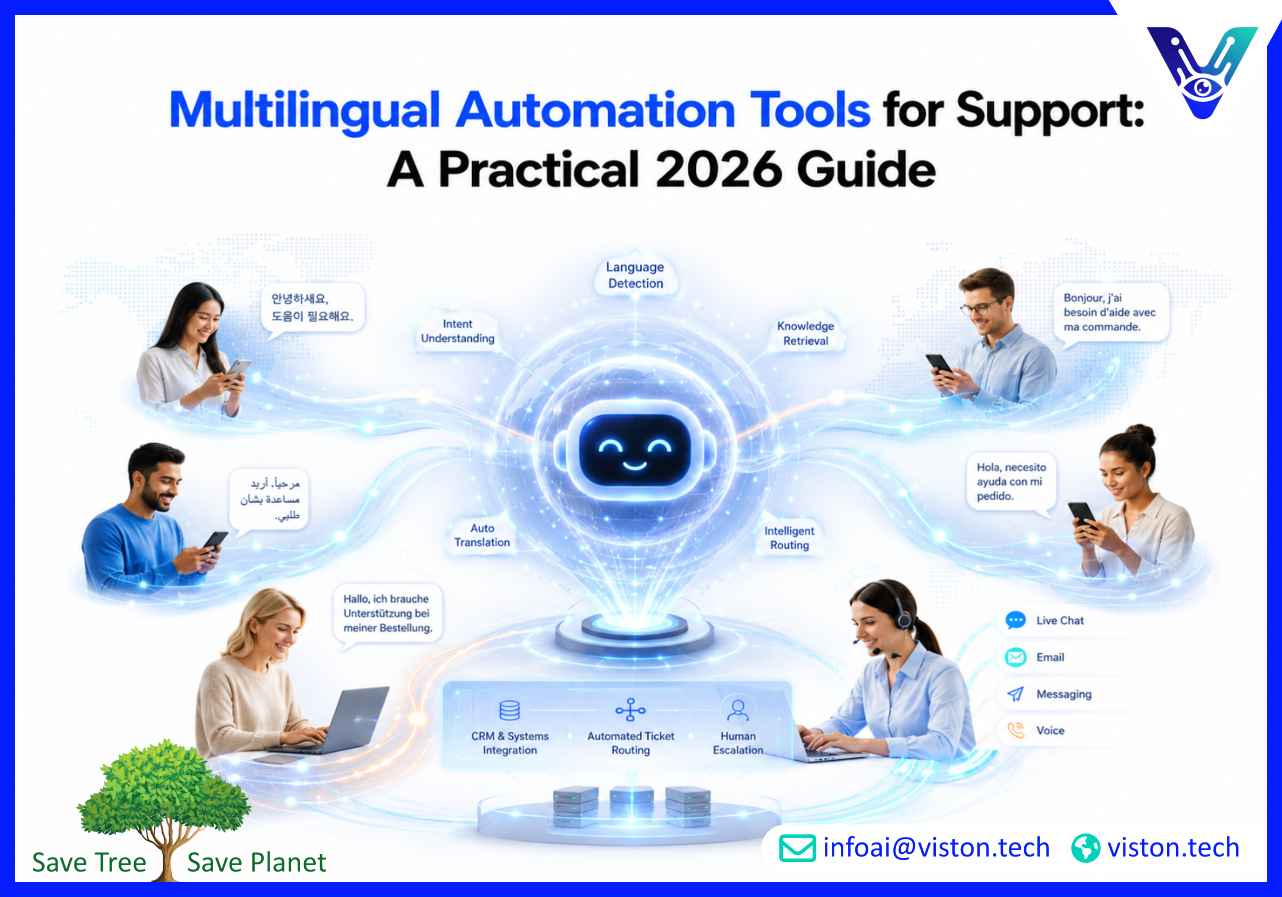
Multilingual Automation Tools for Support: A Practical 2026 Guide
Multilingual automation tools for support help businesses serve customers across languages without creating separate workflows for every market. In 2026, the strongest solutions combine conversational AI, translation, knowledge management, intelligent routing, workflow automation, and human escalation to deliver faster, more consistent customer experiences at scale.
What Multilingual Automation Tools for Support Actually Do
Multilingual support automation is the use of AI, language technology, and connected workflows to understand customer requests, provide relevant answers, complete routine tasks, and route complex cases in the customer’s preferred language.It goes beyond translating an English response into another language. Effective automation must understand intent, context, product terminology, customer history, regional expectations, and the operational steps required to resolve the request.For example, a customer may ask about a delayed order in Spanish through WhatsApp, request a refund in French by email, or report a technical issue in German through a website chatbot. A capable multilingual support system should identify the language, understand the problem, retrieve approved information, perform permitted actions, and escalate the case when human judgment is needed.
Core capabilities of multilingual support automation
Most multilingual automation environments combine several technologies rather than relying on one standalone tool:
Automatic language detection
Machine translation and language generation
Natural language processing for intent and entity recognition
AI chatbots and virtual assistants
Multilingual knowledge base search
Automated ticket classification and routing
Agent-assist translation and response suggestions
CRM, helpdesk, ecommerce, and order system integrations
Workflow automation for refunds, bookings, updates, and follow-ups
Language-specific reporting and quality monitoring
These capabilities may be delivered through customer service platforms, chatbot frameworks, translation APIs, contact center software, workflow automation systems, or custom AI solutions. The right combination depends on support volume, channel mix, languages, business processes, risk level, and integration requirements.
Automation should support both customers and agents
Some tools automate customer conversations directly. Others help human agents work more efficiently by translating incoming messages, summarizing conversations, suggesting answers, retrieving knowledge, and drafting replies in the appropriate language.Many businesses benefit from a hybrid model. Routine, predictable requests can be automated, while sensitive, unusual, or high-value conversations are transferred to a qualified agent with the full translated conversation history. This approach improves scalability without removing human oversight where it matters.
Which Multilingual Support Processes Can Be Automated?
Multilingual automation tools for support are most valuable when they address clearly defined service workflows. Attempting to automate every conversation at once often creates poor responses, weak escalation, and inconsistent customer experiences.A better approach is to begin with high-volume, repeatable requests that have approved answers and predictable outcomes.
Frequently asked questions and knowledge retrieval
AI assistants can respond to questions about products, services, opening hours, delivery policies, account access, subscription terms, warranty conditions, and troubleshooting procedures. They can search approved knowledge sources and deliver answers in the user’s language.The quality of these answers depends heavily on the underlying content. A chatbot cannot provide reliable multilingual support when the knowledge base is outdated, contradictory, incomplete, or written without clear source ownership.
Ticket classification and routing
Automation can identify the customer’s language, issue type, urgency, sentiment, account tier, and required department. It can then assign the ticket to the correct queue or specialist.This reduces manual triage and prevents cases from being delayed because they entered the wrong regional or language-specific queue. Routing rules can also account for service-level agreements, agent availability, subject expertise, and local working hours.
Customer account and order support
When connected to authorized business systems, multilingual assistants can help customers check order status, update contact details, retrieve invoices, confirm appointments, report missing items, reset passwords, or review subscription information.These workflows require more than translation. The automation must authenticate users, retrieve the correct data, apply business rules, record actions, and explain the result clearly in the requested language.
Returns, refunds, and service requests
Automation can collect required information, validate basic eligibility, create a case, generate a return instruction, schedule a collection, or route an exception to a human team. Clear guardrails are important because refund rules, contract terms, consumer rights, and approval thresholds may vary by market.
Agent assistance
Support agents can use multilingual automation to translate messages, generate concise case summaries, identify intent, find approved answers, and draft localized replies. This allows a central support team to handle more languages while maintaining visibility and control.Agent-assist tools should make source information available and allow staff to review responses before sending them, particularly for financial, legal, healthcare, contractual, or emotionally sensitive matters.
Voice and omnichannel support
Modern multilingual support can extend across web chat, email, messaging apps, social channels, mobile applications, SMS, and voice assistants. Customers may begin a conversation in one channel and continue it in another, so context should remain available across the journey.Businesses should avoid implementing separate language tools for every channel without a shared knowledge and reporting layer. Fragmented systems create inconsistent answers, duplicate customer records, and unreliable escalation.
How to Evaluate Multilingual Support Automation Tools
Language count alone is not a meaningful basis for choosing a platform. A tool may claim to support many languages while performing poorly with technical terminology, regional variations, code-switching, informal phrasing, or complex workflows.Evaluation should reflect the conversations, risks, systems, and service standards of the business.
Language accuracy and intent understanding
Test the platform using real customer language rather than carefully written demonstration questions. Include spelling errors, colloquial expressions, product names, abbreviations, mixed-language messages, and region-specific terminology.The system should understand what the customer wants, not simply translate individual words. Intent recognition should also be tested separately for every priority language because performance may vary significantly.
Knowledge grounding and source control
Support automation should answer from approved knowledge sources and follow clear rules when information is missing. Buyers should assess how the system connects to help centres, policy documents, product data, internal guides, and customer records.Important questions include:
Can content owners control which sources the AI uses?
Can outdated documents be removed quickly?
Does the tool show where an answer came from?
Can different users access different information?
How are conflicting sources handled?
Integration depth
A multilingual chatbot that only provides general answers may be useful, but its operational value is limited. More advanced automation should connect with the systems required to resolve customer requests.Relevant integrations may include CRM platforms, helpdesk software, ecommerce systems, booking applications, order management tools, payment systems, identity services, knowledge bases, analytics platforms, and communication channels.Buyers should confirm whether integrations are native, API-based, middleware-supported, or custom-built. They should also test how the system responds when an integration fails or returns incomplete data.
Human handover and escalation
A reliable system must recognize when automation is no longer appropriate. Escalation may be required because the customer is dissatisfied, the request is sensitive, confidence is low, identity cannot be confirmed, or the workflow requires approval.The human agent should receive the original message, translated content, conversation summary, detected intent, customer information, actions already attempted, and relevant system records. Customers should not have to repeat the full issue after transfer.
Security, privacy, and governance
Multilingual conversations may contain personal, financial, commercial, employee, or account information. Businesses need to understand where data is processed, how long it is retained, whether it is used for model training, and which employees or providers can access it.Evaluation should cover encryption, access controls, audit logs, data minimization, retention rules, regional hosting requirements, consent processes, and applicable regulatory obligations. Governance should also define who approves knowledge, monitors performance, reviews failed conversations, and authorizes new automated actions.
Analytics and language-level reporting
Performance must be measured by language, channel, intent, workflow, and customer segment. A strong overall resolution rate can hide poor performance in a specific language or market.Useful metrics include intent recognition accuracy, automated resolution rate, fallback rate, escalation rate, response time, customer satisfaction, workflow completion, translation corrections, repeat contact, and human review rate.
How to Implement Multilingual Support Automation Successfully
Successful implementation begins with service design, not software selection. The business must decide which conversations should be automated, which information sources are trusted, which actions the system may perform, and when human intervention is mandatory.
Prioritize languages using real demand
Start with customer volume, revenue exposure, growth plans, unresolved ticket demand, and service risk. The most valuable language may not be the one with the largest number of users. A smaller market with high-value accounts or long response delays may offer a stronger business case.
Map priority support intents
Identify the most common reasons customers contact support in each language. Group them by volume, complexity, risk, automation readiness, and required systems.Good initial use cases often include order tracking, account guidance, appointment changes, basic troubleshooting, delivery questions, product information, lead capture, and ticket creation. Sensitive complaints, contract disputes, exceptional refunds, and regulated advice usually require stronger controls.
Prepare multilingual knowledge properly
Businesses should not assume that an English knowledge base will automatically produce excellent support in every language. Product terms, policies, units, cultural expectations, tone, legal wording, and examples may need localization.Create a terminology glossary for product names, approved translations, industry terms, prohibited wording, and escalation phrases. Assign content owners and review dates so the knowledge base remains current.
Pilot before expanding
Begin with a limited group of languages, intents, or channels. Test the system using historical cases and controlled live traffic. Review incorrect answers, failed actions, escalations, customer feedback, and agent corrections.Expansion should depend on measured performance rather than a fixed launch date. Each new language should be treated as a service deployment with its own content review, testing, risk assessment, and monitoring plan.
Maintain continuous quality control
Multilingual automation needs ongoing improvement. Customer language evolves, products change, policies are updated, and new support issues appear.Teams should regularly review low-confidence responses, fallback queries, negative feedback, repeated contacts, incorrect routing, failed integrations, and agent-edited replies. These signals help improve knowledge content, intent design, prompts, workflow logic, and escalation thresholds.
How Viston AI Supports Multilingual Support Automation
Viston AI provides Multilingual Support services focused on AI-powered customer communication across languages, channels, and business workflows. Its capabilities include multilingual AI chatbots, natural language processing, language translation, intent recognition, omnichannel support, intelligent routing, escalation, analytics, and integration with business systems.This combination is relevant for organizations that need more than a basic translation widget. A support assistant may need to understand a customer request, retrieve approved knowledge, access CRM or order information, complete an automated step, and transfer the case with full context when human support is required.Viston AI also offers AI chatbot integration, enterprise chatbot development, voice-enabled assistants, workflow automation, language translation services, sentiment analysis, and NLP solutions. These connected capabilities can support customer-facing self-service as well as agent-assist use cases.For global businesses, the practical value lies in designing multilingual support around actual service processes. This includes language-specific intent testing, localized knowledge, system connectivity, controlled automation, human handover, performance monitoring, and continuous optimization. Viston AI’s service portfolio is aligned with organizations seeking a custom, integration-led approach rather than a disconnected set of translation and chatbot tools.
Frequently Asked Questions
What are multilingual automation tools for support?
They are AI and workflow technologies that understand, translate, route, answer, and process customer requests across multiple languages. They may include chatbots, translation systems, agent-assist tools, helpdesk automation, knowledge search, and business system integrations.
Can multilingual support be fully automated?
Routine and predictable requests can often be automated, but full automation is not appropriate for every case. Sensitive complaints, complex technical issues, regulated requests, unusual refunds, and high-value customer situations may require human review or direct escalation.
How are multilingual AI tools different from machine translation?
Machine translation converts content from one language to another. Multilingual support automation also identifies intent, retrieves business information, applies workflow rules, updates systems, routes tickets, and manages human handover.
Which support channels can multilingual automation cover?
It can support website chat, mobile applications, email, WhatsApp, SMS, social messaging, customer portals, contact centres, and voice assistants. Channel coverage depends on the platform and available integrations.
What should businesses test before selecting a tool?
Businesses should test language accuracy, intent recognition, product terminology, code-switching, knowledge retrieval, workflow completion, system integrations, escalation quality, security controls, and reporting by language.
Can Viston AI build multilingual support workflows around existing systems?
Viston AI offers multilingual chatbot support, AI chatbot integration, NLP, translation, workflow automation, and business system integration services. These capabilities are relevant to companies that need multilingual automation connected to their existing customer service operations.
Conclusion
Multilingual automation tools for support can help businesses serve international customers more consistently while reducing repetitive manual work. The strongest implementations combine language understanding, trusted knowledge, workflow automation, system integration, intelligent routing, and effective human escalation. Buyers should evaluate real performance in each priority language rather than relying on language-count claims alone. With clear use cases, localized content, careful governance, and continuous monitoring, multilingual support can become a scalable operational capability. Viston AI offers relevant Multilingual Support expertise for organizations planning connected, AI-enabled support across languages and channels.