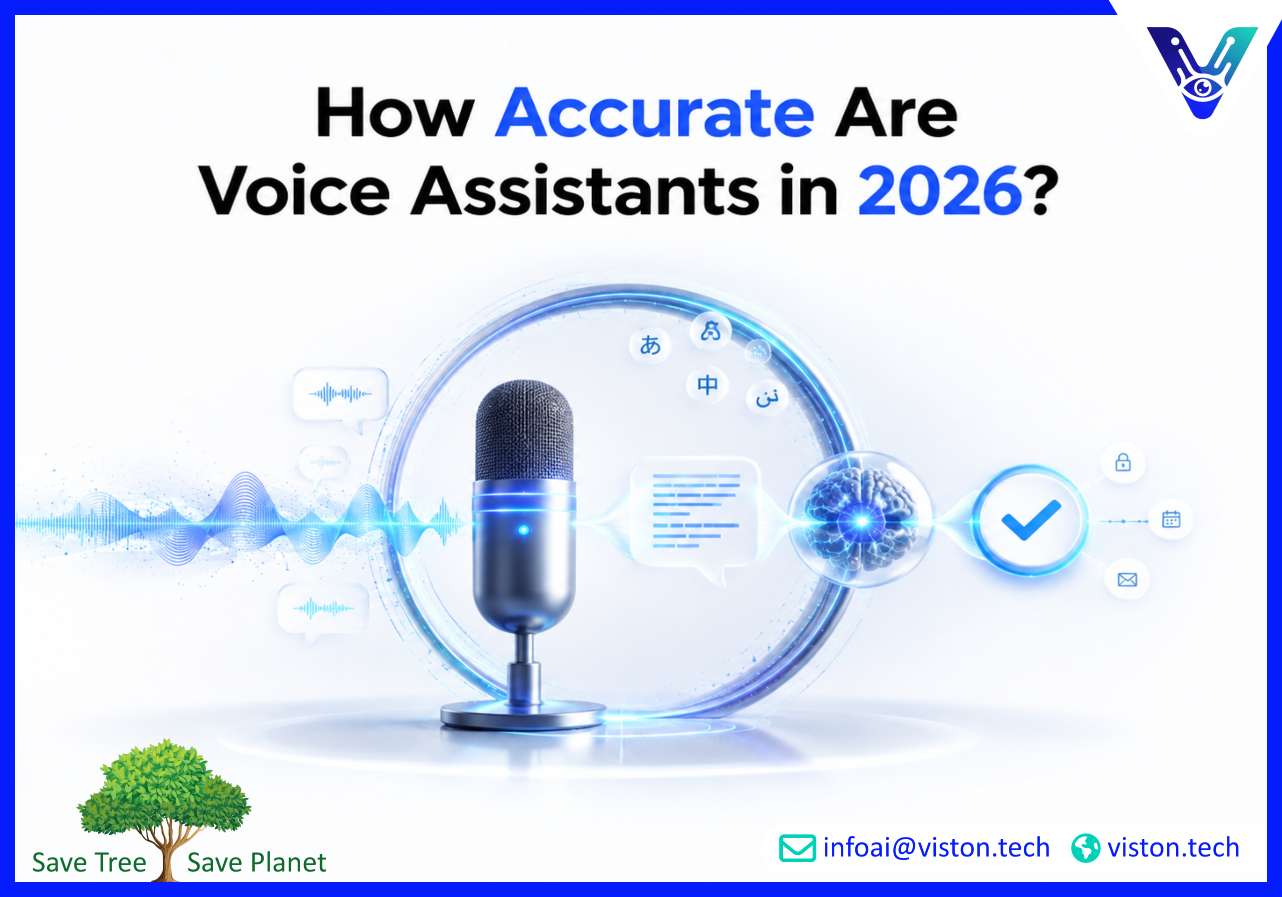
How accurate are voice assistants? In 2026, the honest answer is that accuracy depends on the task, audio conditions, language, business vocabulary, system integrations, and how performance is measured. Modern voice-enabled assistants can be highly reliable for well-defined workflows, but no responsible business should treat accuracy as a single universal percentage.
What Voice Assistant Accuracy Actually Means
Voice assistant accuracy is often discussed as though it were one measurement. In practice, a business voice assistant passes through several stages before it produces a useful outcome. An error at any stage can make the overall experience feel inaccurate, even when the speech transcript itself is correct.
Speech recognition accuracy
The first layer is automatic speech recognition, or ASR. It converts spoken audio into text. The standard technical measure is word error rate, which counts substitutions, deletions, and inserted words against a verified reference transcript. A lower word error rate indicates better transcription performance.Transcription accuracy matters, but it is not the same as business accuracy. A system might transcribe “cancel my renewal” correctly and still route the request to the wrong workflow. It might also mishear one critical item, such as an account number, product name, date, dosage, or monetary amount, while getting the rest of the sentence right.
Intent and entity accuracy
The next layer is whether the assistant understands what the speaker wants and extracts the required details. Intent accuracy measures whether a request is classified correctly. Entity accuracy measures whether the system identifies information such as names, dates, locations, product codes, order numbers, and quantities.
Answer and workflow accuracy
A voice assistant may understand the user correctly but still provide an incomplete answer, retrieve outdated information, or fail to complete an integrated process. Answer accuracy concerns whether the response is grounded in approved knowledge. Workflow accuracy concerns whether the assistant successfully performs the intended action in systems such as CRM, ERP, ticketing, scheduling, inventory, or payment platforms.Businesses should define accuracy as the share of interactions in which the system understands the request, uses correct information, completes the right action, and escalates safely when needed.
How Accurate Are Voice Assistants in Real Business Use?
Modern voice assistants can perform very well in controlled conditions: clear speech, a supported language, a good microphone, low background noise, familiar vocabulary, and a narrow task. Accuracy becomes less predictable when conversations involve phone compression, overlapping speakers, strong background noise, rapid speech, code-switching, regional dialects, unfamiliar names, or specialist terminology.A vendor’s headline recognition figure should not be treated as a guaranteed business result. Benchmarks reflect defined test conditions, while real users may call from vehicles, factory floors, public spaces, or weak mobile connections. The better question is how accurately the complete assistant performs across the organization’s actual users, channels, and workflows.
Accuracy varies by use case
Simple, repetitive requests are generally easier to automate accurately. Examples include checking opening hours, confirming an appointment, tracking an order, resetting a password, capturing a lead, or routing a caller. These tasks have limited intent ranges and can be supported by clear prompts and validation rules.Open-ended conversations involving exceptions, complaints, regulated guidance, ambiguous policies, or multiple goals are harder. A reliable assistant should recognize uncertainty and transfer the interaction rather than improvise.
Accuracy varies across the voice pipeline
Many enterprise voice systems use a streaming pipeline that converts speech to text, sends the text to a language or reasoning model, and converts the response back into speech. Current enterprise implementations depend heavily on streaming and pipelining to reduce delay while preserving conversational flow.Each component introduces quality requirements. Recognition must capture the words, the language layer must follow business rules, retrieval must use approved knowledge, integrations must return correct data, and speech output must be clear.
High accuracy does not mean zero risk
Even a system that succeeds on most interactions can create serious problems if the remaining errors affect high-risk tasks. A minor mistake in a restaurant booking is different from an error involving financial instructions, healthcare information, identity verification, or a safety-critical workflow.For sensitive use cases, businesses should apply confirmation steps, confidence thresholds, restricted actions, audit logs, and human review. Speech services themselves recommend higher confidence thresholds and trained human verification when accuracy is critical.
What Causes Voice Assistants to Make Mistakes?
Voice assistant errors rarely come from one source. They are usually caused by a combination of audio quality, language coverage, data quality, conversation design, system architecture, and weak operational controls.
Noise, channel quality, and speaker overlap
Background music, machinery, traffic, echoes, wind, and other speakers can hide important words. Telephone audio has a narrower frequency range than high-quality microphone audio, while unstable connections may introduce clipping or packet loss. Far-field devices also need to separate the target speaker from room noise.
Accents, dialects, languages, and code-switching
Recognition quality can vary across accents, dialects, speaking speeds, age groups, and languages. Multilingual conversations add another challenge because users may switch languages within one sentence or use English product terms inside another language.Modern speech platforms increasingly support automatic and multi-language identification, including streams where speakers alternate between supported languages. However, feature combinations and language coverage can differ, so multilingual performance must be tested rather than assumed.
Industry terminology and proper nouns
Generic speech models may struggle with brand names, technical abbreviations, product codes, medicines, street names, surnames, and internal terminology. Custom vocabularies and language models can improve recognition of domain-specific words, proper nouns, and acronyms when configured for the correct language.
Ambiguous conversation design
Sometimes the technology hears correctly, but the interaction is poorly designed. Long prompts, unclear choices, too many questions, or missing confirmation can make users respond unpredictably. The assistant may also interrupt too early, fail to handle pauses, or lose context after a correction.Good voice design uses short prompts, one question at a time, natural correction paths, interruption handling, and explicit confirmation for critical details.
Weak knowledge and integrations
A voice assistant cannot be accurate if its source information is outdated or its connected systems return inconsistent data. Duplicate CRM records, stale knowledge articles, broken APIs, missing permissions, and delayed synchronization can all produce incorrect responses.Operational accuracy therefore depends on data governance and integration monitoring. The assistant needs defined sources of truth, reliable authentication, error handling, and clear permissions.
How Businesses Should Test and Improve Voice Assistant Accuracy
The most reliable evaluation uses real representative data, not a single demonstration. Before deployment, businesses should create a test set that reflects actual callers, devices, languages, accents, background conditions, terminology, and task types. Personal or sensitive data should be minimized or anonymized during testing.
Measure more than word error rate
Word error rate is useful for comparing transcription quality, but business teams also need outcome-focused metrics. A practical evaluation framework should include:
Intent recognition accuracy
Entity extraction accuracy for critical details
Task completion rate
Correct answer or grounded response rate
Workflow and API success rate
Fallback and clarification rate
Human escalation rate and handover quality
Latency and interruption handling
Customer satisfaction by use case, language, and channel
Metrics should be segmented because an overall score can hide poor performance for one language, device type, or high-risk intent. Stricter thresholds should apply where errors carry greater consequences.
Use confidence and confirmation intelligently
Confidence scores can help decide whether the assistant should act, ask a clarifying question, repeat a critical value, or transfer to a person. Confirmation is especially important for names, dates, addresses, amounts, account identifiers, and irreversible actions.The right balance depends on the cost of an error. Low-risk information requests may proceed quickly, while payments or cancellations need stronger verification.
Run controlled pilots before broad deployment
A pilot should begin with a limited set of high-volume, well-defined intents. Teams can then review failed transcripts, misunderstood requests, abandoned calls, incorrect actions, and escalations. This evidence should guide vocabulary updates, prompt changes, knowledge improvements, integration fixes, and new guardrails.After launch, regular testing, version control, rollback capability, and human review help keep performance stable as products, policies, and user language change.
How Viston AI Supports Accurate Voice-Enabled Assistants
Viston AI provides Voice-Enabled AI Assistants designed around speech recognition, natural language processing, multi-turn conversations, and enterprise integration. These capabilities are directly relevant to accuracy because a business voice system must do more than create a transcript; it must understand context, use approved information, and complete the right process.Its service positioning includes multilingual support, business-system connectivity, real-time analytics, and model lifecycle management. In practical terms, these capabilities can support assistants that recognize industry terminology, retrieve customer or operational data, track completion and escalation patterns, and improve through monitored testing rather than remaining static after launch.Viston AI also describes support for connecting voice experiences with platforms such as CRM, service management, enterprise resource planning, HR, healthcare, and custom API environments. That integration focus is important for organizations that need voice interactions to create tickets, update records, retrieve status information, schedule actions, or hand conversations to human teams with context.For businesses evaluating Voice-Enabled Assistants, the relevant value is a structured delivery approach: define the use case, test representative speech, configure domain knowledge, establish confidence and escalation rules, integrate trusted systems, and monitor performance after deployment. This helps turn voice accuracy from a marketing claim into a measurable operational standard.
Frequently Asked Questions
Are voice assistants 100% accurate?
No. Voice assistants can achieve strong results for clear, well-defined tasks, but no system is accurate in every environment, language, accent, and workflow. Businesses should design for uncertainty using clarification, confirmation, validation, and human escalation.
What is a good accuracy rate for a business voice assistant?
A good rate depends on the task and cost of error. A low-risk FAQ assistant may tolerate occasional clarification, while financial, healthcare, identity, or safety-related workflows require much stricter thresholds. Task completion and critical-field accuracy are usually more meaningful than one overall percentage.
How is voice assistant accuracy measured?
Speech transcription is commonly measured with word error rate. A complete assistant should also be measured through intent accuracy, entity accuracy, answer correctness, workflow success, task completion, fallback rate, escalation quality, latency, and customer satisfaction.
Do accents and background noise affect voice assistant accuracy?
Yes. Accents, dialects, rapid speech, overlapping speakers, poor microphones, phone compression, echoes, and background noise can reduce recognition quality. Representative testing and acoustic, language, and vocabulary customization can improve performance.
Can voice assistant accuracy improve after deployment?
Yes. Teams can review failed conversations, update custom vocabulary, refine prompts, improve knowledge sources, retrain intent models, repair integrations, and adjust confidence thresholds. Continuous monitoring is essential because user language and business information change over time.
Can Viston AI help test voice assistant accuracy?
Viston AI’s Voice-Enabled AI Assistants service includes speech recognition, NLP, multilingual support, analytics, enterprise integration, and model lifecycle capabilities. These areas align with testing and improving accuracy across recognition, understanding, workflow completion, and ongoing performance.
Conclusion
How accurate are voice assistants? They can be highly effective when the use case is focused, the speech environment is understood, business terminology is configured, and every layer of the workflow is tested. Voice-Enabled Assistants should be judged by correct outcomes, not transcription alone. Businesses need representative testing, confidence controls, reliable integrations, safe escalation, and continuous monitoring. Viston AI’s voice-focused capabilities are relevant to organizations seeking a structured way to design, integrate, and optimize voice experiences around measurable operational accuracy.