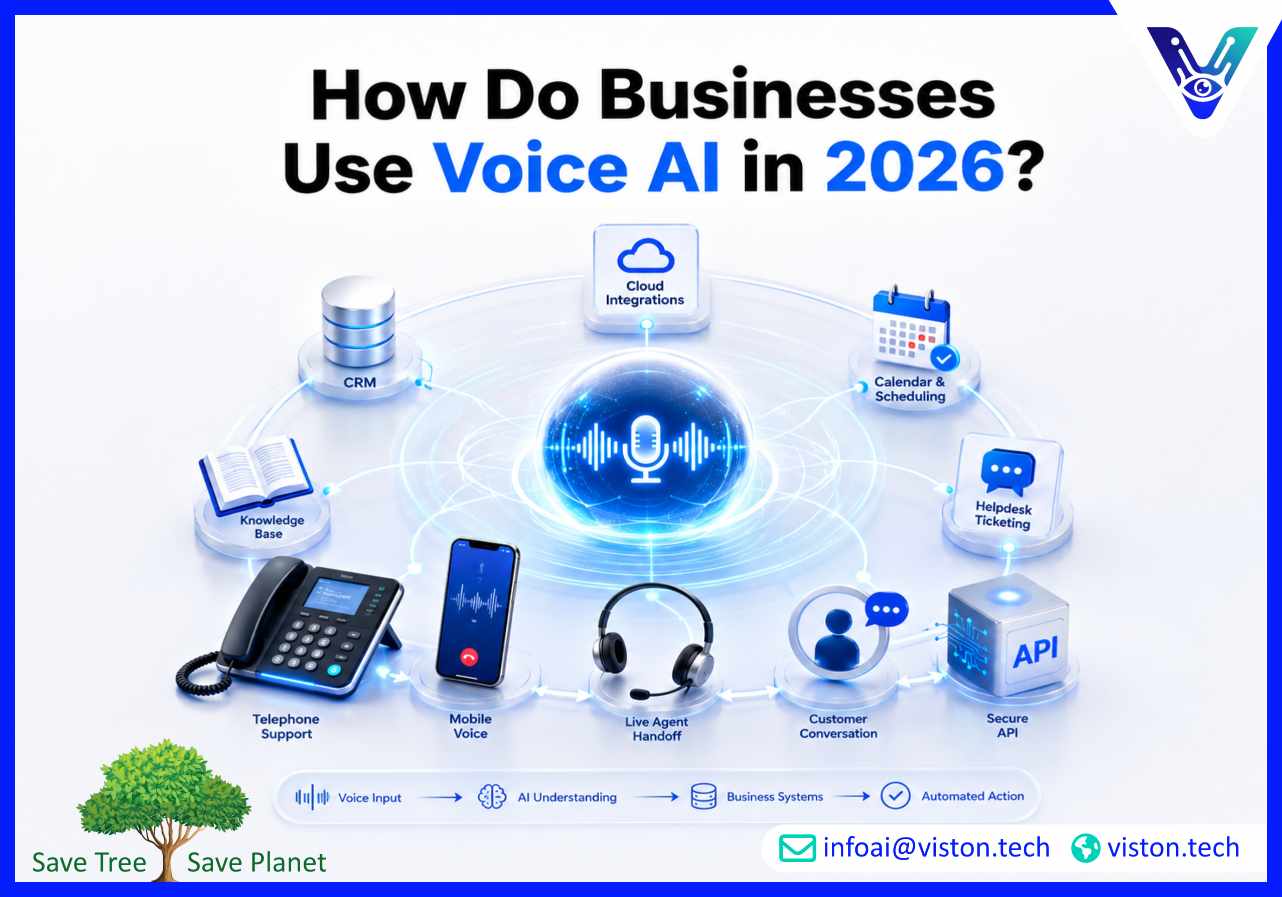
Businesses use voice AI to handle conversations, complete routine tasks, support employees, and connect spoken requests with operational systems. In 2026, the strongest use cases go beyond answering calls: they help organizations qualify demand, retrieve information, update records, automate workflows, and provide faster service without removing human oversight.
What Voice AI Means for Modern Businesses
Voice AI is software that listens to spoken language, understands intent, generates a response, and may complete an action. A business voice assistant typically combines automatic speech recognition, natural language processing, a conversational model, text-to-speech technology, and integrations with CRM, helpdesk, scheduling, order management, or knowledge platforms.This differs from traditional interactive voice response systems, which usually depend on fixed menus. A voice-enabled assistant can let people explain what they need naturally, ask follow-up questions, retain context, and route or complete requests according to business rules.
External and internal applications
Customer-facing voice AI works across phone lines, apps, websites, kiosks, and connected products. Internally, employees may use voice interfaces to search company knowledge, create service requests, record field updates, retrieve account information, or perform hands-free tasks.The real value comes from combining conversation with action. A connected assistant can check an order, book an appointment, open a ticket, update a CRM record, summarize a call, or transfer the conversation with relevant context attached.
How a business voice interaction works
The user speaks through a telephone, application, browser, or device.
Speech recognition converts the audio into text or structured signals.
The system identifies intent, entities, context, language, and confidence.
The assistant retrieves approved information or calls a connected system.
It responds, completes an action, asks for clarification, or escalates.
The interaction is logged for reporting and improvement.
Each step needs controls. Poor transcription, weak knowledge sources, slow integrations, or unclear escalation rules can make an otherwise advanced assistant unreliable.
How Businesses Use Voice AI Across Customer Journeys
The most common answer to “How do businesses use voice AI?” is customer communication. Voice assistants can manage high-volume, repeatable interactions while keeping human agents available for complex, sensitive, or high-value situations.
Customer service and call handling
Businesses use voice AI to answer common questions, identify why a customer is calling, complete approved identity checks, provide status updates, and route calls. Typical tasks include checking delivery progress, confirming service details, resetting credentials, or creating support tickets.A well-designed assistant should detect confusion, frustration, risk, or requests beyond its authority. It can then transfer the interaction and give the human agent a summary, captured details, and actions already attempted.
Appointment scheduling and reservations
Healthcare providers, professional services firms, repair businesses, property companies, hospitality operators, and local service businesses use voice AI to book, reschedule, confirm, or cancel appointments. Calendar integration allows the assistant to check availability, apply scheduling rules, collect required information, and send confirmations.
Lead capture and sales qualification
Sales teams use voice-enabled assistants to respond to inbound inquiries, ask initial qualification questions, capture contact details, identify buying intent, and schedule meetings. The assistant can record needs, company information, timelines, and preferred services before routing the opportunity.Outbound voice AI may support reminders, renewals, event follow-up, or re-engagement where consent and local communication rules permit. Automated calling requires careful treatment of disclosure, opt-out, and data-protection obligations.
Order, delivery, and account updates
Retailers, ecommerce businesses, logistics providers, utilities, and subscription services use voice AI to provide current information from backend systems. Customers may ask where an order is, when a technician will arrive, whether an item is available, or how to change an account detail.Secure identity checks, permission controls, and reliable API connections are essential whenever personal or account-specific information is involved.
Multilingual customer communication
Voice AI can help organizations serve customers in multiple languages without creating a separate operation for every market. The system may detect language, switch during a conversation, or route to a specialist when confidence is low.Multilingual deployment requires testing accents, dialects, names, dates, local terminology, and cultural expectations. Direct translation alone is not enough.
How Voice AI Supports Employees and Business Operations
Voice AI is not limited to contact centers. Businesses also use it as an operational interface that helps employees retrieve information, document work, and trigger approved processes while their hands or attention are occupied.
Internal helpdesks and employee self-service
Employees can use voice assistants to ask IT, HR, facilities, or policy questions. The assistant may guide password-reset steps, explain leave procedures, check ticket status, create a support request, or find an approved document. Identity and access controls should ensure that answers reflect the employee’s role and permissions.
Field service and hands-free workflows
Technicians, warehouse staff, drivers, clinicians, inspectors, and manufacturing teams may use voice commands when typing is impractical. A worker can request equipment information, dictate notes, record an inspection result, confirm inventory, or progress through a checklist.Deployment must account for background noise, protective equipment, unreliable connectivity, specialist vocabulary, and confirmation of safety-critical actions.
Meeting, call, and documentation support
Voice AI can transcribe conversations, separate speakers, create summaries, identify actions, and produce structured records. Sales teams may log notes to CRM, support teams may summarize cases, and managers may capture meeting decisions.Organizations should define when recording is permitted, how participants are informed, where audio and transcripts are stored, retention periods, and access rights. Generated summaries should remain reviewable.
Knowledge access and decision support
Employees can ask spoken questions against approved product documentation, standard operating procedures, service manuals, policies, or customer records. This is useful when staff need information quickly but cannot search several systems.For regulated, financial, medical, legal, or safety-critical decisions, voice AI should support qualified staff rather than replace professional judgment.
What Businesses Need for Reliable Voice AI Implementation
Successful voice AI starts with a defined business problem. Organizations should select a measurable use case, map the conversation journey, identify the systems involved, and define what the assistant may and may not do.
Choose suitable conversations first
High-volume, predictable, lower-risk interactions are usually the best starting point. Examples include appointment confirmation, order tracking, basic account questions, service triage, and internal knowledge retrieval. Complex complaints, negotiations, emergencies, and decisions requiring discretion need stronger human involvement.
Integrate with trusted data and workflows
The assistant needs accurate, current information. Businesses should define authoritative sources, data owners, update cycles, and rules for reading or writing data. Every action should be validated so bookings, tickets, CRM updates, and other transactions are completed correctly.
Design for real speech
Natural conversations include pauses, interruptions, corrections, accents, background noise, and incomplete sentences. The assistant should respond quickly, allow interruption, and confirm sensitive details such as names, addresses, dates, quantities, and account changes.
Build privacy, security, and governance into the service
Businesses should apply data minimization, encryption, role-based access, audit logging, retention controls, and human review according to the use case. Callers should understand that they are interacting with an automated system where disclosure is required or appropriate.Recording, biometric processing, automated calling, consumer protection, and cross-border data requirements also need jurisdiction-specific review.
Measure outcomes rather than call volume
Useful metrics include task completion, first-contact resolution, transfer rate, fallback rate, response latency, customer satisfaction, booking success, qualified lead rate, workflow accuracy, and handover quality. Teams should review failed conversations to improve prompts, vocabulary, knowledge, and routing.The aim is not the lowest escalation rate. It is accurate resolution for suitable requests and timely transfer for the rest.
How Viston AI Helps Businesses Build Voice-Enabled Assistants
Viston AI provides Voice-Enabled AI Assistant services for organizations that need spoken interfaces connected to real business processes. Its service combines speech recognition, natural language understanding, generative AI, conversational context, and speech synthesis to support multi-turn interactions rather than fixed telephone menus.The company’s published capabilities include multilingual voice experiences, intent and entity recognition, sentiment analysis, real-time conversation analytics, and integration with platforms such as Salesforce, SAP, Microsoft Dynamics, ServiceNow, Workday, and custom APIs. These capabilities are relevant when an assistant needs to retrieve live information, create records, trigger workflows, or pass structured context to a human team.Viston AI also positions model operations, monitoring, testing, access controls, auditability, personally identifiable information handling, and human intervention points as part of enterprise delivery. This matters because voice AI performance depends on ongoing governance after launch, not only initial development.For customer service, retail, healthcare, finance, manufacturing, logistics, hospitality, and technology use cases, its practical relevance lies in conversation design, system integration, multilingual capability, deployment, analytics, and continued optimization around a defined operational outcome.
Frequently Asked Questions
What are the most common business uses of voice AI?
Common uses include customer service, call routing, appointment scheduling, order updates, lead qualification, reminders, internal helpdesks, field-service support, call summarization, and hands-free access to business information.
Can voice AI replace a business call center?
Voice AI can automate repetitive interactions, but it should not replace human support for every situation. Complex complaints, sensitive decisions, exceptions, negotiations, and emotionally difficult conversations usually require skilled people and contextual handover.
How is voice AI different from IVR?
Traditional IVR relies mainly on menus and keypad selections. Voice AI lets callers describe a request naturally, supports follow-up questions, retains context, retrieves information from connected systems, and can complete approved tasks.
Is voice AI suitable for small businesses?
Yes, when the use case is focused. A small business may use voice AI for after-hours answering, appointment booking, frequently asked questions, lead capture, or service routing.
What systems can a voice assistant connect to?
A voice assistant can connect to CRM, helpdesk, scheduling, ecommerce, order management, ERP, payment, identity, knowledge base, inventory, field-service, and analytics systems through supported connectors or APIs.
How can Viston AI support a business voice AI project?
Viston AI supports Voice-Enabled Assistants through speech and language technology, conversation design, multilingual capability, enterprise integration, analytics, model operations, governance controls, and ongoing optimization.
Conclusion
How businesses use voice AI depends on where spoken interaction can remove friction, reduce repetitive work, or improve access to information. The most effective Voice-Enabled Assistants handle defined tasks, connect to trusted systems, confirm important actions, and escalate appropriately. In 2026, businesses should evaluate voice AI by task success, service quality, integration reliability, security, and measurable operational outcomes rather than novelty. Viston AI offers relevant capabilities for organizations planning multilingual, integrated, governed, and continuously improved voice assistants.