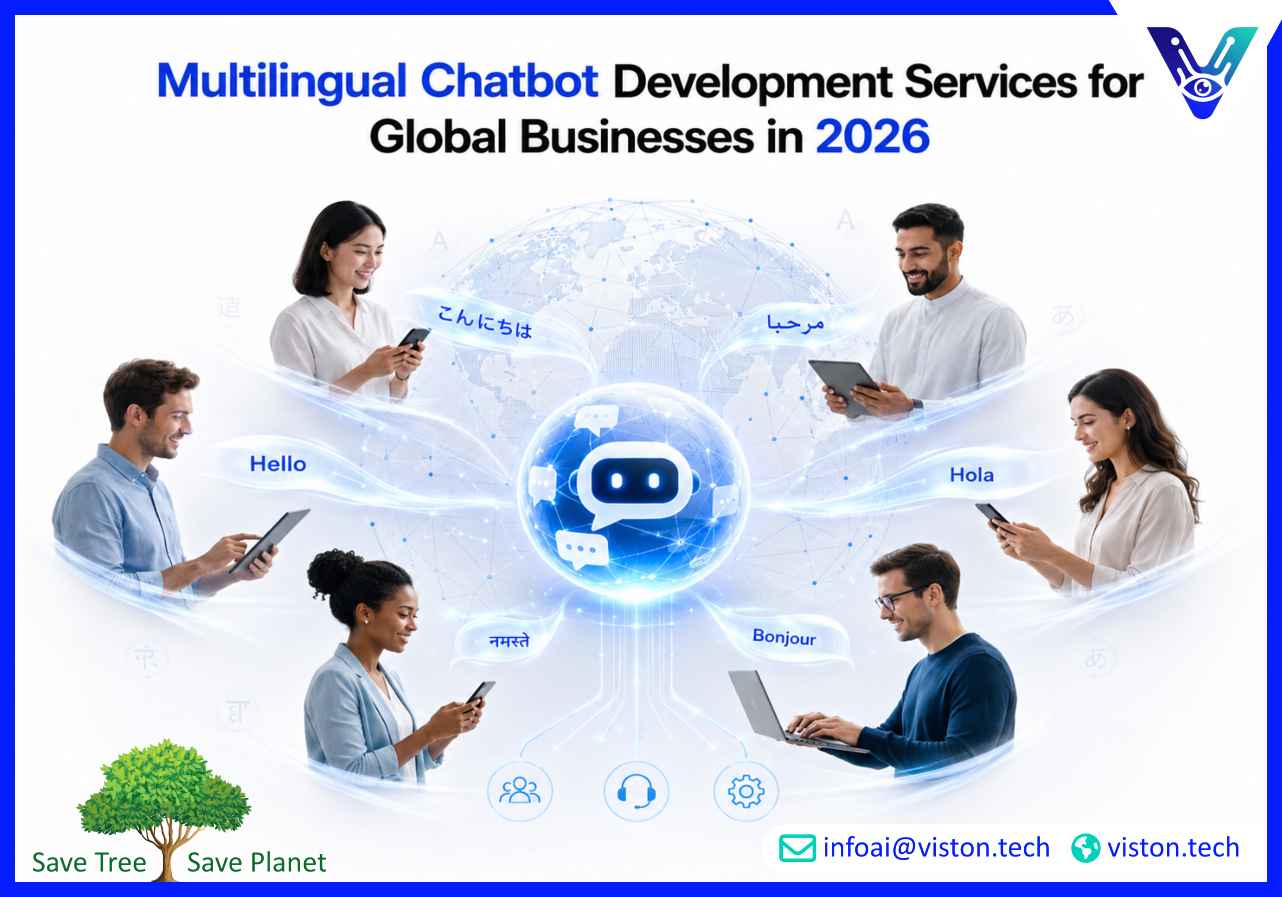
Multilingual Chatbot Development Services for Global Businesses in 2026
Multilingual chatbot development services help businesses support customers, prospects, and employees in the languages they use every day. For global organizations, the challenge is not simply translating chatbot replies. It is building accurate, culturally appropriate, secure conversations that work consistently across markets, channels, workflows, and customer journeys.
What Multilingual Chatbot Development Services Involve
A multilingual chatbot is a conversational AI system designed to understand and respond in more than one language. Effective development goes beyond adding machine translation to an English-language bot. The chatbot must recognize user intent, preserve context, interpret regional phrasing, manage mixed-language conversations, and deliver responses that match local expectations.For a global business, this can involve customer support, lead qualification, product guidance, appointment scheduling, order tracking, employee assistance, knowledge search, and service request automation. The chatbot may operate on a website, mobile application, WhatsApp, social messaging channel, customer portal, or internal collaboration platform.
Translation is only one layer
Direct translation may produce grammatically correct text while still missing the meaning of an expression, the formality expected in a market, or the terminology used by a particular industry. Multilingual chatbot development therefore requires language detection, localization, terminology management, conversation design, knowledge retrieval, testing, and human escalation.Developers also need to account for practical language differences. Some markets use right-to-left scripts. Others rely heavily on transliteration, regional dialects, honorifics, or code-switching between two languages. Date formats, currencies, measurements, addresses, personal names, and regulatory wording may also change by locale.
One chatbot or separate language experiences?
Businesses can use a shared multilingual architecture or create market-specific chatbot experiences. A shared architecture simplifies governance and makes it easier to maintain common workflows. Market-specific configurations provide greater control over local content, regulations, promotions, tone, and escalation routes.The right model often combines both approaches: a central platform for shared knowledge, analytics, security, and integrations, with localized content, language rules, and approval processes for each market.
Why Multilingual Chatbots Matter for Global Operations in 2026
Customers increasingly expect digital support to be immediate, accessible, and relevant to their situation. When a chatbot only works well in one language, international users may receive weaker answers, abandon self-service, or move to human support even when the request is simple.A well-designed multilingual chatbot gives global teams a more consistent service layer. It can answer common questions around the clock, collect structured information, route complex cases, and reduce repetitive work. It can also help businesses enter new markets without duplicating every support process from the beginning.
Better access to support
Language accessibility can affect whether a user understands a policy, completes a purchase, follows troubleshooting instructions, or provides the correct information in a service request. A chatbot that communicates clearly in the user’s preferred language reduces avoidable friction and makes self-service more practical.
Consistent service across channels
Global customers may move between a website, mobile app, messaging platform, email, and live agent. Multilingual support should remain consistent across those touchpoints. Centralized knowledge and conversation rules help prevent a customer from receiving different answers simply because they changed channels or languages.
Scalable support without uncontrolled complexity
Adding languages manually can create duplicated content, fragmented workflows, and difficult maintenance. A scalable solution uses shared knowledge sources, reusable conversation components, structured localization, and language-level quality controls.
Stronger data for international decision-making
A multilingual chatbot can capture information about customer intent, unresolved topics, product interest, support demand, and regional service gaps. When analytics are separated by language and market, leaders can see where content is weak, where escalation is high, and which customer needs are emerging.In 2026, transparency and responsible AI are also becoming more important. Organizations serving users in the European Union should prepare for AI transparency obligations that apply from August 2026, including informing people when they are interacting with an AI system where required. Global chatbot governance should therefore include clear disclosure, human handover, data controls, and documented oversight.
Core Capabilities of a Reliable Multilingual Chatbot
The quality of multilingual chatbot development services should be judged by how well the solution performs in real conversations, not by the number of languages shown on a feature list. Each supported language needs suitable data, terminology, testing, monitoring, and escalation coverage.
Automatic language detection and user preference
The chatbot should identify the user’s language accurately while allowing the user to change it. Detection must work with short messages, spelling variations, transliterated text, and mixed-language input. The user’s preference should persist across the conversation so the bot does not switch languages unexpectedly.
Context-aware natural language understanding
Intent recognition should work across paraphrases, dialects, and local vocabulary. A user asking to “stop renewal,” “cancel my plan,” or using an equivalent regional phrase may have the same underlying intent. The chatbot must recognize that intent and apply the correct workflow, permissions, and escalation rule.
Localized knowledge and retrieval
Global chatbots need trusted knowledge sources for each market. Product availability, delivery terms, refund rules, service hours, legal wording, and pricing may differ by region. Retrieval-based systems can help the chatbot answer from approved documents, but those sources must be current, clearly owned, and correctly segmented by language and geography.
Terminology and brand voice controls
Businesses should maintain approved glossaries for product names, technical terms, regulated phrases, and words that should not be translated. Tone also needs local review. A friendly style in one market may sound overly informal in another, while a literal translation of a slogan may not carry the intended meaning.
Human escalation with language-aware routing
The chatbot should know when automation is no longer appropriate. Sensitive complaints, complex account issues, payment disputes, medical concerns, legal requests, and repeated misunderstandings may require a person. Handover should include conversation history, detected language, customer details, intent, sentiment, and actions already attempted.
Business system integration
A useful chatbot often needs access to CRM, helpdesk, ecommerce, booking, order management, or knowledge systems. Integration allows it to retrieve account-specific information, create tickets, schedule appointments, update leads, and trigger workflows. Access controls must ensure that users only receive information they are authorized to view.
Language-level analytics and quality assurance
Overall chatbot accuracy can hide weak performance in less frequently used languages. Teams should measure intent recognition, fallback rate, task completion, escalation, response quality, customer satisfaction, and workflow success by language. Human reviewers and native-language specialists should assess high-risk content and recurring failures.
How to Plan and Evaluate a Global Chatbot Deployment
A successful deployment begins with business priorities, not a target language count. Organizations should identify the markets, customer journeys, and use cases where multilingual automation will create the most value. High-volume, repeatable, low-risk requests are usually better starting points than complex conversations that depend on judgment.
Start with language and use-case prioritization
Review support volume, customer location, revenue opportunity, current response times, and availability of human agents. A language used by a smaller customer group may still be important if it supports a strategic market or a high-value service. Prioritization should consider business impact as well as message volume.
Prepare and govern the knowledge base
Before development, teams should remove outdated content, resolve conflicting answers, define authoritative sources, and assign content owners. Each language version needs a review process. Translating inaccurate or obsolete information only spreads the problem across more markets.
Design for local journeys
A global chatbot should not assume that every region follows the same process. Payment methods, address formats, identity checks, delivery options, business hours, consent language, and escalation teams can vary. Conversation flows should use local rules while maintaining a consistent brand and service standard.
Test beyond standard phrases
Testing should include spelling errors, informal language, dialects, mixed-language messages, abbreviations, ambiguous requests, long conversations, and attempts to access restricted information. Teams should also test right-to-left display, special characters, mobile layouts, link behavior, and handover to human agents.
Assess security, privacy, and regional compliance
Global deployments may process personal, financial, health, employee, or account data. Buyers should examine data hosting, encryption, retention, access controls, audit logs, model providers, subprocessors, and cross-border data transfers. The chatbot should collect only the information required for the task and apply region-specific consent or disclosure where necessary.
Choose a provider based on delivery depth
A credible provider should be able to explain how it handles localization, knowledge governance, integrations, testing, monitoring, fallback behavior, human review, and post-launch optimization. Buyers should ask for language-specific evaluation methods rather than accepting a single overall accuracy figure.
Which languages, dialects, and scripts are supported and tested?
How are terminology, tone, and local rules managed?
Can the chatbot handle code-switching and transliteration?
How are CRM, helpdesk, and knowledge systems integrated?
What security and data residency options are available?
How is performance measured for each language?
What happens when the chatbot is uncertain or a request is sensitive?
How Viston AI Supports Multilingual Chatbot Development
Viston AI provides multilingual AI chatbot support as part of its conversational AI services for global organizations. Its service offering covers multilingual conversations across web chat, mobile applications, WhatsApp, SMS, voice assistants, and social channels, supported by centralized knowledge management and conversation controls.The company’s approach is relevant to businesses that need more than basic translation. Its published capabilities include context-aware intent recognition, localized and brand-aligned responses, intelligent routing, performance analytics, and integration with enterprise systems. Viston AI also presents language-specific monitoring, escalation, security, and governance as core elements of multilingual delivery.For global customer support, sales, ecommerce, travel, financial services, healthcare, education, logistics, and internal service teams, these capabilities can support common requirements such as 24/7 assistance, localized knowledge access, lead capture, request routing, and consistent cross-channel service.Viston AI’s wider portfolio includes enterprise AI chatbots, AI chatbot integration, natural language processing, workflow automation, voice-enabled assistants, and model monitoring. This allows multilingual support to be designed as part of a broader operational system rather than a disconnected chat interface. Its implementation model also emphasizes discovery, proof of concept, development, integration, monitoring, and ongoing optimization, which is important when languages, policies, and customer expectations continue to change.
Frequently Asked Questions
What are multilingual chatbot development services?
Multilingual chatbot development services design, build, integrate, and optimize chatbots that understand and respond in multiple languages. The work usually includes language detection, localization, intent design, knowledge integration, testing, analytics, security, and human escalation.
Is a multilingual chatbot the same as a translated chatbot?
No. A translated chatbot may simply convert text from one language to another. A multilingual chatbot is designed to understand local phrasing, context, terminology, cultural expectations, regional rules, and language-specific workflows.
How many languages should a business launch first?
Start with the languages linked to the highest support demand, strategic markets, revenue opportunities, or service gaps. A focused launch with strong quality controls is usually more effective than supporting many languages poorly.
How is multilingual chatbot accuracy measured?
Accuracy should be measured separately for each language using intent recognition, answer correctness, fallback rate, task completion, escalation rate, customer satisfaction, and workflow success. Native-language review is particularly important for regulated or sensitive conversations.
Can multilingual chatbots integrate with CRM and support platforms?
Yes. They can connect with CRM, helpdesk, ecommerce, booking, order management, and knowledge systems. These integrations allow the chatbot to retrieve approved information, create or update records, route requests, and complete business workflows.
Can Viston AI develop multilingual chatbots for global businesses?
Viston AI offers multilingual AI chatbot support alongside chatbot development, integration, NLP, voice assistant, automation, and monitoring services. Its published capabilities are aligned with global organizations that require localized, cross-channel conversational support.
Conclusion
Multilingual chatbot development services give global businesses a practical way to improve access, consistency, and scalability across customer and employee interactions. Success depends on more than translation: it requires localized knowledge, reliable intent recognition, secure integrations, language-specific testing, human escalation, and continuous improvement. Businesses should begin with priority markets and measurable use cases, then expand only when quality and governance are proven. Viston AI’s multilingual support and broader conversational AI capabilities make it relevant to organizations seeking a structured, business-focused approach to multilingual chatbot development in 2026.