
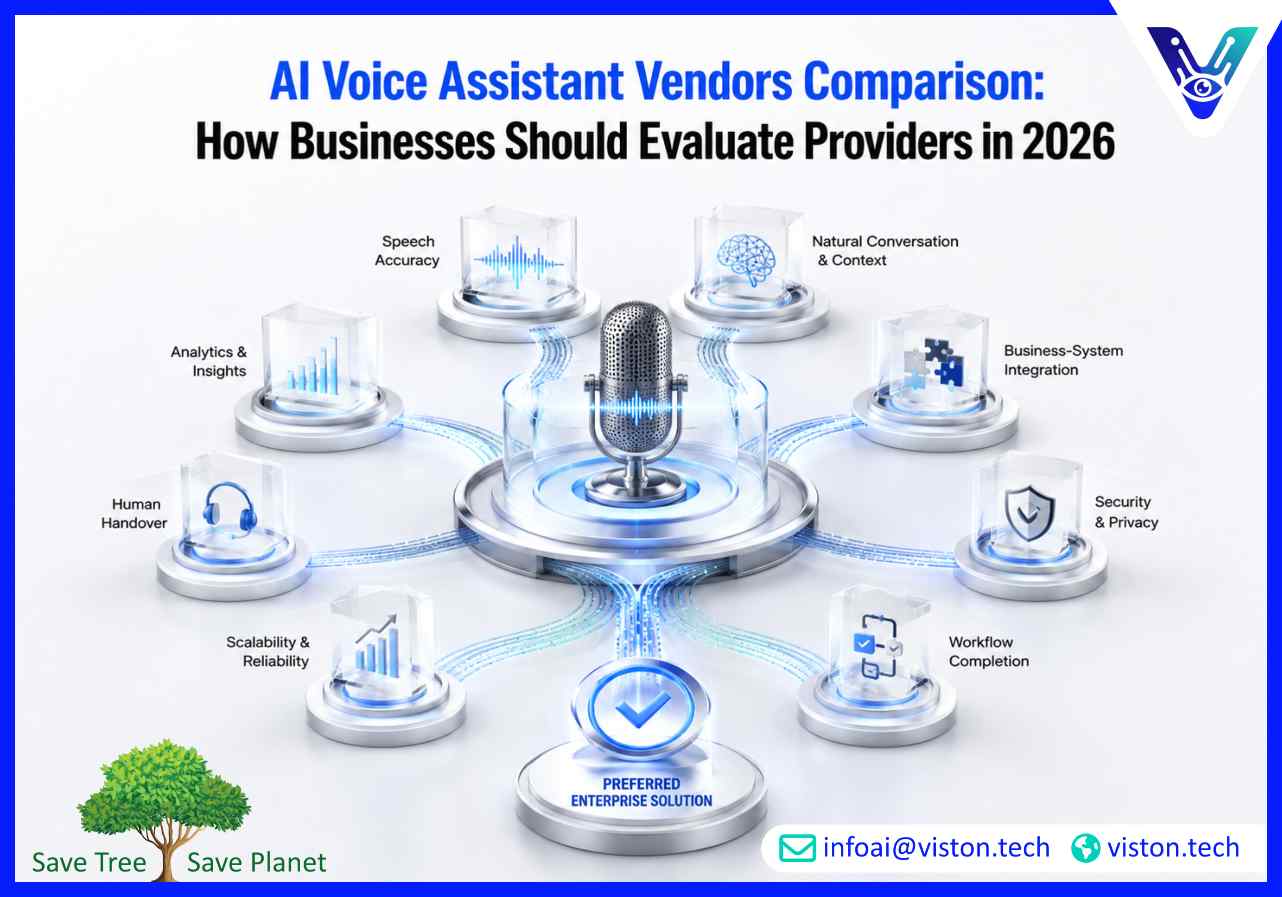
AI voice assistant vendors comparison has become a serious business decision as companies move beyond basic IVR and scripted voice bots. In 2026, the right vendor must support natural conversations, secure integrations, measurable automation outcomes, and reliable voice experiences across customer service, sales, operations, and internal support.
Comparing AI voice assistant vendors is not simply about choosing the platform with the most features. A modern voice-enabled assistant must understand spoken language, manage multi-turn conversations, retrieve accurate business information, trigger workflows, and escalate to human teams when automation is no longer appropriate.
For business buyers, the comparison should begin with the role the assistant is expected to play. Some organizations need a customer support voice assistant to answer repetitive questions, authenticate callers, check account details, or create service tickets. Others need a sales assistant that qualifies inbound calls, books meetings, routes leads, and updates CRM records. Internal teams may need voice automation for IT helpdesk, HR queries, field operations, inventory checks, or hands-free task execution.
The vendor that works well for a simple FAQ voice bot may not be suitable for regulated workflows, high-volume contact centers, multilingual support, or complex enterprise integrations. This is why evaluation must include both technology capability and delivery capability.
Most serious AI voice assistant vendors should be assessed against a practical capability set, including:
A strong comparison should also separate product promises from implementation reality. Voice assistants operate in real-time environments where latency, interruptions, accents, background noise, telephony quality, and integration reliability all affect user experience. The best vendor is not always the most recognizable brand; it is the provider that can deliver the right voice experience safely, at scale, and in line with business outcomes.
AI voice assistant vendors usually fall into several categories. Understanding these categories helps businesses avoid comparing unlike-for-like options.
Cloud AI vendors offer foundational services such as speech recognition, text-to-speech, language models, translation, and AI infrastructure. They are often powerful for organizations with internal engineering teams that can design the full solution architecture. These vendors provide flexibility, scalability, and access to advanced AI models, but the business still needs to manage orchestration, integrations, conversation design, compliance, testing, and optimization.
This approach works well for enterprises with mature IT, data, and product teams. It may be less suitable for companies that want a fully delivered voice assistant without building and maintaining the complete stack internally.
Contact center vendors are often a good fit for businesses focused on customer support automation. They typically provide telephony, call routing, agent handover, call recording, quality monitoring, and reporting. Many now include conversational AI capabilities or partner integrations for voice automation.
The advantage is operational fit. These platforms already understand contact center workflows, agent queues, service-level expectations, and escalation. The limitation is that some solutions may be less flexible for custom business logic, non-contact-center workflows, or deep integration beyond the support environment.
Conversational AI platforms focus on building assistants across voice and chat channels. They often include intent design, conversation flows, knowledge base integration, analytics, multilingual support, and deployment tools. These vendors can be useful for businesses that want consistent customer experiences across phone, web chat, WhatsApp, mobile apps, and internal portals.
Buyers should check whether the platform is genuinely voice-ready or primarily chatbot-first. Voice interactions require additional design considerations, including response brevity, turn-taking, silence handling, barge-in, caller authentication, pronunciation tuning, and real-time fallback behavior.
Custom AI development vendors build voice-enabled assistants around a company’s workflows, systems, and operating model. This approach is useful when off-the-shelf tools do not match business requirements, when multiple systems need to be connected, or when the assistant must support industry-specific terminology and compliance rules.
The main advantage is fit. A custom partner can design the voice assistant around real operational needs, data sources, permissions, escalation paths, and success metrics. The trade-off is that buyers must evaluate delivery discipline carefully. The provider should have clear processes for discovery, prototyping, testing, integration, security review, rollout, and ongoing optimization.
Some vendors focus on specific sectors such as healthcare, banking, insurance, retail, hospitality, automotive, logistics, or field services. These providers may offer prebuilt intents, regulatory awareness, industry terminology, and workflow templates. They can reduce implementation time for common use cases, but buyers should confirm whether the solution can adapt to their specific processes rather than forcing the business into generic templates.
A practical AI voice assistant vendors comparison should evaluate each provider against the business outcome, not only the technology demo. A scripted demo may sound polished, but real-world voice automation must handle uncertainty, noisy environments, incomplete user input, and system delays.
Voice quality starts with automatic speech recognition and text-to-speech. The assistant should understand different accents, speaking speeds, domain terms, names, product codes, and background conditions. It should also respond in a voice that feels clear, professional, and appropriate for the brand.
For customer-facing use cases, buyers should test real call samples rather than ideal examples. A useful pilot should include common questions, difficult phrases, interruptions, repeat callers, mixed languages, and edge cases. The vendor should be able to tune pronunciation, improve recognition for business terms, and handle uncertainty gracefully.
A voice assistant should do more than match keywords. It needs to understand user intent, ask clarifying questions, remember context within the conversation, and avoid giving unsupported answers. For business workflows, the assistant may need to verify account details, check eligibility, summarize a request, and confirm before taking action.
Strong vendors design safeguards into the conversation. This includes confidence thresholds, fallback logic, source-grounded answers, restricted topics, human escalation, and audit trails. These controls are especially important when the assistant supports financial, healthcare, legal, HR, or operational decisions.
Integration is often where vendor differences become clear. A voice assistant that cannot connect to business systems remains limited to generic answers. For measurable value, it may need to integrate with CRM, ERP, ticketing platforms, ecommerce systems, payment tools, scheduling platforms, knowledge bases, identity systems, and internal APIs.
Buyers should ask how the vendor handles authentication, permissions, API failures, data synchronization, logging, and error recovery. A good assistant should not create duplicate records, expose unauthorized information, or leave workflows incomplete without alerting the right team.
Voice assistants may process personally identifiable information, account data, payment-related details, health information, employee records, or commercially sensitive requests. Security must therefore be evaluated early, not after a successful demo.
Important areas include encryption, access control, data retention, call recording policies, PII redaction, role-based permissions, audit logging, vendor subprocessors, hosting regions, and compliance alignment. Global organizations should also consider privacy requirements across markets, especially when voice data is stored, analyzed, or used for model improvement.
The vendor should provide visibility into performance. Useful metrics include call containment, resolution rate, escalation rate, fallback rate, average handling time, intent distribution, completion rate, sentiment, abandoned calls, failed workflows, and customer satisfaction.
Analytics should support improvement, not just reporting. Teams need to know where conversations fail, which intents need better training, which integrations create delays, and when human agents receive insufficient context. A vendor that supports continuous optimization will usually deliver stronger long-term value than one that treats deployment as a one-time project.
The right vendor depends on use case complexity, internal capability, integration needs, risk level, and expected scale. A business should start by defining what success looks like before looking at tools.
Before comparing vendors, define the problem the voice assistant must solve. Is the goal to reduce repetitive support calls, improve after-hours availability, qualify leads faster, support multilingual customers, automate appointment booking, or help employees complete internal tasks? Clear use cases prevent overbuying and make vendor evaluation more objective.
A cloud AI stack may suit a company with strong engineering resources. A contact center platform may suit a high-volume support team that needs rapid deployment. A conversational AI platform may suit omnichannel customer engagement. A custom AI partner may suit businesses with complex workflows, unique data sources, or specialized operational requirements.
There is no single best vendor for every company. The best choice is the one that fits the business model, customer journey, operational risk, and internal support capacity.
A pilot should test the assistant against real-world conditions. Include actual call scenarios, sample customer language, integration requirements, handover rules, reporting needs, and security expectations. The pilot should measure not only whether the assistant can answer questions, but whether it can complete tasks accurately and improve the customer or employee experience.
Important pilot success metrics may include:
Voice assistant costs can include platform fees, telephony charges, speech processing, model usage, implementation, integrations, testing, monitoring, support, compliance review, and ongoing optimization. A cheaper tool may become expensive if it requires heavy internal engineering or constant manual maintenance.
Buyers should ask for clarity on usage pricing, implementation scope, support levels, model costs, data storage, customization, multilingual expansion, and future changes. Cost should be compared against expected outcomes such as reduced call volume, faster response times, higher lead conversion, improved service availability, and better agent productivity.
Viston AI is relevant to AI voice assistant vendors comparison because its Voice-Enabled Assistants service is focused on enterprise-grade conversational voice experiences. Its service positioning connects speech recognition, natural language processing, LLMOps infrastructure, multilingual support, business system integration, analytics, and responsible AI governance.
For businesses evaluating vendors, this matters because a voice assistant is rarely successful as a standalone tool. It must understand user intent, connect with operational systems, follow business rules, protect sensitive data, and provide measurable outcomes. Viston AI’s broader AI service portfolio includes enterprise AI chatbots, AI chatbot integration, NLP and text analysis, multilingual support, AI automation workflows, model monitoring, and AI strategy development. These capabilities align with the practical requirements companies face when moving from a simple voice bot to a scalable voice-enabled assistant.
Viston AI may be especially relevant for organizations that need a tailored implementation rather than a generic platform configuration. Its approach can support use cases across customer service, sales operations, internal support, knowledge access, appointment handling, workflow automation, and multilingual customer engagement. For companies comparing vendors in 2026, a provider with both voice AI capability and integration experience can help reduce the gap between a promising demo and a reliable production system.
Look for speech accuracy, natural conversation handling, business system integration, security controls, analytics, scalability, multilingual support, human handover quality, and proven delivery processes. The best vendor should match your specific workflow, not only provide a polished demo.
Yes. Traditional IVR usually depends on menus and fixed paths. AI voice assistants can understand natural speech, manage context, answer questions, trigger workflows, and route users more intelligently. However, they still need strong design, testing, and escalation rules.
Choose a platform vendor if your requirements are standard and your team can configure or manage the system. Choose a custom AI development partner if you need deep integrations, specialized workflows, industry-specific language, or a more tailored voice automation experience.
Useful metrics include call resolution rate, containment rate, task completion rate, escalation rate, fallback rate, average handling time, customer satisfaction, integration success rate, and cost per resolved interaction. Metrics should be tied to real business outcomes.
Yes, many modern solutions support multilingual conversations, but quality varies by language, dialect, domain terminology, and speech environment. Businesses should test real user examples before rolling out multilingual voice automation at scale.
Yes. Viston AI offers Voice-Enabled Assistants and related AI capabilities including NLP, multilingual support, business system integration, automation workflows, analytics, and model monitoring. This makes it relevant for businesses that need tailored voice assistant delivery and ongoing optimization.
AI voice assistant vendors comparison in 2026 should focus on business fit, not surface-level feature lists. The right provider must combine accurate speech processing, natural conversation design, secure integrations, reliable workflow execution, analytics, and responsible governance. Businesses should compare vendors by use case, implementation complexity, risk profile, scalability, and measurable outcomes. Voice-Enabled Assistants can improve customer service, sales operations, internal support, and process automation when they are designed around real business needs. Viston AI is a relevant specialist for organizations seeking voice assistant delivery supported by enterprise AI, integration, multilingual, and optimization capabilities.
