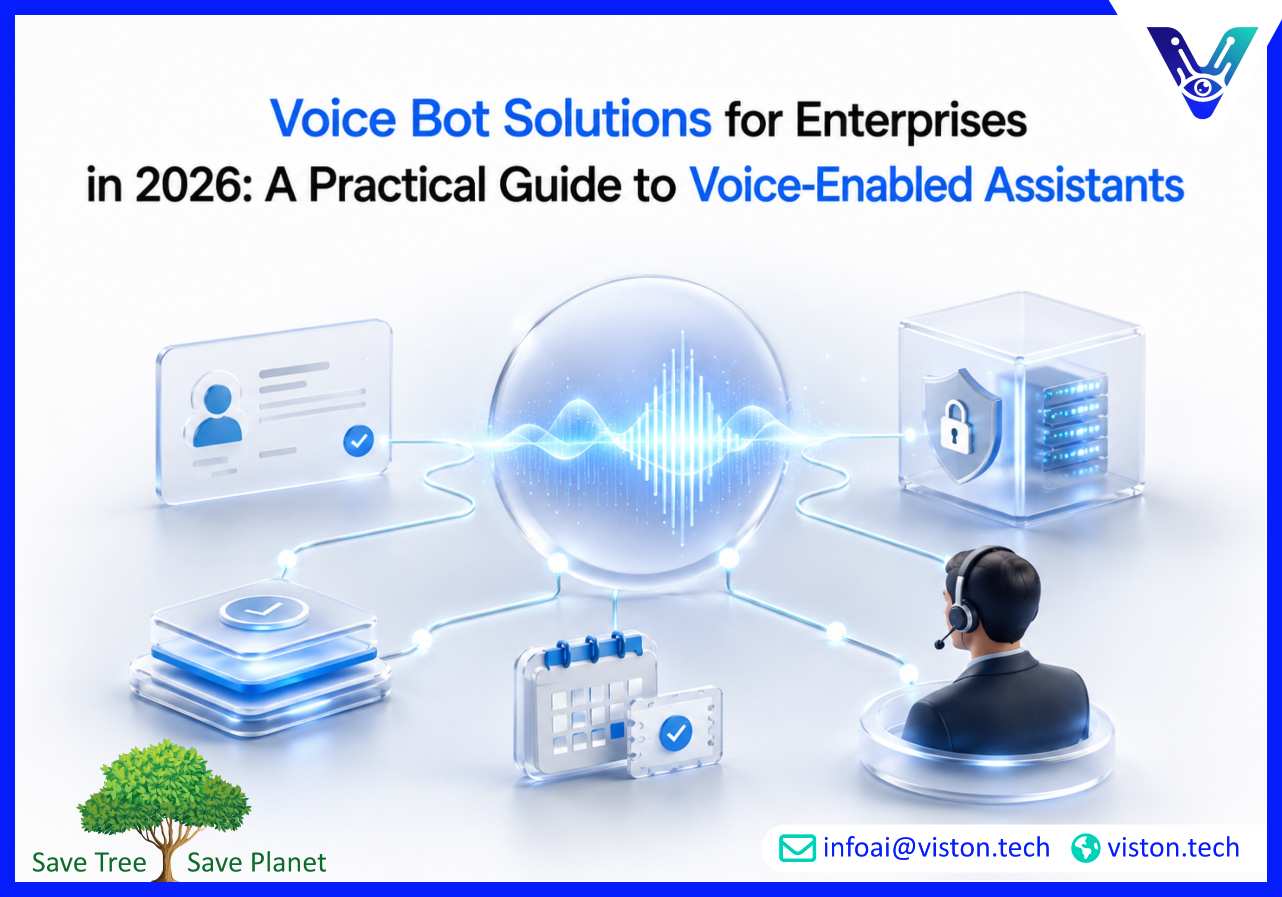
Voice Bot Solutions for Enterprises in 2026: A Practical Guide to Voice-Enabled Assistants
Voice bot solutions for enterprises are becoming essential for businesses that need faster response times, scalable support, and more natural customer or employee interactions. In 2026, voice-enabled assistants are no longer basic call-routing tools; they are intelligent systems that can understand speech, manage workflows, and connect with business platforms.
What Voice Bot Solutions for Enterprises Really Mean
Voice bot solutions for enterprises are AI-powered systems that allow users to interact with a business through spoken conversation. They typically combine automatic speech recognition, natural language processing, dialogue management, text-to-speech, and backend system integration to understand requests and respond in a natural voice. Voice bots are commonly used through phone systems, contact centers, mobile apps, kiosks, connected devices, and internal business tools.For enterprises, the value is not simply that a customer can speak instead of type. The real business value comes from automating high-volume conversations, improving access to information, reducing manual handling, and giving users faster support without forcing them through long menus or repeated form-filling.A modern enterprise voice bot can answer questions, authenticate users, capture information, check records, schedule appointments, create tickets, qualify leads, route calls, summarize conversations, and hand over to a human agent when judgment or empathy is needed. When designed properly, it becomes part of the service operation rather than a separate voice interface.
How enterprise voice bots differ from traditional IVR
Traditional IVR systems usually rely on fixed menus such as “press one for sales” or “press two for support.” Voice bots are more flexible. Users can describe what they need in natural language, and the system can identify intent, ask follow-up questions, retrieve relevant data, and complete tasks. This makes the experience faster and more human, especially when customers do not know which department or menu option applies to their issue.The difference matters for enterprise buyers because rigid menus often create frustration, misrouting, and avoidable agent workload. A well-designed voice-enabled assistant can understand context, remember previous steps in the conversation, and pass structured information to agents or systems when escalation is required.
Why Voice Bot Solutions for Enterprises Matter in 2026
In 2026, enterprise communication is shaped by higher customer expectations, rising service volumes, multilingual markets, distributed teams, and pressure to improve productivity without lowering service quality. Buyers expect instant support, but they also expect accuracy, privacy, and smooth escalation when automation is not enough.Voice bot solutions help enterprises meet these expectations because voice remains a preferred channel for urgent, complex, or accessibility-driven interactions. Customers often call when they need help quickly. Employees may also prefer voice when working hands-free, moving between tasks, or using field devices in operational environments.
Key business problems voice bots can address
Enterprise voice bots are most useful when they solve recurring operational problems. Common examples include long call wait times, repetitive support questions, inconsistent call routing, after-hours service gaps, multilingual support pressure, agent burnout, poor call documentation, and slow access to customer records.They can also support internal productivity. A voice assistant can help employees retrieve policy information, log field updates, check inventory, request IT support, create service notes, or trigger workflow actions without switching between multiple systems.
Where voice-enabled assistants create the most value
The strongest use cases usually combine high conversation volume with clear business rules. These include customer support triage, appointment booking, order status checks, payment reminders, claims intake, HR helpdesk queries, IT service requests, lead qualification, account updates, delivery tracking, and operational reporting.In more complex environments, voice bots can support agents rather than replace them. They can collect caller details, summarize the issue, suggest next actions, and update CRM or helpdesk records. This reduces repetitive work while keeping human teams focused on sensitive, high-value, or exception-based interactions.
Core Capabilities Enterprise Voice Bot Solutions Should Include
Enterprise buyers should evaluate voice bot solutions based on capability, reliability, and operational fit. A simple demo may sound impressive, but production success depends on how the system handles accents, background noise, interruptions, security rules, integrations, reporting, and failure scenarios.
Accurate speech recognition and natural language understanding
Speech recognition converts spoken language into text, while natural language understanding identifies what the user wants. For enterprise use, both must work across real-world conditions: different accents, noisy environments, incomplete phrases, interruptions, and industry-specific terminology. Weak recognition can cause wrong answers, poor routing, and customer frustration.The system should also manage multi-turn conversations. Many business requests require follow-up questions, verification, confirmation, or conditional logic. A user may ask to reschedule an appointment, but the assistant may need to confirm identity, retrieve availability, apply business rules, and update a calendar before completing the request.
Low-latency voice experience
Voice conversations feel natural only when responses are fast. Long pauses make the assistant feel unreliable and can cause users to repeat themselves or abandon the call. Enterprises should evaluate latency across the full chain: speech recognition, intent detection, knowledge retrieval, API calls, response generation, and text-to-speech output.Low latency becomes especially important in contact centers, field operations, healthcare administration, logistics, retail service, and any environment where speed directly affects user satisfaction or operational flow.
Integration with enterprise systems
A voice bot becomes significantly more useful when it connects to CRM, ERP, helpdesk, ticketing, scheduling, payment, identity, inventory, order management, and knowledge base systems. Integration allows the assistant to retrieve live information, complete actions, and create accurate records rather than only provide generic answers.For example, a customer asking about an order should not receive a broad explanation of shipping policies if the system can securely retrieve the actual order status. An employee requesting IT support should not have to repeat the same details after the voice bot creates a ticket.
Security, governance, and human handover
Voice bots may handle personal data, account information, payment details, health-related information, employee records, or commercially sensitive requests. Enterprise deployments therefore need authentication, access control, audit logs, data retention rules, encryption, consent handling, and clear escalation boundaries.Human handover is equally important. A good voice bot should know when not to continue. Low confidence, user frustration, complaint language, unusual account activity, compliance-sensitive requests, and repeated misunderstanding should trigger a smooth transfer with conversation context preserved.
How Enterprises Should Choose and Implement Voice Bot Solutions
Choosing voice bot solutions for enterprises should start with business outcomes, not technology features. The right question is not “Can this bot talk?” but “Which conversations should it handle, what systems must it connect to, and how will we measure success?”
Start with high-value use cases
Enterprises should begin with use cases that are common, structured, and measurable. Suitable starting points include call triage, FAQs, appointment scheduling, password reset guidance, order tracking, service request intake, lead qualification, or internal helpdesk support. These use cases allow teams to prove value before expanding into more complex workflows.Highly regulated or emotionally sensitive conversations should be handled carefully. The voice bot may assist with intake or routing, but final decisions may need human review, compliance checks, or expert approval.
Define success metrics before deployment
Useful KPIs include containment rate, first contact resolution, average handling time, call deflection, escalation rate, customer satisfaction, intent recognition accuracy, workflow completion rate, call abandonment rate, and human handover quality. For integrated voice bots, enterprises should also track CRM update accuracy, ticket creation success, API error rates, and data completeness.Measurement should continue after launch. Voice bot performance improves when teams review failed conversations, add missing intents, refine prompts, improve knowledge content, and monitor how users actually speak in real situations.
Plan for scalability and continuous optimization
Enterprise voice bots must scale beyond a pilot. This means designing for peak call volume, multiple languages, regional variations, disaster recovery, analytics, version control, monitoring, and governance. A voice bot that works for one department may need a stronger architecture before it can support multiple regions, brands, products, or business units.Continuous optimization is essential. Products change, policies change, customer language changes, and new support patterns appear. Enterprises should treat voice bot management as an ongoing service capability, not a one-time implementation project.
How Viston AI Supports Enterprise Voice Bot Solutions
Viston AI is relevant to voice bot solutions for enterprises because its service portfolio includes Voice-Enabled AI Assistants and related enterprise AI capabilities. Its official service page describes voice-enabled assistants that combine natural language processing, speech recognition, LLMOps infrastructure, enterprise integrations, multilingual support, analytics, and governance-oriented delivery for business use cases.This matters for organizations that want voice automation to support real operational outcomes rather than simple scripted responses. Enterprise voice bots often need to connect with CRM, helpdesk, scheduling, ERP, and internal knowledge systems. Viston AI’s broader AI service portfolio includes enterprise AI chatbots, AI chatbot integration, multilingual support, AI automation and workflow bots, NLP and text analysis, MLOps and model monitoring, and custom AI solution development, which are closely aligned with the requirements of voice-enabled assistant projects.For businesses evaluating voice bot solutions, Viston AI’s relevance is strongest where the requirement involves custom implementation, workflow automation, conversational AI design, system integration, monitoring, and scalable deployment. A voice assistant must be designed around real user journeys, business rules, escalation needs, and data governance. Viston AI’s positioning as an enterprise AI solutions company makes it a practical fit for organizations that want voice automation connected to measurable service, support, and operational improvements.
Frequently Asked Questions
What are voice bot solutions for enterprises?
Voice bot solutions for enterprises are AI-powered voice systems that understand spoken requests, respond through natural speech, and automate business conversations. They are used in contact centers, customer service, internal helpdesks, sales workflows, field operations, and other enterprise communication channels.
How are enterprise voice bots different from chatbots?
Chatbots usually interact through text, while voice bots interact through spoken conversation. Voice bots require speech recognition, voice synthesis, latency management, call handling, and audio-quality optimization. Many enterprises use both together as part of a broader conversational AI strategy.
What systems should an enterprise voice bot integrate with?
Common integrations include CRM, ERP, helpdesk platforms, ticketing systems, identity management, payment tools, scheduling software, order management platforms, knowledge bases, analytics dashboards, and communication platforms. The right integrations depend on the use case.
Are voice bot solutions secure enough for enterprise use?
They can be secure when designed with enterprise-grade controls such as authentication, encryption, access permissions, audit logging, data retention policies, PII handling, and human escalation rules. Security should be planned before deployment, not added after launch.
What KPIs should enterprises track for voice bot performance?
Important KPIs include intent recognition accuracy, call containment rate, first contact resolution, escalation rate, average handling time, user satisfaction, workflow completion rate, failed interaction rate, and integration success rate.
Can Viston AI help with enterprise voice bot implementation?
Viston AI offers Voice-Enabled AI Assistants and related enterprise AI services that align with voice bot implementation, including conversational AI, speech recognition, NLP, multilingual support, integration, analytics, and workflow automation. Its relevance depends on the enterprise’s use case, systems, and deployment goals.
Conclusion
Voice bot solutions for enterprises are becoming a practical way to improve service speed, reduce repetitive workload, and create more accessible customer and employee experiences. The strongest results come from voice-enabled assistants that understand natural speech, integrate with business systems, protect sensitive data, and escalate intelligently when human support is needed. In 2026, enterprises should evaluate voice bots as operational infrastructure, not just conversational tools. Viston AI is relevant for businesses seeking enterprise-focused Voice-Enabled Assistants that connect voice automation with workflows, integrations, analytics, and scalable AI delivery.