
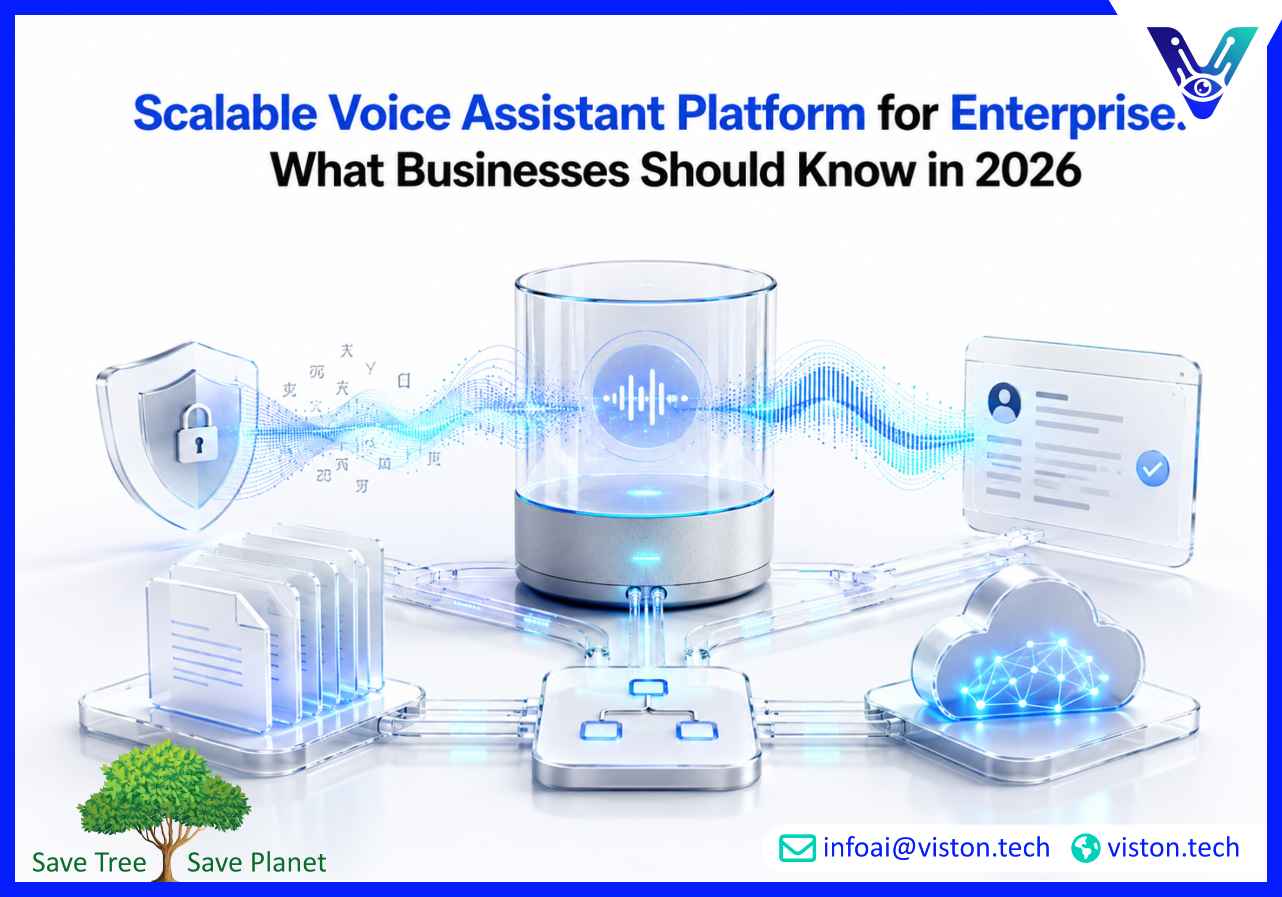
A scalable voice assistant platform enterprise teams can trust is no longer just a call automation tool. In 2026, businesses need voice-enabled assistants that handle real conversations, integrate with operational systems, protect sensitive data, and scale reliably across customers, employees, regions, and channels.
A scalable voice assistant platform for enterprise use is a voice AI system designed to support high-volume, business-critical spoken interactions without losing accuracy, speed, governance, or user context. It combines speech recognition, natural language understanding, large language model orchestration, text-to-speech, workflow automation, analytics, integrations, and security controls into one operational environment.
For enterprise buyers, scalability means more than handling a large number of calls. A platform must work across different departments, languages, accents, customer journeys, backend systems, compliance requirements, and use cases. It should be able to manage a simple appointment request, a multi-step support workflow, a product inquiry, an account update, or an internal employee request without creating friction.
A basic voice bot often follows fixed scripts. A scalable enterprise voice assistant platform must understand intent, ask clarifying questions, retrieve approved knowledge, complete actions through connected systems, and hand over to human teams when automation is not appropriate. This is why modern voice-enabled assistants are increasingly evaluated as enterprise automation infrastructure, not as standalone contact center add-ons.
The best platforms also support conversation memory within approved boundaries, multilingual deployment, analytics dashboards, human-in-the-loop controls, and continuous model improvement. These features help enterprises move from isolated automation to voice systems that support measurable service, sales, operational, and employee experience outcomes.
In 2026, voice remains one of the most important channels for urgent, complex, emotional, and service-led interactions. Customers still call when they need a fast answer, a sensitive issue resolved, or a process completed without navigating long digital forms. Employees also benefit from hands-free voice workflows in support, field operations, warehouses, healthcare environments, manufacturing floors, and internal service desks.
Enterprise scalability matters because voice interactions are unpredictable. Call volume can spike after product launches, outages, campaigns, policy changes, seasonal demand, or operational disruptions. A platform that works well during a pilot may fail under production load if it cannot maintain low latency, accurate recognition, reliable integrations, and smooth handover at scale.
Voice assistant platforms also need to support business continuity. If the assistant is connected to customer service, booking, order tracking, claims intake, employee support, or field operations, downtime and inaccurate responses can create real business risk. Scalability therefore includes resilience, monitoring, rollback options, testing processes, and clear ownership across technical and operational teams.
Business decision-makers now expect voice-enabled assistants to do more than answer FAQs. They want platforms that can authenticate users, understand industry-specific terminology, retrieve current information, trigger workflows, update records, summarize conversations, route cases, measure outcomes, and improve over time.
This has changed the buying criteria. A voice assistant platform should be evaluated on production readiness, not just demo quality. A natural-sounding voice is useful, but it is not enough. Enterprises need to know whether the platform can handle interruptions, background noise, different accents, long conversations, complex intents, sensitive data, and integration failures without damaging the customer experience.
As voice AI becomes more capable, governance becomes more important. A scalable voice assistant platform enterprise teams rely on should include controls for privacy, security, consent, responsible AI use, data retention, model updates, auditability, and escalation. This is especially important for regulated sectors such as finance, healthcare, insurance, telecommunications, public services, education, and enterprise technology.
Strong governance also protects the business from poor automation decisions. The assistant should know when to stop, when to ask for confirmation, when to escalate, and when not to answer. For many enterprises, these boundaries are just as important as the AI model itself.
A scalable enterprise voice assistant depends on architecture. Voice AI involves a chain of systems working together in real time. The user speaks, the platform transcribes speech, interprets intent, retrieves context, generates or selects a response, converts it into speech, and may trigger a workflow in another system. If any part of that chain is slow or unreliable, the user experience suffers.
Latency is one of the biggest differences between a demo voice bot and a production-ready voice assistant. Human conversations depend on timing. Long pauses make the assistant feel unnatural and increase user frustration. Enterprises should look for streaming speech recognition, efficient language model orchestration, fast text-to-speech, and pipeline design that reduces unnecessary delays.
The system should also support barge-in, which allows users to interrupt the assistant naturally. Without barge-in, callers may feel trapped in a script. For customer service and internal support, this feature can make the difference between a useful conversational experience and a frustrating automated menu.
A voice assistant becomes more valuable when it can complete real actions. This requires secure integration with CRM platforms, helpdesk systems, ERP tools, scheduling software, knowledge bases, identity systems, payment workflows, order management platforms, HR systems, and custom APIs.
Integration quality directly affects scalability. If APIs are slow, data is incomplete, or records fail to update correctly, the assistant may provide inaccurate answers or create operational cleanup work. A scalable platform should support real-time data access, error handling, retry logic, logging, permission checks, and fallback routes when a connected system is unavailable.
Enterprise voice assistants should answer from approved and current knowledge sources. This may include product documentation, support articles, internal policies, troubleshooting guides, pricing rules, service workflows, and compliance-approved responses. A scalable platform needs clear knowledge ownership, content versioning, source control, and review cycles.
For complex businesses, retrieval quality is critical. The assistant should not simply generate confident answers. It should retrieve relevant information, respect access permissions, and respond within approved boundaries. When information is missing or uncertain, escalation or clarification is better than an unsupported answer.
Voice interactions often contain personal, financial, health, employment, contractual, or operational information. Enterprise platforms should include encryption, access controls, PII detection, redaction, consent management, audit trails, retention policies, and secure deployment options. For some use cases, voice biometric authentication, liveness detection, and fraud prevention may also be required.
Security should be designed into the platform from the beginning. Retrofitting controls after deployment can be expensive and risky, especially when voice recordings, transcripts, and customer profiles are already flowing through production systems.
Selecting a scalable voice assistant platform should begin with business use cases, not technology features alone. The right platform for a customer support contact center may differ from the right platform for warehouse operations, healthcare appointment scheduling, financial services authentication, or internal IT support.
Enterprises should avoid automating every voice interaction at once. A better approach is to begin with high-volume, repeatable, and measurable use cases where the assistant can provide value quickly. Examples include call routing, appointment scheduling, order status updates, account information requests, lead qualification, password reset guidance, claims intake, HR policy questions, and maintenance logging.
Once the platform proves accuracy, reliability, and business value, teams can expand into more complex workflows. This phased approach reduces delivery risk and gives the business time to refine training data, escalation rules, analytics, and integration logic.
Voice assistant testing should include real accents, background noise, interruptions, incomplete phrases, emotional callers, repeated questions, and edge cases. A platform may perform well in clean demo audio but struggle with real contact center conditions or field environments.
Evaluation should also include multi-turn conversations. The assistant must remember the immediate conversation context, ask useful follow-up questions, and avoid forcing users to repeat information. For enterprise use, conversation quality should be measured by task completion, not just speech recognition accuracy.
Scalable voice-enabled assistants should be measured through business KPIs. Useful metrics include containment rate, first contact resolution, call deflection, average handling time, escalation quality, customer satisfaction, lead qualification rate, booking completion, workflow success, transcript accuracy, fallback rate, and cost per resolved interaction.
Analytics should be available by use case, channel, department, language, region, and customer segment where relevant. This helps teams identify where the assistant performs well, where it needs improvement, and where human support remains essential.
Enterprise voice AI must evolve with the business. Products change, policies change, regulations change, customer expectations change, and new systems are added. A scalable platform should support model monitoring, conversation review, version control, A/B testing, prompt updates, knowledge base refreshes, and controlled deployment changes.
The platform should also provide clear operational ownership. Business teams, IT teams, data teams, security teams, and customer experience leaders all need visibility into how the assistant is performing and how improvements are managed.
Viston AI is relevant to this topic because its Voice-Enabled Assistants service focuses on enterprise-grade conversational AI built around speech recognition, natural language processing, LLMOps infrastructure, business system integration, multilingual support, analytics, and responsible AI governance. These capabilities align closely with what businesses need when evaluating a scalable voice assistant platform enterprise-wide.
For organizations moving beyond scripted voice bots, Viston AI’s approach supports the key layers required for production voice AI: understanding spoken language, managing multi-turn conversations, integrating with existing systems, monitoring performance, and improving models over time. Its service positioning also connects voice assistants with CRM, ERP, helpdesk, knowledge base, and workflow environments, which is essential when enterprises want voice automation to complete real business actions instead of only providing generic answers.
Viston AI’s broader AI service portfolio includes enterprise AI chatbots, AI chatbot integration, NLP and text analysis, multilingual support, AI automation and workflow bots, MLOps and model monitoring, and AI strategy development. This gives businesses a practical foundation for deploying voice-enabled assistants as part of a larger automation and customer experience strategy. For enterprise teams in customer support, sales operations, healthcare, finance, retail, manufacturing, logistics, and internal service functions, Viston AI can help design voice platforms that are scalable, measurable, secure, and aligned with operational goals.
A scalable voice assistant platform for enterprise use is a voice AI system that can handle high volumes of spoken interactions while maintaining accuracy, low latency, security, integration reliability, analytics, and governance across multiple business use cases.
A basic voice bot usually follows fixed scripts or simple call flows. An enterprise voice assistant can understand natural speech, manage multi-turn conversations, retrieve approved knowledge, integrate with business systems, trigger workflows, and escalate with context when needed.
Enterprises should look for speech recognition, natural language understanding, text-to-speech quality, low-latency performance, barge-in support, CRM and helpdesk integration, analytics, multilingual capability, security controls, audit logs, and ongoing optimization tools.
Strong use cases include customer support, call routing, appointment scheduling, order tracking, claims intake, lead qualification, HR support, IT helpdesk assistance, field service reporting, warehouse operations, and hands-free workflow guidance.
Success should be measured through task completion, first contact resolution, containment rate, escalation quality, customer satisfaction, average handling time, workflow success, fallback rate, cost per resolved interaction, and integration accuracy.
Yes. Viston AI’s Voice-Enabled Assistants service is aligned with scalable enterprise voice AI because it covers speech recognition, NLP, LLMOps, multilingual support, business system integration, analytics, governance, and ongoing optimization.
A scalable voice assistant platform enterprise teams can rely on should combine natural voice interaction with secure architecture, reliable integrations, strong governance, and measurable business outcomes. In 2026, voice-enabled assistants are becoming an important part of customer service, internal support, operations, and digital transformation strategies. The most successful deployments start with focused use cases, tested data, clear escalation rules, and continuous optimization. For businesses that want voice AI to scale beyond simple call automation, Viston AI offers relevant Voice-Enabled Assistants capabilities that support practical, enterprise-ready implementation.
