
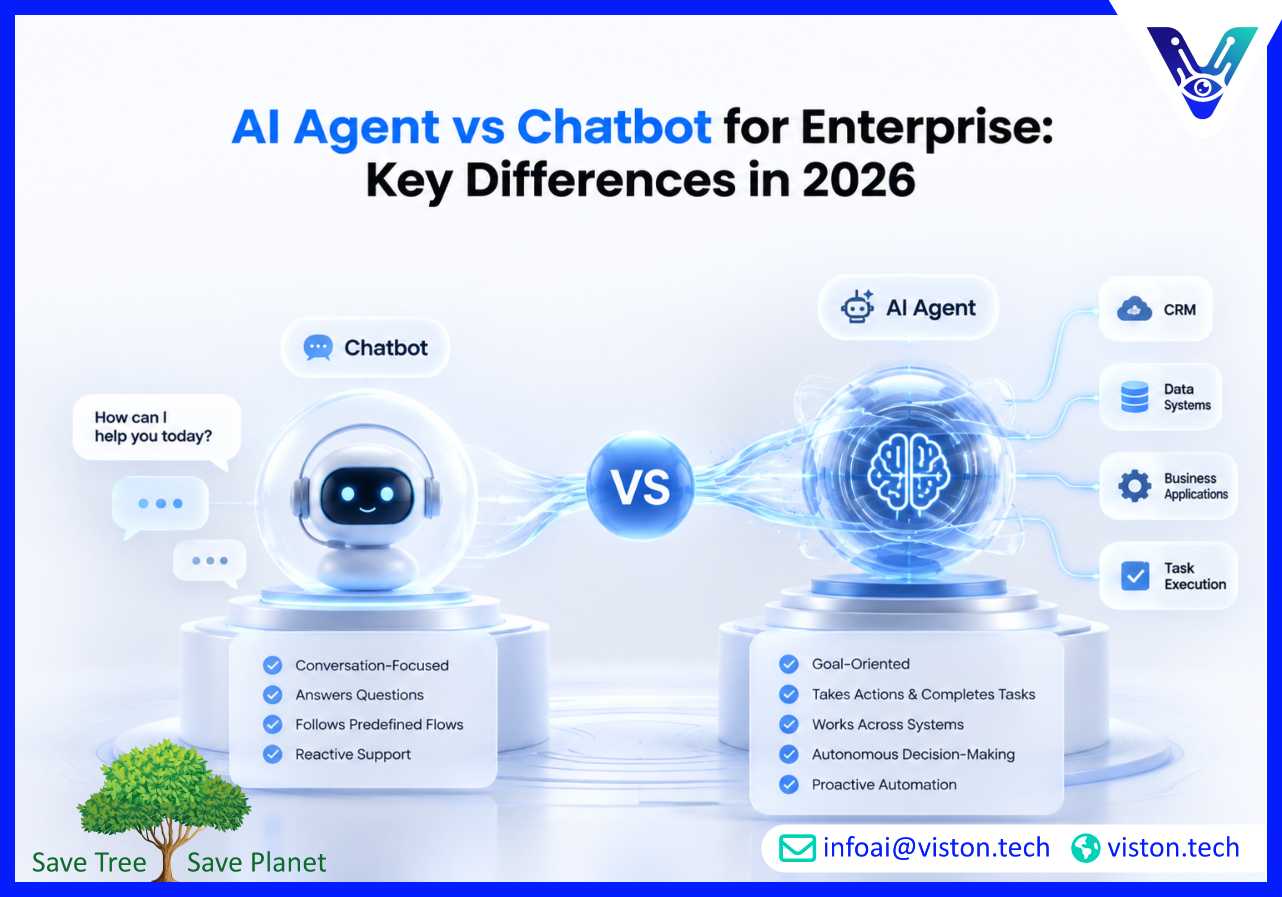
Understanding the difference between AI agent and chatbot enterprise solutions is important for companies planning customer support, internal automation, sales assistance, IT helpdesk, and workflow transformation in 2026.
An enterprise chatbot is usually designed to communicate with users through a conversational interface. It answers questions, guides users through predefined journeys, collects information, retrieves knowledge base content, and routes requests to the right team. Modern enterprise AI chatbots can be far more advanced than older rule-based bots, but their primary role is still conversation and response.
An AI agent goes further. It is designed to understand a goal, make decisions within defined boundaries, use tools, call systems, complete tasks, and coordinate multi-step workflows. In enterprise environments, an AI agent may update CRM records, create tickets, summarize documents, check order status, trigger approvals, schedule meetings, analyze data, or hand work to another agent or human team.
The simplest difference is this: a chatbot mainly talks; an AI agent can talk and act. A chatbot may answer, “Here is how to reset your password.” An AI agent may verify the user, check policy rules, trigger a password reset workflow, update the IT ticket, notify the employee, and log the completed action.
Enterprise AI chatbots are valuable when the business needs fast, consistent, and scalable conversations. They work well for support FAQs, service requests, lead capture, onboarding guidance, product information, policy answers, and customer engagement across websites, portals, messaging apps, and internal tools.
Their strength is controlled communication. A well-built chatbot can reduce repetitive questions, improve response speed, support multiple languages, maintain brand tone, and hand off complex issues to human teams with context.
AI agents are valuable when the business wants automation that completes work, not just answers questions. They are built around goals, tools, permissions, memory, reasoning, and workflow execution. Instead of only responding to a user, an agent can plan the next step, decide which system to use, perform an action, verify the result, and continue until the task is complete or escalation is required.
This makes AI agents useful for enterprise workflows where multiple systems, approvals, data checks, and business rules are involved.
The right choice depends on the use case. Many enterprises do not need to replace chatbots with agents. They need to understand where each fits and how both can work together inside customer, employee, and operational workflows.
Enterprise AI chatbots are usually the right fit when the main requirement is conversational assistance. Common use cases include customer service questions, order tracking guidance, product recommendations, appointment booking, lead qualification, HR policy support, IT helpdesk FAQs, onboarding assistance, and knowledge base search.
For example, a customer support chatbot can answer warranty questions, explain return policies, collect complaint details, and escalate unresolved cases to a live agent. A sales chatbot can qualify leads, ask budget and timeline questions, recommend relevant services, and book a consultation. An internal chatbot can help employees find HR policies, IT instructions, or company process documents.
AI agents are better suited for workflows that involve action, decision support, and system coordination. Examples include creating and prioritizing support tickets, updating CRM opportunities, reviewing documents, comparing vendor quotes, generating reports, reconciling invoices, monitoring compliance tasks, preparing meeting summaries, and coordinating approvals across departments.
An AI agent can be especially useful when a task requires several steps. For instance, a procurement agent may read a supplier request, compare it with policy, check budget availability, create an approval task, notify the responsible manager, and update the procurement system. A chatbot may explain the procurement process, but the agent can help move the process forward.
Some enterprise solutions combine both. A chatbot may serve as the user-facing interface while one or more AI agents work behind the scenes. The employee or customer experiences a simple conversation, but the backend agent handles retrieval, system updates, workflow automation, and escalation logic.
This is often the most practical enterprise model. Users do not need to know whether they are interacting with a chatbot, agent, or multi-agent workflow. They only care that the system understands the request, responds accurately, completes the task, and escalates safely when needed.
The difference between AI agent and chatbot enterprise systems becomes clearer when viewed through architecture, control, risk, integration, and governance. Both solutions may use large language models, natural language processing, retrieval-augmented generation, APIs, and business data. The difference is how much autonomy and operational responsibility the system has.
A chatbot typically waits for user input and responds within a designed conversation flow. It may retrieve information or ask clarifying questions, but it usually does not decide and execute a broad workflow on its own.
An AI agent has a higher level of autonomy. It can interpret a goal, break it into tasks, select tools, complete actions, and adjust based on results. In enterprise settings, this autonomy must be carefully limited through permissions, approval rules, confidence thresholds, and audit logs.
Chatbots can integrate with CRM, helpdesk, ecommerce, HR, ERP, and knowledge systems, but many chatbot implementations use integrations mainly for retrieval or simple data capture. AI agents often require deeper integration because they need to read, write, update, trigger, and verify actions across systems.
This means AI agents usually need stronger API architecture, identity management, event handling, workflow orchestration, and error management. If a chatbot gives a wrong answer, the risk may be customer confusion. If an agent takes the wrong action in a live system, the business impact can be larger.
Enterprise AI chatbots need governance around approved knowledge sources, tone, privacy, security, escalation, and accuracy. AI agents need all of this plus governance around actions. Businesses must define what the agent can do, what it cannot do, which actions require approval, what data it can access, and how every action is logged.
For regulated industries, the difference matters. A chatbot can provide general policy guidance, but an agent that changes account data, processes a claim, updates medical information, or triggers a financial workflow needs stronger controls and review mechanisms.
Chatbot performance is often measured through response time, containment rate, fallback rate, conversation completion, customer satisfaction, escalation rate, and lead conversion. AI agent performance must also measure task success, workflow completion, tool-use accuracy, error rate, approval cycle time, audit quality, and business outcome impact.
This changes how enterprise teams evaluate ROI. A chatbot may reduce support volume. An AI agent may reduce manual processing time, improve operational throughput, and complete work that previously required several people across multiple systems.
The right decision should start with the business problem, not the technology label. Many companies rush toward AI agents because the term sounds more advanced. Others stay with basic chatbots even when their real need is workflow automation. A practical evaluation should focus on user intent, process complexity, risk, and measurable outcomes.
A chatbot is usually the right starting point when users mostly need answers, guidance, structured intake, or simple routing. This is common for customer support, website engagement, lead capture, HR FAQs, IT helpdesk questions, and product information.
Chatbots are also useful when the business needs a controlled first layer of automation before introducing deeper system actions. They can reduce repetitive work, improve service availability, collect cleaner request details, and identify which workflows are worth automating later.
An AI agent becomes more relevant when the user’s request requires action across tools and systems. If the process includes checking records, applying rules, creating tasks, updating platforms, sending notifications, or coordinating approvals, an agent-led architecture may be more suitable.
However, enterprises should avoid giving agents broad autonomy too early. A phased rollout is safer. Start with low-risk workflows, add human approval for sensitive actions, measure performance, and expand only after the system proves reliable.
In many enterprise environments, the best answer is not chatbot versus agent. It is chatbot plus agent. The chatbot gives users an easy conversational entry point. The agent executes the workflow behind the scenes. This model supports both user experience and operational automation.
For example, a customer asks a chatbot to change a delivery address. The chatbot collects the request and confirms identity. An AI agent checks order status, validates whether the change is allowed, updates the order management system, notifies logistics, and confirms the result. The customer sees one smooth interaction, while the enterprise gains automated execution with traceability.
Viston AI is relevant to this topic because the difference between enterprise AI chatbots and AI agents is not only conceptual; it affects solution design, system integration, automation scope, and long-term scalability. Viston AI provides Enterprise AI Chatbots as part of a broader AI service portfolio that includes AI chatbot development, business system integration, custom AI agent solutions, agentic AI workflows, multi-agent orchestration, NLP and text analysis, automation workflow bots, AI strategy, and MLOps.
For businesses comparing an AI agent vs chatbot enterprise approach, this combination matters. A chatbot project may begin with customer support, lead qualification, internal knowledge search, or multilingual assistance. As the organization matures, the same conversational layer may need to connect with CRM, helpdesk, ERP, HR, analytics, and workflow systems. That is where agent-ready architecture becomes important.
Viston AI’s service positioning supports companies that want conversational AI to do more than provide surface-level answers. Its capabilities are aligned with enterprise needs such as contextual conversations, workflow automation, system connectivity, knowledge integration, escalation logic, and performance monitoring. For organizations planning AI adoption in 2026, this makes Viston AI a practical specialist for designing solutions that can start as enterprise chatbots and evolve into more capable agentic workflows where the business case, governance model, and risk controls justify it.
The main difference is action. An enterprise chatbot mainly responds to user questions and guides conversations. An AI agent can interpret a goal, use tools, complete tasks, update systems, and manage multi-step workflows within defined business rules.
Not completely. Many enterprises still need chatbots for support, lead capture, onboarding, and knowledge access. AI agents are more suitable when the business needs automation that performs actions across systems. In many cases, both work together.
An AI agent is usually more autonomous and operationally capable than a chatbot. However, more advanced does not always mean more appropriate. A well-designed chatbot may be better for controlled conversations, while an agent is better for complex workflows that require execution.
A chatbot is generally easier to control because it usually provides information rather than taking action. AI agents require stronger governance, permissions, audit logs, approval workflows, and error handling because they can interact with live enterprise systems.
Yes, a chatbot can evolve into an agent-enabled solution if it gains access to tools, workflow logic, business systems, permissions, and task execution capabilities. The transition should be phased and governed carefully to reduce operational risk.
Yes. Viston AI’s Enterprise AI Chatbots, custom AI agent solutions, agentic workflows, and integration capabilities are relevant for businesses evaluating whether they need a chatbot, an AI agent, or a combined conversational automation architecture.
The difference between AI agent and chatbot enterprise solutions comes down to purpose, autonomy, and execution. A chatbot is best when the business needs scalable conversations, fast answers, guided intake, and support automation. An AI agent is better when the business needs software that can complete tasks, coordinate tools, and move workflows forward. In 2026, enterprises should not choose based on terminology alone. They should evaluate use case complexity, system access, compliance risk, integration depth, and measurable outcomes. Viston AI is positioned to support this decision with enterprise chatbot, agentic workflow, and AI integration capabilities that help organizations build practical, scalable conversational automation.
