
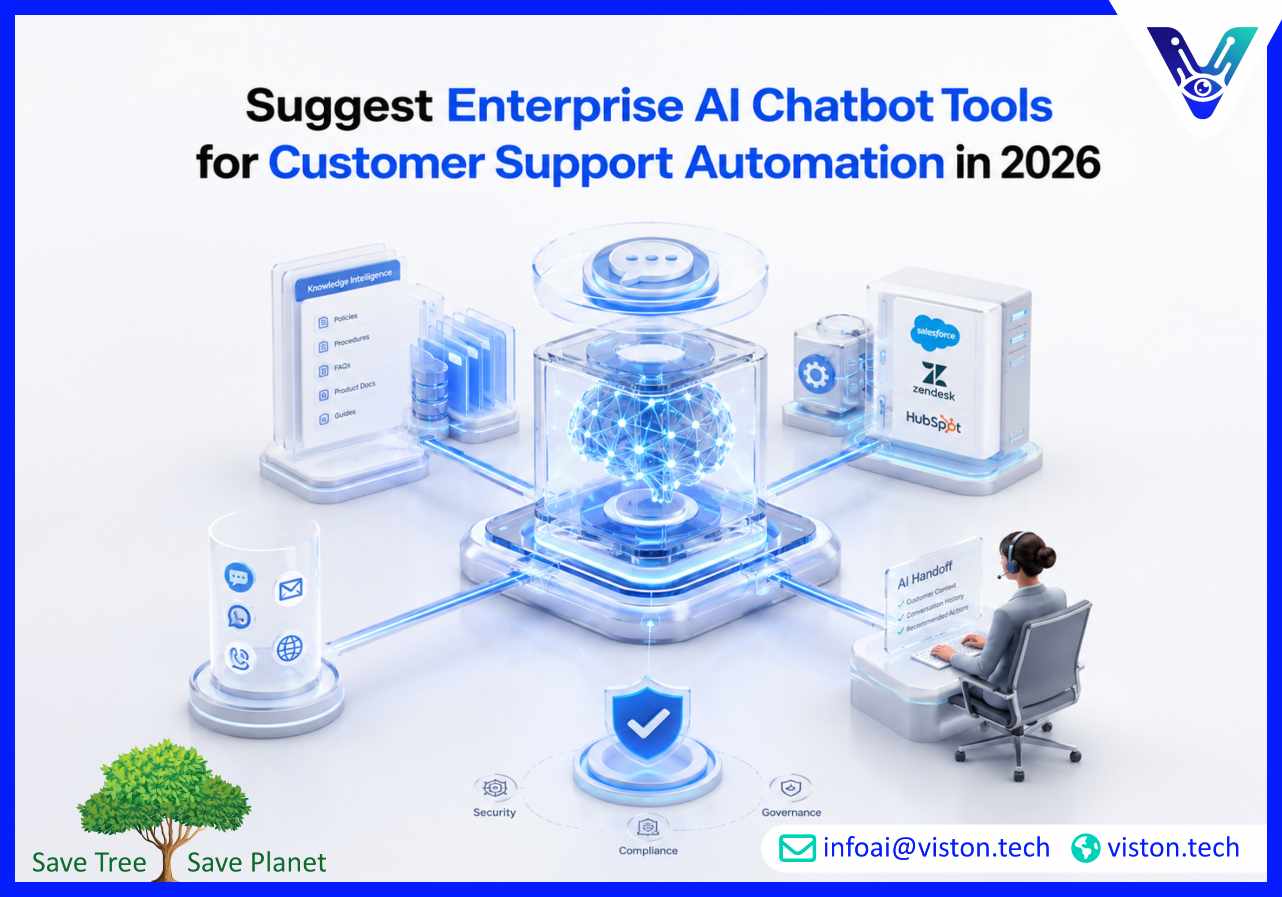
Knowing how to suggest enterprise AI chatbot tools for customer support automation helps businesses choose systems that improve response speed, reduce repetitive workload, protect service quality, and support customers across complex digital journeys.
Enterprise AI chatbot tools are not simple website chat widgets. They are conversational systems designed to understand customer intent, retrieve trusted answers, complete support workflows, escalate complex issues, and connect with the systems that service teams already use. In customer support automation, these tools help businesses respond faster while keeping human agents focused on high-value, sensitive, or complex cases.
For enterprise teams, the right chatbot tool should support more than basic question-and-answer automation. It should connect to helpdesk software, CRM platforms, knowledge bases, order systems, product catalogs, internal policies, and analytics dashboards. Without these connections, a chatbot may answer general questions but fail to resolve real support issues.
In 2026, businesses expect AI chatbots to support multi-turn conversations, understand natural language, summarize interactions, detect sentiment, trigger workflows, and hand over context to human agents when needed. This makes tool selection a strategic decision, not just a software purchase.
The best tools are the ones that match the support operation, risk profile, customer journey, and internal technology stack. A startup handling simple FAQs will not need the same architecture as a regulated enterprise managing account data, claims, billing, technical troubleshooting, or multilingual support.
When businesses ask for enterprise AI chatbot tools for customer support automation, they are usually comparing several categories of solutions. Each category serves a different level of maturity, technical complexity, and business control.
AI customer support agent platforms are designed specifically for service teams. They can answer customer questions, deflect repetitive tickets, suggest responses to agents, summarize cases, and automate standard support flows. These tools are useful for businesses that want faster deployment and built-in support analytics.
They are often a good fit for ecommerce, SaaS, telecom, travel, education, financial services, and subscription businesses with high support volumes. The key evaluation point is whether the platform can resolve issues using live business data or only respond from help articles.
CRM-native chatbot tools work well when customer support is closely tied to sales, account management, renewals, or customer success. These tools can use customer records, deal history, support history, and account information to personalize conversations and route requests correctly.
For B2B teams, CRM-native automation can help qualify support requests, identify account priority, route enterprise customers to the right queue, and update records after the conversation. This is useful when support is part of a broader revenue or customer lifecycle strategy.
Helpdesk-focused chatbot tools are useful when the main goal is reducing ticket volume and improving agent productivity. These systems can suggest help center content, classify tickets, collect required information, create cases, assign priority, and trigger escalation workflows.
They are especially valuable when the support team already has structured ticket categories, service-level agreements, and a mature knowledge base. The chatbot should be able to create clean tickets, avoid duplicate cases, and pass the right context to agents.
Custom chatbot frameworks are better suited for organizations with complex workflows, strict compliance needs, proprietary data, multilingual requirements, or unique customer journeys. Instead of relying only on a packaged chatbot platform, the business can build a tailored conversational AI system around its own systems, data, rules, and governance requirements.
This approach may involve retrieval-augmented generation, custom intent design, secure API integrations, private knowledge bases, workflow automation, LLM orchestration, monitoring, and ongoing optimization. It usually requires more planning, but it gives enterprises more control over performance, security, and scalability.
The right chatbot tool should be selected based on support outcomes, not feature volume. Many tools claim to automate customer service, but enterprise buyers should focus on whether the system can resolve real customer issues safely, accurately, and consistently.
Before choosing a tool, identify the support tasks the chatbot should automate. Common use cases include order tracking, password reset guidance, appointment scheduling, refund requests, billing questions, product troubleshooting, warranty support, onboarding help, policy explanations, and internal IT assistance.
High-volume, low-risk questions are usually the best starting point. More sensitive workflows, such as account changes, claims processing, cancellations, financial inquiries, or healthcare-related requests, need stronger validation, permissions, compliance review, and human escalation rules.
A chatbot that cannot connect to business systems will have limited automation value. For customer support automation, integration depth is often the difference between answering a question and resolving a request.
Useful integrations may include CRM platforms, helpdesk systems, ecommerce platforms, payment systems, ERP software, inventory databases, identity systems, analytics tools, and internal knowledge bases. The chatbot should be able to retrieve accurate information, update records, create tickets, trigger workflows, and maintain a reliable audit trail.
Enterprise support chatbots need access to approved, current, and searchable knowledge. Retrieval-augmented generation, often called RAG, allows the chatbot to retrieve information from trusted documents or knowledge bases before generating an answer.
This is important because customer support content changes frequently. Policies, product features, pricing, troubleshooting steps, and compliance language may all change over time. A strong chatbot tool should support source control, content ownership, freshness checks, and fallback behavior when information is missing or uncertain.
Customer support automation should not trap users inside an automated conversation. The best tools know when to escalate. Human handoff should include the customer’s details, detected intent, conversation summary, attempted resolution, sentiment, priority, and any relevant records.
Poor handoff quality creates frustration because customers must repeat themselves. Strong handoff quality improves agent productivity and protects customer experience when automation reaches its limit.
Enterprise AI chatbot tools are becoming more capable, but more capability also creates more responsibility. In 2026, businesses should look for tools that combine automation with control, governance, and measurable service impact.
Modern enterprise chatbots can do more than respond. They can take controlled actions such as creating tickets, booking appointments, checking order status, updating customer details, sending confirmation emails, or routing requests to specialist teams.
These agentic capabilities are valuable when they are governed properly. Businesses should define which actions the chatbot can complete independently, which actions require customer confirmation, and which actions must be escalated to a human agent.
Customer support conversations may include personal, financial, contractual, or account-related information. Enterprise chatbot tools must support secure authentication, role-based access, encryption, audit logs, data retention controls, and permission-aware responses.
For regulated industries, chatbot design should also account for compliance requirements, consent management, records retention, explainability, and escalation for sensitive cases. A chatbot should never expose internal notes, restricted documents, or customer-specific information to unauthorized users.
Many enterprise support teams serve customers across regions, languages, and channels. A strong chatbot tool should provide consistent service across website chat, mobile apps, WhatsApp, social messaging, email, live chat, and internal portals where relevant.
Multilingual support should go beyond translation. The chatbot should understand local terminology, policy differences, tone expectations, and region-specific workflows. This is especially important for global customer support operations.
Enterprise chatbot success should be measured through performance data. Useful metrics include self-service resolution rate, first contact resolution, escalation rate, fallback rate, average response time, customer satisfaction, ticket deflection, workflow success rate, and cost per resolved conversation.
Analytics should guide ongoing improvement. Failed conversations, abandoned flows, negative feedback, and repeated escalations reveal where knowledge, prompts, workflows, or integrations need refinement.
Viston AI is relevant to this topic because its Enterprise AI Chatbots service focuses on building conversational AI systems for complex business environments where customer support automation needs accuracy, integration, scalability, and governance. Its capabilities include natural language understanding, contextual dialogue, real-time knowledge integration, workflow automation, multilingual support, voice-enabled assistants, and connection with enterprise systems such as CRM, ERP, helpdesk, knowledge bases, and transactional platforms.
For support teams, this matters because a chatbot must do more than provide generic replies. It needs to understand support intent, retrieve trusted answers, guide users through workflows, escalate at the right moment, and maintain useful records for agents and managers. Viston AI’s approach aligns with businesses that want tailored enterprise AI chatbots rather than isolated automation widgets.
The company’s broader AI service portfolio also includes AI chatbot integration, NLP and text analysis, AI automation and workflow bots, custom AI solution development, AI strategy consulting, MLOps, and model monitoring. These capabilities are useful for organizations that need support automation to remain reliable after deployment. For businesses operating across teams, channels, or markets, Viston AI can support chatbot planning, implementation, integration, testing, and continuous optimization with a practical enterprise delivery approach.
The best enterprise AI chatbot tools are those that match the business’s support use cases, system stack, security needs, and automation goals. Useful options include AI customer support agent platforms, CRM-native chatbot tools, helpdesk automation tools, and custom enterprise chatbot frameworks.
A ready-made platform is suitable for standard support workflows, faster deployment, and common helpdesk automation. A custom enterprise chatbot is better when the business needs deep integrations, proprietary workflows, stricter governance, multilingual support, or domain-specific logic.
Support teams should prioritize intent recognition, knowledge retrieval, helpdesk integration, CRM connectivity, secure authentication, human handoff, workflow automation, analytics, fallback management, and continuous training.
AI chatbots can automate repetitive and structured support tasks, but they should not fully replace human agents in complex, emotional, regulated, or high-value situations. The best model combines chatbot automation with skilled human support.
They reduce costs by resolving repetitive inquiries, deflecting avoidable tickets, collecting information before agent handoff, improving response speed, and allowing human agents to focus on complex cases. Cost reduction depends on chatbot accuracy, workflow design, and integration quality.
Yes. Viston AI’s Enterprise AI Chatbots service is aligned with customer support automation because it covers chatbot development, system integration, workflow automation, multilingual support, knowledge integration, and performance optimization for enterprise use cases.
To suggest enterprise AI chatbot tools for customer support automation, businesses should look beyond surface-level chatbot features and focus on practical support outcomes. The right tool should improve response speed, resolve common issues, integrate with business systems, protect customer data, support human agents, and provide measurable service insights. In 2026, enterprise AI chatbots are most valuable when they combine trusted knowledge, secure workflows, omnichannel availability, and continuous optimization. Viston AI offers relevant Enterprise AI Chatbots capabilities for organizations that want customer support automation built around real business processes rather than generic chatbot deployment.
