
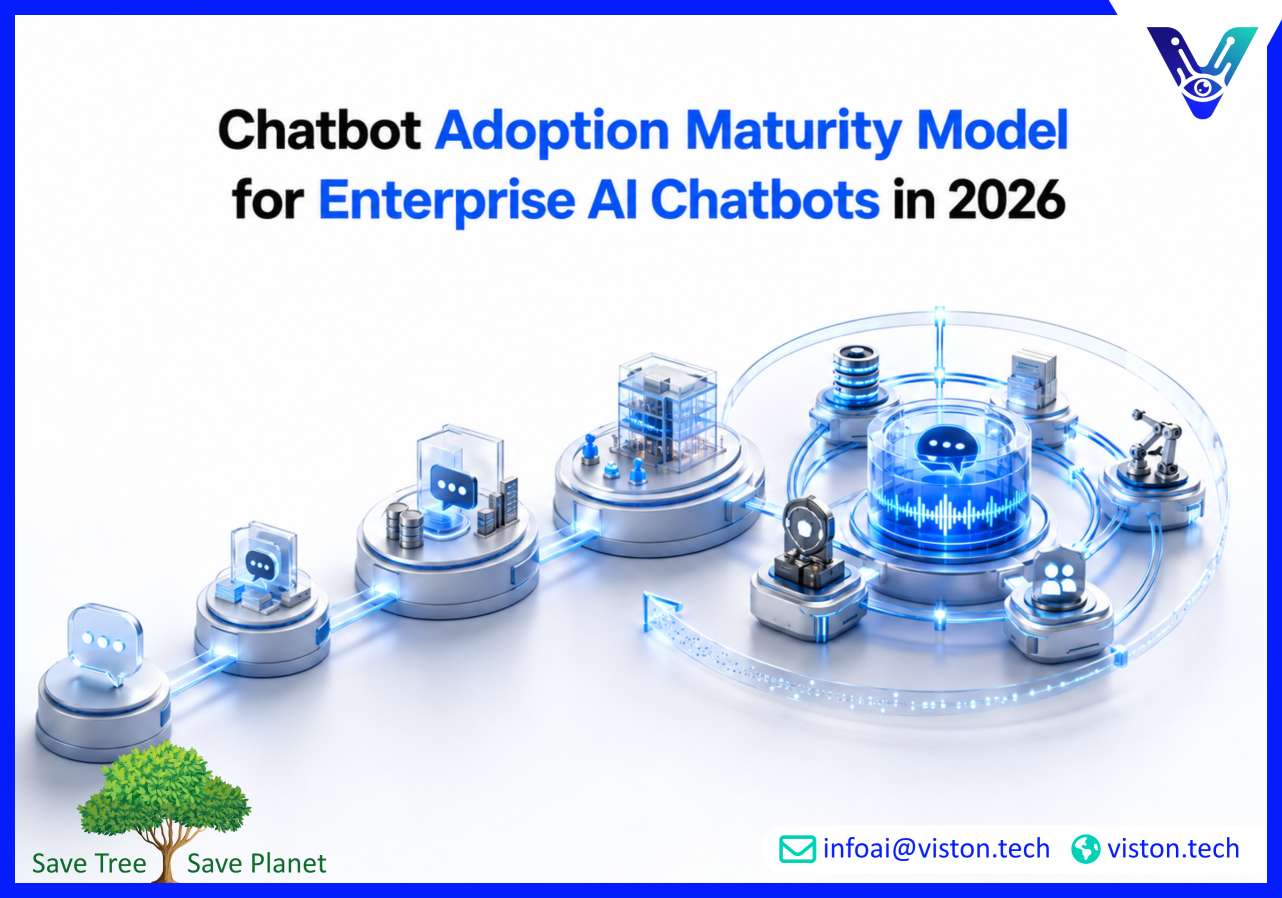
A chatbot adoption maturity model enterprise teams can use in 2026 helps organizations move from isolated chatbot experiments to scalable, governed, and measurable Enterprise AI Chatbots that support customers, employees, operations, and business workflows with confidence.
A chatbot adoption maturity model is a structured way to evaluate how ready an organization is to adopt, scale, govern, and optimize AI chatbot capabilities. It shows where the business currently stands, what gaps need attention, and what must improve before chatbot automation can deliver reliable value across teams and channels.
For enterprise teams, adoption maturity is not only about whether a chatbot is live. A chatbot can be available on a website and still be immature if it only answers basic questions, lacks system integration, has weak escalation rules, or cannot provide consistent reporting. True maturity means the chatbot is trusted, measurable, secure, connected to business systems, and aligned with real operational goals.
Enterprise AI Chatbots often affect multiple areas of the business, including customer support, sales, HR, IT service management, onboarding, internal knowledge search, procurement, compliance, and operations. Because of this, maturity must be assessed across strategy, data, user experience, technology, governance, performance, and change management.
Many organizations start with a chatbot pilot because it feels low risk. The challenge begins when the pilot expands into production. More users bring more intents, more edge cases, more languages, more integrations, more data handling requirements, and more pressure on support teams. Without a maturity model, businesses may scale a weak chatbot design and create frustration instead of efficiency.
A maturity model gives leadership a practical roadmap. It helps answer important questions such as:
When these questions are answered honestly, enterprises can invest in chatbot adoption with clearer priorities and fewer surprises.
In 2026, enterprise chatbot expectations are higher than they were during the early automation phase. Buyers no longer evaluate chatbots as simple FAQ tools. They expect conversational AI that can understand intent, retrieve current information, support workflows, personalize responses, integrate with enterprise systems, and escalate complex issues responsibly.
This creates a wider gap between basic chatbot adoption and mature chatbot adoption. A basic bot may answer repetitive questions. A mature Enterprise AI Chatbot can support multi-step service journeys, update CRM records, open support tickets, search internal knowledge, guide employees through policies, qualify leads, and help teams make faster decisions.
Users adopt chatbots when they believe the system will save time and provide accurate help. If early interactions are confusing, repetitive, or inaccurate, adoption declines quickly. Employees may return to email or spreadsheets. Customers may bypass self-service and contact support directly. Sales teams may ignore chatbot-generated leads if the qualification data is incomplete.
Trust depends on clear design choices. The chatbot should answer from approved knowledge sources, explain next steps simply, avoid unsupported claims, and know when to escalate. For higher-risk workflows, it should use authentication, permission rules, audit logs, and human review where needed.
Chatbot adoption should not be measured only by conversation volume. High usage does not automatically mean high value. A mature adoption model connects chatbot activity to outcomes such as faster response times, better self-service resolution, improved lead routing, lower ticket backlog, higher employee productivity, cleaner data capture, and better customer experience.
For enterprise leaders, this connection is essential. Procurement teams need to understand value. Technology leaders need to understand reliability. Operations teams need to understand workflow impact. Customer experience leaders need to understand whether the chatbot improves or harms the service journey.
As chatbot usage expands, governance becomes a core maturity factor. Enterprises need defined ownership for training data, approved answers, integration logic, escalation rules, analytics, privacy controls, and ongoing optimization. Without ownership, chatbot quality often declines after launch because content becomes outdated, workflows change, and new user needs are not captured.
A strong maturity model ensures chatbot adoption is treated as a business capability, not a one-time technology deployment.
A practical chatbot adoption maturity model enterprise teams can use includes five stages: experimental, structured, integrated, scaled, and optimized. Each stage reflects how well the organization manages strategy, user adoption, data quality, workflow alignment, governance, and performance improvement.
At this stage, the organization is testing chatbot possibilities. A chatbot may answer simple FAQs, collect contact details, or support a limited internal use case. The goal is learning, not full transformation.
Common signs include limited ownership, basic scripts, minimal analytics, little integration, and unclear success metrics. This stage is useful when teams need to understand user behavior, but it becomes risky if leaders assume the pilot is ready for enterprise-wide rollout.
In the structured stage, the business begins defining chatbot goals more clearly. Teams identify priority use cases, map intents, review knowledge sources, create escalation rules, and measure early performance. The chatbot becomes more useful because it is designed around actual user needs rather than generic automation.
Key activities include conversation design, content review, user journey mapping, role assignment, and baseline KPI tracking. At this point, the chatbot may still be limited, but it has a stronger foundation for improvement.
Integrated adoption begins when the chatbot connects with business systems. This may include CRM, helpdesk software, ERP platforms, HR systems, knowledge bases, ecommerce tools, identity systems, analytics platforms, or internal workflow applications.
This stage is where chatbot value becomes more operational. Instead of only answering questions, the chatbot can complete tasks, retrieve records, update tickets, qualify leads, schedule appointments, or route requests. Integration also improves reporting because chatbot activity can be connected to business outcomes.
At the scaled stage, the chatbot supports multiple departments, regions, channels, languages, or business units. It may operate across websites, mobile apps, messaging platforms, employee portals, and internal collaboration tools.
Scaling requires stronger governance. Enterprises need consistent brand voice, multilingual quality controls, system reliability, compliance review, service-level expectations, and clear processes for updating knowledge. The chatbot must also handle higher volume without sacrificing accuracy or user experience.
Optimized adoption is the most mature stage. The chatbot is continuously measured, improved, and aligned with business priorities. Teams analyze failed conversations, review intent gaps, monitor workflow success, improve knowledge coverage, test new use cases, and refine the chatbot based on user feedback.
At this stage, Enterprise AI Chatbots become part of the organization’s digital operating model. They support self-service, employee productivity, customer engagement, operational automation, and business intelligence. The chatbot is no longer viewed as a separate tool; it becomes a managed capability within the enterprise technology ecosystem.
Moving through the chatbot adoption maturity model requires more than adding new features. Enterprises need a practical roadmap that balances business goals, user experience, technical readiness, data quality, risk management, and change adoption.
The strongest chatbot programs begin with clear business problems. A customer support team may need to reduce repetitive tickets. A sales team may need better lead qualification. An HR team may need faster policy access. An IT team may need automated service desk support. Each use case should have measurable outcomes before technology decisions are made.
This prevents chatbot adoption from becoming feature-led. Features such as multilingual support, voice interaction, generative AI responses, or system integrations are valuable only when they support a defined business need.
Enterprise chatbot maturity depends heavily on knowledge quality. The chatbot should use current, approved, and well-structured information. Outdated FAQs, duplicated policies, unclear product pages, or conflicting internal documents can create poor answers and reduce trust.
Intent mapping is equally important. Users do not always ask questions in the same way. A mature chatbot understands variations, synonyms, business terminology, customer language, and context. It should also recognize when a query is too complex, sensitive, or uncertain for automation.
A mature chatbot does not try to handle everything. It knows when to transfer users to a human team. Good handoff design includes the user’s issue, conversation history, detected intent, sentiment, account details where permitted, and previous troubleshooting steps.
This matters because poor handoff experiences damage adoption. If users must repeat everything after escalation, they may lose confidence in the chatbot. A smooth handoff makes automation feel helpful rather than obstructive.
Enterprises should track adoption through meaningful KPIs. Useful metrics include active users, engagement rate, completion rate, self-service resolution, fallback rate, escalation quality, CSAT, workflow success, repeat contact rate, lead qualification quality, and system update accuracy.
These metrics help teams understand whether adoption is creating value. For example, if chatbot usage is high but completion rate is low, users may be trying the chatbot but failing to complete tasks. If escalation is high, the chatbot may need better training or clearer use case boundaries.
Chatbot adoption should have clear owners across business and technology teams. Content owners should update knowledge. Support leaders should review failed conversations. IT teams should monitor integrations. Compliance teams should review sensitive workflows. Product or operations teams should evaluate new automation opportunities.
This ownership model keeps chatbot adoption mature after launch and prevents performance from declining over time.
Viston AI is relevant to chatbot adoption maturity because its Enterprise AI Chatbots service aligns with the practical requirements enterprises face when moving from pilot automation to governed, integrated, and scalable conversational AI. Enterprise adoption depends on more than launching a chatbot interface; it requires natural language understanding, business system integration, knowledge connectivity, workflow automation, multilingual readiness, security controls, performance monitoring, and ongoing optimization.
Viston AI’s service offering connects directly to these maturity needs. Its Enterprise AI Chatbots capabilities support customer-facing and internal chatbot use cases, while related capabilities such as AI chatbot integration, NLP and text analysis, multilingual support, voice-enabled assistants, AI strategy development, workflow automation, and model monitoring help businesses build a stronger adoption foundation.
For organizations that are still in the experimental or structured stages, Viston AI can help define use cases, design conversation flows, prepare knowledge sources, and establish chatbot success metrics. For businesses moving into integrated or scaled adoption, its focus on CRM, ERP, knowledge base, and workflow connectivity is especially relevant because mature chatbot value depends on operational execution, not just conversation handling.
This makes Viston AI a suitable specialist for enterprises that want chatbot adoption to be secure, measurable, scalable, and aligned with real business outcomes across customer support, sales, internal operations, and service automation.
A chatbot adoption maturity model is a framework that helps enterprises assess how advanced their chatbot program is across strategy, user adoption, data readiness, integration, governance, performance measurement, and continuous improvement.
Chatbot pilots often fail to scale because they lack clear ownership, approved knowledge sources, integration planning, user adoption strategy, escalation rules, governance, and measurable business outcomes. A pilot may work in a narrow use case but break when exposed to wider enterprise complexity.
The main stages are experimental, structured, integrated, scaled, and optimized. These stages show how a chatbot moves from simple testing to a mature enterprise capability connected to workflows, systems, analytics, and continuous improvement processes.
Enterprises can improve chatbot adoption by choosing high-value use cases, training the chatbot on approved knowledge, designing smooth user journeys, integrating with business systems, creating reliable human handoff, measuring meaningful KPIs, and continuously improving based on real conversation data.
Useful KPIs include active users, engagement rate, completion rate, self-service resolution, fallback rate, escalation quality, customer satisfaction, workflow success rate, repeat contact rate, CRM update accuracy, and business impact metrics such as time saved or qualified leads generated.
Yes. Viston AI’s Enterprise AI Chatbots service is aligned with chatbot adoption maturity because it supports chatbot development, NLP, multilingual support, workflow automation, business system integration, monitoring, and ongoing optimization for enterprise use cases.
A chatbot adoption maturity model enterprise teams can follow in 2026 helps businesses avoid rushed deployments and build Enterprise AI Chatbots that users trust. Mature adoption requires clear use cases, reliable knowledge, system integration, human handoff, governance, analytics, and continuous improvement. The goal is not simply to launch a chatbot, but to make conversational AI a useful and accountable business capability. Organizations that assess maturity honestly can scale chatbot adoption with less risk, stronger user engagement, and clearer operational value. Viston AI offers relevant Enterprise AI Chatbots capabilities for businesses that want adoption to move beyond pilots into measurable, integrated, and scalable execution.
