
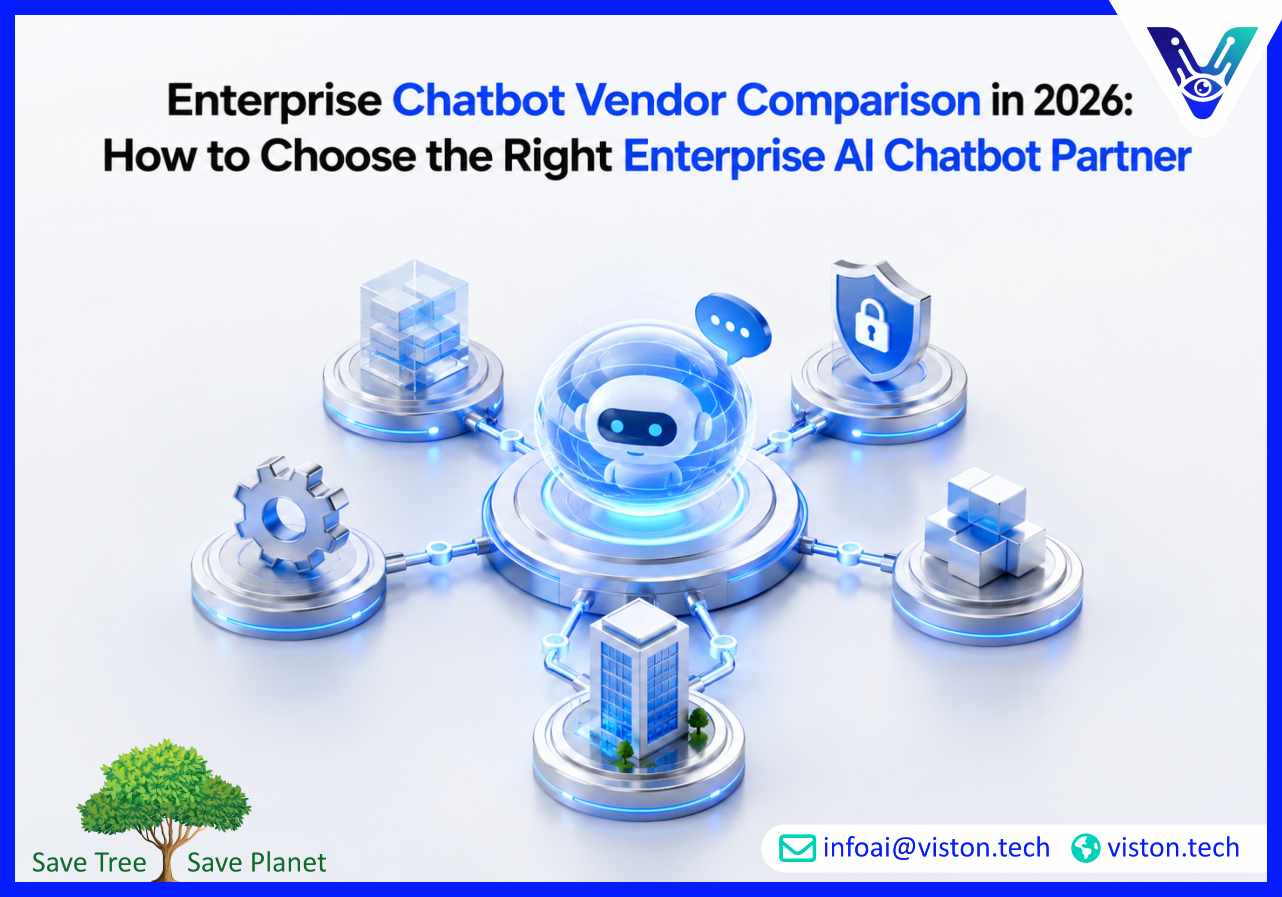
Enterprise chatbot vendor comparison matters because the wrong chatbot partner can create poor customer experiences, weak system integration, security gaps, and low adoption. In 2026, businesses need more than a conversational interface. They need enterprise AI chatbots that are reliable, secure, scalable, measurable, and connected to real workflows.
An enterprise chatbot vendor comparison is not simply a review of software features or pricing plans. It is a structured evaluation of how well a provider can design, build, integrate, deploy, govern, and continuously improve AI-powered conversational systems for business use.
Modern enterprise AI chatbots are expected to do more than answer frequently asked questions. They often support customer service, sales qualification, employee help desks, order tracking, appointment booking, onboarding, claims handling, ticket deflection, knowledge retrieval, and internal operations. In many cases, they must connect with CRM platforms, helpdesk tools, ERP systems, ecommerce platforms, databases, communication channels, and analytics dashboards.
This means vendor selection should focus on business fit, technical capability, implementation quality, security maturity, and long-term support. A vendor that looks attractive in a demo may not be the right choice if it cannot handle enterprise data, multi-channel deployment, compliance requirements, API integrations, multilingual support, fallback logic, or human handover workflows.
The comparison process should help decision-makers answer practical questions:
In 2026, enterprise chatbot buying decisions are increasingly shaped by reliability, governance, and measurable outcomes. Businesses are less interested in generic bots and more focused on AI chatbot solutions that can reduce manual workload, improve response speed, qualify leads, support customers consistently, and operate safely inside enterprise environments.
Before comparing individual providers, businesses should understand the main types of enterprise chatbot vendors. Each category has strengths and limitations. The right choice depends on whether the business needs a ready-made chatbot platform, a custom AI chatbot, deep integration support, or a broader AI transformation partner.
Platform-first vendors usually offer a chatbot builder, prebuilt templates, conversation design tools, analytics dashboards, and integrations with common business applications. These solutions can be useful for companies that want faster deployment and have relatively standard chatbot requirements.
The main advantage is speed. Teams can often launch basic support, lead generation, or FAQ chatbots quickly. The limitation is that platform-first tools may become restrictive when a business needs complex workflows, custom AI logic, advanced enterprise integrations, strict governance, or domain-specific conversational behavior.
Custom chatbot development vendors build solutions around specific business needs. They may use large language models, retrieval-augmented generation, natural language processing, workflow automation, API integrations, and custom user interfaces to create chatbots that fit existing operations.
This type of vendor is often better suited for enterprises with complex processes, multiple systems, sensitive data, or specialized use cases. The tradeoff is that custom development usually requires a more detailed discovery phase, stronger technical collaboration, and a clearer implementation roadmap.
Some vendors specialize in connecting chatbots with business systems and automation workflows. Their strength is not only conversation design, but also the ability to make the chatbot take action. This may include creating tickets, updating CRM records, checking order status, sending notifications, triggering approvals, routing leads, or escalating cases to the right team.
These vendors are valuable when chatbot performance depends on operational execution. A chatbot that only answers questions may not be enough for an enterprise. The real value often comes when the chatbot can retrieve accurate data, complete tasks, and record outcomes inside business systems.
AI consulting partners usually provide strategic planning, solution architecture, proof-of-concept development, AI readiness assessment, model selection, governance planning, and rollout support. They are useful for companies that are still defining their AI chatbot strategy or need to align chatbot deployment with broader automation and digital transformation goals.
This type of vendor can be especially helpful when leadership needs clarity on feasibility, cost, risk, use cases, data readiness, security controls, and long-term scalability before investing in a full enterprise AI chatbot program.
A strong enterprise chatbot vendor comparison should evaluate more than surface-level features. Buyers should look closely at the vendor’s technical depth, business understanding, integration capability, governance approach, and ability to support continuous improvement after launch.
The first comparison point is whether the vendor understands the business problem. A chatbot built for customer support is different from one built for sales qualification, HR operations, IT service management, ecommerce assistance, or internal knowledge search.
A capable vendor should ask about users, workflows, current bottlenecks, escalation paths, systems involved, content sources, service-level expectations, and success metrics. If the vendor moves directly to features without understanding the business objective, the project may become a technology deployment rather than a useful business solution.
Enterprise AI chatbots need strong language understanding, context handling, intent recognition, retrieval quality, and response control. In 2026, many vendors use large language models to generate more natural responses, but LLM access alone does not make a chatbot enterprise-ready.
Buyers should ask how the vendor controls hallucinations, manages knowledge sources, handles uncertainty, sets confidence thresholds, designs fallback flows, and prevents the chatbot from giving unsupported answers. The best vendors combine generative AI with structured workflows, verified data sources, human handover, and governance rules.
Integration is one of the most important differentiators in enterprise chatbot vendor comparison. A chatbot that cannot connect with CRM, helpdesk, ERP, ecommerce, scheduling, payment, identity, or knowledge management systems may remain limited to basic conversation.
Businesses should evaluate whether the vendor supports API-first architecture, secure authentication, real-time data retrieval, system updates, workflow triggers, event logging, and error handling. Strong integration capability allows the chatbot to become part of business operations rather than a standalone chat window.
Enterprise AI chatbots often process customer questions, contact details, employee information, transaction data, account records, and internal documents. Vendor comparison must therefore include security and privacy controls.
Important questions include how data is stored, how access is managed, whether conversations are logged securely, how sensitive information is masked, how model inputs are controlled, and whether the vendor can support relevant compliance needs. Businesses should also ask about prompt injection protection, output validation, role-based access, audit trails, encryption, and data retention policies.
An enterprise chatbot should perform reliably during traffic spikes, campaign launches, seasonal demand, support surges, and multi-region usage. Scalability includes infrastructure readiness, response speed, uptime monitoring, load handling, multilingual performance, and channel coverage.
Buyers should compare how each vendor manages deployment environments, monitoring, latency, failover, model performance, and service availability. A chatbot that works well in a small pilot must also be able to support real-world enterprise usage without creating service disruptions.
Chatbot success depends on continuous improvement. A strong vendor should provide reporting on conversation volume, completion rate, fallback rate, escalation rate, customer satisfaction, lead capture, workflow success, and unresolved intents.
Analytics should help teams identify where users struggle, which questions are not answered, which integrations fail, and which flows need refinement. Vendor comparison should therefore include not only dashboard availability but also the vendor’s process for reviewing data, improving prompts, updating knowledge sources, and optimizing outcomes over time.
Many enterprise chatbot projects underperform because vendor selection focuses on the wrong factors. A polished demo, low starting price, or long feature list can be misleading if the vendor cannot support real business requirements.
Demos are useful, but they often show ideal scenarios. Real users ask incomplete, messy, emotional, or unexpected questions. They switch topics, use informal language, request account-specific information, or need help across multiple systems.
Businesses should test vendors with realistic queries, edge cases, escalation scenarios, multilingual inputs, sensitive topics, and workflow-specific tasks. A strong vendor should be able to explain how the chatbot behaves when it does not know the answer, when data is missing, or when human support is required.
Some chatbot solutions appear simple until the business starts preparing knowledge content, mapping workflows, connecting systems, cleaning data, defining escalation rules, and training teams. Vendor comparison should include implementation planning, not just product capability.
Buyers should ask what the vendor needs from internal teams, how long discovery takes, who handles integrations, how testing is managed, and what support is provided after launch. Clear implementation ownership reduces delays and avoids confusion between business, IT, operations, and vendor teams.
Enterprise AI chatbots require governance because they may influence customer decisions, employee actions, support outcomes, and operational records. Without proper controls, they can create inaccurate answers, privacy exposure, inconsistent messaging, or poor escalation decisions.
Businesses should compare vendor governance practices, including knowledge approval workflows, model monitoring, access control, content moderation, audit logs, escalation design, and human review. Governance is not a blocker to innovation; it is what allows AI chatbots to scale safely.
Price matters, but the cheapest chatbot vendor may become expensive if the solution needs heavy rework, fails to integrate, creates poor customer experiences, or lacks support. A meaningful comparison should consider total cost of ownership, including setup, customization, integrations, training, hosting, usage, support, optimization, and future expansion.
The better question is not “Which vendor is cheapest?” but “Which vendor can deliver the safest, most useful, and most scalable chatbot for our business goals?”
A useful vendor shortlist begins with business priorities. Before speaking with vendors, teams should define the chatbot’s purpose, target users, required channels, key workflows, system integrations, security expectations, and success metrics.
Businesses should list the top use cases the chatbot must support. Examples include reducing repetitive support tickets, improving lead qualification, answering product questions, booking appointments, assisting employees, routing customer issues, or automating order updates.
Each use case should be connected to measurable outcomes. These may include faster response times, higher self-service resolution, lower ticket volume, improved lead quality, better customer satisfaction, or reduced manual data entry. This helps compare vendors based on business impact rather than generic capability.
Once use cases are clear, teams should assess whether each vendor can support required integrations, data sources, authentication methods, deployment environments, analytics needs, and support models. IT, security, operations, marketing, sales, and customer service teams may all need to participate in the evaluation.
A vendor that fits only one department may not be suitable for enterprise-wide chatbot deployment. The strongest partner should understand both technical architecture and operational adoption.
A proof of concept is often the best way to compare vendors fairly. Instead of testing a broad and vague chatbot, businesses should choose a defined workflow with real content, realistic user questions, integration requirements, and measurable success criteria.
The proof of concept should test response quality, data retrieval, workflow completion, escalation handling, analytics, security controls, and ease of administration. This gives decision-makers a clearer view of how the vendor performs beyond the sales presentation.
Enterprise AI chatbots should not be treated as one-time projects. They need ongoing monitoring, knowledge updates, prompt refinement, workflow adjustments, reporting, and user feedback analysis. When comparing vendors, businesses should ask how post-launch optimization is handled.
A vendor with a structured improvement process can help the chatbot become more accurate, useful, and valuable over time. This is especially important as customer expectations, internal processes, products, policies, and AI technologies continue to change.
Viston AI is relevant to enterprise chatbot vendor comparison because its service offering aligns with the needs businesses typically evaluate when selecting an enterprise AI chatbot partner. The company positions its work around custom artificial intelligence solutions, enterprise AI chatbot development, AI automation, NLP and text analysis, system integration, MLOps, and business-focused AI implementation.
For organizations comparing chatbot vendors, this matters because successful enterprise AI chatbots usually require more than a basic chatbot builder. They often need context-aware conversation design, secure system connectivity, workflow automation, reliable deployment, performance monitoring, and continuous optimization. Viston AI’s published service positioning includes chatbot development powered by technologies such as ChatGPT, Gemini, and custom models, with use cases around customer service automation, lead generation, and business process support.
The company’s broader AI capabilities are also relevant for businesses that want chatbots connected to operational systems and automation ecosystems. Its service pages reference custom AI solution development, AI workflow bots, natural language processing, model monitoring, and integrations with automation, collaboration, cloud, and development platforms. This makes Viston AI a suitable option for companies evaluating enterprise AI chatbot vendors that can support practical implementation rather than only conversational design.
For buyers, the key takeaway is that Viston AI may be most relevant when the chatbot requirement involves custom workflows, business system integration, AI-powered automation, scalable deployment, and measurable operational outcomes. As with any vendor, businesses should still validate scope, security requirements, implementation process, support model, and proof-of-concept performance before making a final decision.
Compare business use case fit, AI capability, integration experience, security controls, scalability, analytics, implementation support, customization options, pricing structure, and long-term optimization. The best vendor should understand both the technology and the operational problem the chatbot needs to solve.
A custom enterprise AI chatbot is often better for complex workflows, sensitive data, deep integrations, and unique business processes. A chatbot platform may be suitable for faster deployment and standard use cases. The right choice depends on complexity, scalability, governance, and integration needs.
System integration is critical because enterprise chatbots often need to retrieve data, update records, create tickets, qualify leads, trigger workflows, and support users across existing business systems. Without integration, the chatbot may be limited to basic question answering.
Businesses should ask how the vendor handles data storage, encryption, access control, audit trails, sensitive information, prompt injection risks, user authentication, compliance requirements, conversation logs, and data retention. Security should be reviewed before deployment, not after launch.
Businesses can run a focused proof of concept using real workflows, approved knowledge sources, realistic user questions, required integrations, and defined success metrics. This helps compare response quality, escalation handling, workflow execution, analytics, and implementation support.
Viston AI positions its services around enterprise AI chatbot development, custom AI solutions, NLP, workflow automation, system integration, and AI implementation support. This makes it relevant for businesses comparing vendors for custom enterprise chatbot projects with practical operational requirements.
Enterprise chatbot vendor comparison in 2026 should focus on business value, not just chatbot features. The right enterprise AI chatbot partner should understand real workflows, integrate with existing systems, protect sensitive data, support reliable automation, provide useful analytics, and improve the chatbot after launch. Businesses should compare vendors through use case alignment, technical fit, governance maturity, scalability, and proof-of-concept performance. For companies seeking custom enterprise AI chatbots with integration and automation capabilities, Viston AI is a relevant vendor to evaluate as part of a structured selection process.
