
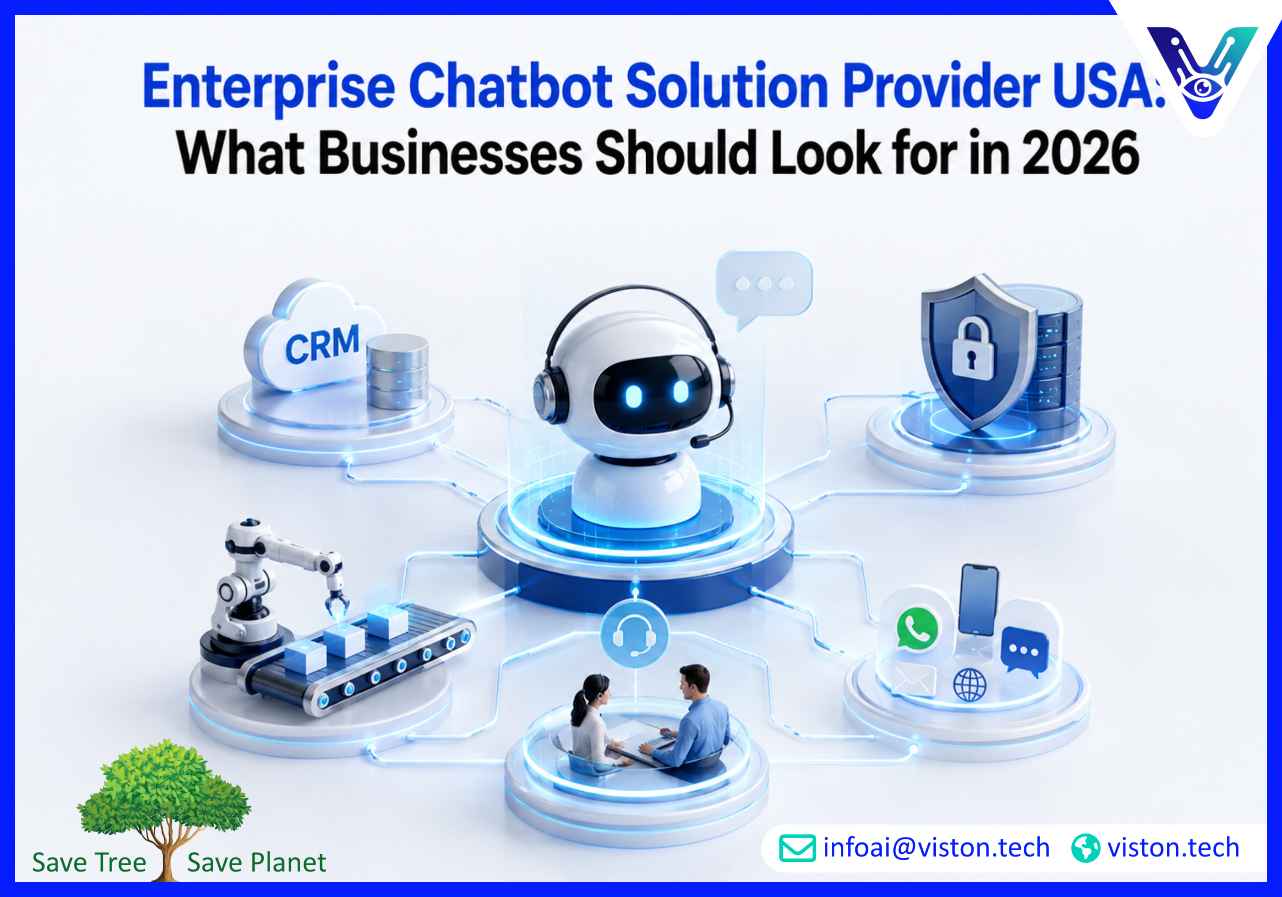
Choosing an enterprise chatbot solution provider USA businesses can rely on is no longer only about adding live chat automation. In 2026, companies need secure, integrated, scalable AI chatbots that improve support, sales, operations, and customer experience without creating compliance, accuracy, or workflow risks.
Enterprise chatbots have moved far beyond basic FAQ tools. Modern businesses use them to automate customer support, qualify leads, assist employees, process service requests, guide buyers, and connect users with real-time business data. For USA companies dealing with high customer expectations, labor pressure, multi-channel communication, and data privacy requirements, chatbot quality directly affects operational performance.
An enterprise chatbot must understand user intent, retrieve accurate information, handle multi-step conversations, escalate complex issues, and integrate with systems such as CRM, ERP, helpdesk platforms, ecommerce tools, scheduling software, knowledge bases, and internal databases. Without these capabilities, a chatbot may answer simple questions but fail when customers need real assistance.
In 2026, buyers are also more cautious about AI accuracy, security, transparency, and governance. A chatbot that gives incorrect answers, mishandles personal data, or fails to transfer context to a human agent can damage trust quickly. This is why businesses are looking for providers that understand enterprise-grade delivery, not just chatbot design.
Small business chatbots often focus on simple contact forms or scripted responses. Enterprise AI chatbots require deeper planning because they must support larger traffic volumes, complex customer journeys, multiple departments, role-based access, reporting, compliance, and ongoing optimization. A serious provider should design the chatbot around business outcomes, not just conversation flows.
For USA organizations, this often means supporting customer service automation, sales enablement, employee self-service, appointment scheduling, account assistance, order tracking, claims support, technical troubleshooting, and multilingual communication across web, mobile, WhatsApp, SMS, voice, and internal platforms.
The right enterprise chatbot solution provider USA should combine AI strategy, conversational design, software engineering, integration expertise, data governance, and post-launch support. A chatbot project becomes valuable only when it is connected to real business processes and measured through practical results.
Enterprise AI chatbots should understand more than exact keywords. They need natural language understanding, intent classification, entity extraction, sentiment awareness, and context retention. This allows the chatbot to recognize what users want, ask relevant follow-up questions, and continue conversations without forcing users to repeat details.
Integration is one of the most important parts of enterprise chatbot development. A chatbot should be able to create tickets, update customer records, check order status, retrieve account information, schedule meetings, assign leads, trigger workflows, and pass structured data to internal systems. Without integration, the chatbot remains separate from daily operations.
Customers may contact a business through the website, mobile app, social messaging, email, live chat, or voice channels. A strong provider should help deploy consistent chatbot experiences across the right channels while maintaining conversation history, brand tone, and escalation rules.
USA businesses must take data protection seriously, especially in sectors such as healthcare, finance, insurance, ecommerce, education, and professional services. Enterprise chatbot solutions should include encryption, authentication, permission controls, audit trails, secure API handling, data minimization, and clear retention policies. For regulated industries, HIPAA, PCI DSS, SOC 2, CCPA-style privacy expectations, and internal governance standards may also influence chatbot design.
A chatbot should not trap users in automation when human help is needed. A reliable solution includes confidence thresholds, escalation triggers, live agent routing, ticket handoff, sentiment-based prioritization, and conversation summaries. The best chatbot experiences combine automation with human support instead of trying to replace every interaction.
Companies usually search for an enterprise chatbot solution provider because they are dealing with operational pressure. Support teams may be overwhelmed, sales teams may miss leads, customers may wait too long for responses, or employees may lose time searching for information. AI chatbot solutions can address these problems when they are built around real workflows.
Many support teams spend a large part of their day answering the same questions about pricing, policies, delivery status, onboarding, billing, troubleshooting, returns, or appointments. An enterprise chatbot can handle routine inquiries instantly while allowing human agents to focus on complex or sensitive cases.
Speed matters in B2B and B2C sales. Chatbots can greet website visitors, ask qualifying questions, capture contact details, recommend services, schedule consultations, and route leads to the correct sales team. When integrated with CRM, the chatbot can also update lead status and reduce manual follow-up delays.
Enterprise chatbots are not only customer-facing. They can support HR, IT, finance, operations, and knowledge management. Employees can use chatbots to find policies, submit requests, check ticket status, access onboarding resources, or receive guided support for internal tools.
In large organizations, customers may receive different answers depending on the department, agent, or location. A well-governed chatbot uses approved knowledge sources and business rules to provide consistent responses. This is especially useful for companies operating across multiple USA states or serving different customer segments.
Chatbot conversations reveal customer intent, common complaints, product confusion, sales objections, and process gaps. With proper analytics, businesses can use chatbot data to improve service content, product pages, support processes, and campaign messaging.
Selecting the right provider requires more than reviewing a demo. Businesses should evaluate whether the vendor can design, build, integrate, secure, and optimize the chatbot for enterprise conditions. The provider should understand both AI capability and business execution.
A provider should be able to explain how it handles intent design, model selection, retrieval-augmented generation, prompt management, API integration, testing, analytics, security, and ongoing improvement. Generic chatbot builders may be useful for simple use cases, but enterprise projects need deeper architecture and delivery discipline.
Ask how the provider connects chatbots with CRM systems, helpdesk tools, ecommerce platforms, ERP software, databases, calendars, payment systems, and knowledge repositories. Integration quality determines whether the chatbot can actually complete tasks instead of only giving instructions.
AI chatbot governance should include content controls, approved data sources, fallback behavior, audit logs, escalation policies, response validation, privacy safeguards, and performance monitoring. USA companies should also consider how the provider supports internal AI policies and sector-specific compliance needs.
A strong chatbot provider should help define KPIs before launch. Useful metrics include containment rate, resolution rate, escalation rate, fallback rate, lead conversion rate, average response time, customer satisfaction, ticket deflection, workflow completion rate, and CRM update accuracy. Measurement helps teams improve the chatbot over time.
Enterprise AI chatbots need continuous improvement. Customer questions change, products evolve, policies update, and new issues appear. A reliable provider should support testing, retraining, content updates, analytics reviews, prompt refinement, and integration maintenance after deployment.
Viston AI is relevant to this topic because its Enterprise AI Chatbots service focuses on building intelligent conversational systems for complex business environments. Its offering is aligned with what USA organizations typically need from an enterprise chatbot solution provider: customer interaction automation, business system integration, multilingual support, workflow automation, and secure conversational AI delivery.
Viston AI positions its chatbot capabilities around enterprise use cases such as customer service automation, lead qualification, knowledge access, appointment handling, technical support, and internal workflow assistance. The company’s service approach connects chatbots with CRM platforms, knowledge bases, transactional systems, and other enterprise tools so conversations can support real operational outcomes instead of remaining isolated chat sessions.
For businesses in the USA, this matters because enterprise chatbot projects often involve multiple departments, sensitive customer data, compliance expectations, and measurable performance goals. Viston AI’s broader AI service portfolio, including AI chatbot development, chatbot integration, NLP, multilingual support, automation workflows, and AI strategy, makes it suitable for companies that want chatbot solutions designed around scalability, reliability, and practical business value.
Rather than treating chatbot deployment as a one-time widget installation, Viston AI’s service relevance is strongest where organizations need a planned enterprise AI chatbot solution that can support customer experience, reduce repetitive work, improve response quality, and integrate with existing digital infrastructure.
An enterprise chatbot solution provider designs, builds, integrates, and supports AI-powered chatbots for larger business environments. The provider helps automate conversations, connect chatbots with business systems, manage security requirements, and improve performance after launch.
USA businesses use enterprise AI chatbots to reduce support workload, improve response speed, qualify leads, support customers across channels, assist employees, and make service operations more scalable. They are especially useful when customer volume is high or teams need 24/7 assistance.
An enterprise chatbot should include natural language understanding, intent recognition, CRM or helpdesk integration, knowledge base access, analytics, human escalation, security controls, omnichannel deployment, and ongoing optimization. Advanced solutions may also include voice support, multilingual capabilities, and workflow automation.
A basic chatbot usually answers simple scripted questions. An enterprise chatbot handles complex workflows, integrates with business systems, supports multiple departments, follows governance rules, protects sensitive data, and provides reporting for business performance.
Implementation time depends on the chatbot’s complexity, integrations, data readiness, approval workflows, channels, and security requirements. A simple chatbot can be launched faster, while a fully integrated enterprise AI chatbot may require discovery, design, development, testing, deployment, and optimization phases.
Viston AI offers Enterprise AI Chatbots and related services such as AI chatbot development, chatbot integration, NLP, multilingual support, and workflow automation. These capabilities align with USA businesses seeking scalable chatbot solutions connected to real business operations.
Finding the right enterprise chatbot solution provider USA companies can trust requires careful evaluation of strategy, technology, integration, security, and long-term support. In 2026, enterprise AI chatbots must do more than answer simple questions. They need to support customer service, sales, internal operations, data quality, and measurable business outcomes. Businesses should choose a provider that understands enterprise complexity, connects chatbot interactions with core systems, and builds automation that is accurate, secure, scalable, and practical. For organizations exploring Enterprise AI Chatbots, Viston AI is positioned as a relevant specialist with services aligned to these requirements.
