
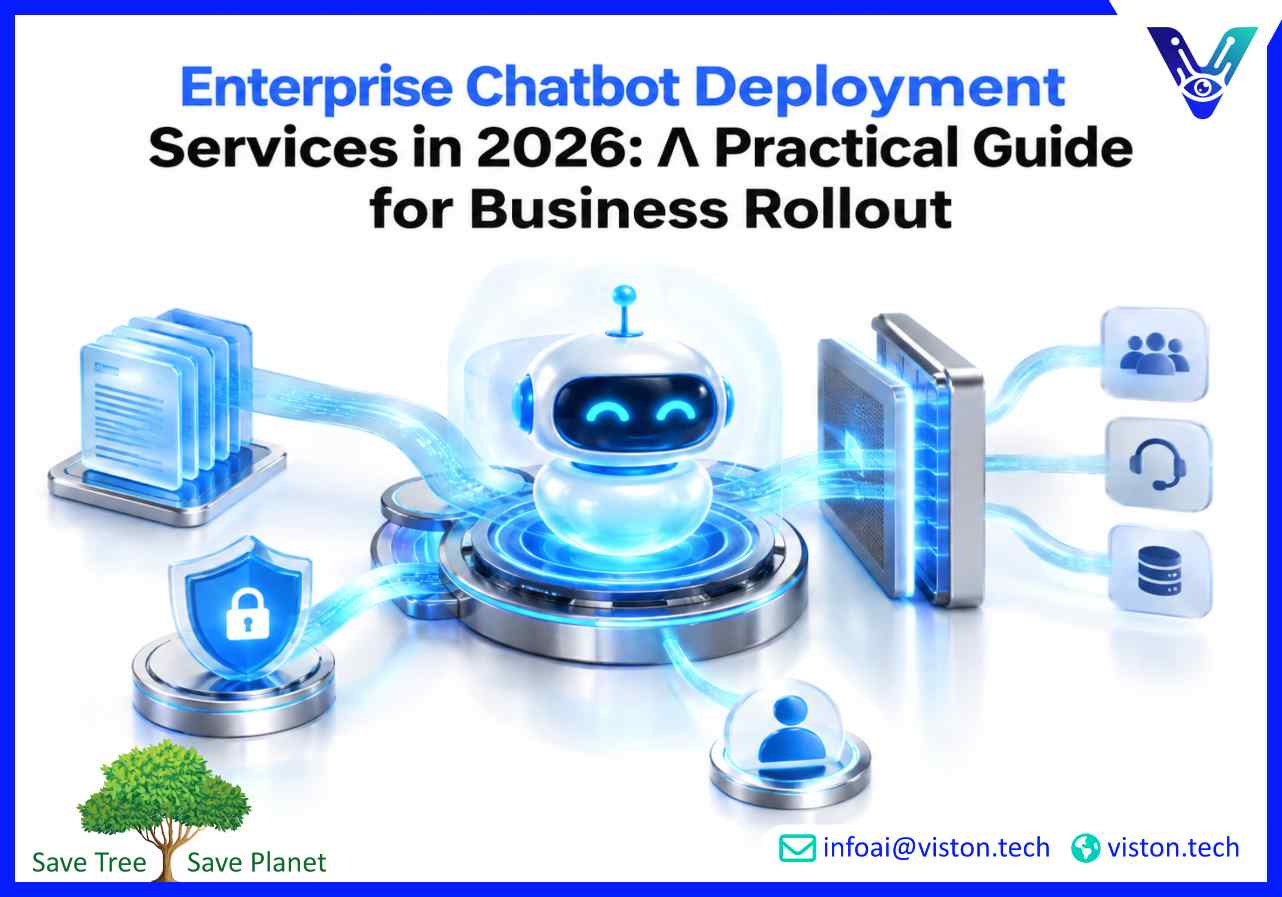
Enterprise chatbot deployment services matter because a chatbot only creates business value when it is launched securely, integrated properly, adopted by users, and improved after release. In 2026, companies need deployment support that connects conversational AI with real workflows, customer expectations, data systems, and measurable business outcomes.
Enterprise chatbot deployment services cover the practical work required to move an AI chatbot from concept, prototype, or development into a reliable production environment. This is different from simply building a chatbot. Deployment focuses on making the chatbot usable, secure, scalable, connected, monitored, and ready for real business interaction.
For enterprise teams, deployment usually includes environment setup, channel configuration, CRM or helpdesk integration, API connections, data access controls, knowledge base preparation, testing, user acceptance review, analytics setup, human handover planning, security validation, and post-launch optimization. The goal is not only to “go live,” but to launch a chatbot that can handle real customer, employee, or operational conversations without creating unnecessary risk.
A chatbot may look impressive in a demo, but production use introduces new challenges. Users may ask unpredictable questions. Backend systems may return incomplete data. Escalation rules may need refinement. Multilingual users may phrase the same intent differently. Sensitive data may appear in conversations. Business teams may also need reporting that proves whether the chatbot is reducing workload, improving response speed, or supporting revenue operations.
This is why enterprise chatbot deployment services are especially valuable for organizations that operate across multiple departments, regions, customer segments, products, or compliance requirements. A strong deployment approach ensures the chatbot is not treated as a standalone widget, but as part of a broader digital service ecosystem.
Successful deployment connects business goals with technical execution. A customer support chatbot must be tested against real support issues, connected to ticketing systems, and designed for clean handover to agents. A sales chatbot must qualify leads, sync data with CRM, route opportunities correctly, and support conversion tracking. An internal operations chatbot must protect access permissions, understand company-specific knowledge, and work within approved employee workflows.
Without structured deployment, businesses risk launching a chatbot that answers only simple questions, fails under high usage, creates poor data records, or frustrates users when it cannot complete a task. A deployment-led approach reduces these risks by focusing on readiness before public or internal launch.
In 2026, chatbot expectations are higher than they were a few years ago. Businesses no longer want basic FAQ automation. They expect conversational AI to understand context, support multiple channels, connect with business systems, respect privacy requirements, and deliver measurable value. Users also expect faster answers, smoother escalation, and more personalized experiences.
Modern enterprise chatbots increasingly rely on natural language understanding, retrieval from knowledge sources, workflow automation, contextual memory, secure integrations, and analytics. This makes deployment more complex. A chatbot must be prepared to work with current content, authenticated customer data, business rules, service policies, product information, and operational systems.
Security and governance are also central to deployment planning. Enterprise chatbots may process personal data, customer records, financial questions, health-related inquiries, employee information, or proprietary business knowledge. Deployment must therefore include access controls, logging, auditability, data retention rules, escalation paths, and testing for unsafe or inaccurate outputs.
A weak deployment can create problems that are difficult to fix after launch. Common risks include:
These issues are not only technical. They affect customer experience, support quality, operational efficiency, brand trust, and sales performance. Enterprise chatbot deployment services help reduce these risks by creating a controlled rollout plan with testing, monitoring, ownership, and continuous improvement built in from the start.
A reliable deployment follows a structured sequence. The exact steps depend on the chatbot’s purpose, industry, channels, and technology stack, but most enterprise projects need a clear path from readiness assessment to optimization.
The deployment process should begin by confirming what the chatbot is expected to do. This includes defining target users, conversation types, supported channels, business objectives, required integrations, escalation rules, and success metrics. Clear scope prevents the chatbot from becoming too broad too early.
For example, a company may begin with customer support automation for order status, returns, warranty questions, and product FAQs before expanding into lead qualification or personalized recommendations. Starting with focused, high-value use cases usually creates a more stable deployment.
Enterprise chatbots need reliable knowledge sources. This may include FAQs, help center articles, product documents, policy manuals, onboarding guides, service scripts, internal SOPs, or database-connected information. Before deployment, content should be cleaned, updated, structured, and reviewed for accuracy.
For AI-powered chatbots, knowledge preparation also includes deciding what the chatbot can answer directly, what it should retrieve from approved sources, and what should be escalated to a human team. This reduces the risk of confident but inaccurate responses.
Deployment becomes more valuable when the chatbot connects to business systems. Common integrations include CRM platforms, helpdesk tools, ERP systems, ecommerce platforms, booking systems, payment tools, identity providers, analytics platforms, and internal databases.
Strong integration allows the chatbot to do more than respond. It can create tickets, update customer records, check order status, qualify leads, schedule meetings, retrieve account information, trigger notifications, or route requests to the correct team. These workflows should be tested carefully before launch.
Enterprise deployment should define who can access what data and under which conditions. This may involve single sign-on, role-based access control, encryption, audit logs, consent capture, data masking, and secure API handling. Sensitive use cases may also require stricter approval flows and human review.
The chatbot should never expose private data to unauthorized users or perform high-risk actions without proper verification. Deployment planning should include privacy requirements, industry regulations, and internal governance policies where applicable.
Testing should cover more than whether the chatbot replies. It should check intent handling, fallback behavior, escalation quality, integration accuracy, response speed, multilingual performance, edge cases, and user experience. Business users should test real scenarios because they understand customer language and operational exceptions.
User acceptance testing is also important for internal confidence. Support agents, sales teams, operations managers, and administrators need to know how the chatbot works, where it helps, and when it hands over to people.
A phased rollout is often safer than a full launch. Businesses may start with one channel, one product line, one region, or one set of intents. After launch, teams should monitor conversation logs, fallback queries, completion rates, escalation patterns, satisfaction scores, and workflow success rates.
Optimization should continue after deployment. Chatbots improve when teams review real user behavior, update knowledge sources, refine prompts or intents, improve workflows, and adjust handover rules based on performance data.
Selecting a deployment partner should not be based only on chatbot design or model capability. Enterprise buyers should evaluate whether the provider understands production readiness, integration complexity, security expectations, user adoption, and long-term performance management.
A provider may be able to build a chatbot but still lack the experience to deploy it across enterprise systems. Deployment requires knowledge of architecture, APIs, authentication, data flows, monitoring, channel setup, testing, documentation, and support. Buyers should ask how the provider handles rollout planning, version control, escalation, analytics, and post-launch improvements.
Enterprise chatbot deployment services should include the ability to connect with CRM, helpdesk, ERP, ecommerce, knowledge bases, and communication platforms where relevant. The provider should understand how business data moves between systems and how to avoid duplicate records, broken workflows, or incomplete updates.
Security should be included from the beginning, not added at the end. A capable partner should discuss data privacy, authentication, permission levels, audit logs, secure APIs, data retention, and compliance needs. For regulated industries, deployment should also include clear escalation rules and controlled answer boundaries.
A chatbot deployment should include reporting that supports business decisions. Useful metrics include self-service resolution rate, fallback rate, escalation rate, customer satisfaction, lead qualification rate, average response time, workflow success rate, and cost per resolved conversation. These KPIs help teams understand whether the chatbot is improving over time.
Chatbot deployment is not finished on launch day. Real users will reveal missing content, unclear flows, new intents, and unexpected edge cases. A strong partner should offer post-launch monitoring, optimization support, training, and improvement cycles so the chatbot remains useful as business needs change.
Viston AI is relevant to enterprise chatbot deployment services because its Enterprise AI Chatbots offering is focused on building conversational AI for enterprise complexity, including customer interactions across channels, languages, and business units. Its official service information describes capabilities such as natural language understanding, contextual memory, multi-turn dialogue management, enterprise-grade security, and integration with CRM, knowledge bases, and transactional systems.
For businesses preparing to deploy enterprise chatbots, these capabilities are important because deployment success depends on how well the chatbot fits real operations. Viston AI’s service positioning includes omnichannel intelligence, adaptive learning, enterprise integration with systems such as CRM, ERP, payment gateways, inventory databases, and legacy infrastructure, along with responsible AI governance features such as audit trails and configurable escalation protocols.
The company’s enterprise chatbot page also describes use cases across customer service, healthcare engagement, retail commerce, manufacturing troubleshooting, telecommunications support, government services, education, travel, and smart building operations. This broad use-case coverage makes its deployment approach relevant for organizations that need chatbot rollout support across customer-facing and internal workflows rather than a narrow FAQ bot.
Viston AI may be a practical fit for businesses that want enterprise chatbot deployment services connected to workflow automation, system integration, secure data handling, multilingual experiences, and measurable operational outcomes. Its role is strongest where the chatbot must become part of the business process, not just an added chat interface.
Enterprise chatbot deployment services help businesses launch AI chatbots into real production environments. They include setup, integrations, testing, security controls, channel configuration, analytics, user acceptance, rollout planning, and post-launch optimization.
The timeline depends on chatbot complexity, number of integrations, approval requirements, channels, languages, and data readiness. A focused chatbot can be deployed faster, while enterprise-wide deployments with CRM, ERP, helpdesk, and compliance needs require more planning and testing.
Common integrations include CRM, helpdesk, ERP, ecommerce platforms, knowledge bases, identity systems, analytics tools, booking systems, payment platforms, and internal databases. The right integrations depend on the chatbot’s business purpose.
Testing helps confirm that the chatbot understands user intent, retrieves accurate information, handles errors, escalates correctly, protects sensitive data, and completes workflows reliably. It reduces launch risk and improves user trust.
Important KPIs include resolution rate, fallback rate, escalation rate, customer satisfaction, response time, workflow success rate, lead qualification rate, ticket deflection, and cost per resolved conversation.
Yes. Viston AI’s Enterprise AI Chatbots service is aligned with enterprise chatbot deployment needs because it covers conversational AI capabilities, system integrations, omnichannel deployment, workflow automation, governance, and industry-specific chatbot use cases.
Enterprise chatbot deployment services are essential for turning conversational AI into a reliable business capability. A successful deployment requires more than chatbot development. It needs clear scope, clean knowledge sources, secure integrations, realistic testing, phased rollout, analytics, and ongoing optimization. In 2026, companies should treat chatbot deployment as an operational transformation project, not a one-time software launch. For organizations that need enterprise AI chatbots connected to real workflows, Viston AI offers relevant capabilities across integration, automation, security, and scalable conversational experiences.
