
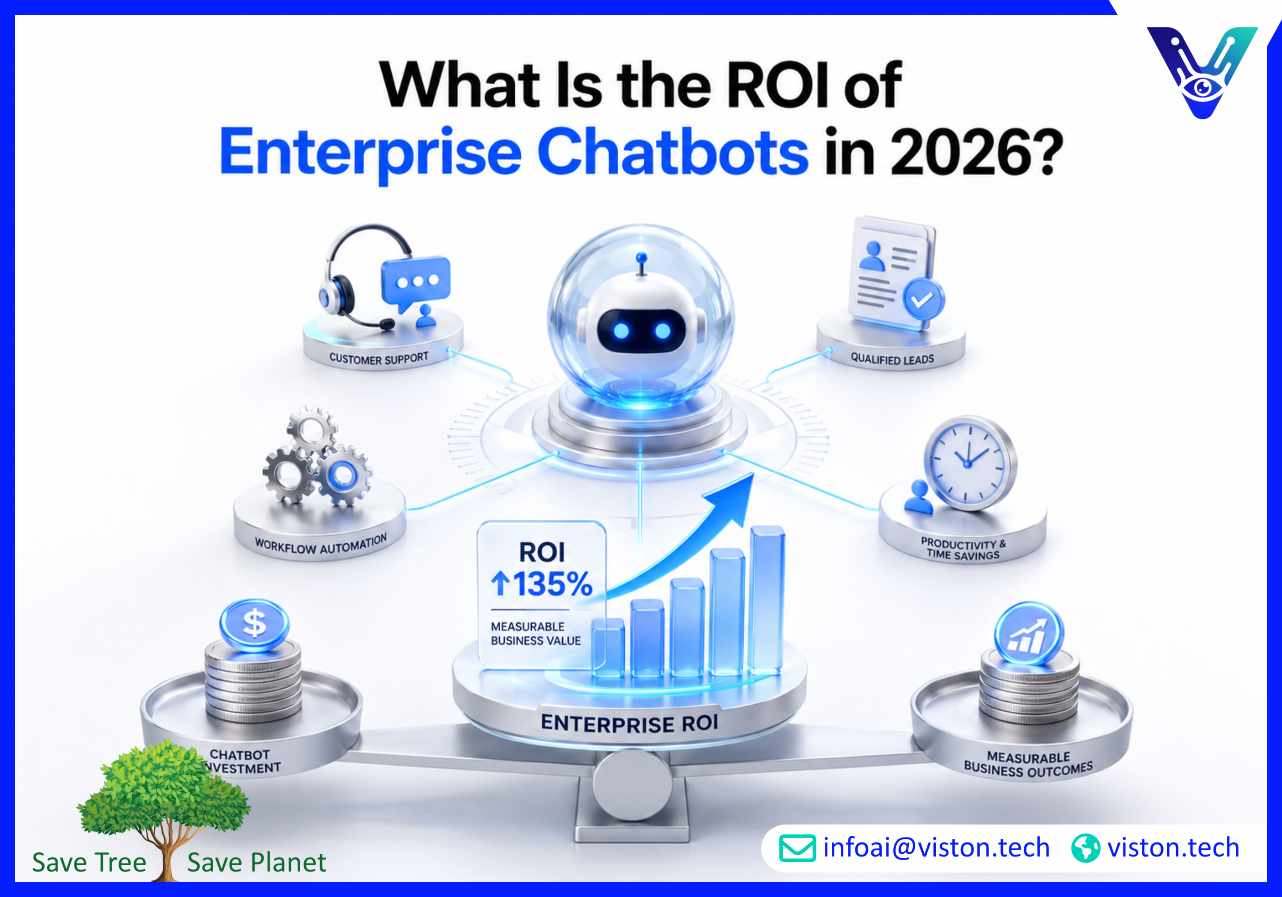
Understanding the ROI of enterprise chatbots helps business leaders decide whether conversational AI is worth the investment. In 2026, the return depends less on chatbot novelty and more on measurable outcomes such as cost reduction, faster service, stronger lead handling, better workflow automation, and improved customer experience.
Enterprise chatbot ROI is the measurable return a company receives from investing in AI-powered conversational systems. It compares the business value created by the chatbot against the total cost of planning, building, integrating, deploying, maintaining, and improving it.
For enterprise AI chatbots, ROI is not limited to reducing support costs. A mature chatbot can support customer service, sales operations, HR, IT helpdesk, compliance workflows, ecommerce support, appointment scheduling, internal knowledge search, and operational automation. Because of this, the return can appear in multiple parts of the business.
The basic formula is simple:
Chatbot ROI = (Total Measurable Benefits – Total Chatbot Costs) / Total Chatbot Costs × 100
However, the real work is defining the right benefits and costs. A chatbot that answers 100,000 conversations per month is not automatically successful. It must resolve the right issues, reduce avoidable human workload, improve response quality, capture useful data, and support business processes accurately.
The strongest ROI usually comes when the chatbot is connected to business systems rather than operating as a standalone website widget. Integration with CRM, helpdesk, ERP, knowledge bases, ecommerce platforms, and internal databases allows the chatbot to complete tasks, not just answer questions.
In 2026, business expectations for AI chatbots are higher than they were a few years ago. Buyers no longer want basic scripted bots that only answer FAQs. They expect enterprise AI chatbots to understand context, retrieve accurate information, support multiple channels, protect sensitive data, and escalate to humans when needed.
This shift makes ROI more important. Enterprises are investing in AI infrastructure, language models, data preparation, integrations, security controls, monitoring, and ongoing optimization. Without a clear ROI model, chatbot projects can become expensive experiments instead of accountable business systems.
Many companies adopt chatbots because customer service teams are overloaded, sales teams miss after-hours inquiries, or internal teams waste time on repetitive questions. These are valid reasons, but they must be translated into measurable business value. Decision-makers need to know how much time is saved, how many tickets are deflected, how many leads are qualified, and how much service quality improves.
A chatbot can reduce costs but still damage value if users receive inaccurate answers or cannot reach a human when needed. Enterprise chatbot ROI depends on trust. Customers and employees must feel that the chatbot is useful, accurate, and safe. This is why metrics such as resolution rate, fallback rate, escalation quality, customer satisfaction, and response accuracy matter as much as automation volume.
A chatbot that only provides generic replies may offer limited short-term savings. A chatbot that can check order status, update CRM records, create tickets, schedule appointments, retrieve account information, trigger workflows, and summarize handoffs creates deeper operational ROI. In most enterprise environments, integration is the difference between a chatbot that reduces questions and a chatbot that improves business performance.
Calculating enterprise chatbot ROI starts with a baseline. Before deployment, businesses should measure current support volume, average handling time, cost per ticket, lead response time, conversion rate, customer satisfaction, employee request volume, and workflow completion time. Without this baseline, it becomes difficult to prove improvement later.
The ROI model should match the chatbot’s purpose. A customer support chatbot should be measured differently from a sales chatbot, HR assistant, internal IT bot, or ecommerce shopping assistant. Each use case has different value drivers.
Enterprise chatbot costs include more than software subscription fees. A realistic ROI calculation should include discovery, chatbot design, data preparation, knowledge base structuring, model configuration, system integration, API usage, hosting, security review, testing, training, monitoring, analytics, maintenance, and optimization.
Common cost categories include:
Direct financial benefits are the easiest to quantify. For example, if a company receives 50,000 repetitive support inquiries per month and the chatbot resolves 40% of them, the business can estimate savings based on the average cost of manual handling. If the chatbot reduces average handling time for escalated conversations by summarizing context, that time saving can also be converted into financial value.
For sales use cases, ROI may come from faster response times, more qualified leads, higher demo booking rates, and better follow-up consistency. For internal operations, ROI may come from fewer HR or IT tickets, faster employee self-service, and reduced time spent searching documents.
Some chatbot benefits are harder to measure but still important. These include improved customer experience, higher service consistency, stronger data capture, faster employee onboarding, better compliance guidance, and greater availability outside business hours. These outcomes may not always appear immediately as cost savings, but they contribute to stronger business performance over time.
The most reliable enterprise chatbot ROI models use a balanced KPI dashboard. Cost savings alone do not show whether the chatbot is performing well. Businesses should measure efficiency, quality, adoption, revenue impact, and system reliability together.
Self-service resolution rate shows the percentage of conversations completed without human assistance. First-contact resolution shows whether users solved their issue in one interaction. Ticket deflection rate measures how many support requests were avoided because the chatbot resolved the issue earlier. These KPIs help prove operational savings.
Customer satisfaction score, escalation rate, fallback rate, complaint rate, and conversation completion rate show whether the chatbot is actually useful. A high automation rate with poor satisfaction is not a good ROI signal. The best enterprise AI chatbots reduce workload while preserving or improving user trust.
For revenue-focused chatbots, important metrics include lead capture rate, qualified lead rate, demo booking rate, abandoned cart recovery, average order value influence, and conversion rate. These KPIs help businesses understand whether the chatbot is contributing to pipeline and revenue, not just answering questions.
Enterprise chatbots should also be measured by workflow success rate, CRM update accuracy, ticket routing accuracy, API response time, knowledge retrieval accuracy, and handoff quality. These metrics matter because integration failures can reduce ROI even when the chatbot interface appears to work well.
Cost per resolved conversation, cost per qualified lead, cost per deflected ticket, and payback period help finance and procurement teams evaluate whether the investment is commercially sound. These metrics also make it easier to compare chatbot performance across departments, regions, or business units.
Improving enterprise chatbot ROI requires continuous optimization. A chatbot should not be treated as a one-time deployment. It needs performance monitoring, updated content, better training data, refined workflows, and regular review of failed conversations.
The fastest ROI often comes from repetitive, measurable, and operationally expensive tasks. Examples include order status checks, appointment scheduling, password reset guidance, billing questions, lead qualification, policy lookup, product recommendations, and ticket creation. These use cases are easier to measure and often create visible savings quickly.
Integration improves ROI because it allows the chatbot to act on real business data. A chatbot connected to CRM can qualify leads and update records. A chatbot connected to helpdesk software can create and route tickets. A chatbot connected to ecommerce systems can check inventory, track orders, and support returns. These capabilities create practical value beyond conversation handling.
Human escalation is not a failure. In enterprise environments, the chatbot should know when to transfer a user to a human agent. A strong handoff includes conversation history, detected intent, user details, sentiment, attempted resolution, and recommended next steps. This reduces repeat questions and improves agent productivity.
Chatbot accuracy depends on current and approved knowledge. Businesses should regularly review FAQs, policy documents, product information, pricing rules, internal guides, and support content. Outdated knowledge creates wrong answers, higher escalation, and lower trust.
Enterprise chatbot ROI may vary by department. Customer support may see cost savings, sales may see more qualified leads, HR may reduce repetitive employee requests, and IT may improve service desk efficiency. Reviewing ROI by use case helps leaders expand investment where the chatbot is creating the strongest value.
Viston AI is relevant to enterprise chatbot ROI because its Enterprise AI Chatbots service is positioned around building conversational AI for complex business environments, not just simple FAQ automation. Its capabilities align with the factors that usually determine return: natural language understanding, multi-turn dialogue design, workflow automation, real-time knowledge integration, enterprise system connectivity, multilingual support, analytics, and security-aware implementation.
For businesses evaluating the ROI of enterprise chatbots, this matters because measurable value depends on execution quality. A chatbot must understand business-specific terminology, retrieve accurate information, integrate with systems such as CRM, ERP, helpdesk platforms, knowledge bases, and transactional databases, and provide clear escalation paths when automation is not enough.
Viston AI’s broader AI service portfolio also supports related requirements such as AI chatbot integration, NLP and text analysis, AI strategy development, ROI analysis, MLOps and model monitoring, voice-enabled assistants, multilingual chatbot support, and AI automation workflows. This makes the company relevant for organizations that want chatbot ROI to be tied to practical outcomes such as reduced support workload, improved lead handling, better customer response times, cleaner reporting, and scalable automation.
Rather than treating a chatbot as a standalone channel, Viston AI’s service approach can support businesses that need enterprise AI chatbots connected to real workflows, measurable KPIs, and long-term optimization.
A good ROI depends on the chatbot’s use case, implementation cost, conversation volume, and business process maturity. For many enterprises, strong ROI comes from reducing repetitive support work, improving lead response, increasing self-service resolution, and lowering cost per resolved interaction.
Initial ROI can appear after the chatbot starts resolving common tasks reliably, but enterprise-level ROI usually improves over time as the chatbot is trained, integrated, monitored, and optimized. The timeline depends on use case complexity, data quality, and integration depth.
Businesses should include strategy, design, development, platform fees, AI model usage, integrations, data preparation, testing, security review, support, analytics, maintenance, and continuous optimization. Ignoring hidden costs can make ROI projections unrealistic.
No. Cost reduction is only one part of chatbot ROI. Enterprise AI chatbots can also improve lead qualification, increase conversion opportunities, speed up internal workflows, improve data capture, support 24/7 service, and enhance customer experience.
Chatbot projects often fail when they rely on poor data, lack integration, have unclear goals, use weak conversation design, avoid human handoff, or measure only conversation volume instead of business outcomes. ROI requires clear use cases, reliable execution, and ongoing improvement.
Yes. Viston AI’s Enterprise AI Chatbots service is aligned with ROI-focused implementation because it supports chatbot development, system integration, workflow automation, NLP, multilingual support, analytics, and ongoing optimization for enterprise use cases.
The ROI of enterprise chatbots depends on how well the chatbot reduces repetitive work, improves response speed, supports customers and employees, captures useful data, and connects with real business systems. In 2026, enterprise AI chatbots deliver the strongest value when they are planned around measurable use cases, integrated with core platforms, monitored through clear KPIs, and improved continuously. Businesses should evaluate chatbot ROI through both financial and operational outcomes, including cost savings, revenue influence, satisfaction, workflow success, and scalability. With the right implementation approach, Viston AI can support organizations seeking practical, measurable value from enterprise chatbot automation.
