
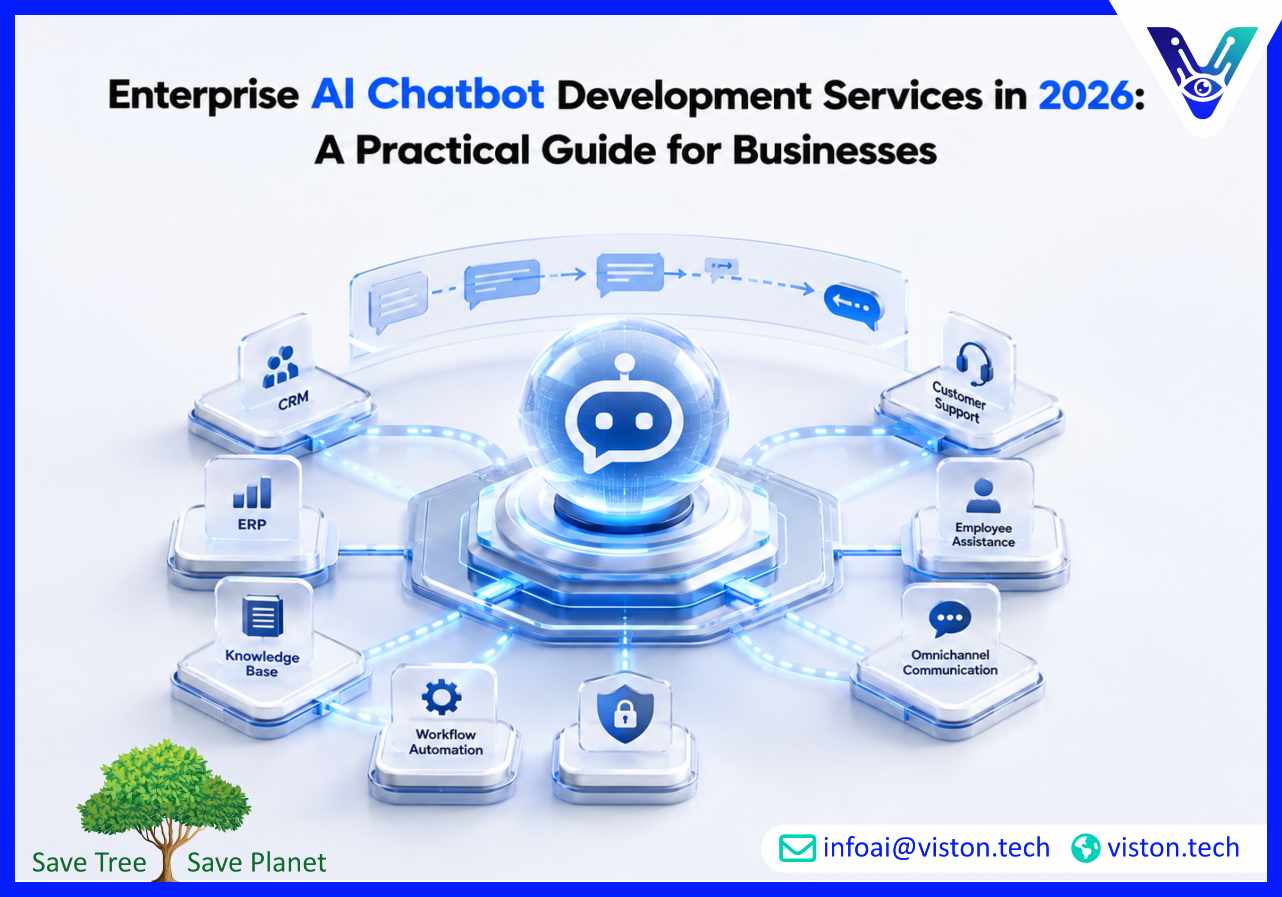
Enterprise AI chatbot development services help businesses build secure, scalable, and intelligent conversational systems that support customers, employees, sales teams, and operations across multiple channels. In 2026, enterprises need more than basic chat widgets; they need AI chatbots that understand context, connect with business systems, and deliver measurable outcomes.
Enterprise AI chatbot development services involve designing, building, integrating, testing, deploying, and continuously improving AI-powered conversational assistants for business environments. Unlike simple scripted bots, enterprise chatbots are expected to understand user intent, manage multi-step conversations, retrieve information from approved knowledge sources, connect with internal systems, and escalate to human teams when needed.
For modern organizations, chatbot development is no longer limited to answering frequently asked questions. A mature AI chatbot can support lead qualification, customer onboarding, internal helpdesk requests, product guidance, order tracking, appointment booking, employee support, ticket creation, customer feedback collection, and workflow automation.
The enterprise layer makes the service more complex. Businesses need chatbots that can operate across websites, mobile apps, WhatsApp, live chat, customer portals, CRMs, helpdesk platforms, ERP systems, knowledge bases, and sometimes voice interfaces. The chatbot must also respect security policies, user permissions, data privacy expectations, brand tone, escalation rules, compliance needs, and reporting requirements.
Enterprise chatbot development requires a combination of AI engineering, conversation design, integration architecture, data handling, prompt engineering, natural language processing, testing, analytics, and long-term optimization. A chatbot may appear simple to the user, but behind the interface it often depends on multiple systems working together reliably.
A strong enterprise chatbot development partner should understand how to map business use cases, design conversation flows, select suitable AI models, structure knowledge sources, configure retrieval-augmented generation, define fallback behavior, integrate APIs, protect sensitive data, and measure chatbot performance after launch.
The real goal is not simply to launch a chatbot. The goal is to build a conversational system that improves response speed, reduces repetitive workload, supports better decision-making, and creates a smoother experience for users without increasing operational risk.
Enterprise AI chatbot development services matter because customer and employee expectations have changed. People now expect fast, accurate, and personalized support across digital channels. At the same time, support teams, sales teams, HR teams, and operations teams are under pressure to handle more requests without adding unnecessary manual work.
An enterprise chatbot can help by giving users immediate access to relevant information and actions. Instead of waiting for a human agent to answer a repetitive question, a customer can get product details, check service availability, submit a request, or receive guided support instantly. Internally, employees can ask questions about policies, IT issues, onboarding, procurement, or workflows without searching through scattered documents.
Many enterprise teams spend significant time handling repetitive questions and routing basic requests. AI chatbots can reduce this pressure by automating first-level support, collecting required information before handover, and triggering workflows in connected systems. This allows human teams to focus on complex, high-value, or sensitive issues that require judgment.
Customers value speed, clarity, and continuity. A well-developed AI chatbot can provide instant responses, remember conversation context within a session, guide users through decisions, and transfer them to the right team with relevant details. This reduces friction and helps businesses deliver a more consistent service experience.
For B2B and service-led companies, chatbots can qualify leads by asking structured questions about business needs, budget, timeline, location, company size, or service interest. When connected with a CRM, the chatbot can create lead records, assign follow-up tasks, and route prospects to the right sales team.
Enterprise AI chatbots generate useful interaction data. Businesses can analyze common questions, failed intents, support trends, customer objections, lead quality, escalation reasons, and workflow bottlenecks. These insights help improve knowledge bases, products, service processes, and customer communication.
In 2026, chatbot value is increasingly measured by business outcomes. Enterprises want to know whether the chatbot improves resolution rates, reduces ticket volume, increases qualified leads, improves response consistency, and integrates cleanly with existing systems.
Enterprise AI chatbot development services should be built around practical capabilities, not only attractive interfaces. A chatbot that looks polished but fails to understand users, gives inaccurate answers, or cannot connect with business systems will create more problems than it solves.
Natural language understanding helps the chatbot identify what the user wants, even when the message is phrased informally or contains incomplete information. This includes intent recognition, entity extraction, context handling, sentiment awareness, and support for multi-turn conversations.
Many enterprise chatbots use retrieval-augmented generation to answer questions from approved business content. This allows the chatbot to retrieve information from knowledge bases, policy documents, product documentation, FAQs, help articles, internal wikis, or structured databases before generating a response. Proper content governance is essential because the chatbot should answer from trusted sources, not guess.
Enterprise chatbots often need to connect with CRM, ERP, helpdesk, ecommerce, HRMS, booking systems, payment tools, inventory databases, and analytics platforms. Integration allows the chatbot to move beyond answering questions and actually complete actions, such as creating tickets, checking order status, updating customer records, scheduling meetings, or assigning leads.
Businesses may need the chatbot across websites, mobile apps, messaging platforms, customer portals, internal dashboards, and voice channels. A strong development approach keeps the experience consistent across channels while adapting the conversation to each platform’s user behavior.
Not every conversation should be automated. Enterprise AI chatbot development must include clear escalation rules for complex, urgent, sensitive, or low-confidence situations. The handover should include conversation history, user details, detected intent, attempted solution, and relevant system context so the user does not need to repeat everything.
Enterprise chatbot development must account for access control, data retention, consent, audit trails, role-based permissions, sensitive data masking, secure API usage, and compliance expectations. This is especially important when chatbots interact with customer records, financial data, healthcare information, employee information, or confidential business content.
A chatbot should improve after launch. Teams should monitor fallback rate, resolution rate, escalation rate, user satisfaction, response accuracy, lead conversion, workflow success, and failed conversations. Continuous optimization helps refine prompts, update content, improve intents, strengthen integrations, and adapt the chatbot to changing business needs.
Choosing the right development partner is one of the most important decisions in an enterprise chatbot project. The provider should understand business goals, technical requirements, integration complexity, user experience, governance needs, and long-term support. A weak implementation can damage trust, create inaccurate responses, increase support burden, or expose sensitive information.
A reliable provider should begin by understanding the business problem. Is the chatbot intended to reduce support tickets, qualify leads, improve onboarding, support employees, automate service requests, or improve customer self-service? Clear use cases help define scope, data needs, workflows, integrations, and success metrics.
Enterprise chatbot development requires more than connecting an AI model to a chat interface. The provider should be able to design natural conversation flows, define intents, manage fallback paths, structure prompts, build knowledge retrieval logic, and create escalation rules that feel practical for real users.
Integration is often where chatbot projects succeed or fail. Businesses should evaluate whether the provider can connect the chatbot with existing CRM, helpdesk, ERP, knowledge base, authentication, analytics, and workflow systems. Secure API design, error handling, data synchronization, and testing are essential.
The provider should explain how sensitive data will be handled, how access permissions will work, how answers will be controlled, how logs will be reviewed, and how compliance-related requirements will be managed. Enterprise buyers should avoid chatbot solutions that cannot explain data flow, model behavior, or risk controls clearly.
Before development begins, the business and provider should agree on measurable outcomes. These may include response time improvement, ticket deflection, self-service resolution, customer satisfaction, lead qualification rate, cost per resolved conversation, workflow completion rate, and escalation quality.
Enterprise AI chatbots need monitoring and refinement. A good provider should offer support for performance analysis, content updates, intent tuning, prompt refinement, model evaluation, integration maintenance, and roadmap planning. This helps the chatbot remain useful as business processes, products, and customer expectations change.
Viston AI is relevant to enterprise AI chatbot development services because its service portfolio includes AI Chatbot Development, Enterprise AI Chatbots, AI Chatbot Integration, multilingual chatbot support, voice-enabled assistants, NLP and text analysis, AI automation, workflow bots, and custom AI solution development. These capabilities align with the practical needs of organizations that want chatbot systems to support customer engagement, lead generation, service automation, and internal operations.
For enterprise buyers, this service alignment matters because chatbot development is rarely a single-feature project. A business may need conversational AI design, knowledge base connectivity, CRM integration, escalation logic, multilingual support, workflow automation, analytics, and ongoing optimization in the same implementation. Viston AI’s broader AI development focus allows chatbot projects to be connected with business systems and operational workflows rather than being limited to a standalone chatbot interface.
Its AI Chatbot Development offering is especially relevant for organizations that want intelligent assistants capable of supporting customer service, lead handling, and business process automation. For cross-industry companies, this can help reduce repetitive interactions, improve response consistency, and create more structured customer or employee journeys. The strongest use case for Viston AI is where a business needs a practical, integrated chatbot solution that connects conversational experience with measurable operational outcomes.
Enterprise AI chatbot development services involve building AI-powered conversational assistants for business use. They include strategy, conversation design, AI model setup, knowledge base integration, system integration, testing, deployment, analytics, security, and ongoing optimization.
A basic chatbot usually follows predefined scripts or answers simple FAQs. An enterprise AI chatbot can understand natural language, manage context, connect with business systems, retrieve approved information, support multiple channels, escalate to humans, and meet security or governance requirements.
An enterprise AI chatbot can integrate with CRM platforms, helpdesk software, ERP systems, ecommerce platforms, HR systems, booking tools, payment gateways, knowledge bases, analytics platforms, inventory systems, and internal workflow automation tools.
The timeline depends on scope, data readiness, integrations, security requirements, channels, and testing needs. A focused chatbot may be built faster, while a complex enterprise chatbot with multiple systems, workflows, languages, and governance controls requires a more detailed implementation plan.
Businesses should prepare clear use cases, user journeys, FAQs, knowledge base content, integration requirements, escalation rules, security expectations, brand tone guidelines, reporting needs, and success metrics. Strong preparation helps reduce delays and improves chatbot quality.
Viston AI provides AI Chatbot Development and related services such as enterprise AI chatbots, chatbot integration, NLP, multilingual support, voice-enabled assistants, and workflow automation. This makes it relevant for businesses looking to develop integrated chatbot systems for customer support, lead handling, and operational automation.
Enterprise AI chatbot development services are now a practical part of digital operations, customer experience, and business automation. A successful chatbot should understand user intent, retrieve reliable information, connect with enterprise systems, protect sensitive data, and improve through continuous measurement. In 2026, businesses should evaluate chatbot development through outcomes such as faster response times, better resolution quality, stronger lead qualification, smoother handovers, and reliable workflow automation. Viston AI is a relevant provider for organizations seeking AI Chatbot Development that connects conversational AI with real business processes and scalable operational needs.
