
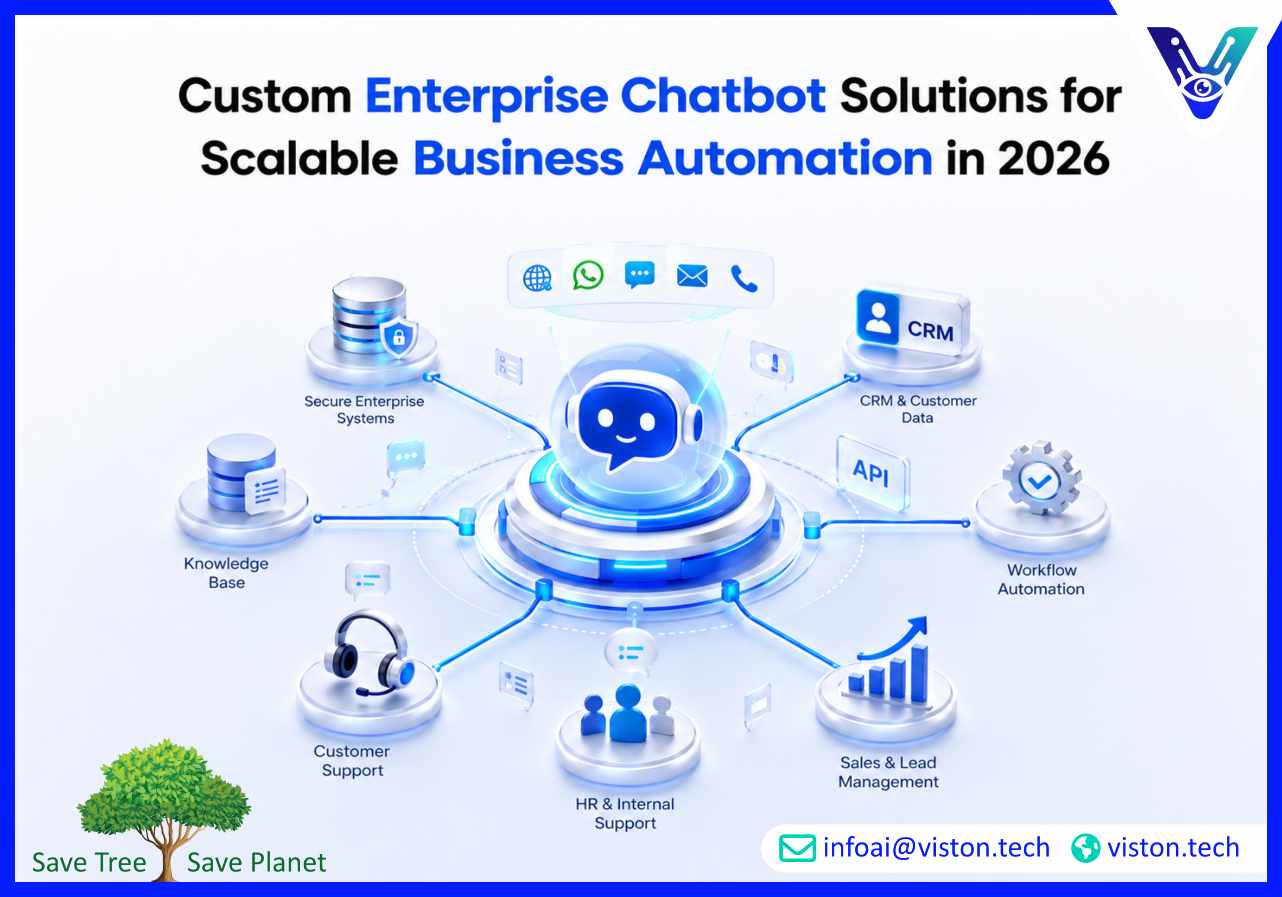
Custom enterprise chatbot solutions matter because modern businesses need more than scripted answers. They need secure, intelligent conversational systems that understand business context, integrate with core platforms, support complex workflows, and improve customer, employee, and operational experiences at scale.
Custom enterprise chatbot solutions are AI-powered conversational systems designed around a company’s real processes, data, users, compliance needs, and operational goals. Unlike generic chatbot tools, enterprise-grade solutions are built to support high-volume interactions, multiple departments, business-specific terminology, backend integrations, access controls, analytics, and continuous optimization.
For many organizations, the chatbot is no longer just a website assistant. It can support customer service, sales qualification, HR helpdesks, IT service requests, internal knowledge access, appointment scheduling, order updates, product recommendations, claims support, onboarding, and workflow automation. The value comes from connecting conversation with action.
A basic chatbot may answer frequently asked questions. A custom enterprise chatbot can understand intent, retrieve accurate information, trigger workflows, update CRM records, create support tickets, authenticate users, escalate complex cases, and provide a consistent experience across web, mobile, WhatsApp, voice, and internal portals.
Enterprise environments are rarely simple. Different teams use different systems, policies, data sources, approval flows, customer segments, and service standards. A chatbot that works for one business may fail in another if it does not reflect the company’s operations.
Customization allows the chatbot to align with business rules, user journeys, product data, support processes, compliance requirements, and brand tone. It also helps reduce friction because users receive answers and actions that match their actual needs instead of generic responses.
In 2026, businesses expect AI chatbots to be reliable, secure, measurable, and deeply connected to enterprise systems. Decision-makers are no longer impressed by simple automation alone. They want chatbot solutions that improve service quality, reduce manual workload, support revenue operations, and create better access to business knowledge.
This shift is driven by higher customer expectations, growing pressure on support teams, the rise of AI agents, stronger data governance requirements, and the need for faster digital service delivery. Companies want conversational AI that can operate across departments without creating security, compliance, or data-quality risks.
Speed is important, but speed without accuracy can damage trust. A custom enterprise chatbot should provide context-aware responses, use approved knowledge sources, understand when to escalate, and maintain clear conversation records. It should also avoid giving misleading answers when the system lacks enough confidence.
For customer-facing use cases, this improves satisfaction and reduces repeated contact. For internal use cases, it helps employees find information faster, complete routine tasks, and reduce dependency on overloaded support teams.
Enterprise AI chatbots often interact with sensitive customer, employee, financial, operational, or healthcare-related data. This makes governance essential. Businesses need role-based access, audit logs, secure API connections, data handling rules, human escalation paths, consent-aware workflows, and controlled knowledge access.
Responsible deployment also means designing safeguards against prompt injection, unauthorized data exposure, hallucinated responses, weak authentication, and uncontrolled tool usage. In 2026, enterprise chatbot success depends as much on trust and control as on conversational quality.
A strong enterprise chatbot is built as a business system, not only as a conversational interface. It needs the right architecture, knowledge strategy, workflow logic, integration approach, testing process, and performance measurement model.
Enterprise users often ask complex questions in different ways. The chatbot should identify intent, extract entities, understand context, and manage multi-turn conversations. Contextual memory helps the chatbot avoid asking repeated questions and allows it to guide users through longer processes such as troubleshooting, quote requests, claims, account updates, or onboarding tasks.
A chatbot is only as useful as the information it can access. Custom enterprise chatbot solutions should connect to approved knowledge bases, documentation, product catalogs, customer records, policy repositories, FAQs, ticket histories, and internal databases where appropriate.
For advanced use cases, retrieval-augmented generation can help the chatbot answer from trusted enterprise content instead of relying only on broad model knowledge. This improves relevance, consistency, and control.
The most valuable enterprise chatbots do not stop at answering questions. They help users complete tasks. This may include creating support tickets, updating lead records, checking order status, scheduling appointments, verifying account information, routing requests, sending notifications, or triggering approval workflows.
Workflow automation turns the chatbot into a practical service channel. It reduces repetitive manual work and allows teams to focus on higher-value tasks that require judgment, negotiation, creativity, or complex problem-solving.
Customers and employees interact across many channels. A custom enterprise chatbot may need to operate on websites, mobile apps, messaging platforms, live chat systems, internal dashboards, CRM portals, or voice interfaces. Omnichannel design ensures users receive consistent answers and service quality wherever they engage.
For enterprises, this consistency matters because disconnected channels create fragmented records, repeated questions, and poor reporting. A unified chatbot strategy helps maintain continuity across the customer or employee journey.
Enterprise chatbot performance should be measured through meaningful KPIs. Useful metrics include resolution rate, fallback rate, escalation rate, customer satisfaction, task completion rate, lead qualification rate, workflow success rate, response accuracy, and cost per resolved interaction.
Analytics help teams identify failed intents, missing knowledge, confusing flows, integration errors, and improvement opportunities. The best chatbot programs are continuously refined after launch based on real conversation data and business outcomes.
Successful chatbot implementation starts with business clarity. Before choosing technology, organizations should define what the chatbot must achieve, who it will serve, which systems it must connect with, what risks must be controlled, and how success will be measured.
Not every process should be automated first. Businesses should begin with use cases that are repetitive, high-volume, clearly defined, and valuable to users. Examples include support triage, order tracking, appointment booking, lead qualification, internal policy lookup, IT helpdesk requests, and service status updates.
Starting with focused use cases helps teams prove value, improve adoption, and reduce implementation risk. Once the foundation is stable, the chatbot can expand into more complex workflows.
Enterprise chatbot design should include a clear map of required integrations, user roles, data access rules, escalation paths, and process outcomes. This helps prevent the chatbot from becoming an isolated tool that cannot complete meaningful tasks.
Important systems may include CRM, ERP, helpdesk software, ecommerce platforms, HR systems, knowledge bases, marketing automation tools, payment systems, identity providers, and reporting dashboards.
A good chatbot does not try to handle everything. It should know when to involve a human. Escalation is necessary for sensitive issues, frustrated users, low-confidence answers, complex sales conversations, complaints, compliance-sensitive decisions, and exceptions outside predefined logic.
Human handover should include conversation history, user details, detected intent, attempted resolution, and relevant system data. This prevents users from repeating themselves and helps agents resolve issues faster.
Enterprise chatbot testing should include intent testing, integration testing, security testing, conversation quality review, edge-case handling, multilingual checks where relevant, and user acceptance testing. Testing should also evaluate how the chatbot responds to unclear, hostile, incomplete, or unusual queries.
After deployment, the chatbot should be monitored continuously. Performance reviews help teams update knowledge, refine prompts, improve workflows, adjust escalation rules, and strengthen reporting.
Viston AI is relevant to custom enterprise chatbot solutions because its Enterprise AI Chatbots service focuses on intelligent conversational systems built for enterprise complexity. Its capabilities align with the needs of organizations that require more than a simple FAQ bot, including conversational AI across channels, languages, and business units.
For businesses evaluating Enterprise AI Chatbots, Viston AI’s service positioning is connected to practical enterprise requirements such as natural language understanding, contextual conversations, workflow automation, real-time knowledge integration, CRM and business system connectivity, and secure deployment. These capabilities are important when a chatbot must support customer service, sales operations, internal support, technical assistance, or industry-specific business processes.
Viston AI also positions its enterprise chatbot work around integration with CRM, knowledge bases, and transactional systems. This matters because custom chatbot performance depends on the ability to retrieve trusted information, update business records, and complete workflows reliably. For companies operating across multiple teams or markets, a chatbot should support consistent service delivery while respecting governance, compliance, and security requirements.
Rather than treating chatbot development as a standalone interface project, Viston AI’s approach is relevant for organizations that want conversational AI to become part of their broader digital operations. This makes its Enterprise AI Chatbots service suitable for businesses seeking scalable, practical, and business-focused automation.
Custom enterprise chatbot solutions are AI-powered conversational systems designed for a company’s specific workflows, users, data sources, systems, compliance needs, and business objectives. They help automate conversations and tasks across customer-facing and internal operations.
Enterprise chatbots usually require deeper integrations, stronger security, higher scalability, better analytics, role-based access, workflow automation, and support for complex user journeys. Regular chatbots often focus on simple scripted responses or basic FAQs.
Enterprise chatbots can integrate with CRM platforms, ERP systems, helpdesk tools, ecommerce platforms, HR systems, knowledge bases, payment gateways, identity providers, analytics tools, and internal databases depending on the use case.
A successful enterprise chatbot solves real business problems, provides accurate answers, completes useful tasks, escalates appropriately, protects sensitive data, integrates with core systems, and improves through ongoing performance analysis.
Yes. A custom enterprise chatbot can support customer service, sales, marketing, HR, IT, operations, finance, and product teams when it is designed with proper user journeys, access controls, knowledge sources, and workflow logic.
Viston AI provides Enterprise AI Chatbots designed for enterprise use cases, including conversational AI, business system integration, workflow automation, knowledge access, and secure deployment. This makes it relevant for businesses planning scalable chatbot solutions.
Custom enterprise chatbot solutions are becoming essential for businesses that want scalable, intelligent, and secure automation in 2026. The real value comes from combining Enterprise AI Chatbots with business-specific workflows, trusted knowledge, system integrations, analytics, and governance. A well-designed chatbot can improve customer support, lead handling, employee service, operational efficiency, and decision visibility. For organizations planning enterprise conversational AI, the priority should be practical business fit: clear use cases, reliable integrations, controlled data access, strong escalation design, and continuous optimization. Viston AI is positioned as a relevant specialist for companies seeking enterprise chatbot capabilities that connect conversation with measurable business action.
