
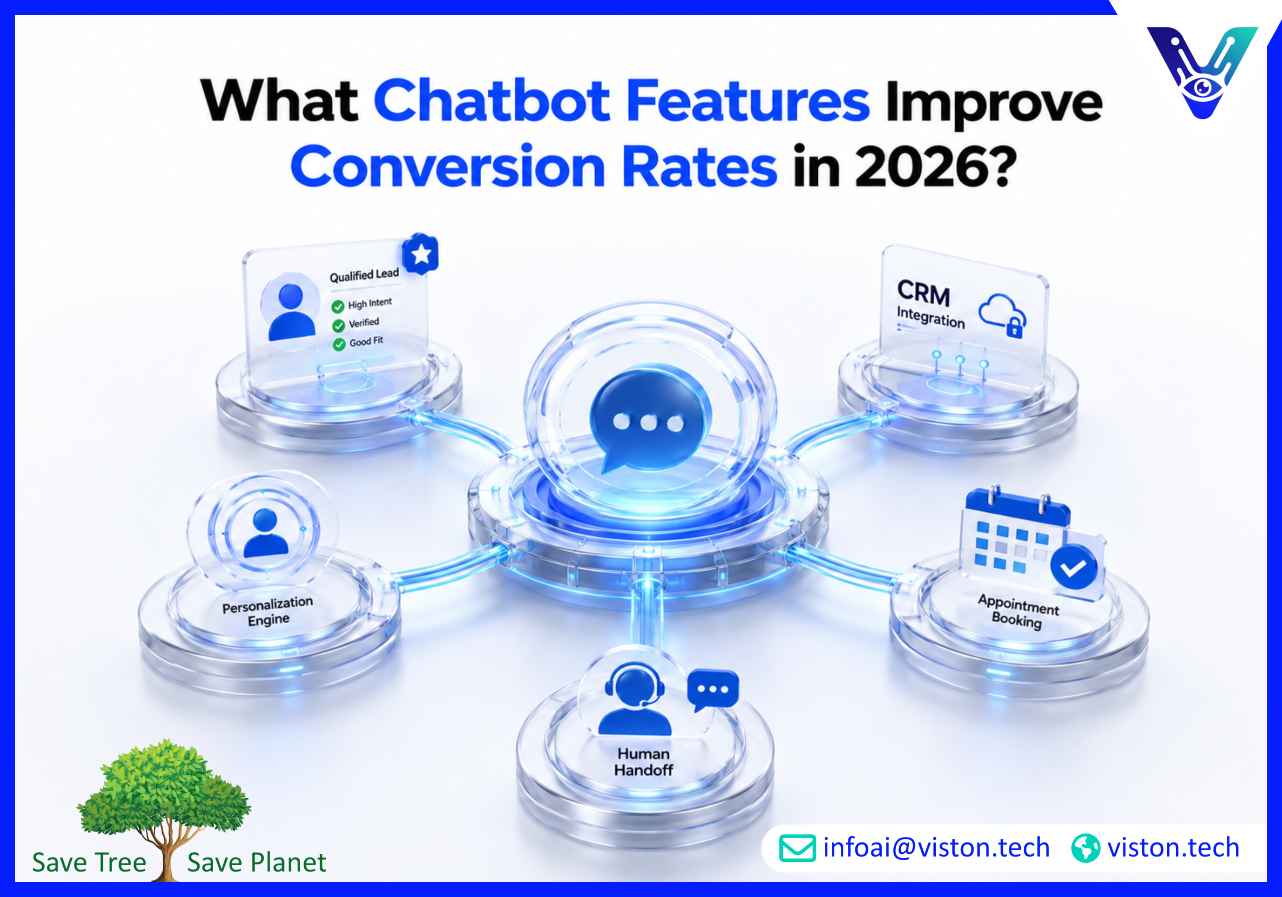
Chatbots influence conversions when they do more than answer basic questions. In 2026, businesses need intelligent, integrated chatbot experiences that qualify leads, personalize conversations, reduce friction, support buyer decisions, and connect directly with sales, CRM, support, and marketing workflows.
The chatbot features that improve conversion rates are the ones that help users move from curiosity to action with less effort. A high-converting chatbot does not simply greet visitors or repeat FAQ content. It understands intent, asks useful questions, guides users to the right offer, captures qualified lead data, and hands conversations to the right team when human support is needed.
For business websites, SaaS platforms, e-commerce stores, service providers, marketplaces, healthcare portals, finance platforms, education websites, and B2B lead generation funnels, chatbot conversion depends on timing, relevance, accuracy, and trust. A chatbot that appears too early, asks too many questions, gives vague answers, or fails to connect with backend systems can reduce confidence instead of improving engagement.
The most effective chatbot features for conversion improvement include:
Conversion-focused AI Chatbot Integration is not just about installing a chat widget. It is about designing a conversational system that supports the buyer journey from first question to booked call, completed purchase, submitted form, qualified lead, or resolved objection.
Buyer expectations have changed. Visitors no longer want to search through long pages, wait for email replies, or fill out forms before understanding whether a business can help them. They expect fast answers, clear options, relevant recommendations, and simple next steps. This is especially important when a visitor is comparing multiple vendors, products, services, or platforms.
In 2026, chatbot performance is judged by business outcomes, not by conversation volume alone. A chatbot may handle thousands of chats, but if those conversations do not produce qualified leads, booked meetings, completed transactions, support deflection, or useful customer data, the system is not improving conversion performance.
Many potential customers leave because they cannot quickly find pricing guidance, service details, availability, product fit, delivery timelines, or support options. A chatbot can reduce this friction by giving immediate answers and directing users to the correct next step. Fast response is especially valuable for high-intent visitors who are ready to speak with sales, request a quote, schedule a demo, or compare solutions.
Generic chatbot replies rarely convert well. A visitor exploring enterprise software has different questions than a small business owner looking for a basic automation solution. A conversion-focused chatbot should adjust its conversation based on user intent, industry, company size, location, lifecycle stage, product interest, and previous interaction history where available.
A chatbot connected to CRM, ERP, inventory, booking, billing, support, or product data can provide more useful answers than a standalone bot. For example, it can check order status, recommend a product based on availability, create a support ticket, qualify a lead in CRM, or book a meeting based on real calendar availability. These integrated actions shorten the path between interest and conversion.
Modern users are more aware of data privacy, AI errors, and automated interactions. A chatbot that clearly explains what it can do, avoids pretending to be human, escalates responsibly, and protects user data is more likely to build confidence. Accuracy, transparency, and secure handling of customer information are now part of chatbot conversion strategy.
The strongest chatbot conversion features work together. One feature may capture attention, another may qualify the visitor, and another may move the user into a sales or support workflow. Businesses should evaluate chatbot features based on how they support measurable actions, not just how advanced they sound.
Intent recognition allows the chatbot to understand why a visitor is starting a conversation. A user may want pricing, technical support, product recommendations, order help, a demo, a consultation, or information about implementation. When the chatbot identifies intent early, it can respond with the right flow instead of forcing every visitor through the same script.
For conversion improvement, intent recognition should cover both simple and complex queries. It should understand commercial intent, urgency, objection signals, comparison language, and buying-stage questions. For example, “How much does this cost?”, “Can this integrate with Salesforce?”, and “I need this for my team next month” should not receive the same generic response.
Lead qualification is one of the most important chatbot features for B2B conversion. Instead of sending every conversation to sales, the chatbot can collect key details such as company size, industry, budget range, urgency, service need, current tools, decision-maker role, and preferred contact method.
A well-designed qualification flow should feel like a helpful conversation, not a long form. It should ask only the questions needed to route the lead properly. When integrated with CRM, the chatbot can create or update lead records, assign scores, trigger follow-up workflows, and notify the right sales representative.
Recommendation features help visitors choose the right product, plan, package, service, or solution. This is valuable when businesses offer multiple options and buyers are unsure which one fits their needs. The chatbot can ask a few guided questions and then suggest the most relevant next step.
For service businesses, this may mean recommending a consultation, audit, integration package, support plan, or implementation roadmap. For e-commerce, it may mean recommending products based on use case, budget, availability, preferences, or previous behavior. For SaaS, it may guide visitors toward the right plan, feature set, or onboarding path.
Appointment booking is a direct conversion feature because it removes the delay between interest and action. When a visitor is ready to speak with a team, the chatbot should offer available time slots, collect required details, confirm the meeting, and send calendar invites automatically.
This feature is especially useful for consultations, demos, discovery calls, sales meetings, healthcare appointments, education counseling, financial advisory sessions, and professional services inquiries. The fewer steps required to book, the higher the chance that the visitor completes the action.
AI should not block the user from getting human help. High-value leads, technical questions, complaints, pricing negotiations, compliance concerns, and complex buying decisions often require a human conversation. A chatbot improves conversions when it knows when to escalate.
A strong human handoff feature should transfer the conversation history, user details, intent, and previous chatbot responses to the agent. This prevents the user from repeating information and gives the sales or support team the context needed to continue smoothly.
Basic chatbot features may help with engagement, but advanced AI Chatbot Integration improves conversion by connecting conversation data with business systems. These features are especially important for companies that rely on CRM, marketing automation, customer support platforms, analytics tools, e-commerce systems, booking software, or internal databases.
CRM integration allows chatbot conversations to become part of the customer record. This helps sales teams understand what the visitor asked, which offer they showed interest in, what objections appeared, and what follow-up is needed. It also prevents lost leads because captured information flows directly into the sales pipeline.
When CRM integration is properly configured, the chatbot can create leads, update contact fields, assign owners, trigger email sequences, and notify teams about high-intent conversations. This turns chatbot engagement into a structured revenue workflow.
Not every visitor is ready to buy immediately. Marketing automation integration helps nurture users who are interested but not yet ready for direct sales contact. The chatbot can add users to relevant email journeys, send content based on their interest, segment leads by intent, and trigger remarketing audiences where appropriate.
This is useful for longer B2B buying cycles, high-ticket services, enterprise software, education programs, healthcare inquiries, and complex consulting offers where users need more information before converting.
Retrieval-augmented generation, often called RAG, helps AI chatbots answer questions using approved company content, documentation, policies, product data, FAQs, pricing rules, or support resources. This improves accuracy and reduces the risk of vague or incorrect answers.
For conversion-focused use cases, RAG can help visitors compare features, understand implementation steps, review service scope, check eligibility, evaluate technical requirements, and resolve objections without waiting for manual support.
Customers may begin a conversation on a website, continue on WhatsApp, receive a follow-up email, and later speak with sales. A conversion-focused chatbot should support this kind of journey without losing context. Multichannel continuity helps businesses deliver consistent answers and maintain user history across touchpoints.
This feature is especially useful for businesses with mobile-first audiences, international customers, field sales teams, customer support centers, or omnichannel commerce operations.
Analytics show whether a chatbot is actually improving conversions. Useful metrics include completed conversations, qualified leads, booked meetings, fallback rates, abandoned flows, common questions, unresolved intents, handoff rates, customer satisfaction, and revenue influenced by chatbot interactions.
Optimization should be continuous. Businesses should regularly review chatbot transcripts, improve weak answers, remove unnecessary steps, test different prompts, adjust qualification questions, and align chatbot flows with sales feedback.
The best chatbot feature set depends on the conversion goal. A chatbot built for lead generation will not need the same design as one built for customer support, e-commerce checkout, appointment booking, or account management. Businesses should begin with the outcome they want to improve.
Prioritize intent recognition, qualification questions, CRM integration, meeting scheduling, lead scoring, human handoff, and follow-up automation. The chatbot should identify serious buyers quickly and move them into the right sales process.
Prioritize product recommendations, cart recovery, order tracking, inventory integration, return support, discount eligibility, payment guidance, and personalized offers. The chatbot should reduce hesitation and help users complete purchases confidently.
Prioritize consultation booking, service fit assessment, project requirement capture, pricing guidance, case routing, FAQ support, and sales handoff. The chatbot should help visitors understand whether the business can solve their specific problem.
Prioritize knowledge base integration, ticket creation, account lookup, live agent escalation, sentiment detection, multilingual support, and post-resolution feedback. Reducing support friction can indirectly improve conversions by increasing trust and customer satisfaction.
Prioritize secure API integration, role-based access, audit logs, workflow automation, ERP and CRM connectivity, system monitoring, compliance controls, and scalable architecture. Enterprise chatbots must be reliable, secure, and aligned with operational processes.
Viston AI is relevant to businesses evaluating chatbot features because its AI Chatbot Integration service focuses on connecting conversational AI with real business systems, not just deploying standalone chat interfaces. Its service capabilities include AI chatbot integration, AI chatbot development, enterprise chatbots, integration with business systems, multilingual support, voice-enabled assistants, NLP and text analysis, AI automation, workflow bots, and custom AI solution development.
For businesses trying to improve conversion rates, this matters because chatbot performance depends heavily on what the chatbot can access and trigger. A chatbot that connects with CRM, ERP, customer service, booking, analytics, or marketing platforms can qualify leads, update records, route requests, synchronize data, and support more personalized user journeys.
Viston AI’s approach is especially useful for organizations that need secure, scalable, and business-focused chatbot implementation. Its broader AI capabilities, including automation, model monitoring, data strategy, and custom AI development, support chatbot systems that can evolve beyond simple scripted interactions. For companies across general business sectors and global markets, this makes Viston AI a practical partner for building chatbot experiences that support lead generation, customer engagement, workflow automation, and measurable conversion outcomes.
Lead qualification often has the strongest direct impact for B2B businesses because it identifies serious buyers and moves them into the sales process quickly. For e-commerce, personalized product recommendations and cart support usually have the highest conversion value.
AI chatbots can increase conversions for simple and repeatable journeys, but high-value or complex sales often need human handoff. The best results usually come from combining AI automation with timely human support.
CRM integration ensures chatbot conversations become actionable lead or customer records. It helps sales teams follow up faster, track user intent, avoid duplicate data entry, and connect chatbot engagement with pipeline performance.
Not always. Asking too early can reduce engagement. A better approach is to answer the visitor’s initial question, build relevance, and then request contact details when the user shows intent, such as asking for pricing, demos, availability, or consultation.
Viston AI supports conversion-focused chatbot projects through AI Chatbot Integration, business system connectivity, workflow automation, chatbot development, multilingual support, and custom AI solutions that help businesses turn conversations into qualified actions.
Businesses should track qualified leads, booked meetings, completed purchases, form submissions, support deflection, handoff quality, fallback rate, conversation abandonment, and revenue influenced by chatbot interactions.
The chatbot features that improve conversion rates are the ones that reduce friction, understand buyer intent, personalize the journey, connect with business systems, and guide users toward clear next steps. In 2026, effective AI Chatbot Integration requires more than a basic website widget. Businesses need secure, data-connected, measurable chatbot experiences that support lead generation, sales enablement, customer support, and workflow automation. Viston AI offers relevant chatbot integration capabilities for organizations that want conversational AI to become a practical part of their conversion strategy.
