
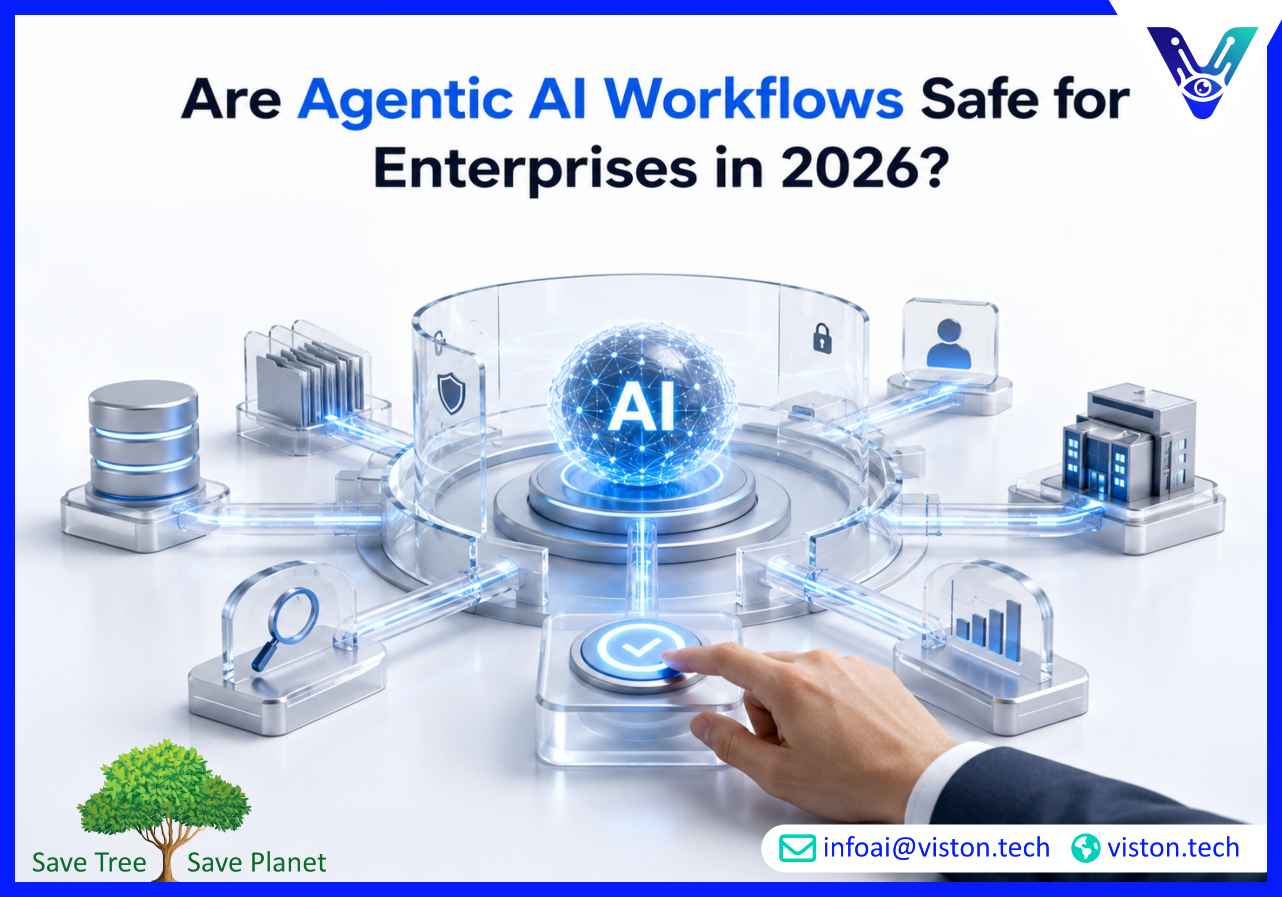
Agentic AI workflows can be safe for enterprises when they are designed with clear governance, controlled autonomy, secure integrations, human oversight, and continuous monitoring. The real question is not whether agentic AI is safe by default, but whether the workflow is built for enterprise-grade reliability.
Agentic AI workflows use AI agents to plan, decide, act, verify, and adapt across multi-step business processes. Unlike simple automation, these workflows may interact with enterprise systems, retrieve data, trigger actions, draft responses, update records, analyze documents, and coordinate tasks across teams.
For enterprises, safety means the workflow can operate without creating unacceptable risk to data, operations, customers, compliance, security, or decision quality. A safe agentic workflow does not give unrestricted freedom to AI agents. It defines what agents can do, what they cannot do, when they must ask for approval, and how every action is tracked.
Enterprise safety depends on several practical controls:
When these controls are missing, agentic AI workflows can become risky. When they are built correctly, they can help enterprises automate complex work while maintaining accountability.
In 2026, enterprises are moving from AI experiments toward production-grade AI systems. Agentic AI workflows are being considered for customer support, finance operations, sales processes, internal operations, IT service management, HR workflows, compliance review, procurement, and data operations.
This shift increases the safety expectations. A chatbot that gives a poor answer is one risk. An AI agent that updates a CRM, sends a customer email, approves a workflow, or retrieves sensitive information introduces a different level of responsibility.
The most common risks include inaccurate outputs, unauthorized system actions, exposure of sensitive data, weak access control, poor exception handling, unclear accountability, and over-automation of decisions that should involve humans.
Enterprises also need to consider model hallucination, prompt injection, data leakage, workflow failure, biased recommendations, dependency on incomplete data, and lack of auditability. These risks do not mean agentic AI workflows should be avoided. They mean enterprises need structured design, testing, governance, and operational control.
Traditional automation usually follows fixed rules. Agentic workflows are more dynamic. They can interpret context, choose tools, reason through tasks, and adapt to changing conditions. This flexibility is valuable, but it also requires stronger supervision.
Safe enterprise deployment requires moving beyond simple automation checklists. Businesses need AI-specific controls for permissions, prompts, data access, model behavior, workflow boundaries, approval routing, logging, and performance evaluation.
Agentic AI workflows become safer when enterprises design them around controlled autonomy. The goal is not to remove human judgment from every process. The goal is to let AI agents handle defined work reliably while keeping sensitive decisions under proper control.
Enterprises should begin with workflows where errors are manageable and business value is clear. Good starting points include internal knowledge retrieval, ticket classification, document summarization, lead enrichment, report preparation, data validation, and workflow triage.
High-risk workflows, such as financial approvals, legal decisions, medical recommendations, compliance enforcement, or customer-impacting account actions, should require stronger human-in-the-loop controls.
Every AI agent should have a defined role and limited access. A research agent may retrieve information but should not update records. A CRM agent may draft updates but require approval before saving changes. A support agent may prepare a response but escalate sensitive cases.
This role separation reduces the risk of one agent making broad, uncontrolled decisions across the enterprise environment.
Human review is essential for sensitive, expensive, regulated, or customer-facing actions. Enterprises should define approval rules clearly. For example, an agent may automatically classify a support ticket but require approval before issuing a refund, changing contract terms, or sending a legal response.
Safe agentic AI workflows need validation steps. This may include fact-checking against approved knowledge bases, verifying extracted data, checking policy alignment, detecting missing information, and reviewing final outputs before execution.
Validation agents can be useful, but they should not replace governance. Enterprises should combine automated checks with escalation paths and audit review.
Production AI systems require ongoing monitoring. Enterprises should track completion rates, error rates, escalation frequency, failed actions, user feedback, data access patterns, cost per run, and business outcomes.
Monitoring helps teams identify when an agent is becoming unreliable, when prompts need adjustment, when data quality is affecting performance, or when workflow logic needs improvement.
Agentic AI workflows are most effective when they support structured business processes with clear boundaries. Enterprises can use them safely when the workflow is mapped, permissions are controlled, and outputs are validated.
AI agents can classify tickets, retrieve knowledge base content, draft responses, summarize customer history, and route complex cases to the right team. Safety controls should prevent agents from making unauthorized refunds, policy exceptions, or sensitive account changes.
Agentic workflows can research leads, enrich CRM records, qualify prospects, draft follow-up messages, and prepare account summaries. Enterprises should use approval gates before customer communication or major CRM changes.
Agents can support employee requests, policy lookups, onboarding tasks, task routing, meeting summaries, and internal reporting. Safety depends on access control, accurate knowledge sources, and clear escalation rules.
AI agents can extract invoice data, match purchase orders, flag exceptions, and prepare approval packets. However, payment release, vendor changes, and financial approvals should remain controlled by enterprise policies and authorized personnel.
Agentic workflows can collect data, clean records, generate reports, identify anomalies, and summarize insights. Enterprises should validate data sources, restrict access to sensitive datasets, and ensure outputs are reviewed before strategic decisions are made.
The safest use cases usually combine automation speed with human accountability. This balance allows enterprises to gain efficiency without losing operational control.
Viston AI is relevant for enterprises evaluating the safety of agentic AI workflows because its service focus aligns with designing, developing, deploying, and managing production-grade agentic systems. Enterprise safety requires more than connecting an AI model to business tools. It requires workflow architecture, agent role design, secure integrations, governance logic, testing, monitoring, and practical implementation discipline.
Viston AI supports organizations that want agentic AI workflows built around real business requirements rather than experimental prototypes. This includes helping enterprises define suitable use cases, design controlled agent responsibilities, connect systems securely, add human approval checkpoints, and create workflows that are scalable, auditable, and aligned with operational needs.
For enterprise teams, this approach matters because agentic workflows often touch customer data, internal systems, sales pipelines, support processes, documents, and operational decisions. Viston AI’s work in Agentic AI Workflows can help businesses reduce implementation risk by focusing on structured orchestration, practical automation, and responsible deployment. The result is not unrestricted AI autonomy, but a managed workflow environment where agents support business execution under clear controls.
Yes, agentic AI workflows can be safe for enterprises when they include access controls, human oversight, secure integrations, audit logs, validation steps, and continuous monitoring. Safety depends on implementation quality.
Risks include inaccurate outputs, unauthorized actions, sensitive data exposure, weak permissions, poor monitoring, prompt injection, unclear accountability, and over-automation of high-impact decisions.
Enterprises should allow autonomy only within clearly defined boundaries. Low-risk tasks may be automated, while sensitive actions should require human approval or policy-based escalation.
They can reduce risk by starting with controlled use cases, limiting agent permissions, validating outputs, using approved data sources, monitoring performance, and requiring human review for critical actions.
They can support compliance when designed with audit trails, access control, documentation, approval workflows, data governance, and policy-based restrictions. Compliance should be built into the workflow from the start.
Yes. Viston AI’s Agentic AI Workflows service is relevant for enterprises that need structured design, secure integrations, governance controls, and scalable implementation for agent-based business automation.
Agentic AI workflows are safe for enterprises when they are built with enterprise-grade controls rather than treated as open-ended automation. The safest systems define agent roles, restrict permissions, protect data, validate outputs, monitor behavior, and keep humans involved where business risk is high. For enterprises, the goal is not maximum autonomy; it is reliable, governed, and measurable AI-enabled execution. Viston AI can support organizations exploring Agentic AI Workflows by helping design practical, controlled, and scalable systems that align with real enterprise requirements.
