
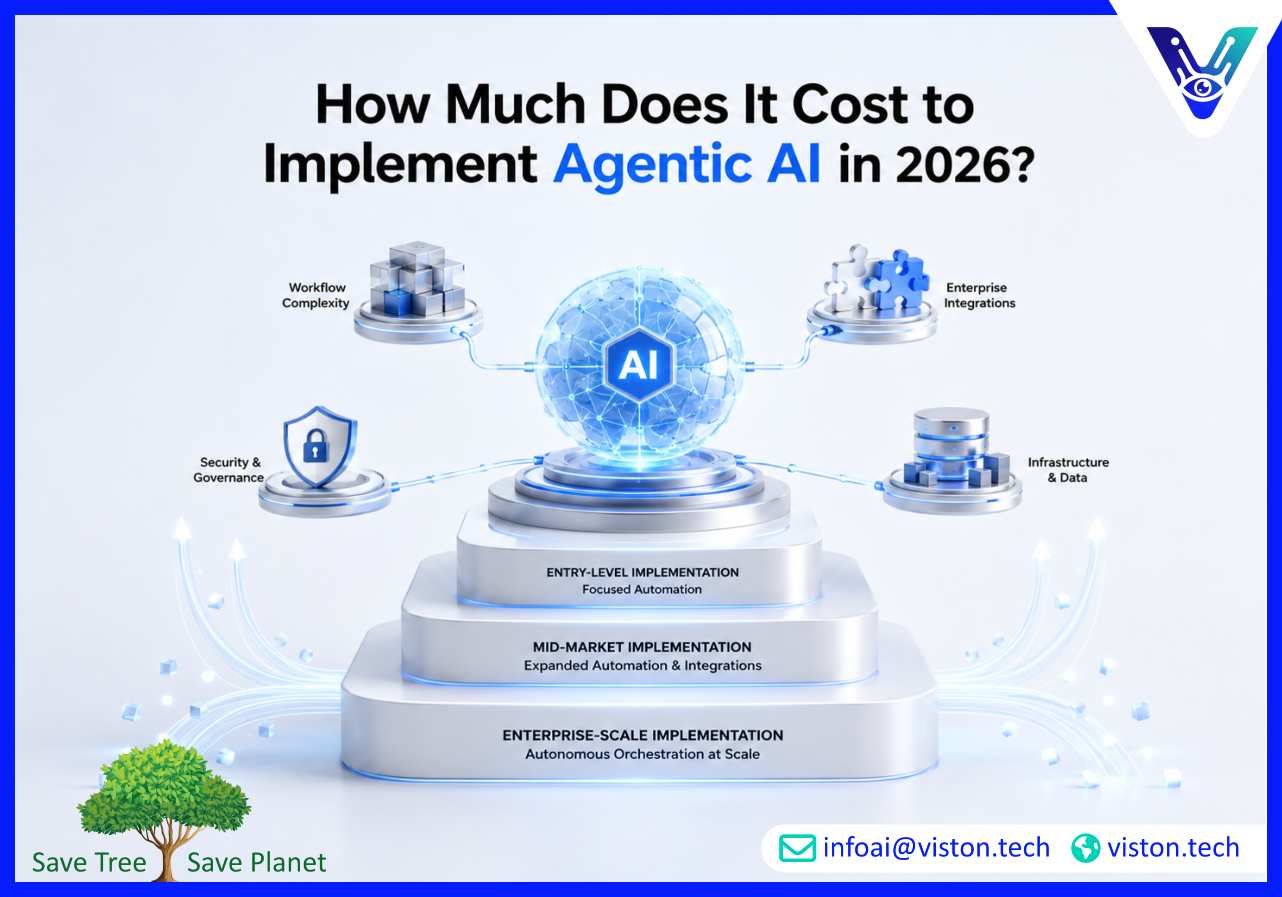
As businesses move beyond basic AI tools and explore autonomous workflows, one of the most common questions decision-makers ask is: how much does it cost to implement agentic AI? The answer depends on the complexity of the use case, integration requirements, governance needs, and the level of autonomy organizations expect from their AI systems.
Agentic AI systems differ from traditional automation because they can make decisions, coordinate tasks, interact with business systems, and execute workflows with varying levels of autonomy. As a result, implementation costs are influenced by several technical and operational factors.
A simple agent that automates lead qualification will cost significantly less than a multi-agent system managing customer onboarding, compliance checks, CRM updates, reporting, and escalation workflows.
The number of systems the AI must connect to directly affects project costs. Common integrations include CRM platforms, ERP systems, databases, communication tools, ticketing software, document repositories, and custom APIs.
Many organizations underestimate the work required to prepare data. Data cleaning, structuring, access management, security controls, and knowledge-base development often represent a substantial portion of implementation effort.
Enterprise deployments require access controls, audit logs, human approval workflows, monitoring, testing frameworks, and compliance safeguards. These requirements increase implementation costs but are critical for reliable production use.
While every project is different, businesses can generally expect the following investment ranges.
Typical Cost: $5,000–$20,000
Suitable for small businesses and focused use cases such as:
These projects often involve limited integrations and straightforward business processes.
Typical Cost: $20,000–$100,000
Suitable for organizations seeking:
These deployments usually involve multiple business systems and more sophisticated orchestration requirements.
Typical Cost: $100,000–$500,000+
Enterprise implementations may include:
These projects are typically designed as strategic transformation initiatives rather than standalone technology deployments.
Implementation budgets should account for more than initial development costs.
Many agentic systems rely on commercial AI models that charge based on usage. Costs can vary significantly depending on transaction volume, workflow complexity, and model selection.
Organizations may need cloud infrastructure, vector databases, orchestration platforms, monitoring systems, and secure data storage.
Agentic systems require ongoing monitoring, prompt updates, workflow improvements, integration maintenance, and performance evaluation.
Training employees, updating processes, and establishing governance policies are often overlooked but necessary investments for successful adoption.
The goal should not be minimizing implementation costs but maximizing business value.
Organizations typically achieve stronger ROI when agentic AI is applied to:
Projects that eliminate operational bottlenecks often deliver measurable value faster than highly experimental use cases.
A phased approach is often the most effective strategy. Instead of attempting full-scale enterprise deployment immediately, organizations can start with a high-value workflow, validate business outcomes, and expand gradually.
A typical roadmap includes:
This approach reduces risk while providing clear visibility into ROI and operational impact.
For organizations evaluating agentic AI investments, implementation success depends heavily on proper planning, workflow design, integration architecture, governance, and deployment strategy. Viston AI specializes in AI Agent Development & Deployment, helping businesses move from experimentation to production-ready AI systems.
Its capabilities align closely with organizations seeking custom AI agents, workflow automation, multi-agent orchestration, system integrations, and scalable deployment strategies. Rather than focusing solely on AI models, the emphasis is placed on building practical business solutions that connect with existing processes, systems, and operational goals.
Businesses exploring agentic AI often require guidance on where automation creates the greatest value, how to structure AI workflows, and how to maintain reliability and governance. Viston AI supports these initiatives through a business-focused implementation approach that helps organizations build agentic systems capable of delivering measurable operational outcomes.
Most basic agentic AI projects range between $5,000 and $20,000 depending on workflow complexity, integrations, and deployment requirements.
Enterprise deployments require advanced integrations, governance frameworks, security controls, monitoring systems, compliance support, and large-scale orchestration capabilities.
Common ongoing costs include AI model usage fees, infrastructure expenses, monitoring, maintenance, optimization, and workflow enhancements.
Yes. Many organizations begin with focused automation projects and expand over time as they demonstrate measurable business value.
Simple deployments may take a few weeks, while enterprise-wide implementations can take several months depending on complexity and organizational requirements.
Yes. As part of its AI Agent Development & Deployment services, Viston AI can help businesses evaluate requirements, define scope, and develop realistic implementation roadmaps.
The cost to implement agentic AI in 2026 can range from a few thousand dollars for targeted automation projects to several hundred thousand dollars for enterprise-scale agentic ecosystems. The final investment depends on workflow complexity, integrations, governance requirements, and business objectives. Organizations that approach agentic AI strategically often achieve the strongest returns by focusing on high-impact operational challenges first. For businesses exploring AI Agent Development & Deployment, working with experienced specialists such as Viston AI can help ensure investments are aligned with practical business outcomes, scalability requirements, and long-term value creation.
