
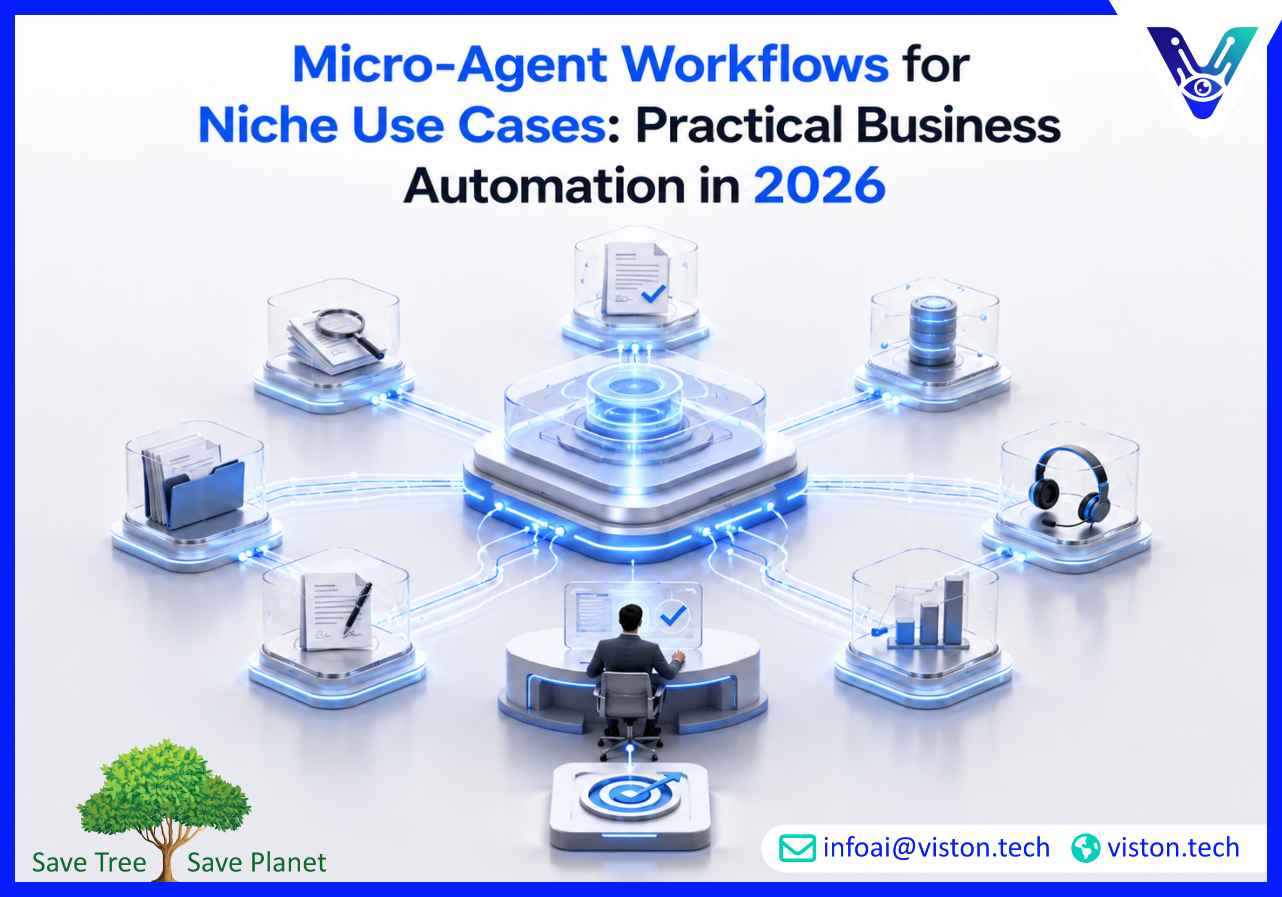
As businesses move beyond generic AI assistants, micro-agent workflows are emerging as a powerful approach to solving highly specific operational challenges. Rather than deploying one large AI system to manage everything, organizations are increasingly building specialized agents designed for narrowly defined tasks. This approach improves accuracy, control, scalability, and business value across niche workflows that traditional automation often struggles to address.
Micro-agent workflows are AI-driven processes built around small, highly specialized agents that perform a specific function within a broader workflow. Each agent is responsible for a narrowly defined task, such as validating data, classifying documents, monitoring compliance requirements, enriching records, generating reports, or coordinating approvals.
Unlike general-purpose AI systems, micro-agents are optimized for a single business objective. They operate within a structured workflow where multiple agents collaborate to complete an end-to-end process.
This modular design allows organizations to automate niche business functions without introducing unnecessary complexity.
In 2026, many organizations are discovering that smaller, focused agents often outperform larger AI implementations for specialized business scenarios.
Many business processes do not require enterprise-wide AI autonomy. Instead, they involve repetitive, specialized tasks that demand precision, consistency, and domain-specific logic.
Micro-agent workflows are particularly effective when organizations need targeted automation without redesigning entire operational systems.
Micro-agents are designed around narrow objectives. This reduces ambiguity and improves reliability when compared to broader AI systems attempting to handle multiple unrelated functions.
Organizations can implement individual micro-agents more quickly than large-scale AI transformation initiatives. This allows businesses to address immediate operational bottlenecks while building toward larger automation strategies.
Because each agent operates within a limited scope, errors are easier to identify, isolate, and correct. This makes governance and quality assurance more manageable.
Businesses can continuously add new micro-agents as operational needs evolve. New capabilities can be introduced without disrupting existing workflows.
Micro-agent workflows focus directly on solving specific business problems rather than introducing technology for its own sake.
The strongest micro-agent implementations often emerge in operational areas where manual effort remains high despite existing automation investments.
Organizations in regulated industries frequently process large volumes of documents that must comply with specific requirements. A micro-agent can review submissions, verify mandatory fields, flag inconsistencies, and route exceptions for human review.
Procurement teams can deploy agents that continuously monitor supplier certifications, contract renewals, insurance documents, and compliance records.
Rather than handling all support inquiries, a micro-agent can identify niche ticket categories, collect required information, assess urgency, and direct cases to appropriate teams.
Many organizations require highly specialized datasets. Micro-agents can gather, validate, enrich, and standardize information from multiple sources before updating internal systems.
Legal teams can use micro-agents to identify key clauses, summarize obligations, flag missing information, and prepare documents for attorney review.
Micro-agents can monitor internal documentation, identify outdated content, recommend updates, and improve knowledge accessibility across departments.
Organizations often require reports that combine information from multiple systems. Micro-agents can gather data, validate inputs, generate summaries, and distribute reports automatically.
Successful micro-agent workflows require careful planning, orchestration, and governance. Businesses that achieve the best outcomes focus on workflow design rather than AI technology alone.
The most effective projects start with a clearly defined operational challenge. Organizations should focus on measurable inefficiencies, repetitive activities, or bottlenecks that create business impact.
Each micro-agent should perform a single function exceptionally well. Overloading agents with multiple responsibilities often reduces effectiveness.
Orchestration determines how agents communicate, share context, transfer tasks, and escalate issues. Without orchestration, individual agents cannot function as a coordinated workflow.
Most niche workflows require integrations with CRMs, ERP systems, databases, document repositories, communication platforms, or custom applications.
Organizations should define approval checkpoints for sensitive decisions involving compliance, finance, legal matters, customer communications, or strategic business actions.
Metrics such as workflow completion rates, exception frequency, processing time, accuracy, and business outcomes help organizations optimize agent performance over time.
While micro-agent workflows offer significant benefits, organizations should address several common implementation challenges.
Deploying too many isolated agents without a cohesive orchestration strategy can create operational complexity rather than reducing it.
Agents require access to accurate and current information. Poor context management often results in inconsistent outputs.
Niche workflows frequently span multiple business systems. Integration planning is critical for reliable execution.
Organizations must establish monitoring, access controls, audit trails, security standards, and performance evaluation processes.
As businesses add more agents, coordination becomes increasingly important. Proper orchestration architecture supports long-term scalability.
Organizations exploring micro-agent workflows often require expertise that extends beyond model selection. Building effective Agentic AI Workflows involves understanding business processes, workflow orchestration, system integration, governance, automation strategy, and operational scalability.
Viston AI specializes in Agentic AI Workflows that help businesses transform highly specific operational challenges into structured AI-driven processes. By focusing on workflow design, agent coordination, automation architecture, and integration planning, Viston AI supports organizations seeking practical implementations rather than isolated AI experiments.
For businesses operating in specialized industries, micro-agent workflows can unlock significant value by automating targeted tasks while maintaining visibility, control, and reliability. Viston AI’s approach aligns closely with organizations looking to deploy focused AI agents that solve real operational problems and integrate seamlessly into existing business environments.
As niche automation requirements continue to grow in 2026, businesses increasingly need workflow solutions that balance flexibility, governance, scalability, and measurable business outcomes. This is where specialized expertise in agentic workflow design becomes especially valuable.
A micro-agent workflow consists of multiple specialized AI agents that perform narrowly defined tasks within a coordinated business process. Each agent focuses on a specific responsibility while orchestration manages workflow execution.
Traditional automation relies on predefined rules, while micro-agent workflows can use AI reasoning, contextual understanding, and adaptive decision-making within controlled operational boundaries.
Organizations with specialized processes, regulatory requirements, complex documentation, operational bottlenecks, or niche workflow needs often benefit most from micro-agent implementations.
Yes. When designed with proper governance, security controls, monitoring, and orchestration, micro-agent workflows can support enterprise-scale operations.
Organizations should focus on repetitive, high-volume, specialized tasks that require manual effort, consume significant resources, or create operational delays.
Yes. Viston AI provides expertise in Agentic AI Workflows, helping organizations design, orchestrate, integrate, and deploy specialized AI agents aligned with business objectives and operational requirements.
Micro-agent workflows for niche use cases represent one of the most practical applications of Agentic AI Workflows in 2026. By assigning highly specialized responsibilities to focused AI agents, businesses can automate targeted operational challenges while maintaining control, governance, and scalability. Rather than pursuing broad automation initiatives, organizations are increasingly achieving meaningful results through carefully designed micro-agent systems. For businesses seeking structured implementation and workflow orchestration expertise, Viston AI provides specialized support in developing Agentic AI Workflows that align AI capabilities with real-world operational needs.
