
A practical guide for agency leaders and marketing operations teams evaluating autonomous AI systems
Marketing agencies are under mounting pressure to do more with less — faster campaign delivery, smarter personalisation, and leaner teams. Using agentic workflows in marketing agencies is fast becoming the strategic differentiator that separates operationally mature agencies from those still relying on fragmented, tool-by-tool automation. Understanding what agentic AI actually offers — and how to implement it without operational risk — is now a core leadership decision.
Traditional marketing automation follows fixed rules. A trigger fires, an action executes, and the sequence repeats unchanged regardless of context. This works well for simple, high-volume tasks — welcome emails, form confirmations, scheduled social posts — but it breaks down the moment real judgment is required.
Agentic workflows operate differently. An AI agent perceives the current situation, reasons through available data, determines the most appropriate action, executes it, and evaluates the result. This perceive-reason-act loop means the agent can handle ambiguity, adapt to changing conditions, and make decisions that conventional automation simply cannot. For marketing agencies, this distinction is significant. Most of the high-value work in agency operations — qualifying inbound leads, interpreting campaign performance signals, drafting client-facing reports, prioritising creative briefs — requires exactly the kind of contextual reasoning that rule-based tools cannot replicate.
The shift is not about replacing marketing teams. It is about extending what a team can execute without proportional increases in headcount. An agency that deploys agentic AI across its campaign delivery, content production, and client reporting workflows can take on more clients, move faster, and produce more consistent output — while its people focus on strategy, relationships, and creative direction.
The practical value of agentic AI in agency environments becomes clearest when mapped to specific operational challenges. The following use cases represent the highest-impact applications for agencies operating in 2026.
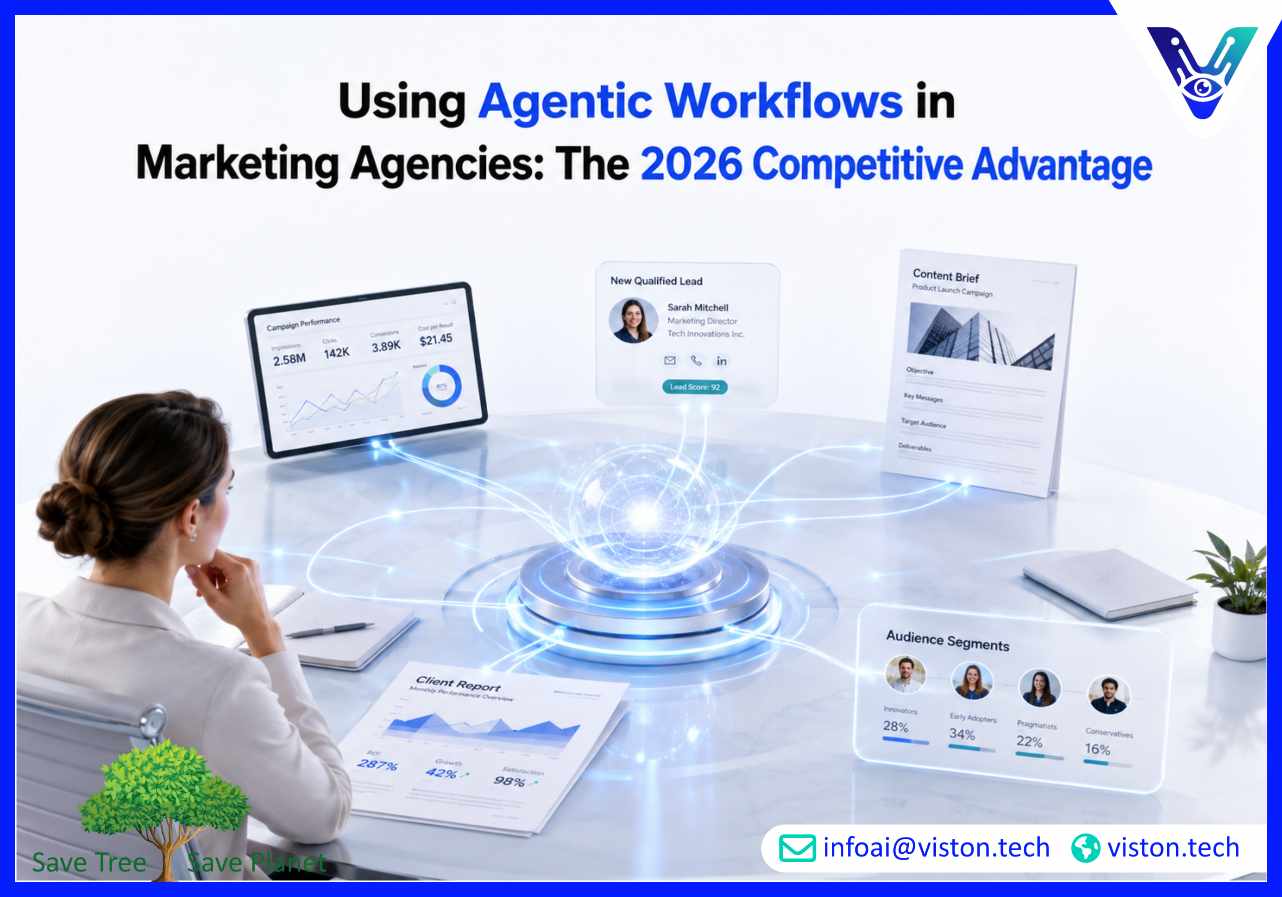
Paid media campaigns generate continuous performance data that most agencies review periodically rather than continuously. An agentic workflow changes this entirely. An agent can monitor live campaign metrics across Google Ads, Meta, LinkedIn, and programmatic channels simultaneously, identify underperforming segments as they emerge, and either flag recommendations for human review or — within defined guardrails — apply optimisations directly. This shifts campaign management from reactive to genuinely proactive, reducing wasted spend and shortening the time between insight and action.
Agency new business pipelines depend on speed. When a prospective client submits an enquiry, response time and the quality of initial engagement directly affect conversion rates. An agentic workflow can receive inbound submissions, analyse the content of free-text messages, assess fit against defined criteria, assign a priority score, draft a personalised initial response, and route the lead to the appropriate team member — all without human intervention. The account director gets a qualified, contextualised lead and a drafted reply, not a raw form submission.
Content teams in agencies face a recurring tension: clients expect consistent volume across blogs, social posts, email sequences, and ad copy, but creative quality deteriorates when production is rushed. A well-designed agentic workflow addresses this with a multi-agent approach — one agent researches topics and identifies keyword opportunities, a second produces a structured draft, a third checks tone alignment against brand guidelines, and a fourth optimises for SEO. The human creative lead reviews final output rather than managing each step in the production chain.
Building monthly or weekly client reports is one of the most time-consuming and least strategically valuable tasks in a typical agency. An agentic workflow can pull data from connected platforms — Google Analytics, CRM systems, ad platforms, social dashboards — synthesise performance against agreed KPIs, generate written commentary, and produce a formatted report ready for account manager review. What previously took two to three hours per client can be reduced to a brief quality check.
Effective personalisation requires analysing customer behaviour at a level of granularity that manual processes cannot sustain. Agentic workflows can continuously analyse behavioural signals — purchase history, engagement patterns, content preferences, lifecycle stage — and dynamically update audience segments, trigger personalised communications, and adjust messaging across channels. The result is marketing that adapts to the individual rather than approximating the average.
The operational upside of agentic workflows is real, but sustainable deployment requires careful preparation. Agencies that rush implementation without addressing the foundational requirements tend to encounter reliability issues, data quality problems, and governance gaps that erode the business case.
Agents are only as effective as the data they can access. Before deploying agentic workflows, agencies must assess whether their key data sources — CRM records, campaign platforms, analytics tools, client databases — are accessible via API, whether data quality is sufficient to support reliable reasoning, and whether the systems involved can handle the read and write operations that agents will perform. Disconnected data silos produce erratic agent behaviour and undermine the consistency that makes agentic AI valuable.
One of the most common implementation mistakes is deploying agents with insufficient scope definition. Every agentic workflow should have clearly defined boundaries: what the agent is authorised to do autonomously, what requires human approval before execution, and what it should escalate rather than attempt to resolve. In a marketing context, this might mean an agent can adjust bid strategies within a defined percentage range autonomously but must flag any creative asset changes for human review. Clear guardrails protect client relationships and ensure the agency remains in control of quality.
The technical architecture underlying agentic workflows has a direct bearing on reliability, scalability, and debuggability. Frameworks including LangGraph, CrewAI, and AutoGen each offer different strengths — LangGraph provides stateful, cyclical control flow suited to complex multi-step processes; CrewAI simplifies multi-agent collaboration with role-based orchestration; AutoGen supports flexible conversational agent patterns. The right choice depends on the specific workflow requirements, not simply familiarity. Agencies building on the wrong framework often encounter problems at scale that require costly rebuilds.
Unlike conventional automation where workflows either execute correctly or produce a logged error, agentic AI behaviour requires ongoing evaluation. Production deployments should include tracing and observability tooling — such as LangSmith for LangGraph-based systems — to identify where agents make suboptimal decisions, where latency accumulates, and how performance evolves over time. Without observability, agencies cannot improve agent behaviour or demonstrate performance accountability to clients.
Agencies handling client data across marketing operations must ensure agentic workflows are designed with compliance built in. This includes data access controls that limit agent scope to what is necessary, clear data retention and processing policies, and — where client data is subject to GDPR or equivalent regulations — documented lawful bases for processing and appropriate contractual safeguards. Compliance should be a design requirement embedded from the start, not an afterthought addressed post-deployment.
Agencies that have moved fastest to deploy agentic workflows have also produced the clearest lessons about what goes wrong. The most common failure patterns are worth understanding before committing to an architecture.
The first mistake is starting with too broad a scope. Deploying an agent to handle an entire campaign lifecycle before any single workflow has been validated creates compounding reliability risks. The more practical approach begins with a single, high-volume, well-defined process — client reporting, for instance, or inbound lead triage — validates the agent’s output quality in a controlled environment, and then expands scope incrementally.
The second is treating agentic AI as a one-time deployment rather than an ongoing system. Agent performance degrades when the data environment changes, when client requirements shift, or when external platforms update their APIs. Agencies that treat deployment as the finish line rather than the starting point consistently encounter reliability issues that could have been anticipated with a proper maintenance and monitoring approach.
The third is underinvesting in human-in-the-loop design. The most effective agentic workflows in agency settings are not fully autonomous — they are intelligently supervised. Identifying which decisions require human review and designing the workflow so that escalations are clear, fast, and actionable is what separates reliable production deployments from experimental prototypes.
Viston AI specialises in enterprise-grade agentic AI workflows, managing the full implementation lifecycle from workflow design through deployment, observability, and ongoing governance. For marketing agencies, their capabilities cover the specific technical and operational requirements that production deployments demand.
Their engineering team builds multi-agent systems using LangGraph, CrewAI, and AutoGen Studio, selecting the architecture based on the complexity and operational requirements of each use case. For agencies operating across multiple client accounts with varied martech stacks, Viston’s API-first integration approach and comprehensive connectivity assessments ensure that agents connect reliably to CRM platforms, ad systems, analytics tools, and proprietary client databases — not just the integrations that happen to come pre-built.
Observability is a core part of their delivery approach. Viston implements LangSmith-based tracing from the outset of every deployment, providing the visibility agencies need to monitor agent behaviour, identify performance issues, and demonstrate reliability to clients. Their Responsible AI at Scale framework embeds data privacy controls and regulatory compliance — including GDPR — into the agent architecture itself, which matters considerably for agencies handling personal data across client marketing campaigns.
For agencies evaluating whether agentic workflows represent a viable operational investment, Viston’s structured approach to proof-of-concept delivery is designed to produce demonstrable results quickly, while laying the technical foundation needed for production-scale deployment.
An agentic workflow is an automated process managed by an AI agent that can perceive a situation, reason through available data, decide on appropriate actions, execute them, and evaluate the outcome — all without following a fixed, pre-programmed sequence. In marketing agencies, this might mean an agent that monitors campaign performance across platforms and autonomously optimises underperforming segments, or one that receives inbound enquiries, qualifies them against fit criteria, and drafts personalised responses for account team review.
Standard marketing automation tools follow deterministic trigger-action logic — if a condition is met, a predefined action fires. Agentic workflows introduce reasoning and adaptability. An agent can interpret unstructured data such as free-text messages, handle multi-step decisions that depend on context, and adjust its behaviour based on outcomes rather than following a fixed sequence regardless of what is happening. This makes agentic AI suited to the more complex, judgment-intensive tasks that conventional automation cannot handle.
The strongest candidates are processes that are currently high-volume, time-consuming, and reliant on a degree of judgment or data interpretation — client reporting, inbound lead qualification, campaign performance monitoring, content production pipelines, and audience segmentation updates. Processes that are simple, fully structured, and require no contextual reasoning are generally better served by conventional automation tools. The best agentic workflow strategies use both in a hybrid architecture.
Agencies need accessible, quality data before agent deployment makes sense. Key platforms — CRM systems, ad accounts, analytics tools, and reporting dashboards — should be accessible via API. Data quality must be sufficient to support reliable agent reasoning, and appropriate access controls need to be in place before connecting agent systems to client data environments. A connectivity assessment before any build begins is a sound investment that reduces implementation risk significantly.
Compliance must be embedded in the agent architecture from the start. This includes implementing strict data access controls that limit agent scope, defining lawful bases for any personal data processing under GDPR or equivalent regulations, ensuring audit logging captures agent actions for accountability, and establishing governance frameworks that allow ongoing monitoring of agent behaviour against defined compliance requirements. Agencies in regulated client sectors — financial services, healthcare — face additional requirements that should be assessed during the design phase.
For a well-defined, high-priority workflow with accessible data and a clear process specification, proof-of-concept deployments can be operational within two to four weeks. Full production deployments — covering multiple workflows, comprehensive integrations, observability tooling, and governance frameworks — typically require longer depending on the complexity of the client data environment and the number of systems involved. Viston AI’s methodology is structured to deliver initial proof-of-concept results within that two-to-four-week range, providing demonstrable value before a broader rollout commitment.
Using agentic workflows in marketing agencies is no longer a forward-looking experiment — it is an operational decision with measurable implications for capacity, quality, and competitive positioning. Agencies that deploy agentic AI effectively gain the ability to scale operations without proportional cost increases, deliver more consistent and personalised work, and free their people for the strategic and creative work that clients actually value. The risks are real but manageable with sound architecture, appropriate guardrails, and ongoing observability. Viston AI’s enterprise-focused approach to agentic AI workflow implementation is designed for agencies navigating this decision with production-grade requirements and client accountability in mind.
