
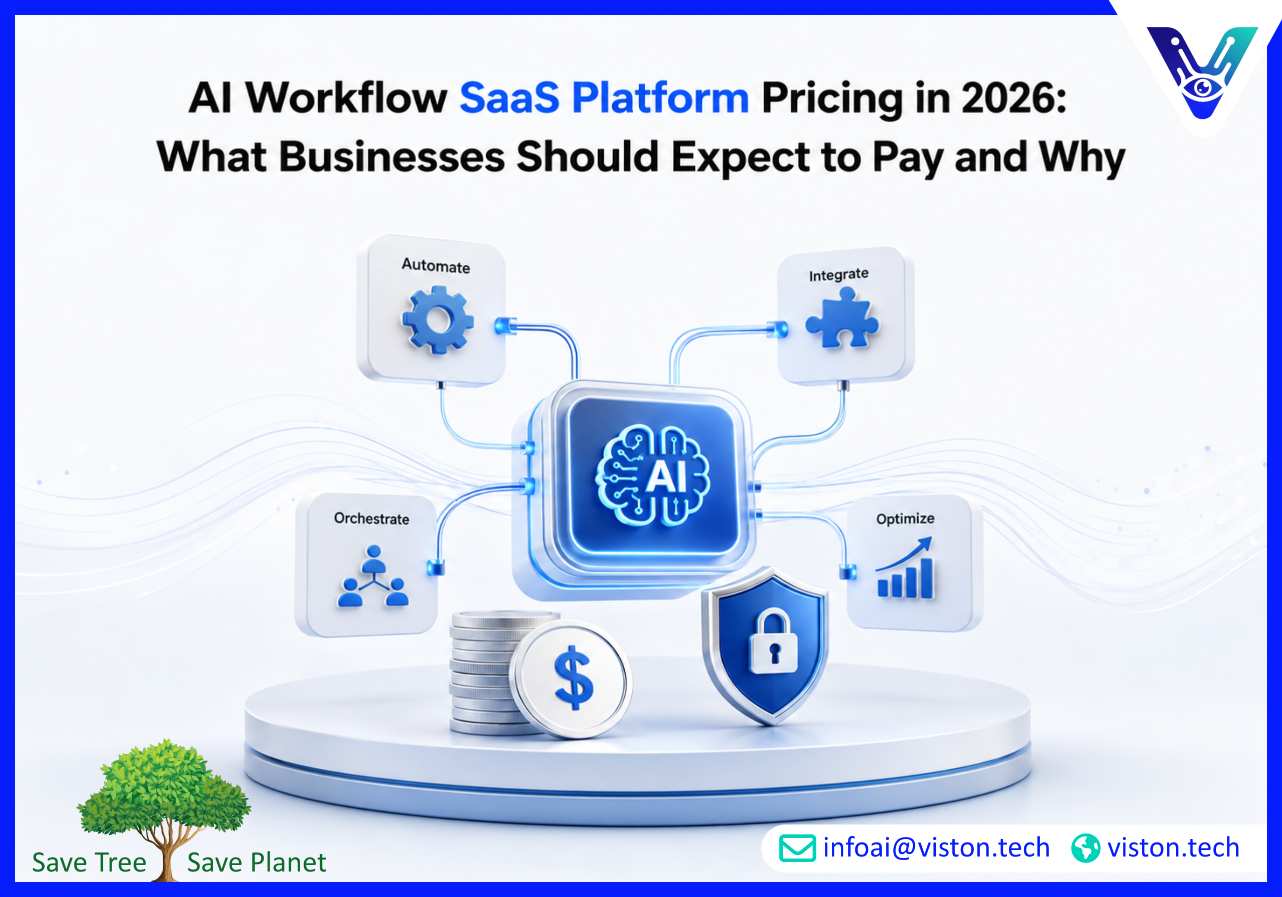
As AI adoption matures, businesses are moving beyond standalone chatbots and experimenting with agent-driven automation that can execute tasks across systems, teams, and workflows. One of the most common questions decision-makers ask is: how much does an AI workflow SaaS platform cost? Understanding AI workflow SaaS platform pricing in 2026 requires looking beyond subscription fees and evaluating the capabilities, integrations, scalability, and business outcomes these platforms deliver
AI workflow SaaS platforms are designed to automate and orchestrate business processes using AI agents, workflow automation engines, integrations, and decision-making capabilities. Pricing structures vary significantly because platforms differ in complexity, deployment scope, and automation capabilities.
Most vendors use one or a combination of the following pricing models:
This is the most common approach. Organizations pay a recurring monthly or annual fee based on platform access, feature tiers, user counts, or workflow volume.
Some AI workflow platforms charge according to consumption metrics such as:
This model can benefit businesses with fluctuating workloads but may require closer cost monitoring.
Many enterprise-focused platforms combine fixed subscriptions with variable usage costs. Organizations receive a predictable platform fee while paying additional charges for intensive AI processing or workflow volume.
Two AI workflow platforms may appear similar at first glance but have significantly different pricing structures. The difference usually comes down to capability, complexity, and implementation requirements.
Simple workflow automation generally costs less than multi-agent orchestration systems that coordinate planning, execution, validation, escalation, and reporting activities.
Organizations automating customer onboarding, sales operations, procurement, compliance reviews, or enterprise support processes often require more advanced functionality than basic workflow automation.
The number and complexity of integrations directly affect overall platform costs.
Common integrations include:
The more connected the workflow environment becomes, the more sophisticated the platform infrastructure must be.
Basic AI assistants typically cost less than advanced agentic systems capable of reasoning, planning, tool execution, memory management, and autonomous workflow completion.
In 2026, businesses increasingly prioritize platforms that support multiple specialized AI agents working together under orchestration frameworks.
Enterprise-grade security features often increase pricing but are essential for organizations handling sensitive data.
These may include:
Industries with strict regulatory obligations typically require more advanced platform capabilities.
While exact pricing varies between providers, businesses should evaluate AI workflow platforms as strategic operational investments rather than simple software purchases.
Smaller organizations often begin with limited workflow automation projects focused on customer support, lead management, internal productivity, or document processing.
These deployments typically prioritize rapid implementation, lower operational costs, and minimal infrastructure requirements.
Growing companies usually require:
Pricing considerations often shift toward scalability and operational efficiency rather than initial platform costs.
Large enterprises frequently invest in comprehensive AI workflow environments that support multiple departments, business units, and operational functions.
Enterprise deployments often include:
For these organizations, total value creation often outweighs subscription costs.
Businesses that focus only on software pricing often overlook the broader financial impact of workflow automation.
A well-designed AI workflow platform can generate value through:
Organizations should assess potential return on investment by examining how automation affects business performance rather than comparing platform fees alone.
Questions worth asking include:
These factors often have a greater impact on long-term value than subscription pricing differences between vendors.
For organizations evaluating AI workflow SaaS platforms, the technology itself is only one part of the equation. Successful adoption requires workflow design, orchestration planning, integration strategy, governance, testing, and ongoing optimization.
Viston AI specializes in Agentic AI Workflows that help businesses move beyond isolated AI tools and create coordinated automation systems capable of executing real operational tasks. Rather than focusing solely on software deployment, the approach emphasizes aligning AI workflows with measurable business objectives.
This includes designing multi-agent workflows, integrating AI systems with existing business platforms, establishing governance controls, and creating scalable automation architectures that support long-term growth. Organizations seeking to evaluate platform pricing should also consider implementation quality, integration readiness, workflow complexity, and operational outcomes.
For businesses exploring agentic AI adoption in 2026, a workflow-first approach often delivers greater value than selecting a platform based solely on subscription costs.
Workflow complexity, integration requirements, AI model usage, agent capabilities, security features, and scalability requirements are among the biggest pricing factors.
Some platforms use per-user pricing, while others charge based on workflow executions, AI usage, automation volume, or enterprise licensing models.
It depends on workload patterns. Businesses with predictable usage may prefer subscriptions, while organizations with variable demand may benefit from usage-based pricing.
Many enterprise deployments benefit from implementation support, particularly when workflows involve multiple systems, custom integrations, governance requirements, or agent orchestration.
ROI is typically measured through reduced labor costs, improved productivity, faster process execution, fewer errors, better customer experiences, and operational efficiencies.
Yes. Viston AI helps organizations design, integrate, deploy, and optimize Agentic AI Workflows that align automation initiatives with practical business goals and operational requirements.
AI workflow SaaS platform pricing in 2026 depends on far more than software access. Workflow complexity, integration needs, security requirements, AI capabilities, and scalability expectations all influence total investment levels. Businesses evaluating platforms should focus on operational outcomes, automation value, and long-term ROI rather than subscription costs alone. As agentic automation becomes increasingly important across industries, organizations that invest in well-designed Agentic AI Workflows can achieve meaningful improvements in efficiency, decision-making, and business performance. For companies seeking practical implementation expertise, Viston AI provides specialized support for building scalable and business-focused AI workflow environments.
