
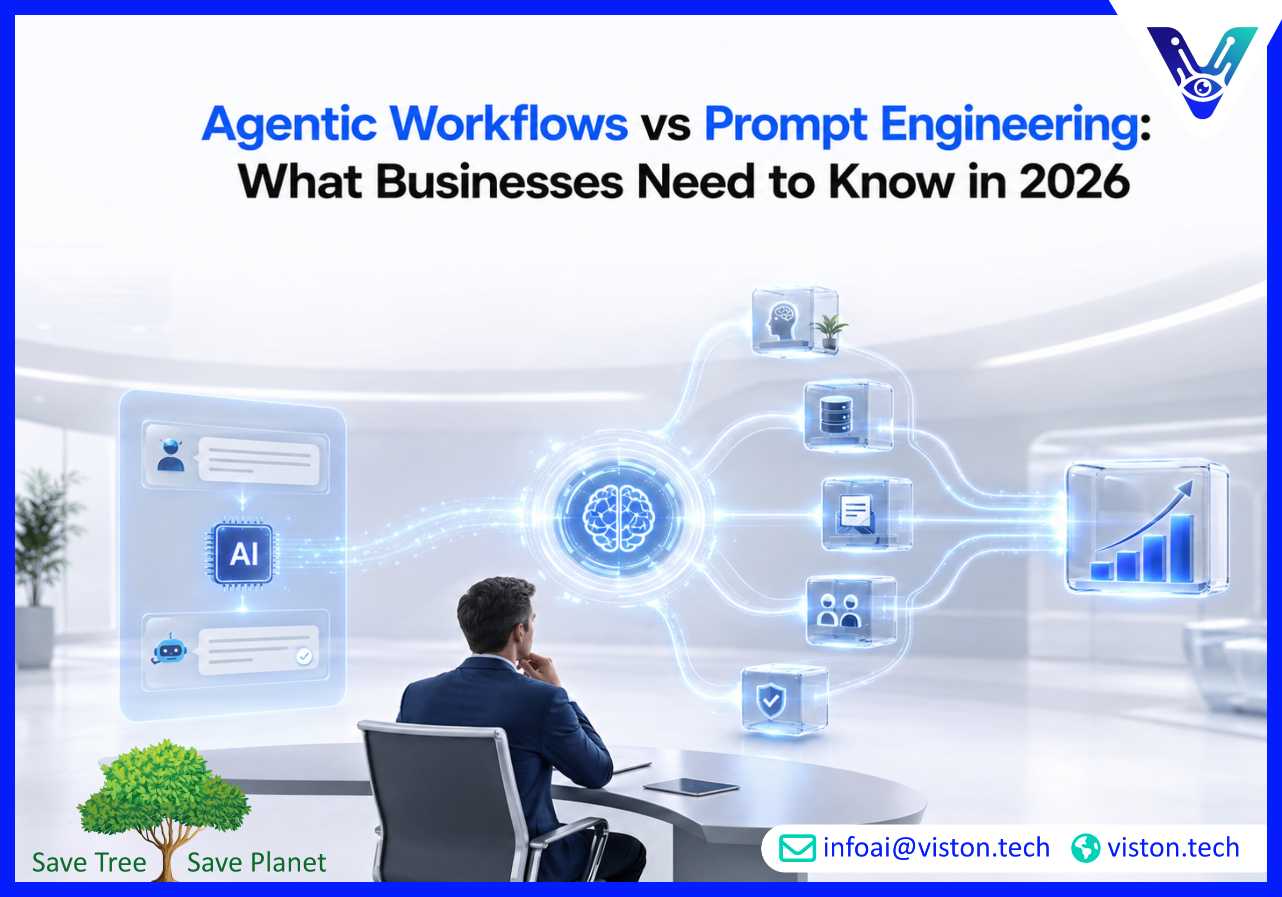
As AI adoption matures in 2026, businesses are moving beyond simple chatbot interactions and exploring more advanced ways to automate operations. Two concepts frequently discussed in this evolution are prompt engineering and agentic workflows. While both leverage large language models (LLMs), they serve fundamentally different purposes. Understanding the distinction is essential for organizations planning scalable AI initiatives, workflow automation, and long-term digital transformation strategies.
Prompt engineering focuses on designing effective instructions that guide AI models toward producing desired outputs. Agentic workflows, on the other hand, involve autonomous AI agents that can plan, reason, make decisions, interact with systems, and complete multi-step tasks with limited human intervention.
Although prompt engineering remains an important component of AI implementation, agentic workflows represent a broader operational framework designed to automate business processes rather than individual interactions.
Businesses evaluating AI investments often ask whether prompt engineering alone can solve their operational challenges or whether agentic workflows provide greater long-term value. The answer depends largely on workflow complexity, scalability requirements, integration needs, and business objectives.
Prompt engineering is the practice of crafting inputs, instructions, context, and constraints to improve the quality and relevance of AI-generated outputs.
When users interact with AI systems such as large language models, the quality of results often depends on how requests are structured. Prompt engineers develop instructions that help AI systems understand objectives, context, tone, formatting requirements, and expected outputs.
Examples include:
The primary goal is improving response quality through better communication between humans and AI systems.
For businesses just beginning AI adoption, prompt engineering often provides an accessible entry point.
Despite its value, prompt engineering has limitations when organizations need automation beyond content generation or conversational assistance.
As business requirements grow, these limitations become increasingly apparent.
Agentic workflows represent a more advanced approach where AI agents perform tasks, make decisions, interact with tools, and coordinate actions to achieve specific business outcomes.
Unlike prompt-based interactions that focus on generating responses, agentic systems focus on completing objectives.
An agentic workflow may include:
The workflow can involve multiple specialized agents working together through orchestration frameworks.
Consider a lead qualification process.
A prompt-engineered system might answer questions about leads when asked.
An agentic workflow could:
The workflow achieves a business objective rather than simply generating content.
Prompt engineering focuses on improving AI responses.
Agentic workflows focus on completing business processes.
Prompt-based systems require user interaction for each task.
Agentic systems can operate autonomously within defined boundaries.
Prompt engineering is suitable for isolated interactions.
Agentic workflows are designed for multi-step operational processes.
Prompt engineering often requires minimal integrations.
Agentic workflows typically connect with CRMs, ERPs, databases, APIs, communication tools, analytics platforms, and internal systems.
Prompt engineering improves information generation.
Agentic workflows improve operational execution.
Prompt engineering scales conversations.
Agentic workflows scale business operations.
Prompt engineering remains highly valuable in many business situations.
Marketing teams use prompts to generate blogs, social media content, ad copy, product descriptions, and email campaigns.
Organizations use prompts to summarize documents, answer questions, and retrieve information from knowledge bases.
AI-powered research tasks often benefit from carefully structured prompts.
Prompt templates can improve consistency in customer communication.
When workflows are simple and human oversight remains central, prompt engineering can deliver significant value.
Organizations often outgrow prompt-only implementations as operational requirements increase.
Agentic systems can automate lead processing, qualification, outreach, CRM updates, and reporting.
Agents can classify tickets, retrieve information, escalate cases, and coordinate resolution workflows.
Invoice processing, reconciliation, approval routing, and reporting can benefit from agentic orchestration.
Employee onboarding, document management, candidate screening, and internal support workflows can be streamlined.
Data extraction, validation, enrichment, monitoring, and reporting can be handled through coordinated AI agents.
These use cases require more than content generation. They require execution.
Several market trends are accelerating the adoption of agentic workflows.
Organizations manage growing volumes of data, applications, and customer interactions.
Businesses seek scalable ways to improve efficiency without proportionally increasing headcount.
Modern orchestration frameworks enable agents to collaborate, communicate, and coordinate actions more effectively.
API ecosystems and workflow platforms make it easier for agents to interact with enterprise systems.
Organizations increasingly evaluate AI based on operational results rather than model performance alone.
These trends are shifting investment priorities from isolated AI interactions toward end-to-end workflow automation.
Although agentic systems offer significant benefits, successful implementation requires careful planning.
Organizations must define permissions, approval requirements, and escalation rules.
Agent access to business systems requires robust authentication and monitoring.
Connecting multiple systems often presents technical challenges.
Poorly designed workflows can create inefficiencies and operational risks.
Businesses need visibility into workflow outcomes, exceptions, and system behavior.
Addressing these challenges is critical for sustainable deployment.
For organizations evaluating agentic workflows, implementation success depends on more than selecting AI tools. Effective deployment requires workflow design, orchestration planning, system integration, governance frameworks, monitoring strategies, and ongoing optimization.
Viston AI specializes in Agentic AI Workflows, helping businesses design and deploy AI-driven systems that automate operational processes across departments and platforms. Rather than focusing solely on prompt optimization, the approach centers on building structured workflows capable of delivering measurable business outcomes.
This includes identifying automation opportunities, defining agent responsibilities, integrating business systems, establishing governance controls, and creating scalable architectures that align with organizational objectives.
As businesses increasingly move beyond basic AI interactions, specialized expertise in agentic workflow development becomes essential for achieving sustainable automation and operational transformation.
No. Prompt engineering remains important because AI agents still rely on prompts internally. However, prompt engineering alone is often insufficient for complex workflow automation.
Yes. Prompt engineering is often a component of agentic systems. Well-designed prompts help agents perform tasks more effectively within larger workflows.
For simple content and information tasks, prompt engineering may provide faster returns. For operational automation and scalable process improvement, agentic workflows often deliver greater long-term value.
Yes. Small businesses can benefit from agentic workflows in sales, support, operations, and administrative processes, provided implementation aligns with business goals.
Industries with complex processes, high data volumes, and multiple systems—including finance, healthcare, logistics, retail, manufacturing, and professional services—often see substantial benefits.
Viston AI provides Agentic AI Workflow services that support workflow design, orchestration, integration, automation strategy, deployment, and optimization for organizations seeking practical AI-driven business transformation.
The debate around agentic workflows vs prompt engineering is not about choosing one over the other. Prompt engineering remains valuable for improving AI interactions, while agentic workflows extend AI capabilities into real business execution. As organizations focus increasingly on automation, productivity, and operational scalability in 2026, agentic workflows are becoming a critical component of enterprise AI strategies. Businesses that understand when to use each approach can make more informed technology investments and achieve stronger business outcomes. For organizations exploring advanced automation opportunities, Agentic AI Workflows provide a practical path toward scalable, outcome-driven AI implementation.
