
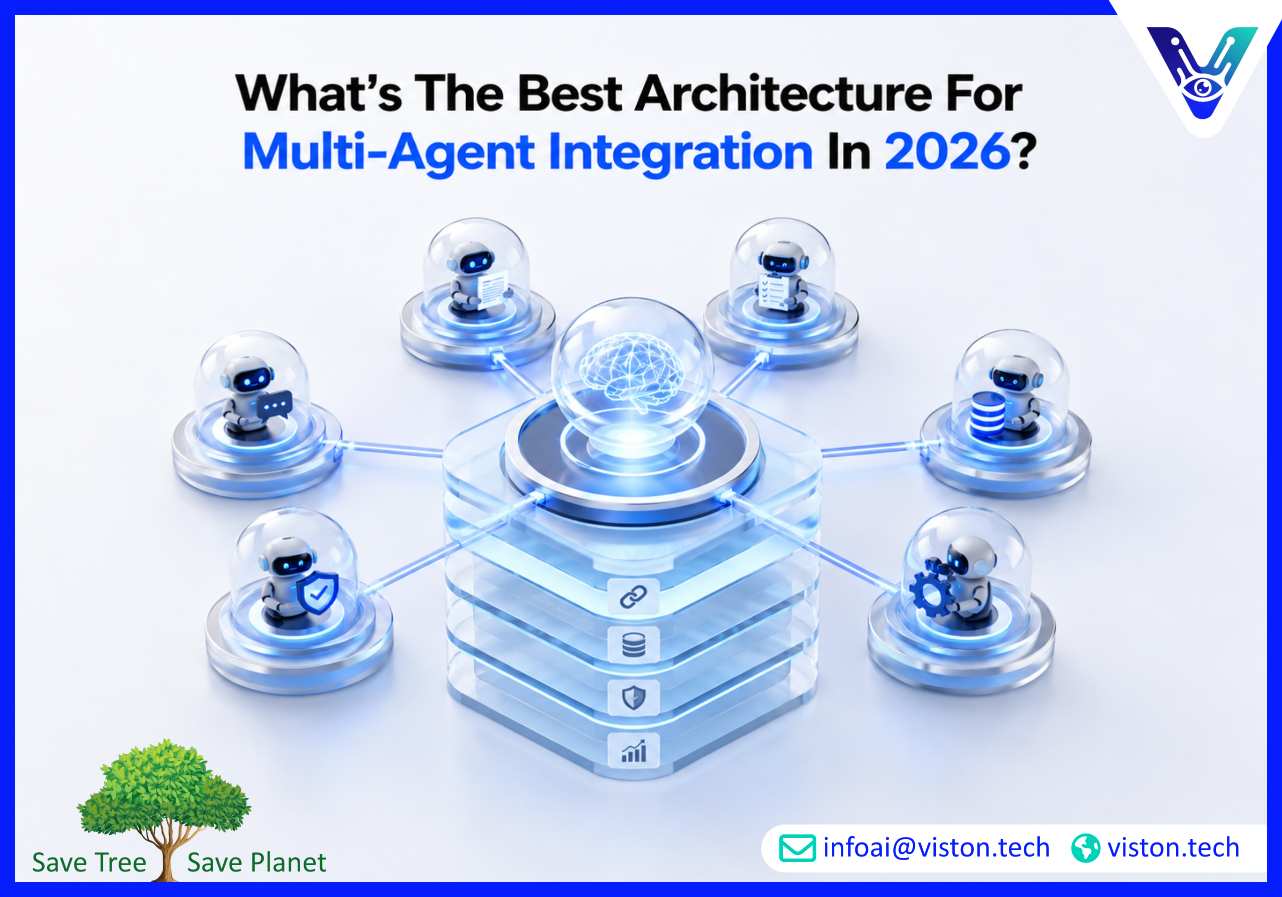
Choosing the best architecture for multi-agent integration is now a practical business decision, not just a technical design choice. In 2026, companies need AI agents that can coordinate tasks, connect with business systems, manage context, and operate safely across real workflows
Multi-agent integration architecture is the technical and operational structure that allows multiple AI agents to work together across business systems. Instead of one AI assistant handling every task, the architecture divides work between specialized agents that communicate, use tools, access data, follow workflow rules, and escalate decisions when needed.
The best architecture for multi-agent integration is not simply a group of agents connected to a large language model. It includes orchestration, secure system access, shared context, memory, monitoring, governance, error handling, and human approval points. This structure makes AI agents useful in real business environments where reliability matters.
For example, a sales operations workflow may include a research agent, CRM update agent, email drafting agent, qualification agent, compliance review agent, and reporting agent. Each agent performs a specific role, while the integration layer ensures the workflow remains controlled, traceable, and aligned with business rules.
Businesses are moving beyond experimental AI tools and toward agentic systems that can support day-to-day operations. This shift creates higher expectations for reliability, scalability, security, and measurable outcomes. Poor architecture can lead to duplicated actions, inconsistent outputs, data leakage, workflow failures, and limited trust from teams.
A strong multi-agent integration architecture helps businesses manage complexity. It ensures agents know their roles, understand what data they can access, use approved tools, follow defined workflow logic, and involve humans when judgment or approval is required.
In 2026, the best architecture is one that combines flexibility with control. AI agents should be capable enough to handle complex tasks, but not so autonomous that businesses lose visibility, accountability, or governance.
The best architecture for multi-agent integration is usually a layered, orchestration-led architecture. This model separates agent roles, workflow control, data access, integrations, governance, and monitoring into clear layers. It avoids the risk of building a chaotic network of agents that communicate without structure.
This layer defines how the workflow begins. A trigger may come from a user request, CRM update, support ticket, email, document upload, form submission, scheduled process, API event, or internal business rule.
Clear triggers are essential because multi-agent systems need a defined starting point. Without this, agents may act on incomplete, duplicate, or irrelevant inputs.
The orchestration layer is the control center of the architecture. It decides which agent acts first, how tasks are routed, when agents communicate, when retries happen, when approvals are needed, and when the workflow ends.
This layer may include workflow engines, agent orchestration frameworks, queue systems, routing logic, task state management, and approval gates. It keeps the system organized and prevents agents from making uncontrolled decisions.
Each agent should have a defined role. Common agent types include:
This specialization improves reliability because each agent can be tested, monitored, and improved independently.
Multi-agent integration depends on secure connections to business systems. These may include CRM platforms, ERP systems, ticketing tools, databases, project management platforms, email systems, document repositories, analytics tools, payment systems, and custom APIs.
The integration layer should use permission-controlled access. Agents should only be able to perform actions required for their role. For example, a research agent may read CRM data but should not update financial records. An execution agent may update a status field but should not send customer-facing communication without approval.
Agents need the right context to make useful decisions. This layer manages customer records, workflow history, internal policies, knowledge bases, business rules, documents, previous interactions, and task state.
Good context management prevents agents from repeating work, losing information between steps, or producing inconsistent outputs. For many businesses, retrieval-augmented generation, vector databases, structured databases, and controlled memory systems are important parts of this layer.
Governance protects the business from unnecessary risk. This layer includes access control, audit logs, approval rules, data privacy controls, prompt and instruction management, role-based permissions, security reviews, and compliance checks.
For sensitive workflows, governance should define which actions agents can complete automatically and which actions require human review. This is especially important for finance, legal, healthcare, customer data, employee records, regulated communications, and high-value transactions.
A production multi-agent system must be monitored continuously. Businesses should track completion rates, response accuracy, exception frequency, failed tool calls, escalation reasons, user feedback, processing time, cost per workflow, and business outcomes.
Monitoring allows teams to improve agents over time and detect problems before they affect customers or internal operations.
There are several ways to organize multi-agent integration. The right model depends on workflow complexity, risk level, system maturity, and business goals.
In a centralized model, one orchestration layer manages all agents and workflow decisions. This is often the safest architecture for businesses starting with multi-agent integration because it provides stronger control, clearer monitoring, and easier governance.
Centralized architecture works well for structured workflows such as lead qualification, support triage, document processing, reporting, invoice review, and CRM automation.
In a decentralized model, agents communicate more independently and make decisions with less central control. This can be useful for complex research, simulation, planning, or exploratory workflows where flexibility matters.
However, decentralized systems are harder to audit and govern. They require strong safeguards, clear communication protocols, and careful testing before being used in business-critical environments.
For most businesses, the best architecture for multi-agent integration is hybrid. A hybrid model uses centralized orchestration for control while allowing specialized agents to collaborate within defined boundaries.
This approach gives businesses the reliability of structured workflows and the flexibility of agent collaboration. It is especially useful when agents need to work across multiple systems, departments, and data sources while still following business rules.
Viston AI is relevant to businesses evaluating the best architecture for multi-agent integration because its service offering aligns with Agent Integration Services, AI automation, workflow bots, agentic AI workflows, and custom AI agent solutions. These capabilities are directly connected to the practical work required to design, integrate, deploy, and optimize multi-agent systems.
Multi-agent architecture requires more than selecting an AI model. Businesses need workflow analysis, agent role design, orchestration planning, system integration, secure API access, data readiness, monitoring, and governance. Viston AI can support organizations that want to connect AI agents with business systems such as CRMs, ERPs, helpdesks, databases, knowledge platforms, and workflow tools.
Its Agent Integration Services are especially relevant for companies that need AI agents to operate inside real processes rather than remain isolated prototypes. This can include automating sales operations, customer support, internal knowledge workflows, reporting, data processing, document handling, and back-office coordination.
For organizations working across global markets, a structured integration approach helps reduce operational risk while improving scalability. Viston AI’s focus on practical AI implementation makes it suitable for businesses that need architecture built around business outcomes, not experimental automation alone.
The best architecture is usually a layered, orchestration-led hybrid architecture. It combines centralized workflow control with specialized agents, secure integrations, shared context, governance, and monitoring.
Orchestration controls how agents communicate, sequence tasks, handle exceptions, use tools, and escalate decisions. Without orchestration, multi-agent systems can become unreliable and difficult to manage.
No. Each agent should have role-based access only to the systems and actions needed for its task. This improves security, reduces risk, and makes the system easier to audit.
Centralized architecture is better for controlled business workflows. Decentralized architecture may suit exploratory tasks. Most businesses benefit from a hybrid model that balances control and flexibility.
AI agents can integrate with CRM systems, ERP platforms, helpdesks, databases, email tools, document repositories, analytics platforms, project management tools, and custom APIs.
Yes. Viston AI’s Agent Integration Services align with designing agent roles, connecting business systems, planning orchestration, and supporting scalable AI agent workflows.
The best architecture for multi-agent integration in 2026 is structured, secure, orchestration-led, and built around real business workflows. Companies need more than multiple AI agents; they need clear roles, controlled system access, shared context, human approval points, governance, and monitoring. A hybrid architecture is often the strongest choice because it supports both flexibility and operational control. For businesses exploring Agent Integration Services, Viston AI offers relevant expertise in connecting AI agents with practical workflows, business systems, and scalable automation goals.
