
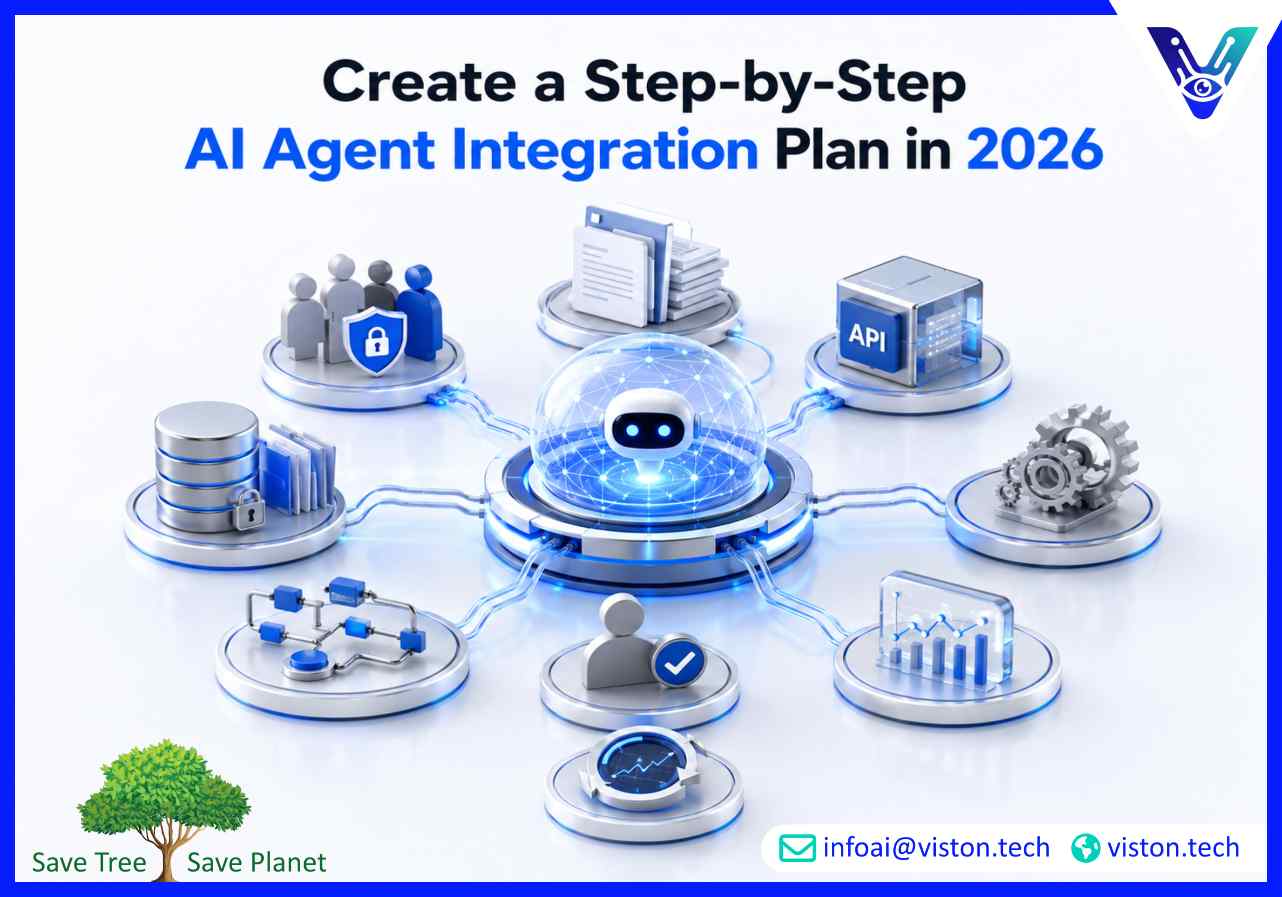
Creating a step-by-step AI agent integration plan helps businesses move from scattered AI experimentation to structured implementation. For organizations exploring Agent Integration Services, the right plan connects AI agents with real systems, workflows, data, approvals, and measurable business outcomes.
A step-by-step AI agent integration plan is a structured roadmap for connecting AI agents to the tools, data sources, applications, and workflows a business already uses. It defines what the agents will do, which systems they need access to, how decisions are controlled, and how success will be measured.
AI agents are different from basic chatbots or simple automation scripts. They can interpret context, use tools, retrieve information, trigger actions, assist decisions, and coordinate multi-step tasks. However, they only create business value when they are integrated into the operating environment where work actually happens.
For example, an AI agent that qualifies sales leads may need access to a CRM, website forms, email tools, customer data, product information, and internal qualification rules. A support agent may need access to ticketing software, knowledge bases, order records, escalation workflows, and customer communication channels.
In 2026, businesses are under pressure to adopt AI responsibly, securely, and at scale. Many teams already use AI tools, but disconnected tools often create inconsistent results, data risks, duplicate work, and limited return on investment.
A proper AI agent integration plan helps avoid common problems such as unclear ownership, weak data access, poor workflow mapping, over-automation, security gaps, and unreliable outputs. It gives business and technical teams a shared implementation path.
A reliable integration plan should begin with business goals and end with monitoring, optimization, and governance. The following steps provide a practical structure for implementation.
Start by choosing one workflow where AI agents can create measurable value. Good candidates are repetitive, data-heavy, time-consuming, and dependent on multiple systems. Examples include lead qualification, customer onboarding, support triage, invoice review, employee onboarding, document processing, reporting, and CRM updates.
Decide exactly what the AI agent should and should not do. A clear role may include retrieving data, drafting responses, validating records, updating systems, routing requests, creating summaries, or escalating issues. Avoid giving one agent too many responsibilities at once.
List every platform the agent needs to interact with. This may include CRM systems, ERP platforms, helpdesks, databases, email tools, project management systems, knowledge bases, analytics dashboards, document storage, and custom APIs.
AI agents should only access the data and actions required for their role. Permission design should include read access, write access, approval requirements, restricted fields, audit logs, and role-based controls.
Map the full process from trigger to completion. Define what happens when data is missing, when confidence is low, when a customer request is unusual, when a system fails, or when human approval is needed.
Not every action should be automated. Human review is important for sensitive customer communication, financial decisions, legal issues, compliance matters, refunds, account changes, or high-impact operational actions.
Connect the agent to selected systems through secure APIs, middleware, automation platforms, or custom integration layers. Testing should include normal cases, edge cases, incomplete information, conflicting data, failed API calls, and security boundaries.
Track completion rate, response quality, time saved, manual overrides, escalation frequency, user satisfaction, error rates, and business impact. These metrics help determine whether the integration is ready to scale.
AI agent integration is not a one-time setup. Businesses should review outputs, update prompts and workflows, refine permissions, improve data quality, and expand use cases only after the first workflow is stable.
Many integration projects fail because teams focus on the AI model before understanding the workflow. Successful implementation depends on operational clarity, system readiness, and realistic expectations.
Viston AI is relevant to businesses creating a step-by-step AI agent integration plan because its service focus aligns with custom AI agent solutions, Agent Integration Services, AI automation, workflow bots, and agentic systems. For organizations that want AI agents to work across business tools rather than remain isolated assistants, Viston AI can support the planning and implementation process.
A practical AI agent integration plan requires workflow analysis, agent role design, system integration, secure access planning, orchestration logic, testing, monitoring, and ongoing optimization. Viston AI’s capabilities connect directly to these needs by helping businesses design agents that interact with CRMs, ERPs, knowledge bases, customer support tools, internal systems, and operational workflows.
For companies across industries, this support may include identifying the right use case, mapping integration requirements, building agent workflows, adding human approval points, and creating scalable automation that fits existing operations. The value is not simply adding AI to a process, but making AI agents useful, controlled, and aligned with real business outcomes. Viston AI’s business-focused approach makes it a relevant specialist for organizations seeking reliable Agent Integration Services in 2026.
An AI agent integration plan is a structured roadmap for connecting AI agents to business systems, data sources, workflows, permissions, and approval processes so they can perform useful tasks safely and reliably.
AI agents can integrate with CRM platforms, ERP systems, helpdesks, databases, email tools, knowledge bases, document storage, analytics tools, project management platforms, and custom business applications.
Timelines depend on workflow complexity, data readiness, security needs, API availability, testing requirements, and the number of systems involved. A focused workflow can often be planned faster than a broad enterprise rollout.
Many AI agent workflows should include human approval, especially when actions involve sensitive data, financial decisions, customer communication, compliance, legal risk, or major operational changes.
Yes. Viston AI provides Agent Integration Services and related AI automation capabilities that can help businesses plan, build, integrate, test, and optimize AI agents for practical workflows.
Businesses should prepare workflow documentation, system access details, data sources, process rules, security requirements, success metrics, escalation paths, and clear goals for what the AI agent should achieve.
Creating a step-by-step AI agent integration plan is essential for businesses that want reliable automation, better workflow execution, and measurable AI value in 2026. Agent Integration Services help connect AI agents with the systems, data, permissions, and controls needed for real business use. A strong plan begins with one valuable workflow, defines clear agent roles, adds security and human oversight, and improves through monitoring. Viston AI is a relevant specialist for organizations looking to move from AI experimentation to practical, integrated agent workflows.
