
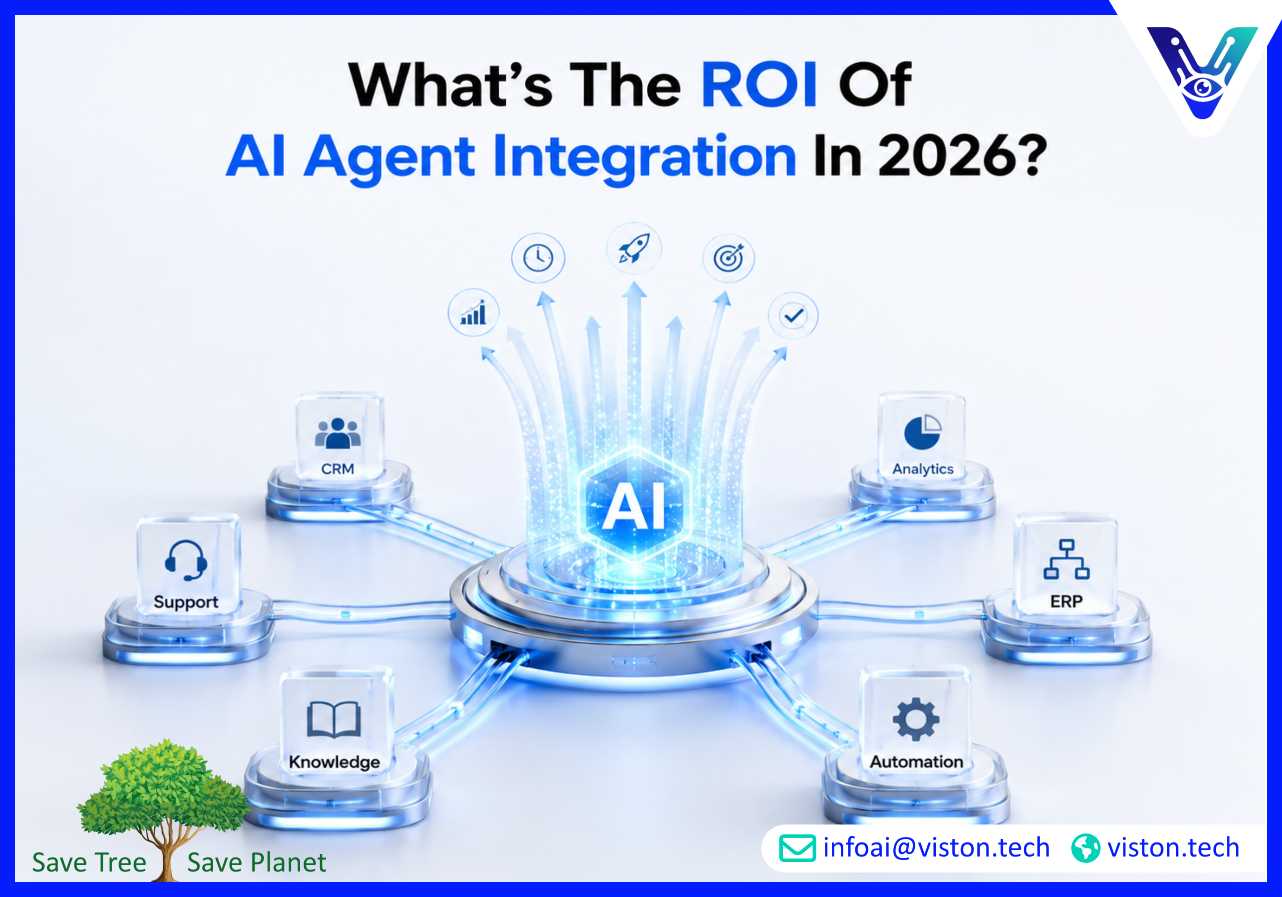
AI agent integration ROI depends on how effectively autonomous agents reduce manual work, improve process speed, increase accuracy, and connect with existing business systems. For companies investing in Agent Integration Services, the return comes from measurable operational gains, not simply from adopting AI technology.
The ROI of AI agent integration measures the business value created when AI agents are connected to workflows, applications, data sources, and operational systems. Unlike standalone chatbots or basic automation tools, integrated AI agents can retrieve information, take action, update systems, support decisions, and coordinate tasks across business platforms.
For business leaders, ROI is usually evaluated through practical outcomes such as time saved, reduced labor costs, faster response times, fewer errors, improved customer experience, higher sales productivity, and better scalability. The strongest ROI appears when AI agents are embedded into high-volume, repetitive, data-heavy, or coordination-heavy processes.
In 2026, companies are looking beyond experimentation. They want AI agents that work inside CRMs, ERPs, helpdesks, internal knowledge bases, communication tools, analytics platforms, and custom applications. Agent Integration Services help make that possible by connecting agent intelligence with real business execution.
AI agent integration creates ROI by improving how work gets completed across teams and systems. The value is not limited to one department. Sales, support, operations, finance, HR, marketing, procurement, and data teams can all benefit when AI agents are properly integrated.
Many teams spend hours moving information between systems, checking records, preparing responses, updating tickets, creating reports, or following repetitive processes. Integrated AI agents can handle much of this work automatically, allowing employees to focus on higher-value decisions, client relationships, and strategic tasks.
AI agents can work continuously, retrieve information quickly, and trigger actions without waiting for manual handoffs. This improves response speed in customer support, sales follow-ups, onboarding, reporting, internal requests, and back-office workflows.
When agents are connected to approved data sources and governed workflows, they can reduce errors caused by manual copying, inconsistent responses, missed steps, or outdated information. This is especially valuable for businesses managing customer records, compliance checks, invoices, service requests, or operational reporting.
Integrated agents can answer questions, route requests, summarize records, recommend next steps, and support faster resolution. This improves both external customer experience and internal employee productivity.
As businesses grow, manual processes often become expensive and difficult to manage. AI agent integration helps organizations scale workflows without increasing headcount at the same rate.
Measuring the ROI of AI agent integration requires clear baseline data before implementation. Businesses should identify the current cost, time, error rate, and performance of the workflow they want to improve.
A simple ROI model compares the cost of implementation, integration, support, and AI usage against measurable savings and revenue improvements. For example, if an integrated AI agent reduces 500 monthly manual hours across support and operations, the value can be calculated against employee cost, productivity gains, faster delivery, and improved service quality.
However, ROI should not be measured only in cost savings. Some of the most important returns come from better decision-making, stronger customer retention, faster sales cycles, improved data quality, and reduced operational risk.
Not every AI agent project delivers the same return. ROI depends on the quality of workflow selection, integration design, data readiness, governance, and adoption.
The best ROI usually comes from workflows that are repetitive, frequent, rules-supported, data-driven, and business-critical. Examples include lead qualification, customer support triage, CRM updates, invoice processing, document review, onboarding, reporting, and internal knowledge retrieval.
An AI agent that only answers questions may provide limited value. An agent connected to business systems can retrieve records, update platforms, trigger workflows, summarize data, escalate exceptions, and complete tasks. Deeper integration often creates stronger ROI.
AI agents need reliable, structured, and accessible data. Poor data quality can reduce accuracy, increase errors, and weaken business trust. Before integration, companies should review data sources, access permissions, documentation, and system reliability.
Strong access controls, audit logs, approval rules, monitoring, and human-in-the-loop checkpoints are essential. ROI suffers when businesses deploy agents without control over what they can access, generate, or execute.
Even a technically strong system may underperform if teams do not understand how to use it. Training, workflow alignment, clear ownership, and performance reporting help improve adoption and long-term value.
Viston AI is relevant for businesses evaluating the ROI of AI agent integration because its work aligns with AI automation, workflow bots, custom AI agents, and agentic system implementation. For companies investing in Agent Integration Services, ROI depends on building agents that are not only intelligent but also connected to real business workflows.
Viston AI can support organizations by helping design, develop, integrate, and scale AI agents that connect with business tools, data sources, and operational processes. This may include agents for sales workflows, customer support, internal knowledge retrieval, reporting, process automation, data handling, and back-office operations.
A strong implementation approach considers workflow mapping, system integrations, role-based agent design, security controls, human review points, testing, monitoring, and continuous improvement. These factors directly affect ROI because they determine whether AI agents produce reliable business outcomes or remain disconnected experiments.
For companies across industries and global markets, Viston AI’s relevance lies in helping translate AI agent potential into practical execution. By focusing on measurable outcomes such as reduced manual effort, faster workflows, improved accuracy, and scalable automation, Viston AI can help organizations approach AI agent integration with stronger commercial clarity.
The ROI of AI agent integration is the measurable business value gained from connecting AI agents to workflows, systems, and data sources. It may include cost savings, time reduction, faster service, fewer errors, improved productivity, and increased operational capacity.
ROI timelines depend on workflow complexity, integration scope, data readiness, and adoption. Smaller workflow integrations may show value within weeks, while enterprise-wide agent systems may require several months to deliver measurable returns.
High-volume, repetitive, data-heavy, and coordination-heavy workflows usually produce the best ROI. Common examples include customer support triage, lead qualification, CRM updates, invoice review, onboarding, reporting, and internal knowledge search.
No. Cost reduction is important, but ROI also comes from faster decisions, better customer experience, improved data quality, higher employee productivity, stronger compliance controls, and scalable operations.
Yes. Viston AI can support businesses with AI automation, workflow bots, custom AI agents, and integration-focused implementation that connects agent capabilities to practical business outcomes.
Businesses should evaluate workflow value, manual effort, system readiness, data quality, security requirements, integration complexity, user adoption, support needs, and the metrics they will use to measure success.
The ROI of AI agent integration depends on choosing the right workflows, connecting agents to real business systems, and measuring outcomes clearly. Agent Integration Services can help companies reduce manual work, improve speed, strengthen accuracy, and scale operations more efficiently. In 2026, businesses should evaluate AI agent projects through measurable business impact rather than technology excitement alone. Viston AI is a relevant partner for organizations that want practical, integration-led AI agent solutions designed around operational value and long-term scalability.
