
A practical guide for business decision-makers evaluating agentic AI workflow investment
Understanding the real cost of building AI workflows is one of the most critical steps before committing to an agentic AI investment. Budgets are frequently underestimated, timelines are misaligned, and hidden infrastructure costs derail deployments that looked straightforward on paper. Whether your organisation is building from scratch or expanding an existing automation stack, knowing where the money actually goes puts you in a far stronger position to evaluate providers, scope projects accurately, and measure return on investment.
Traditional software projects have relatively predictable cost structures — licenses, implementation hours, integration work, and support contracts. Agentic AI workflows are fundamentally different. They combine model inference costs, orchestration infrastructure, data pipeline requirements, security and compliance architecture, and ongoing monitoring into a single deployment. Each layer carries its own cost profile, and those costs shift as usage scales.
The perceive-reason-act loop that defines agentic AI also introduces variability that static automation does not. An agent responding to complex, unstructured inputs — customer emails, documents, multi-step instructions — consumes significantly more computational resource per task than a simple trigger-action workflow. Token consumption, tool call frequency, and retry logic all affect the final bill in ways that only become visible once a system is live.
Businesses that enter agentic AI projects with a fixed-software mindset consistently underbudget. Those that understand the cost structure upfront can phase their investment more intelligently, build in the right governance from the start, and avoid expensive re-architecture later.
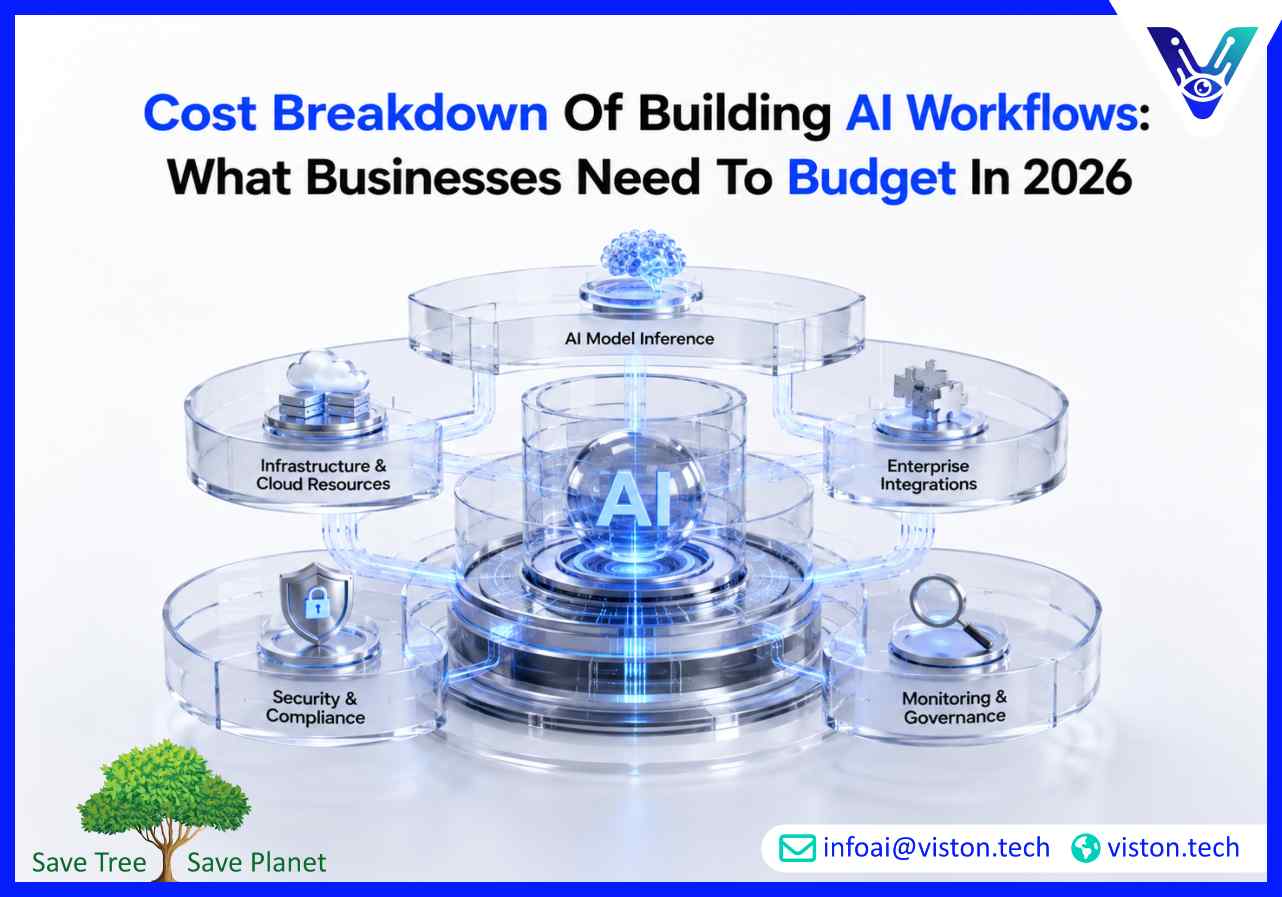
A production-ready agentic AI workflow involves several distinct cost layers. Understanding each one separately — rather than treating the project as a single line item — is the foundation of accurate budgeting.
The largest variable cost in most AI workflow deployments is model inference. Every time an agent reasons, classifies, drafts, or makes a decision, it consumes tokens through a language model. At scale, this compounds quickly. A workflow processing thousands of documents per day, handling multi-turn conversations, or running multi-agent orchestration across several specialised models can accumulate significant monthly API spend. The choice of model tier — frontier models versus lighter, faster options optimised for specific tasks — has a direct impact here, and the right architecture uses the appropriate model for each task rather than routing everything through the most capable and most expensive option.
Agentic workflows require infrastructure to manage agent state, coordinate tool calls, handle retries, route between agents, and maintain execution context across multi-step tasks. Frameworks such as LangGraph, AutoGen, and CrewAI each carry their own hosting and operational requirements. Cloud infrastructure costs — compute, storage, queuing, and networking — vary based on workflow complexity, concurrency requirements, and the volume of tasks being processed. For enterprise deployments integrating with legacy ERPs, internal APIs, and proprietary databases, the infrastructure layer is rarely trivial.
Connecting an AI workflow to real business systems is almost always where the most significant development time is spent. Pre-built connectors exist for common SaaS platforms, but enterprise environments typically require custom API integrations, authentication handling, data transformation layers, and error management that goes well beyond standard connector configuration. The depth and complexity of the existing technology stack directly determines integration cost. Systems with clean, well-documented APIs reduce this burden considerably. Legacy infrastructure without modern API access layers adds meaningful time and cost.
For regulated industries and enterprises handling sensitive data, security and compliance are not optional additions — they are structural requirements that must be designed in from the outset. This includes role-based access controls limiting what data agents can access, encryption in transit and at rest, audit logging for every agent action, data residency configurations where GDPR or regional compliance applies, and guardrails that bound agent behaviour within acceptable operational limits. Organisations that treat compliance as an afterthought typically spend more correcting it later than they would have spent building it correctly the first time.
Unlike deterministic automation, AI agent behaviour evolves. An agent that performs well in testing may degrade over time as input patterns change, model updates are released, or edge cases emerge in production. Observability tooling — such as LangSmith for LangGraph-based systems, or custom tracing pipelines — is an ongoing operational cost, not a one-time setup expense. Regular evaluation cycles, prompt refinement, and performance benchmarking are built-in costs of running production agentic AI, and they need to be accounted for in any realistic budget.
The human cost of building AI workflows — solution architecture, agent design, prompt engineering, integration development, quality assurance, and deployment — typically represents a significant share of total project cost, particularly in the early phases. Experienced AI engineers and architects who understand both the technical and business dimensions of agentic systems are in high demand in 2026, and their day rates reflect that. Businesses working with specialist implementation partners generally see faster time-to-value than those relying on generalist development teams without prior agentic AI experience.
Not all AI workflows carry the same cost profile. The single most important factor in determining total investment is the complexity of the workflow being built. A useful way to think about this is across three broad tiers.
Simpler, single-agent workflows — handling a well-defined task such as document classification, email triage, or structured data extraction — are typically the lowest-cost entry point for agentic AI. The scope is contained, integration requirements are limited, and the path from proof-of-concept to production is relatively short. These workflows suit organisations that want to validate the technology before committing to larger investments.
Mid-complexity workflows involving multi-step reasoning, integration with two or more enterprise systems, or adaptive decision logic across variable inputs require more substantial design, testing, and infrastructure investment. These represent the majority of enterprise agentic AI projects in 2026 and typically require experienced implementation partners to deliver reliably.
The highest-cost tier involves multi-agent architectures — systems where multiple specialised agents collaborate, hand off tasks, and operate in parallel to complete complex business processes. Orchestration design, inter-agent communication, fault tolerance, and governance across a multi-agent system all add meaningful cost and complexity. These deployments deliver the most significant operational transformation but require the most rigorous architectural planning and specialist expertise to execute well.
One of the most common budget errors in agentic AI projects is treating the initial build as the total investment. The ongoing cost of running, maintaining, and improving AI workflows is a permanent operational line item, and it deserves the same analytical rigour as the upfront capital cost.
Model inference costs scale directly with usage. As workflow adoption grows across an organisation, API spend grows with it. Infrastructure costs follow the same pattern. Businesses should model their cost trajectory at projected scale from the outset, not only at initial deployment volume.
Maintenance and iteration are structural requirements. Prompts need refinement as requirements evolve. Agent logic needs updating when business processes change. New integrations need to be added as the technology stack grows. Security configurations need reviewing as threats evolve and compliance obligations change. None of this is unexpected — it is simply the reality of operating sophisticated AI systems in production environments.
Governance and oversight also carry ongoing cost. Monitoring agent behaviour, reviewing edge cases, updating guardrails, and maintaining audit trails for compliance purposes are recurring activities that require dedicated time and capability. Organisations that invest in proper governance infrastructure reduce the risk of costly operational failures significantly.
Viston AI specialises in enterprise-grade agentic AI workflow design, delivery, and governance — and their approach to cost is built around one principle: no organisation should commit budget without understanding exactly where it goes and why.
Their process begins with a structured assessment of workflow complexity, integration requirements, and data environment before any build begins. This gives clients a clear, itemised view of the cost drivers specific to their deployment — model inference requirements, infrastructure architecture, integration scope, compliance overhead, and observability needs — rather than a generic estimate that obscures the real variables.
Viston builds using frameworks including LangGraph, AutoGen Studio, and CrewAI, selecting the architecture that best matches the workflow’s complexity and scale requirements. For enterprises operating legacy infrastructure, their API-first integration approach reduces unexpected connectivity costs that frequently inflate mid-project budgets. Their Responsible AI at Scale framework embeds security, data privacy controls, and regulatory compliance — including GDPR, HIPAA, and CCPA alignment — into the build from day one, removing the cost of retroactive compliance remediation.
For organisations evaluating the cost of building AI workflows, Viston’s methodology is designed to deliver accurate scoping, predictable investment, and proof-of-concept results within two to four weeks — giving decision-makers the data they need to make confident commitments at each phase of the deployment.
Cost varies considerably based on workflow complexity, integration scope, and compliance requirements. Simple single-agent workflows with limited system integrations can be built for a fraction of what a full multi-agent enterprise deployment requires. The most important step is to assess the specific workflow requirements before attempting to estimate cost — generic benchmarks rarely reflect the variables of an individual organisation’s environment.
Ongoing costs include model inference at scale, cloud infrastructure, observability and monitoring tooling, prompt and agent maintenance, integration updates as systems evolve, and governance oversight. Organisations should build these into their operational budget from the outset rather than treating the initial build as the only investment.
Framework selection affects both build cost and operational cost. Some frameworks require more specialist expertise to implement, increasing development time. Others have higher infrastructure overhead at scale or more complex debugging requirements, affecting ongoing maintenance cost. The choice of framework should be based on workflow requirements and long-term operational fit, not solely on familiarity.
Yes, and this is generally the most prudent approach for organisations new to agentic AI. Starting with a clearly defined, contained workflow as a proof-of-concept allows businesses to validate performance, measure return, and understand their actual cost profile before committing to broader deployment. This reduces the risk of large capital commitments based on assumptions rather than evidence.
Compliance requirements — particularly in regulated industries operating under GDPR, HIPAA, or CCPA — add meaningful cost to the design, build, and ongoing operation of AI workflows. Access controls, audit logging, data residency configuration, and governance frameworks all require specialist design work. Embedding compliance from the outset is significantly more cost-efficient than retrofitting it after deployment.
Working with a specialist provider such as Viston AI typically reduces total cost of ownership despite a higher upfront professional services cost. Experienced teams avoid the re-architecture expenses that result from incorrect initial design, deliver faster time-to-value, and build governance frameworks correctly from the start — all of which reduce the risk of the costly corrections that commonly affect in-house or generalist-led deployments.
The cost breakdown of building AI workflows is not a single figure — it is a layered structure of model inference, infrastructure, integration, compliance, observability, and ongoing maintenance that needs to be understood at the component level before any accurate budget can be set. Businesses that approach this with the rigour it deserves make better investment decisions, manage implementation risk more effectively, and build systems that scale without unexpected cost increases. Viston AI’s structured approach to agentic AI workflow design and delivery is built precisely to give organisations that clarity — accurate scoping, transparent cost architecture, and enterprise governance embedded from day one.
