
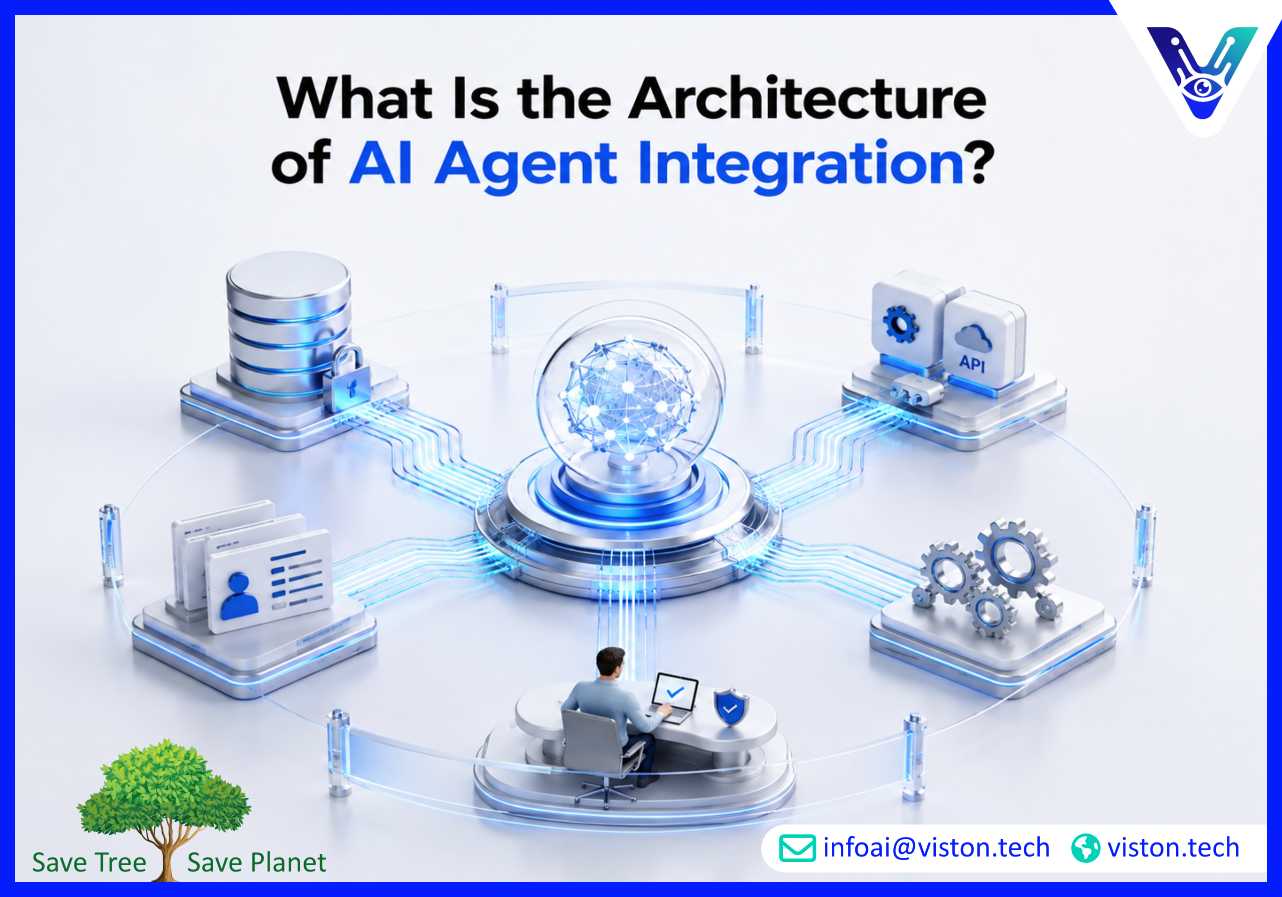
Understanding the architecture of AI agent integration helps businesses design agent systems that are secure, scalable, connected, and reliable. In 2026, successful AI agent integration is not just about adding an AI model to software. It requires a structured architecture that connects data, tools, workflows, APIs, governance, and human oversight.
AI agent integration architecture is the technical and operational structure that allows AI agents to interact with business systems, process information, make decisions, trigger actions, and complete tasks within controlled workflows.
An AI agent may need to read customer data from a CRM, retrieve policy information from a knowledge base, summarize documents, update records, send notifications, create tickets, escalate exceptions, or coordinate with other agents. The architecture defines how all of this happens safely and consistently.
Unlike a basic chatbot, an integrated AI agent does not only answer questions. It works across systems. This means the architecture must support data access, authentication, tool usage, orchestration, memory, monitoring, compliance, and fallback handling.
The right architecture turns AI agents from isolated assistants into reliable operational components within the business technology stack.
A well-designed AI agent integration architecture usually includes several connected layers. Each layer performs a specific role and helps keep the system reliable, secure, and scalable.
This is where users interact with the agent. It may include chat interfaces, internal portals, helpdesk systems, CRM panels, messaging platforms, mobile apps, or workflow dashboards.
The interface should make it easy for users to request tasks, review outputs, approve actions, and understand what the agent has done. For business users, clarity is just as important as automation.
This layer contains the AI agent’s core logic. It interprets instructions, breaks tasks into steps, determines what information is needed, selects tools, produces outputs, and decides whether escalation is required.
In more advanced systems, this layer may include multiple specialized agents. For example, one agent may classify requests, another may retrieve data, another may validate outputs, and another may execute approved actions.
The orchestration layer coordinates how agents and workflows operate. It controls sequencing, dependencies, handoffs, retries, approvals, timeouts, and exception handling.
This is one of the most important parts of AI agent integration. Without orchestration, agents may produce useful responses but fail to complete structured business processes reliably.
AI agents become more valuable when they can use tools. This layer connects agents to CRMs, ERPs, ticketing systems, databases, document platforms, analytics tools, communication systems, payment systems, and custom applications.
APIs, webhooks, middleware, connectors, and secure function calls are commonly used to give agents controlled access to business systems.
The data layer gives agents access to the information they need. This may include structured data, unstructured documents, knowledge bases, policies, product information, customer records, historical tickets, and internal documentation.
Strong data architecture improves accuracy. Poor data quality, outdated documents, and fragmented systems can lead to unreliable agent outputs.
AI agents must operate within clear security boundaries. This layer manages authentication, authorization, role-based access, data privacy, audit logs, encryption, approval rules, and compliance controls.
For businesses, this layer is essential because agents may interact with sensitive customer, financial, operational, or employee information.
Production AI agents need continuous monitoring. Businesses should track task success rates, response quality, errors, escalations, latency, cost, user feedback, and workflow completion.
This layer helps teams improve performance and identify risks before they affect customers or operations.
The architecture of AI agent integration depends heavily on how agents connect with existing systems. Most businesses already use several platforms, so the agent must fit into the current environment rather than forcing a complete system replacement.
API-based integration allows agents to send and receive information from business applications. For example, an agent can check CRM records, create a support ticket, update a lead status, or retrieve order details.
This approach is flexible and scalable when systems offer reliable APIs.
Agents can be connected to workflow automation platforms to trigger actions across multiple tools. This is useful for processes such as lead routing, customer onboarding, invoice review, employee support, and internal approvals.
Some agents need access to structured data for reporting, analysis, forecasting, or decision support. In these cases, the architecture may include secure database queries, data pipelines, or governed access to analytics environments.
Many agents rely on retrieval-based architecture to answer questions using approved company knowledge. This may include policy documents, manuals, FAQs, contracts, product guides, support articles, and internal procedures.
Not every task should be fully automated. The architecture should define when agents must ask for approval, escalate to a team member, or pause before taking action.
This is especially important for legal, financial, compliance-related, customer-facing, or high-value operational decisions.
Building a reliable AI agent system requires more than connecting an AI model to business software. The architecture must be designed around real workflows, business risk, data quality, user needs, and long-term scalability.
Each agent should have a defined role. A support triage agent, sales research agent, document review agent, and CRM update agent should not all operate with the same instructions or permissions.
Clear responsibilities improve reliability, testing, monitoring, and accountability.
Agents should only access the systems and actions required for their role. For example, an agent may be allowed to read customer records but not delete them. Another may draft an email but require human approval before sending it.
AI agent integration architecture must account for missing data, API errors, conflicting instructions, incomplete records, unusual requests, and low-confidence outputs.
Fallback paths, retries, escalation rules, and validation checks help prevent workflow breakdowns.
Agents need the right context at the right time. Too little context produces weak answers. Too much irrelevant context can reduce accuracy and increase cost.
Strong architecture controls what data is retrieved, how it is summarized, how long context is retained, and when it is refreshed.
Businesses need to know what an agent did, why it did it, what data it used, which tools it accessed, and whether a human approved the action.
Audit logs are important for quality control, compliance, debugging, and stakeholder trust.
A pilot agent may work well for one team but fail when expanded across departments. Scalable architecture should support higher usage, more workflows, additional integrations, cost controls, versioning, and ongoing optimization.
Viston AI is relevant to businesses exploring the architecture of AI agent integration because its service focus includes Agent Integration Services, custom AI agent solutions, multi-agent orchestration, and agentic AI workflows. These capabilities align directly with the practical requirements of designing connected AI agents that can work across business systems and operational processes.
For organizations planning AI agent integration, the architecture must connect AI reasoning with secure tools, workflows, data sources, and human oversight. Viston AI can support this by helping businesses define agent roles, map workflows, design integration logic, connect agents with existing applications, and structure implementation around measurable business outcomes.
Its service relevance is especially useful for companies that want AI agents to move beyond simple chat experiences and support real operational work. This may include CRM automation, customer support workflows, internal knowledge retrieval, document processing, workflow routing, reporting, or multi-agent coordination.
By focusing on practical integration rather than isolated experimentation, Viston AI can help businesses build AI agent architectures that are scalable, secure, and aligned with business needs. This makes its Agent Integration Services relevant for organizations across industries and global markets looking to adopt agentic systems responsibly in 2026.
AI agent integration architecture is the structure that connects AI agents with business systems, data, APIs, workflows, tools, security controls, and monitoring processes so they can complete tasks reliably.
The main components include the user interface, agent reasoning layer, orchestration layer, API and tool integration layer, data layer, security layer, and monitoring layer.
Orchestration controls how agents perform tasks, communicate, hand off work, manage approvals, handle errors, and complete workflows. It makes agent behavior more structured and dependable.
Yes. AI agents can integrate with CRM, ERP, helpdesk, database, analytics, document, and communication systems through APIs, connectors, automation tools, or middleware.
AI agent integration can be secure when designed with role-based access, authentication, encryption, audit logs, approval controls, data governance, and clear permission boundaries.
Yes. Viston AI’s Agent Integration Services align with designing and implementing AI agents that connect with business tools, workflows, data systems, and orchestration requirements.
The architecture of AI agent integration is the foundation for turning AI agents into useful business systems. A strong architecture connects agents with data, tools, workflows, APIs, governance, monitoring, and human oversight. In 2026, businesses need integration designs that are secure, scalable, auditable, and aligned with real operational needs. Agent Integration Services help organizations avoid fragmented AI experiments and build connected systems that can support measurable outcomes. Viston AI is a relevant specialist for businesses seeking practical AI agent integration that connects technology capability with business execution.
