
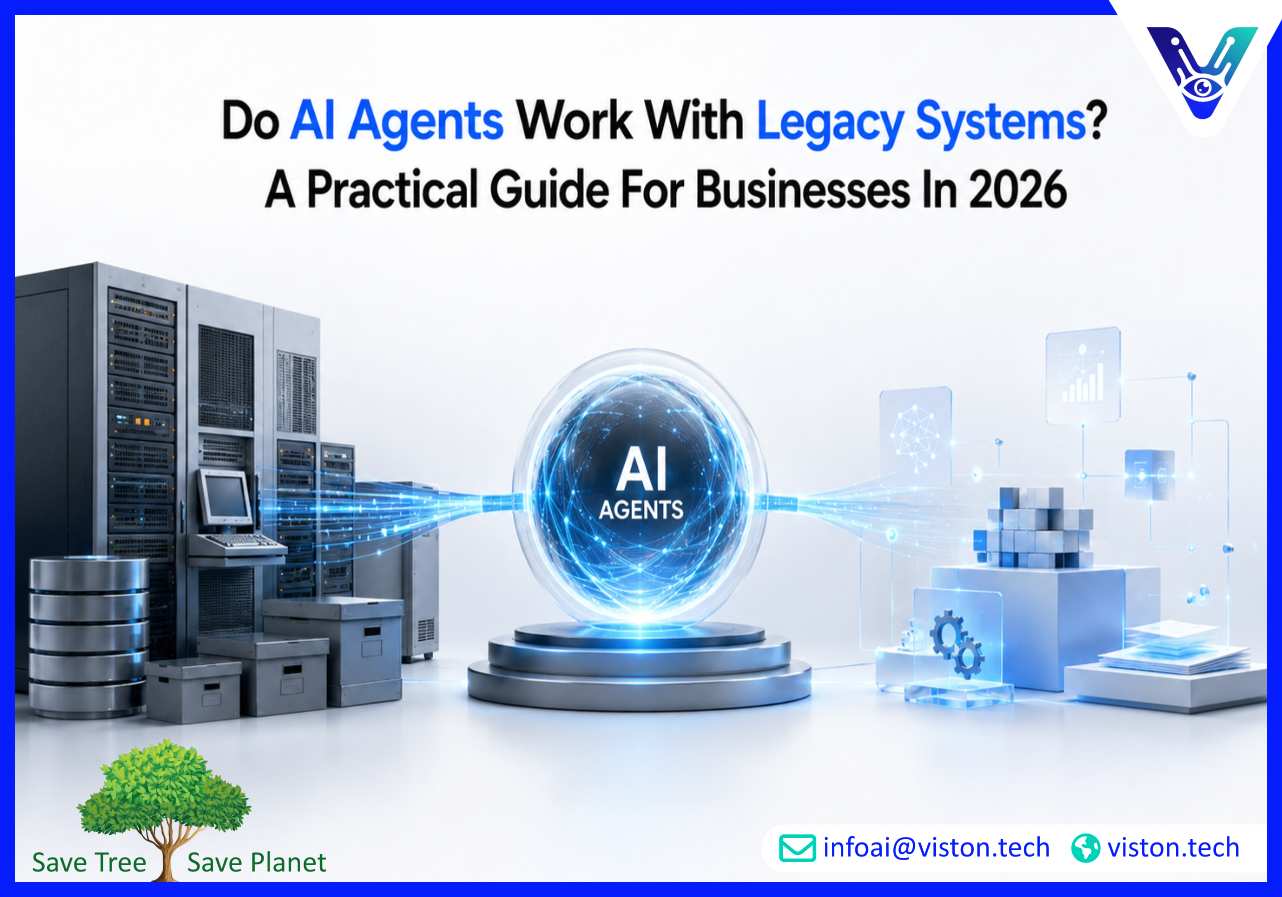
Many organizations want to adopt AI agents but hesitate because critical business operations still rely on legacy software. The good news is that AI agents can work with legacy systems in many cases, provided the right integration, security, and deployment strategy is in place. For businesses looking to modernize without replacing core systems, AI agents can create a bridge between older infrastructure and modern automation capabilities.
Despite ongoing digital transformation efforts, legacy systems continue to power essential operations across industries. Financial platforms, ERP solutions, manufacturing systems, customer databases, healthcare applications, and custom-built software often contain years of business logic and operational data
Replacing these systems can be expensive, disruptive, and risky. As a result, many organizations seek ways to improve efficiency and introduce AI capabilities without undertaking a complete technology overhaul.
This is where AI agents offer significant value. Instead of requiring immediate replacement of legacy infrastructure, AI agents can interact with existing systems and extend their functionality through automation, intelligence, and workflow orchestration.
AI agents are designed to perform tasks, access information, make decisions within defined boundaries, and interact with business applications. Their ability to work with legacy systems depends largely on how those systems expose data and functionality.
Some legacy applications have modern APIs or can be extended with middleware solutions. In these cases, AI agents can securely access data, trigger actions, update records, and automate workflows using standard integration methods.
Many older systems store valuable business information in databases. AI agents can retrieve, analyze, and process information directly from approved data sources while following security and governance policies.
When APIs are unavailable, AI agents can work alongside RPA technologies. This allows agents to interact with user interfaces, navigate screens, extract information, enter data, and complete repetitive tasks that traditionally required manual effort.
Integration platforms can act as intermediaries between AI agents and legacy applications. These solutions help standardize communication, manage workflows, and reduce the complexity of connecting modern AI capabilities to older systems.
Organizations increasingly choose AI agents because they allow modernization without forcing immediate system replacement.
AI agents can automate repetitive processes that currently require employees to move information between disconnected systems. This reduces manual workloads and improves productivity.
Legacy systems often contain large volumes of valuable data that can be difficult to access. AI agents can retrieve relevant information quickly, helping teams make faster decisions.
Customer-facing AI agents can access data from legacy systems to provide accurate responses, process requests, and support service operations without requiring employees to manually search multiple applications.
Rather than replacing mission-critical software immediately, businesses can gradually introduce AI capabilities while extending the useful life of existing technology investments.
AI agents can connect processes across legacy and modern systems, creating more seamless workflows and reducing operational bottlenecks.
While AI agents can work with legacy systems, successful implementation requires careful planning.
Older systems may contain inconsistent, incomplete, or outdated information. AI performance depends heavily on the quality of the data it accesses.
Many legacy environments were not designed with modern AI integrations in mind. Organizations must implement proper access controls, encryption, monitoring, and governance frameworks.
Some legacy applications have little documentation or rely on outdated technologies. Integration projects often require technical assessment before deployment begins.
Older systems may have processing limitations that affect how frequently AI agents can access information or perform actions.
Introducing AI into established workflows requires employee training, process updates, and operational alignment to ensure successful adoption.
Organizations that achieve successful results typically follow a structured implementation approach.
Businesses that treat AI adoption as an operational transformation initiative rather than a standalone technology project often achieve better long-term results.
For organizations exploring how AI agents can work alongside legacy infrastructure, Viston AI provides AI Agent Development & Deployment services focused on practical business implementation. Successful AI adoption often requires more than building an agent—it requires understanding workflows, integration requirements, security considerations, and operational goals.
Viston AI helps businesses evaluate where AI agents can create value, identify suitable integration approaches, and design solutions that connect with existing business systems. This may include API integrations, workflow automation, agent orchestration, business process optimization, and deployment strategies tailored to organizational requirements.
By focusing on real-world operational use cases, organizations can modernize workflows while continuing to leverage critical legacy applications. This approach helps reduce implementation risk while creating a foundation for scalable AI-driven automation.
Yes. AI agents can often work with legacy software through RPA tools, database connections, middleware platforms, or custom integration approaches when APIs are unavailable.
Not necessarily. While legacy systems can create integration challenges, many organizations successfully deploy AI agents alongside older applications using appropriate integration strategies.
No. Many businesses introduce AI agents specifically to improve existing workflows while maintaining their current systems and reducing the need for immediate replacement.
Financial services, healthcare, manufacturing, logistics, retail, government, and enterprise organizations frequently integrate AI agents with legacy infrastructure.
Security depends on implementation. Proper authentication, access controls, encryption, monitoring, governance, and compliance measures are essential for secure deployment.
Yes. Viston AI’s AI Agent Development & Deployment services can help organizations assess integration requirements, develop AI agents, and deploy solutions that work alongside existing business applications and workflows.
AI agents can work effectively with legacy systems and have become an important modernization strategy for businesses in 2026. Rather than forcing costly system replacements, organizations can use AI agents to automate workflows, improve access to information, enhance customer experiences, and increase operational efficiency. Successful deployment requires careful planning, secure integration, and a clear understanding of business objectives. For organizations exploring AI Agent Development & Deployment, Viston AI provides expertise that helps bridge the gap between legacy infrastructure and modern AI-powered operations.
