
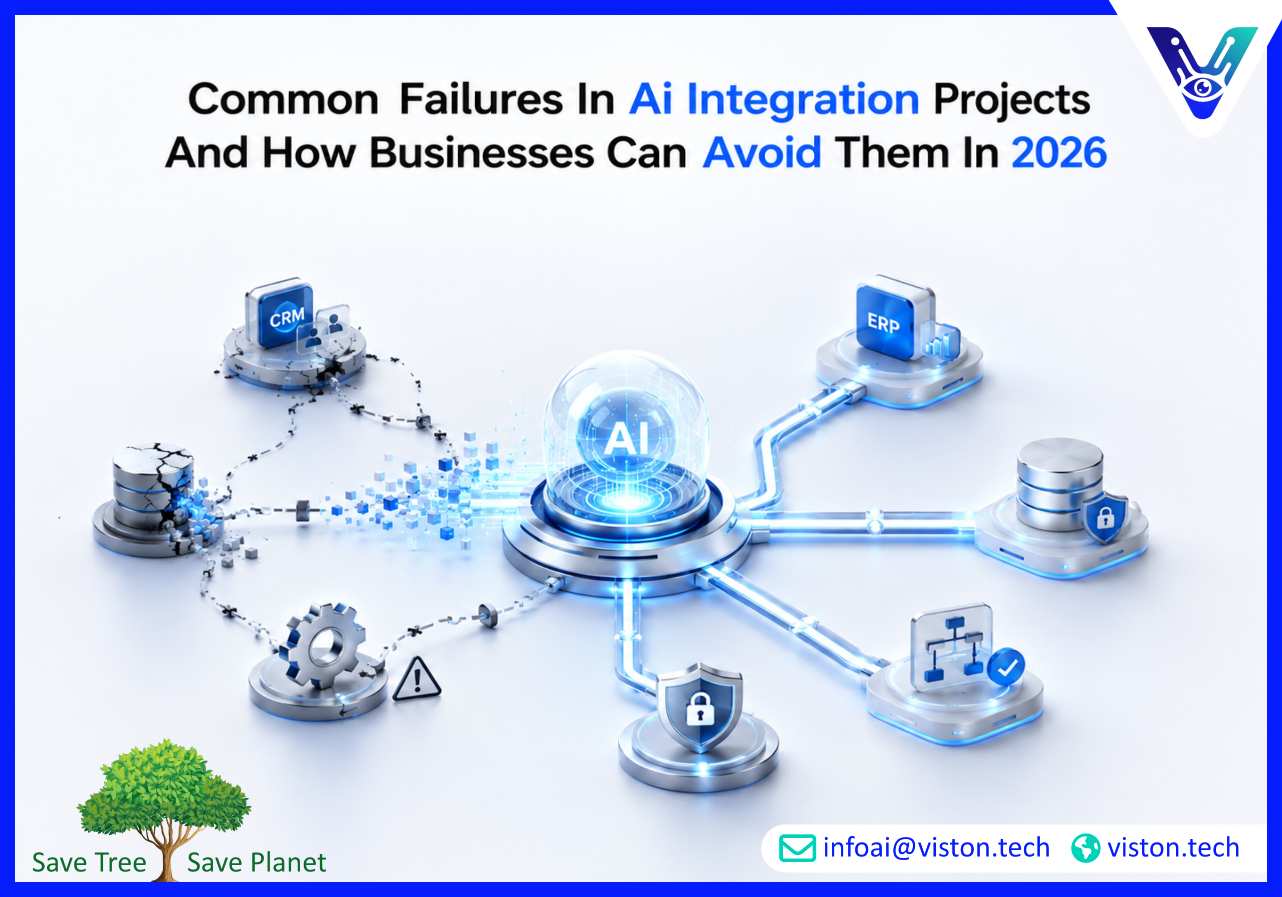
AI adoption continues to accelerate across industries, but many organizations still struggle to achieve measurable outcomes from their AI initiatives. While artificial intelligence offers significant opportunities for automation, efficiency, and innovation, AI integration projects often fail due to planning gaps, technical challenges, poor execution, or unrealistic expectations. Understanding the common failures in AI integration projects is essential for businesses that want to maximize the value of their AI investments in 2026.
Many organizations focus heavily on selecting AI tools or models while underestimating the complexity of integrating AI into existing business processes. Successful AI adoption requires alignment between technology, workflows, data, governance, people, and operational objectives.
An AI model may perform well in testing environments, but real-world implementation introduces challenges such as fragmented systems, inconsistent data, security requirements, user adoption concerns, and workflow dependencies. Without addressing these factors, even promising projects can struggle to deliver meaningful business value.
Businesses increasingly recognize that AI integration is not simply a technology deployment. It is a transformation initiative that affects multiple parts of the organization.
One of the most common reasons AI integration projects fail is the absence of clearly defined business goals. Organizations sometimes pursue AI because competitors are doing so or because the technology appears promising.
Without measurable objectives, teams struggle to determine success criteria, prioritize use cases, or justify ongoing investment.
Examples of clear objectives include:
AI projects perform best when they solve specific business problems rather than serving as general innovation initiatives.
AI systems depend heavily on reliable data. Organizations often discover that critical information is scattered across multiple platforms, stored in inconsistent formats, or contains inaccuracies.
Common data-related challenges include:
When AI agents or workflows operate on poor-quality data, outputs become unreliable and user trust quickly declines.
Some businesses try to transform multiple departments simultaneously. While ambitious AI roadmaps may appear attractive, large-scale deployments often create unnecessary complexity.
Successful organizations typically start with a focused, high-value use case before expanding to additional workflows. Incremental implementation allows teams to validate assumptions, refine processes, and build organizational confidence.
Attempting enterprise-wide deployment too early often leads to resource strain, implementation delays, and poor adoption rates.
AI solutions rarely operate independently. They must interact with CRM platforms, ERP systems, databases, support software, communication tools, document repositories, and business applications.
When integration planning is inadequate, businesses encounter:
Strong system integration is often more important than selecting the latest AI model.
Not every business decision should be fully automated. Many AI integration projects fail because organizations assume AI can replace human judgment in every scenario.
High-risk activities often require human review, including:
Organizations that establish clear approval workflows typically achieve higher trust and lower operational risk.
As AI systems gain access to sensitive information and business processes, security becomes a critical concern. Poor governance can expose organizations to operational, legal, and reputational risks.
Common governance failures include:
Security and governance should be built into the architecture from the beginning rather than added later.
AI is powerful, but it is not a universal solution. Organizations sometimes expect immediate transformation after deployment. When results fail to match expectations, stakeholder confidence can decline.
Successful AI adoption requires continuous optimization, monitoring, and refinement.
Employees often play a critical role in AI success. Resistance to change, unclear responsibilities, or insufficient training can significantly reduce adoption rates.
Businesses should communicate how AI supports employees rather than positioning it as a replacement strategy.
Many projects move into production without comprehensive testing. Real-world workflows frequently contain exceptions, edge cases, incomplete data, and unexpected user behavior.
Testing should include:
Organizations that invest in rigorous testing typically experience fewer operational disruptions.
Businesses can significantly improve success rates by following a structured integration strategy.
Focus on measurable operational improvements rather than technology adoption alone. Define success metrics before implementation begins.
Select workflows where AI can generate meaningful value without introducing excessive complexity.
Data quality, governance, and accessibility should be addressed before large-scale deployment.
Design AI systems that connect seamlessly with existing business platforms and workflows.
Clearly define where AI can operate autonomously and where human approval remains necessary.
Track performance, workflow completion rates, user adoption, error frequency, business impact, and operational efficiency after deployment.
Continuous improvement is often the difference between short-term experimentation and long-term AI success.
Modern AI initiatives increasingly involve multiple AI agents working together across systems, workflows, and business processes. Agent Integration Services help organizations design, deploy, and manage these environments effectively.
Rather than focusing solely on individual AI tools, agent integration addresses orchestration, workflow coordination, system connectivity, governance, security, monitoring, and business process alignment.
Organizations using agent-based architectures can benefit from:
When implemented correctly, agent integration reduces many of the operational challenges that commonly derail AI projects.
For organizations investing in AI-driven transformation, avoiding common implementation mistakes is often as important as selecting the right technology. Viston AI provides Agent Integration Services that help businesses design practical, scalable, and business-focused AI environments.
Its approach focuses on aligning AI agents with operational workflows, business objectives, existing systems, and governance requirements. This includes workflow analysis, integration planning, orchestration design, automation strategy, security considerations, and performance optimization.
Businesses frequently encounter challenges involving disconnected systems, unclear automation strategies, workflow complexity, and adoption barriers. Through Agent Integration Services, Viston AI helps organizations establish structured implementation frameworks that reduce risk and improve the likelihood of successful deployment.
As AI ecosystems become increasingly sophisticated in 2026, businesses require more than standalone AI tools. They need coordinated solutions that integrate effectively into day-to-day operations while supporting scalability, reliability, and measurable business outcomes.
The most common reason is a lack of clear business objectives. Organizations often focus on technology rather than defining measurable operational outcomes.
Data quality is critical. AI systems rely on accurate, accessible, and well-governed data to generate reliable outputs and support business decisions.
Yes. Human-in-the-loop controls are important for high-risk decisions, compliance-sensitive processes, financial approvals, and customer-facing activities.
Absolutely. Weak integration can create data silos, workflow disruptions, reporting inconsistencies, and reduced automation effectiveness.
Agent Integration Services help organizations connect AI agents with workflows, systems, governance frameworks, and operational processes to improve deployment success.
Viston AI provides Agent Integration Services that help businesses plan, integrate, orchestrate, and optimize AI-driven workflows while reducing common implementation risks.
Understanding common failures in AI integration projects is essential for organizations seeking meaningful business outcomes from artificial intelligence in 2026. Challenges such as poor data quality, weak system integration, unrealistic expectations, governance gaps, and inadequate planning continue to impact adoption efforts across industries. Businesses that approach AI integration strategically, with strong operational alignment and structured implementation practices, are more likely to achieve sustainable results. Agent Integration Services play an important role in connecting AI capabilities with real business workflows, and Viston AI helps organizations navigate this complexity through practical, scalable integration approaches that support long-term success.
